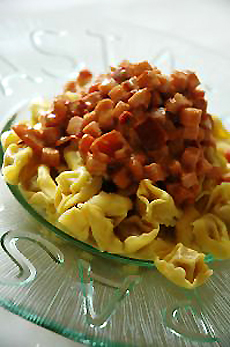
Tortellini, here with a tomato sauce and diced ham, is an elaborate rendition of a food that began as simple noodles, thousands of years ago. Photo by Nathalie Dulex | SXC.
October 2007
|
 |
The History Of Pasta
Pasta History: It Traveled From China To Arabia To Italy
Pasta is an ancient food—not so ancient that it predates written records, but no one was taking notes when this popular food first came onto the scene. Scholars credit the Chinese with making pasta from rice flour as early as 1700 B.C.E. The pasta-centric Italians believe pasta dates back to the ancient Etruscans, who inhabited the Etruria region of Italy (the central western portion of Italy, what now are Tuscany, Latium and Umbria) from the Iron Age into Roman times (from the 11th century B.C.E. to the 1st century B.C.E.). Around 400 B.C.E., they began to prepare a lasagna-type noodle made of spelt. The Romans who followed made lagane, a kind of lasagna, from a dough of water and flour. However, both the Etruscans and the Romans baked their noodles in an oven, so boiled pasta had yet to be born in Italy.
According to the American historian Charles Perry, who has written several articles on the origins of pasta, the first clear Western reference to boiled noodles, is in the Jerusalem Talmud of the 5th century C.E. Written in Aramaic, it used the word itriyah. By the 10th century, itriyah in many Arabic sources referred to dried noodles bought from a vendor, as opposed to fresh ones made at home. Other Arabic sources of the time refer to fresh noodles as lakhsha.¹
¹ See “Pasta: Where It Came From And How It Got There,” by Corby Kummer, published on MrSleepersPasta.com.
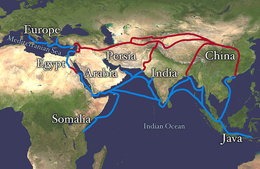
Credit for the invention of boiled pasta is given to the Arabs. Traders from Arabia packed dried pasta on long journeys over the famed “Silk Road” to China. They carried it to Sicily during the Arab invasions of the 8th century.² The dried noodle-like product they brought with them could easily be reconstituted into a hot, nutritious meal. This is most likely the origin of the dried pasta that began to be produced in great quantities in Palermo at this time. The word “macarone” derives from the Sicilian term for making dough forcefully; early pasta-making was a labor-intensive, day-long process (more about that in a few paragraphs). |
The Silk Road or Silk Route was an interconnected series of routes spanning 5,000 miles through Southern Asia, traversed by caravan and ocean vessel, connecting Chang’an (today's Xi’an), China with Antioch (in today’s Turkey) as well as other points. The term is a translation from the German Seidenstrasse, bestowed by German geographer Ferdinand von Richthofen in 1877. |
How the pasta was eaten is not known, but many old Sicilian pasta recipes still include other Arab culinary introductions such as raisins and cinnamon. The oldest macaroni recipes in existence are from Sicily and still part of today’s cuisine: macaroni with eggplant (eggplant was introduced by the Arabs in Sicily around the year 1000, via India) and macaroni with sardines. What the Italians most likely did add is sauced pasta.
²There were repeated invasions between 827 and 965 C.E., with the fall of Palermo in 831 and the fall of Siracusa in 878.
The Middle Ages
Documents from the 12th century describe something like a factory in the area of Palermo, that exported dry pasta to regions of southern Italy. By the 1300s dried pasta had spread to Genoa. Genovese sailors, among the most active traders in the Mediterranean, carried the pasta north from Sicily, and from the port of Genoa it traveled to other areas, including Provence and London. Genoa became a trader, and then a producer, of dry pasta. Pasta was very popular for its nutrition and its shelf life, and was ideal for long ocean voyages.
What about the belief that the great Venetian explorer, Marco Polo, introduced pasta to Italy from China? There is much historic record to show otherwise. And while Marco Polo was visiting the Far East (he set out in 1271 and returned in 1295), in 1279, the last will and testament of Ponzio Baestone, a Genoan soldier, was written. In this will, Baestone bequeathed “bariscella peina de macarone,” a small basket of macaroni.
We know from this and other written records that pasta was in Italy before Marco Polo’s return. Dry pasta was unknown to the Chinese. What Polo did bring back in 1295 was rice flour pasta, the perishable, soft kind from which Chinese dumplings had been made since 1,700 B.C.E., and the concept of stuffed pasta. Today the “dumpling” style of pasta is manifested in ravioli, gnocchi and other preparations using regular wheat flour, eggs and water. It is referred to as “dumpling”-style or soft pasta, even when it is dried hard. |

These steamed, meat-filled dumplings, or tangbao, may be similar to what Marco Polo introduced to Italy when he returned to Venice from China. Flatten them out a bit, and they’d look similar to modern, handmade Italian ravioli. Photo by Joan Ho.
|
That a basket of pasta was bequeathed in a will shows that it was still a luxury in the 13th century. By 1400 it was being produced commercially, in shops that retained night watchmen to protect the goods. Why was it so costly? Labor! Barefoot men had to tread on dough to make it malleable enough to roll out. The treading could last for a day. This is because milled durum wheat, semolina, is granular like sugar, not powdery like other flours. It must be kneaded for a long time (which is why it is not used in homemade pasta—the motors of home machines are not sufficient to process it). The dough then had to be extruded through pierced dies under great pressure, a task accomplished by a large screw press powered by two men or one horse.
Durum wheat was well-suited to the soil and weather of Sicily and equally to Campania, the region around Naples. It was grown in large quantity in southern Italy. Naples also had an ideal climate for drying pasta: mild sea breezes alternating with hot winds from Mount Vesuvius. This ensured that the pasta would not dry too slowly and become moldy, or dry too fast and crack. A thriving pasta industry developed in the region.
The Pasta Renaissance
By the 1600s, in an industrial revolution in Naples, a process was invented to extrude the dough through a mechanical die, allowing for the large-scale, efficient production of pasta. This allowed the pasta to have a long shelf life, and brought Naples out of a severe economic depression. Imports of meat and fresh produce had become expensive, but flour was available, and pasta had become more affordable after the invention of the mechanical press. Dry pasta quickly became the people’s food, to the point that Neapolitans were commonly called mangia-maccheroni (macaroni-eaters). Southern Italy had hundreds of artisan pasta makers. The number of pasta shops in Naples grew from 60 in the year 1700 to 285 in 1785.
Although pasta became very popular, dry pasta was the food of the man in the street. Since its introduction, it was eaten using the hands (remember its origins as a soldier’s field provision). It was sold as street food by vendors called maccaronaros who cooked it over a charcoal-stoked fire; it was eaten on the spot with bare hands, plain or sprinkled with grated sheep or goat cheese, no sauce. The wealthy, who did not eat with their hands, ate fresh pasta stuffed and seasoned with cheeses and meats—lasagna-type preparations that had been around since Roman times and the newer dumpling styles from China. Around 1700, one of the chamberlains to King Ferdinand II thought to use a fork with four short prongs to eat the long strands of cooked dried pasta. After that, eating long “strings” of pasta became a common practice. It enabled pasta to be served at banquets all over Italy, and from there to all of Europe and the world.
Photo of fettuccine by Michael Richter | Morguefile.
The next big advancement occurred a hundred years later, with the marriage of pasta and tomatoes. Although yellow cherry tomatoes had been brought back from the New World by Christopher Columbus at the turn of the 16th century and then by Hernando Cortez in 1529, they were used as a houseplant. (The Italian word for tomato is pomi d’oro, golden apple.) The fruit, a member of the nightshade family, was viewed as poisonous. Lean times drove peasants to try the fruit, with happy consequences. The first documented tomato sauce recipe is from 1839.
From Handmade To Factory-Made
Pasta spread through southern Italy and other shapes appeared, including spaghetti, vermicelli and the short tube shape called macaron. But pasta was still an artisan product, handmade locally by small family businesses.
In 1824 in northern Italy, close to Genoa, the first industrial pasta factory was established by the Agnese family. In November 1827, Giulia Buitoni, a widowed mother of five children, started another pasta factory nearby.
|
Casa Buitoni—not the original factory started by Giulia Buitoni, but a symbol of the success that bought this Tuscan villa for her grandson, Giuseppi. The property is now the product development center for Buitoni International. |
For centuries, the Italian peninsula had comprised disparate states under different rulers, whose people spoke different dialects. In 1862, after insurrection, revolution and war, King Vittorio Emanuele II, the ruler of Sardinia, helped unite the warring states into the nation of Italy.
With peace, travel was much safer and more frequent. Italians gained exposure to pasta-making techniques and recipes of other regions, with an explosion in creativity and proliferation of shapes. Then, in the decades from 1880 to 1900, waves of southern Italians began to immigrate to America, bringing pasta with them.
American Pasta
However, pasta first came to the U.S. much earlier. Thomas Jefferson served as minister to France from 1785 to 1789, and was introduced to pasta during a trip to Naples. He returned to the U.S. with crates of “maccheroni” and a pasta-making machine (which he proceeded to redesign). While Corby Kummer references a pasta factory established in Philadelphia in 1798 by a Frenchman (Zingerman’s Guide to Good Eating gives the date as 1794), any name and details beyond this are lacking. Most sources, including the National Pasta Association, credit a later Frenchman with establishing America’s first pasta factory, in Brooklyn in 1848. A flour miller from Lyon, Antoine Zerega, had a horse in his basement to turn the millstone; and like the Neapolitans, he hung his spaghetti strands on the roof to dry. Today, the fifth generation of Zeregas run the leading supplier of pasta to the foodservice industry in North America.
Spaghetti and meatballs had yet to appear. Macaroni had been brought to England earlier by the Genovese sailors, and the British baked it with cheese and cream—in essence, making macaroni and cheese, a preparation also popular in the north of Italy. They also baked pasta in sweet dessert custards, similar to German-Jewish noodle puddings. These recipes crossed the pond and were enjoyed by 19th-century Americans. According to Corby Kummer, upper-class Americans also purchased pasta imported from Sicily, which then, as today, had more cachet than the domestic product. The information in the remainder of this article comes largely from Mr. Kummer’s extensive piece, Pasta: Where It Came From And How It Got There.
As other pasta factories sprouted up, the cost of pasta became more affordable. By the time of the Civil War (1861 to 1865), even the working classes could afford a pasta dinner. Cookbooks of the period indicate that the common way to prepare pasta was still baked with cheese and cream. In the mid-1880s, according to food historian Karen Hess, cookbooks published as far west as Kansas included recipes for macaroni, some involving a tomato and meat sauce. But pasta did not become the beloved dish it is today: it lost its cachet once the masses could afford it. The fashionable restaurants of New York, which served Continental cuisine, did not serve pasta or any other traditional Italian dish, even though many of these restaurants were run by Italians.
The huge wave of Italian immigration that began toward the end of the 19th century was ultimately responsible for pasta becoming an American staple. From 1880 to 1921, more than five million Italians immigrated to America, three quarters of them from the regions south of Rome. Two scholars have studied the food of the Italian immigrants extensively: Harvey Levenstein, a professor of history at McMaster University in Ontario, and Joseph Conlin, a professor of history at Chico State University in California. They report that the immigrants from Campania became established as grocers, such that the tomato paste, oregano and garlic basic to their region’s cuisine were more readily available than seasonings typical of other regions, such as Sicilian pine nuts, wild fennel, and saffron or ginger for the cuisine of Basilicata, the region to the east of Campania. |
Map of Italy, highlighting Calabria, courtesy of Wikipedia. |
Thus, the seasonings used for “Italian food” in America were primarily the classic ones of Campania carried in the local grocery stores, because it was difficult and expensive to obtain ingredients from other regions. What became Italian-American cuisine was different from the old country cuisines for other reasons, too. There were fewer varieties of fruit, vegetables and cheeses available than in Italy, and much more meat which was cheap and plentiful in America.
Spaghetti And Meatballs
Spaghetti and meatballs is a dish unknown in Italy, but probably had its origin in several baked Neapolitan pasta dishes served at religious festivals such as Carnival and Christmas. (Naples is the capital of Campania.) Remembering that meat in Italy is costly, these dishes used meatballs the size of walnuts—unlike the American version that used meatballs the size of eggs—and also included other ingredients as ham and boiled eggs. The large portions served, and heavy seasonings of garlic, oregano and hot pepper flakes, are American developments.
Photo: The American version of spaghetti and meatballs, large meatballs showing off the plentitude of meat in America, is unknown in Italy.
The Mainstreaming Of Pasta
Although hundreds of small pasta factories opened in America’s Little Italys, Italians preferred to buy imported pasta, however expensive, because it was made from durum wheat. (American farmers did not grow durum until the 20th century.) It’s easy to chart the subsequent quick growth of pasta. Some highlights:
- In the 1890s, the Franco-American brand of canned spaghetti was launched.
- World War I (1914 to 1918) brought imports to a halt, and the number of American pasta-makers rose from 373 to 557.
- Pasta was inexpensive at a time when food prices were rising. Recipes for spaghetti and tomato sauce started turning up in women’s magazines.
Millers sponsored “eat more wheat” campaigns in the early 1920s. Pasta manufacturers began to use durum, which they advertised as being higher in protein than soft wheat (it is, but not by much).
- Campbell’s, Heinz and other manufacturers brought out canned macaroni with tomato sauce.
- In 1927, Kraft introduced grated parmesan cheese in a cardboard container with a perforated top, as a topping for spaghetti with tomato sauce.
- Cafeterias became very popular in the 1920s, and spaghetti and tomato sauce was a hot item. Italians nationwide opened “spaghetti houses” to serve blue-collar workers. By the end of the decade, the Italian restaurant had become the most popular type of ethnic restaurant in America, a position it still holds.
Photo of spaghetti in pot by Clara Neroli | Morguefile.
- The Great Depression of the 1930s made inexpensive food like spaghetti a necessity. Spaghetti and meatballs began to appear regularly on millions of American tables.
- Today pasta is a completely versatile food: from school cafeteria to the most exclusive restaurant, from main course to side to dessert, it fills any need asked of it.
Today durum wheat is a huge crop, producing more than 100 million bushels annually, largely in North Dakota. According to the National Pasta Association, America manufactures more pasta than any other country in the world—more than five billion pounds a year. In 2000, five billion pounds of pasta were produced: 4.5 billion in dry pasta and .5 billion in frozen and fresh pasta.
In terms of being an “American” food: macaroni and cheese made the list of the top 10 foods of the century, according to an article in the Sacramento Bee that polled authorities on the foods most representative of American cooking in the 1900s³. Spaghetti and meatballs did not make the list.
³The ten are apple pie, barbecue, chili, chocolate chip cookies, fried chicken, hamburger/cheeseburger, Jell-O, macaroni and cheese, pancakes and pizza.
Content copyright © 2005-
2012
Lifestyle Direct, Inc. All rights reserved. Images are the copyright of their respective owners.

|
 |
|
|