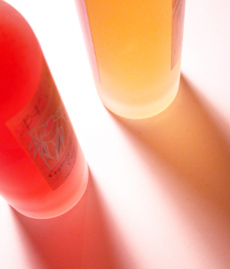
Bottle of red, bottle of white. Wine vinegars, along with balsamics, are most popular with foodies. On a mass basis, cider vinegar and distilled white vinegar are the big sellers.
|
By day, DAVID SCHOENBERGER is a marketing executive for a Fortune 500 financial services company. By night, he is an ideation consultant, an entrepreneur and a writer on food and fun. His writing can be found in Self and Glamour.
|
|
June 2005
|
 |
Vinegar 101
From The Old Testament to Today’s Food Bibles
If products were people, then vinegar would have good reason to lie about “her” age: “she” is over 10,000 years old! Vinegar has a legacy that goes back—way back—to ancient times, where it was inadvertently created alongside its alcoholic forbears—wine, beer, and other spirits. Vessels with traces of vinegar dating back to 6000 B.C. have been found in Egypt and China.
First written about in Babylonian times circa 5000 B.C., vinegar made with dates* found its way to kitchens and campfires everywhere. One legend has Cleopatra, to win a bet with Marc Antony, dissolving a pearl in a glass of vinegar and quaffing the mixture.
| |
* |
Vinegar requires a fermentation of sugar, and can be made from almost anything that contains it: fruits (apples, berries, coconuts, grapes, melons, peaches), grains (sorghum, rice, barley malt), whey, sugars (molasses, sugar cane, honey, maple syrup), or vegetables (beets, potatoes). The most commonly used varieties—not necessarily by foodies—are apple cider vinegar and distilled white vinegar. |
What we can be sure of, however, is that vinegar is mentioned—twice—not in a mere ancient cookbook but in the mother of all books, the Bible (in both the Book of Ruth and in Proverbs). It is specifically called for in the Talmud, to make the haroseth for Passover.
Hippocrates prescribed a watered-down vinegar drink to his patients. Caesar’s army, drank it too; although as a preventative medicine, not as a palliative. Some scholars believe that Jesus, while on the cross, was given a drink of vinegar with water as a painkiller.
While most people think of vinegar as something that is made from wine, it can be made from the fermented juices of virtually any plant material, including rice, grain and fruit. Thus, while European vinegar is basically an alcoholic beverage that has gone sour, and the word vinegar that we use today is French for sour wine (vin is wine and aigre means sour), around the world vinegars are made from a broad variety of bases. Any liquid containing sugar and starch can conceivably be made into vinegar once alcohol fermentation has begun. Different cultures make vinegars made from their local produce, fermenting dates, honey, raisins, rose petals, sorghum and sugar cane.
Whatever language one speaks, cultures the world over use vinegar in meals as part of marinades, sauces, salsas, mustards, ketchups, relishes, chutneys, sambals, jellies, jams, and preserves—not to mention as a cleaning agent, disinfectant, and medical treatment (which we won’t be dwelling on any more in this article—we’re here to eat). Unopened bottles of vinegar can be stored indefinitely. Producers recommend that opened bottles should be used up within 6 months to enjoy peak flavor; although we have kept vinegars much longer than that (years!). All bottles should be kept in a cool, dark place—including those gourmet bottles with sprigs of herbs inside. You need to choose if they’ll be food or decor, since daily exposure to bright light can alter the flavor over time.
The Making & Manufacturing of Vinegar
Vinegar is the end-product of a chemical reaction that occurs when bacteria (Acetobacter aceti) come into contact with alcohol. The bacteria turn the alcohol to to acetic acid and water. It is the alcohol turned acidic which provides vinegar’s unique taste. While acetic acid provides the vinegar with its primary taste component, it is the nature of the actual alcohol itself that gives the vinegar its specific character.
|

Balsamic vinegar production at Villa Gaidello, a working farm organic farm in Italy’s Po River Valley between Modena and Bologna. It has a restaurant and restaurant and guest rooms, for individual travelers or corporate meetings. |
Vinegar can be produced or generated in a number of different ways. It can take months with a hit-or-miss outcome; so by 2,000 B.C.E., much vinegar was produced commercially by vinegar “masters.” Even so, success was not guaranteed. It was not until medieval times in Orléans, France, that a method was perfected, still used today for low-volume, high-quality batches.
The Orléans Method involves placing a barrel on its side, filled to the three-quarter mark with diluted wine or beer and the all-important vinegar starter, or “mother” (mère de vinaigre) from a previous batch.* Two large holes on either side of the barrel admit the oxygen required for the chemical reaction. They are covered with screens to keep curious critters away during the initial aging period, during which time the barrel sits inert for two to three months at about 85°F. Then the entire content minus 10% or so (which is used as starter for the next batch) is poured through a spigot inserted into one of the two holes and bottled. More modern (read: artificially accelerated and cost-effective) techniques for generating vinegar involve replacing the wooden barrel altogether. Mass production employs a giant vat into which a lesser quality wine is sent via a funnel lined with wood chips, called “trickling.” This setup allows the wine to pick up wood flavor nuances while exposing the mixture to much more oxygen as it makes its way down. The technique decreases the average production time from months to days.
*The “mother” is a film of living bacteria on the surface of the liquid being soured. Mother can also grow in bottles of vinegar at home, especially those that have been sitting for a long time in a warm, dark environment. While unattractive, mother is harmless and believed to be beneficial to digestion. Refrigerating vinegar will slow or stop the formation of the mother. You can decant vinegar into another bottle, clean the bottle with the mother, and pour the vinegar back in.
The “sourness” or acidic stringency of vinegar is determined by the amount of acetic acid produced during the chemical reaction. The amount and intensity of the acid, in turn, depend upon what ingredient was used to make the vinegar. On the tartness scale:
- Distilled white vinegars are always the strongest and most stringent
- Wine vinegars come in second
- Beer and cider vinegars and malt vinegar fall somewhere in the middle
- Rice wine vinegars are milder
- Balsamic vinegars are the most mellow.
It is important to note that the quality of the ingredients, processing style, aging and bottling will affect the ultimate taste of the vinegar; so the tartness ranking is relative.
With a taste penchant for all things acetic, I grew up loving vinegar for its bright and sour taste. I loved what it felt like in the mouth and then in my stomach. I would literally drink red wine vinegar from the bottle (when no one was looking) and add it as a topping to any non-dairy meal.
Over time, my desire for such a sensation has sated, and it is the more artfully produced product that moves me and my somewhat more discriminating taste buds. Balsamic has unsentimentally replaced red wine vinegar in most of my dressings and marinades. I do throw some high-quality red into the mix on occasion, for old time’s sake.
That vinegar is still such an essential ingredient after so many millennia is a tribute to its taste and versatility. Perhaps “she” needn’t lie about her age after all.
Types of Vinegar: A Glossary From THE NIBBLE Editors
Balsamic Vinegar
The tradition of balsamic vinegar-making in Modena, Italy has not changed in 600 years. Trebbiano grapes are boiled down to a near-syrup and go through multiple fermentations and lengthy maturation periods. The finest, which must be judged and given a seal of approval, are called tradizionale. The oldest tradizionale, exquisitely complex, syrup-like and so rare that they are doled out with medicine droppers, can be 80 or 100 years old or older and cost hundreds of dollars for an ounce. A basic tradizionale aged 12 to 20 years is $125 and higher for 100 milliliters; an extravecchio aged more than 25 years is $175 and higher. A 40 year old can be $500. It is so fine, a perfect combination of sweet and sour, that it is drunk like a wine as a digestif. Such vinegar is also used in droplets to complement Parmesan cheese, ice cream, breasts of duck, and other prepared plates. An authentic tradizionale will bear the red seal of the Consorzio Tra Produttori Dell’Aceto Balsamico Tradizionale di Modena.
There is a second level of official balsamics called condimento, or salsa grade. They do not adhere to the same rigorous standards as tradizionale (e.g., a tradizionale must be aged in a series of five casks made of different, specified woods, one of which is now extinct in Italy); but some are as good as tradizionales—you can buy 20- to 100-condimento balsamics. There are also everyday commercial-grade condimento vinegars. A highly-concentrated grape must (mash) is used as the base of balsamic vinegar instead of the red Trebbiano-based wine with which the has been was made for centuries. All authentic balsamics are made in the cities of Modena and Reggio: the caves in the surrounding hills are very conducive to aging. |
Balsamic Vinegar
Caveat emptor: the majority of balsamic vinegar sold is imitation, benefiting from the enormous growth in popularity and the price of real balsamic. An estimated two-thirds of the vinegar labeled “balsamic” is just generic red wine vinegar flavored with sugar, caramel, vanilla, and other flavorings and colorings to emulate balsamic. Read the label. If it doesn’t state grape must or balsamic, it isn’t the real thing. If you’ve tasted the real deal, even the commercial product, it will be evident.
Read our separate article with a full explanation of balsamic vinegar. |
Cane Vinegar and Coconut Vinegar
These two vinegars, unfamiliar to most people, bear mention because of the growing interest in Pacific Rim foods, and predictions that Pac Rim will follow Mexican, Japanese and Southwestern as the next pervasive American food trend.
Made wherever sugar cane is grown (or available) cane vinegar has a full and slightly sugary flavor—which should come as no surprise given its base. Not commonly consumed in the U.S. but very often used in the Philippines, it is often used in pickling, mustard-making and in vinaigrettes. We may see more of it here soon.
Coconut vinegar is low in acidity, with a musty flavor and a unique aftertaste. It is used in many Thai dishes. If you see a bottle in an ethnic market, try it.
|

Coconut Vinegar
|
Champagne Vinegar
Made from the grapes of the Champagne region of France (the grapes are Chardonnay and/or Pinot Noir), Champagne vinegar is considerably more expensive than regular white wine vinegar. It is also is far more refined in taste, and should be used in delicate preparations where the flavor of the vinegar can shine through. |

Champagne Vinegar |
Cider Vinegar
Substituting malt with apple cider, or more often these days, apple mash*, results in honey-colored cider vinegar. Some discriminating noses can actually taste or sense hints of apple in higher quality cider vinegars. The product, which is often used to pickle fruit, usually is filtered. However, unfiltered vinegar is made from unfiltered organic cider. If you believe that drinking vinegar is good for your health, this is your product. It is a popular choice for dressings for fruit and vegetable salads, marinades, and for making chutneys.
*There are different definitions of mash related to alcohol. Generally, it is a fermentable starchy mixture from which alcohol or spirits can be distilled. In this case, it is the mixture of alcohol that is being fermented into vinegar. |

Cider Vinegar |
Distilled White Vinegar
Distilled vinegar, also known as spirit vinegar, is made from distilled alcohol. Colorless and strong in scent and astringency, it should not be used as a table vinegar, but for pickling and canning; or as a household cleaner (it’s great for cleaning non-porous surfaces such as glass, and for removing calcium deposits from the coffee maker). Distilled vinegar also can be used as a detergent and a disinfectant. Heloise has many household hints for it—in fact, vinegar has even more uses than baking soda. People who use it as an all-purpose vinegar on food either have a iron palate or a strong preference for things sour. |
Distilled White Vinegar
|
Herb, Fruit, & Spice Vinegars
Herb (tarragon, herbs de Provence, e.g.), fruit (raspberry, maple, plum, e.g.) and spice (ginger, garlic, vanilla, e.g.) vinegars are made by adding these elements to either wine or cider vinegars. The bottled mixture is allowed to stand for some time before it is released in order for the flavors to blend. (Some fruit vinegars are made by the fermentation of fresh fruit juice.) This is a category in which vinegar continues to evolve for foodies, as new flavors—yuzu and ancho chile, e.g.—enter our culinary repertoire and become incorporated into vinegars we can use to flavor everyday foods. These vinegars are popular in vinaigrettes and add special flavor to sauces, soups and marinades. |

Tarragon Vinegar |
Malt Vinegar
A key ingredient used in the brewing of beer, malt can be used as the base of vinegar, which is made in the same manner as mass-produced wine vinegars. The resulting flavor is distinctive and the vinegar can be strong. As such, malt vinegar is used most often for pickling or as condiment. The British and Canadians use it instead of ketchup to complement French fries and other vegetables.
|

Malt Vinegar |
Plum Vinegar
Plum vinegar (umeboshi) is is not a true vinegar, but the brine drawn off from pickled plums that is used as a substitute for vinegar and salt in recipes. It has a tasty sour fruit flavor that is delicious in salad dressings and can be used as “fusion” flavor in marinades and reductions.
|

Plum Vinegar |
Rice Vinegar: White, Black and Red
Popular in rice-growing regions, especially China and Japan, these vinegars are made from fermented rice or fermented rice wine. Chinese rice vinegars are usually stronger and darker than those of Japan, which are relatively mild and mellow.
Just as with grapes, rice comes in multiple colors and its color will dictate the vinegar’s color. Black rice vinegars are smoky and best for braising meat. Red rice vinegars have tart and sweet qualities, and are used in soups and with seafood. White rice vinegars are mild and soft. Use them in salad dressings, sauces, or as condiments on fish, vegetables and grain dishes. |

Red Rice Vinegar |
Sherry Vinegar
Made like sherry from a blend of different wines, authentic sherry vinegar is made in Spain using the solera style of aging, fermented for years in a series of increasingly smaller oak barrels. This long aging process and artisan technique commands a higher price tag than most other vinegars. A dark, intensely-flavored vinegar with a sweet finish, sherry vinegar is used like fine balsamic to add a gourmet touch to dishes. Like the wine, the vinegar induces a connoisseur’s vocabulary: the attributes “fat” and “rich” are often given to vinegars made from sherry, and a fine product’s complexity can be considered “mellow.” There are many gourmet recipes for sherry vinegar; it should also be used with salads featuring cheese.
|

Sherry Vinegar |
Wine Vinegar
While most vinegars in this category are made from red and white wine, there are specialty variations like champagne and sherry vinegars. As with wine, red wine vinegar is aged longer (up to 2 years), while white wine can be aged for as briefly as a few weeks. Red wine vinegars tend to have more roundness of flavor, but white wine vinegars are better suited for lighter colored sauces and other dishes where the red color would be intrusive.
It follows that the higher quality wine used, the better the taste of the vinegar; and the producers of better wine vinegars describe their vinegars as “subtle” and “complex.” Vanity wine vinegars are those made from specific varietals: Cabernet Sauvignon, Pinot Noir, Merlot, Zinfandel, Chardonnay, et al. Using a varietal wine creates a higher-caliber and more expensive product.
White wine vinegar is a staple of French cuisine, for hollandaise and béarnaise sauces, fish marinades and for deglazing. It can be used to bring out the sweetness fruit (e.g. strawberries and melons) and to replace cream, butter and salt, adding flavors without calories and sodium.
Vinegar photos by Melody Lan. |

Red Wine Vinegar

White Wine Vinegar |
© Copyright 2005-2008 Lifestyle Direct, Inc. All rights reserved. Images are the copyright of their individual owners.

|
 |

|
|