![]() |
|||
![]() Costlier than gold: the Périgord truffle of France and the white Alba truffle of the Piedmont, in Italy. Photos by Kelly Cline.
December 2006 |
Product Reviews / Main Nibbles / VegetablesTruffles: An Overview & GlossaryBlack Périgord Truffles and White Alba Truffles Are Two Of Life’s Great Luxuries
|
Man has been known to enjoy truffles for at least 2,500 years (the Romans cooked them and ate them with honey, although in the Middle Ages they were regarded as poisonous and only regained their status over the last few hundred years). People have tried for generations to cultivate the great truffles with no success in duplicating them, although they are getting closer. As science advances, current attempts include inoculating tree roots with Tuber Melanosporum, the Périgord truffle organism. While this method does produce edible truffles, they are not of the quality of Périgord truffles. It may be a function of more carefully matching up the exact climate and soil to that of the Périgord region.† Whoever finds the magic formula will be up to his or her elbows in “black diamonds.” †A truffle grower in Chucky, Tennessee, Tom Michaels, feels he has achieved that, and top chefs such as Daniel Boulud and Thomas Keller are excited by the truffles (Michaels’ truffles are currently selling for $800 a pound). |
![]() A cross-section of the glorious Périgord truffle. |
The top four sought-after varieties of fresh truffles are sky-high to begin with. The prices vary widely among varieties (from sky-high to astronomical), and from one year to the next, depending on the size of the harvests. Typically, the Melanosporum, the top black truffle, may cost five times more than the Brumale, Uncinatum or Aestivum—currently $1,000 to $2,100 a pound. The Magnatum white truffle is the costliest: It can be four times more expensive than the Melanosporum.
A big problem is that as more and more people of means discover the pleasures of truffles, demand increases—but each year, fewer and fewer truffles are harvested. The crop in Périgord is estimated to be 25% of what it was a century ago. As a result, products are misrepresented: In France, agricultural agencies conduct lab analyses of black truffles to ensure they are legitimate French products and not inferior Chinese or Spanish black truffles that have been soaked in truffle juice to enhance their aroma. Lesser white truffles from other areas of Italy show up at the famed Alba market, attempting to pass as the great White Piedmont (or Magnatum or Alba) truffle, the world’s costliest truffle. (The Alba White Truffle Market is the only one where every truffle is tested to guarantee quality and type.) More pallid-tasting summer truffles are passed off to the unknowing as winter truffles. As with caviar (or anything else), if you don’t know what you’re buying, it’s easy to be duped...and the unknowing then wonder why they’ve just spent a small fortune on something that tastes no better than a supermarket mushroom.
![]() Sundried tomato ravioli stuffed with mushrooms in a light butter sauce, finished with truffle oil and black truffle shavings. |
Truffles need to be consumed within a few days after they’re harvested. If anyone gives you a fresh truffle, by all means, don’t save it! Cancel your dinner plans and decide how to cook it! If you’re given (or fed) a fine truffle in the U.S., it may be a heavenly experience, but likely not as great an experience as it would be if you were in Périgord or Tuscany and it had been pulled out of the ground a day or two earlier. Most vegetables begin to wilt after harvesting, some faster than others. Truffles begin to lose their aroma: shipping overseas and getting into the retail channel adds days until the truffle gets onto your plate. In ten days, they couldn’t give it away free (well, O.K., free) to a savvy truffle buyer. Here’s what we suggest: Indulge yourself gloriously by taking a truffle vacation in the fall or winter. Get together a group of friends for a custom gourmet tour (X.O. Travel Consultants, 1.212.947.5530, specializes in creating gourmet food and wine tours for groups of ten or more). |
Chances are, you’ll decide this is the trip you want to make every year. Suddenly, you’ll find yourself with a whole new group of truffle-loving friends, and will be the toast of your town. Perhaps you’ll think of us and carry back a fresh truffle so we can share some of the experience.
Fresh truffles should be used within 7 to 10 days of being harvested. The first question to ask your purveyor is, when did these arrive in the store, and when were they harvested (he or she may not know the latter, but should). Of course, the sniff test works, if you’re planning to use the truffles that day. If there is no wonderful aroma, or it is faint, pass them by. You should be overwhelmed with happiness at the strong scent of the truffles.
Only buy truffles from a trusted purveyor who has expertise in truffles. Truffle fraud abounds and even retailers who aren’t experts can be taken. Currently, Chinese truffles worth no more than wild mushrooms are being doctored and sold as Périgord truffles, worth more than $1,000 a pound. They look just like Périgord truffles, so it’s easy to get taken. While they have no scent and no more flavor than mushrooms, unscrupulous dealers nest them with genuine truffles, and they pick up the aroma. So they may pass the sniff test, but you’ll be very disappointed with the flavor—very expensive mushrooms.
Also, select truffles that are 30 to 40 grams in size, 1 to 1.4 ounces, what would be an Extra Grade truffle. In France, truffles are graded Extra, Category 1, Category 2 and Unclassified. There are both weight and aesthetic considerations. Extra truffles must weigh a minimum of 30 grams and be the size of a ping-pong ball, with a similarly round shape; it must have “very slight” defects. However, experts point out that we should not be too hasty to judge an imperfectly-shaped truffle; that often, the most perfect looking, round truffles are those that are picked while still green, and will never develop their full aroma potential. While you can consider a Category 1 truffle, small truffles are hard to handle and very large truffles have a lower percentage of surface area which is where aroma is most concentrated. (Thus, the publicity over the largest truffle, purchased by one restaurant or another for many thousands of dollars, is just that—more publicity to get people into the restaurant, than great-quality truffle.)
Truffles remain fresh for a very short time, which will vary according to the species, the maturity of the truffle, the presence of larvae and the method of storage. Of course, unless you saw it come out of the ground, you have no idea how old your truffle is when you get it, but here is the recommended process to keep truffles fresh for about two weeks following harvest:
Black truffles release more aroma when cooked, so are generally added to sauces and risottos, stuffed into roulades and foie gras terrines, cooked with eggs, lamb, sweetbreads, seafoods, poultry....the creativity extends even to black truffle ice cream (a specialty of THE NIBBLE’s Wine Editor, Kris Prasad). The famous truffle dish Tournedos Rossini, created for the great opera composer who frequented the top restaurants in Paris, combined beef medallions, foie gras, and black truffles with Madeira. (It’s often made with wild mushrooms to make it affordable at fine restaurants year-round. We’ve included the recipe for Tournedos Rossini below.) Paradoxically, heat destroys the flavor of white truffles: They are generally grated raw over pasta, eggs, and other dishes.
Canned Truffles
What about those cans and jars of truffles? If someone gives you a jar of them, by all means use it. But truffles quickly lose their flavor after harvesting. So, you’ll pay a reasonable amount for something that’s somewhat removed from its former self—like canned peaches. It’s best to save your money and go to a top restaurant for a truffle dish during December. Consider it your holiday treat.
We feel the same about truffles from other parts of the world. If you’ve already enjoyed the glories of Périgord and Alba truffles and want to see what truffles from China and other origins taste like, consider it an investment in exploration. But if you’ve never had the greats, don’t spend a lot of money on something that’s just O.K. and may have you questioning what the fuss is about. Save up a huge amount of money and go for the real thing.
We haven’t had frozen truffles so can’t comment on how they hold up; and we have very much enjoyed truffle paste, truffle butter, truffle oil and truffle salt. All brands are not equally good, so if you’re not willing to risk your own money testing different varieties, try to read reviews or get recommendations from friends or others who have tried them.
Pairing Truffles And Wine
Serve black truffles with a fine St. Emilion or a Brunello. The locals in Périgord will enjoy their truffles with a good Cahors wine, but few of those wines find their way to the U.S. The wine of choice for white truffles is Barbera or the other great Nebbiolo-based wines, Barolo or Barbaresco.
Buying Truffles
As with other rare and expensive items, it’s best to buy truffles from a merchant you trust. There are no “bargain truffles.” Few of us are expert truffle buyers (experts judge not only the aroma, but examine the flesh for color and firmness, via a small cut in the truffle). While it’s tempting to want to save money on something so expensive, a flat-tasting truffle that still costs a large amount of money is no bargain.
Essentially, there are two great truffles. Tuber melanosporum, the black Périgord truffle, and Tuber magnatum pico, the white Alba truffle. The others here, lesser truffles, can still be tasty; they’re just not a celestial experience worth $1,000 or $2,000 a pound.
BLACK TRUFFLES: THE FABULOUS FUNGI OF FRANCE
(With Some In England, Italy & Spain)
Melanosporum or Périgord Truffle (Winter Black Truffle) (pay-ree-GORE). Perhaps the most well-known truffle in the world is the winter black truffle, Tuber melanosporum vitt., more famous as the Périgord truffle or “truffe du Périgord” (photo at top left). Called the queen of truffles (or the princess, by the writer Colette), it is found in southern France, and in some parts of Spain and Italy. Depending on region, it reaches maturity between November 15 and March 31: The height of maturity in Périgord is January. It grows four to five inches underground, generally in oak forests; its appearance is black with a skin that has been called both warty and diamond-like. The flesh ranges from chocolate brown to nearly black with delicate white veining. The aroma and taste are earthy—of forest undergrowth, damp earth, and roasted dry fruits—and it has a long and memorable aftertaste. It is worth its weight in gold, and then some. At $1,000 to $2,100 per pound retail, it is nicknamed “black diamonds” due to the combination of the faceted skin (a striking mosaic of interlocking polygons) and its high price. The flesh ranges from chocolate to nearly black with delicate white veining. The aroma and flavor are intoxicating and uniquely melanosporum. Unfortunately, the price is likely to go higher: Since the late 19th century, Périgord’s truffle crop has been declining, and is estimated to be just 5% of what it was over a century ago. The French resisted the thought of cultivating the truffle, but recent scientific advances have led to inoculating the roots of traditional host trees, that are being tested in hospitable environments around the world. Melanosporum is also found in Italy, in the region of Norcia in Umbria.
Uncinatum or Bourgogne (boor-GUN-yuh). The Bourgogne truffle, Tuber uncinatum chatin, is closely related to the the Summer Black Truffle, Tuber aestivum. It is found in the Dordogne between October 1 and December 31, and has a chocolate smell and taste. It is perhaps the second-best truffle in France, after the Périgord truffle. It is black with large, pointed warts that form in a diamond; the flesh is a chocolate-brown color.
Brumale (broo-MAHL). Tuber brumale is harvested between November 1 and March 15 on the same sites as the Périgord truffle. Unfortunately, before it is washed (then, you can see that the polygon mosaic surface, called the peridio, is less well-defined), Tuber brumale can look a lot like the Périgord truffle both outside and inside* and can be sold to the unwary as such. But, caveat emptor: Instead of the amazing earthy aroma of the Tuber melanosporum, the Périgord truffle, Brumale is much less developed, lacking the heavenly complexity of Melanosporum. One variety, the musk brumale, smells of turnip nuanced with garlic and tastes very peppery and characteristically turnip-like. It sells for half the price of the Périgord truffle. Our suggestion: Save your money and wait for a fresh Périgord truffle. Don’t buy rump roast when you want to know what wagyu tastes like.
*The flesh tend to be lighter, with have more pronounced veins.
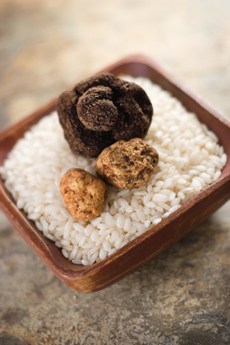
Aestivum, Truffe d’Été (Summer Black Truffle) (TROF day-TAY), Truffe de St. Jean. The Summer Black Truffle, Tuber aestivum, is found in southern France, Spain, southern England (it is also known as the English truffle) and Italy. It tends to be larger and tougher than the Melanosporum, has a smoother surface and a lighter interior, or glebe, often as white as in the photo at the right. It has a taste of forest mushrooms and a subtle aroma of “underwood” or underbrush—not as pungent and aromatic as the black winter truffles but nice in salads and as a flavoring element in sauces and soups. Its season is May 1 through September 30. There are other truffles that grow throughout France, but like most other truffles found in temperate, moist regions throughout the world, the are without much flavor and aroma, and not worth the expense: Wild mushrooms, commonly available and very affordable, provide much more enjoyment. |
![]() The summer black truffle, Tuber aestivum, has a smooth surface and a lighter interior, or glebe. |
Most black truffle-based products (truffle butter, truffle oil, truffle paste) use the summer black truffle.
OTHER BLACK TRUFFLES
Chinese Black Truffle (Tuber sinensis, a.k.a. Tuber himalayensis and Tuber indicum). These truffles look exactly like Tuber melanosporum, the Périgord truffle. Unfortunately, they taste nothing like them—they are cheap truffles that have no more value than a typical wild mushroom (in fact, there is no record of culinary use in China, where they are used medicinally). However, if they are left to rest with authentic Périgord truffles, they will take on their aroma, and can be sold to unwitting buyers for the same astronomical prices. Alas, the texture and flavor are merely mushroom. Chinese truffles are the topic of truffle fraud: They are imported and deliberately doctored, through the transfer of aroma and sometimes artificial coloring, to pass as Tuber melanosporum, the Périgord truffles. This is why you should only buy truffles from trusted purveyors.
Oregon Truffles (Black & White). Both black truffles (Leucangium carthusiana) and white truffles (Tuber oregonense and Tuber gibbosum,* formerly known as Tuber
gigantum) are found in the Pacific Northwest, from Vancouver Island, British Columbia, to northern California. Oregon has a large concentration of them, often found in the Douglas Fir forests of the Willamette Valley. The season is November through March. The black truffle has a dark brown exterior and a white glebe when unripe; it matures to a dark brown glebe with white veins. The white truffle has a tan exterior and a white glebe that matures to a taupe color with white veining. Oregon truffles have a pungent scent (less so then Périgord truffles) that dissipates with heat, so black and white both must be treated with the same care as Italian white truffles—shaved raw over food, never cooked. The black truffles have They have a pungent, earthy truffle aroma with notes of pineapple, and a strong truffle flavor that has made them popular with chefs in the region. Photo of Oregon black truffles courtesy of MarxFoods.com.
*These are actually the same species; Oregonense fruits in the winter, gibbosum fruits in the spring.
White Truffles
The two finest white varieties are from Italy: the great Tuber magnatum pico—the Alba truffle—and Tuber albidium pico, or Bianchetto. It can be confusing, because the Alba truffle is not Tuber albidium pico, but Tuber magnatum pico. The easiest way to remember this is with this phrase: The Alba truffle is magnatum, not albidium. Say it a few times, and it will stick!
White truffles are softer and more perishable than black truffles, and are almost always served raw (they cannot tolerate the heat of cooking). Generally, they are gently warmed for a few minutes to help enhance their bouquet.
There are many types of white truffles. As with black truffles, all are inferior to the main event, the Magnatum or Alba truffle. Some connoisseurs will only eat the Magnatum. So, when you are offered white truffles, you need to know, as with black, what you are buying. Lesser truffles may cost significantly less, but they are still very expensive. You may wish to save up and experience the real thing.
Magnatum or Alba Truffle or White Piedmont Truffle. Tuber magnatum pico is also known as the white truffle, the Alba white truffle, in Italian, bianco pregiato (pregiato means precious or rare), in French truffe blanche du Piemont (photo at top left). It is found from October 1 through December 31, chiefly in the Piemonte (Piedmont) and Emilia Romagna regions of northern Italy (it can be found, though in much smaller amounts, in some areas of central Italy and in southern France). It is found in the vicinity of oaks, lime trees and poplars. are not white. It is known for its luscious, heady aroma. The surface is smooth, but it is not white—it has a creamy, cafe au lait color that can have yellow and grey highligh. The veined flesh (gleba) varies from blond to chestnut depending on the type of tree that hosts the truffle. The skin is smooth and shows yellow-grey coloration; the flesh has a light whitish-reddish-brownish cast with white veins. Its aroma is reminiscent of garlic, shallot and cheese. It is only consumed raw, usually shaved over pasta or rice. It loses all flavor when cooked. The name “magnatum” refers to the rarity and costliness: only magnates could afford them. The name Alba comes from the Italian town in the Piedmont region in the northwest corner of Italy that is the center of the white truffle trade. The second most famous white truffle town is Asti, a city (and province) in Piedmont. Pico, part of its botanical species name, honors the Italian botanist who first identified Tuber Magnatum.
Albidum or Bianchetto (bee-on-KEHT-toe) Truffle or March Truffle or Tuscan Truffle. Tuber albidum pico or Tuber borchii vitt., is also also known as the bianchetto (whitish) and the marzuolo (March) truffle for the peak month of harvest, the Spring truffle, the Tuscan truffle, the blanquette or bianchetti truffle. It has a sharp taste when raw. But when added to oil or butter, its flavor becomes similar to the prized Tuber Magnatum Pico. The season is from January 10 through April 30th. The name honors both the town of Alba and the botanist Pico. The majority of white truffle products (truffle paste, truffle oil, e.g.) are made with the Albidium truffle.
Other Truffle Terms
Black Winter Truffle. This is an unspecific term. If someone is marketing it as such, it is most likely not the Périgord truffle, or it would be trumpeted as such.
Gleba or Glebe. The flesh, or interior, of the truffle. It is textured and often veined.
Peridio. The textured coating over the skin of black truffles, providing the diamond or warty appearance. White truffles do not have a peridio.
Tartufo. The Italian word for truffle. The ice cream dessert of the same name is a ball of vanilla ice cream, often with a cherry and nuts in the center, enrobed in chocolate. The first chocolate ganache tartufos, candy, were created just after the French revolution by French chefs and intended to resemble the precious Périgord truffles. The ice cream version appeared around the Victorian era, when the molding of ice cream into flowers, fruits, and other shapes became popular.
| LEARN MORE ABOUT YOUR FAVORITE FOODS THE NIBBLE has more than 50 food glossaries. If you like truffles, you may also like our Caviar Glossary. Or how about chocolate truffles in our Chocolate Glossary? |
Many of us who can’t afford regular helpings of truffle have been feeding our hunger with truffle oil, which imparts truffle flavor at a price almost anyone can afford. Did you ever wonder why an item that costs $60 an ounce (or more) can be sold as an oil for $1 an ounce, or why black and white truffle oils are sold for the same price when white truffles sell for twice the amount of black? The answer is something that even chefs at good restaurants are surprised to hear: Truffle oil is not flavored with truffles. Zut alors!
Most of us think that the oil is made by infusing olive oil with scraps of truffle—and one or two artisan houses may do this, but their oil costs almost as much as fresh truffles. The secret, known to everyone in the truffle oil industry, is that aromatic compounds (read: synthetic chemicals) with names like 2,4-dithiapentane emulate the flavor and aroma of truffles. Scientists have approximated the qualities of the truffle as they approximate the scents of fruits and flowers for potpourri and beauty products. None of this stops us from using truffle oil to scramble an egg or make truffled mashed potatoes (though we prefer truffle butter for these purposes), toss with pasta, baste chicken or drizzle over beef or game. You can also use it as a knock-out dipping oil; if money is no object, buy 8 ounces of Urbani black truffle oil for $35 or so. |
|
Not all truffle oils taste the same, of course. Everybody’s “lab skills” are different, and some of those we’ve tasted do taste like they came from the lab. So it pays to buy the small size, for $10 or less a pop, until you find one you like; or invite your truffle-loving friends to a co-op truffle oil tasting party, where everyone splits the cost of the oils and foods (baguettes, sliced boiled potatoes or more elaborate fare if you wish). You’ll go home drunk on truffle oil—but able to pass any breathalyzer test.
There are many glorious recipes using truffles, but you don’t have to spend hours making Tournedos Rossini or spend $1,000 on a pound of truffles. A couple of ounces goes a long way, using these time-honored techniques:
|
![]() Risotto with shavings of truffle and Parmigiano-Reggiano cheese. |
Truffles’ aroma is released as soon as they are warmed through: Prolonged cooking and/or high heat to not improve the flavor.
Truffled Scrambled Eggs
One of our favorite ways to enjoy truffles. It’s not just for breakfast: It’s a pretty princely lunch or even dinner dish.
Serves 1
Ingredients
Directions
‡NOTE: Professional chefs will cook this dish in a ceramic skillet over a water bath. The key to making perfect scrambled eggs is slow-cooking, which is easier over a water bath than a flame.
Not So Quick Prep:
Tournedos Rossini Recipe
Serves 4
Ingredients
*Demi-glace is a type of brown sauce traditionally made in professional kitchens by combining equal parts of beef or veal stock and with espagnole sauce (a reduction of brown stock, brown roux, bacon fat, onions, carrots, celery, tomato purée and seasonings). It is very labor-intensive. Demi-glace concentrates can be bought at specialty food stores; or home cooks can use a simple reduction of veal stock as follows:
In the pan, deglaze the pan juices with 3 ounces of veal stock plus 3 drops of Port, 2 drops of brandy and 2 drops of Madeira. Allow to reduce.
Directions
We found an impressive-looking recipe on a food blog: The recipe is from La Truffière, a Paris restaurant specializing in black truffle. It is called Le Soufflé Chaud à la Truffe Mélanosporum, Grand Marnier Black Truffle Melanosporum Soufflé with Orange Brandy Liqueur (Grand Marnier or any comparable liqueur can be used—click on the link for the recipe). The writer, François Micheloud, lives in Switzerland and gets to La Truffière more often than we can. We envy him! But we are thankful that he has painstakingly documented the preparation of this recipe.
Photo of soufflé courtesy of François Micheloud, F-X.com.
If your idea of a vacation is food and wine travel, consider a fall trip to northern Italy, where you can take in a weekend truffle fair and surround yourself with aromas of truffle so heady, you will swoon. The restaurants are full of truffle dishes at the time, and you can have truffles at dinner in local restaurants.
The festivals take place over several weekends in September, October and November. Acqualagna also holds a black truffle festival on the next-to-last Sunday of February, and a summer black truffle festival in August. Contact your travel agent to find a specialist in truffle tours; or to put together a deluxe custom trip for 10 or more people tailored to your specific interests (truffle markets plus sightseeing, top restaurants, vineyard trips, shopping, etc.) contact X.O. Travel Consultants, Ltd. at 1.212.947.5530.
If you’d like to learn more about truffles, here are two books packed with information, that also make beautiful gifts (with or without a pound of fresh truffles attached).
![]() |
![]() |
|
Truffles: Ultimate Luxury, Everyday Pleasure, by Rosario Safina and Judith Sutton. The history, types of truffles and truffle products plus 100 simple and delicious recipes for the home cook: soups, appetizers, entrees, etc. The recipes can be used everyday as well as for special occasions; and the explanations of truffle types and guidelines on buying are extremely useful, especially for the more affordable products like truffle butter and truffle cheese. Click here for more information or to purchase. |
Caviar, Truffles, and Foie Gras: Recipes for Divine Indulgence, by |
© Copyright 2005-2008 Lifestyle Direct, Inc. All rights reserved. Images are the copyright of their respective owners.
![]()
|
Spread The Word: Each icon below links to a site where you can bookmark, share and comment on this article:
|