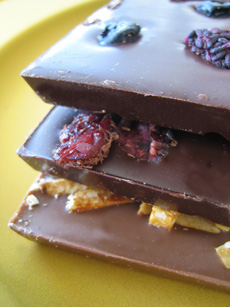
Artisanal bars from Michael Mischer Chocolates of Oakland, California. Photo by Melody Lan | THE NIBBLE.
|
KAREN HOCHMAN’s first word was not cacahuatl...but as her mother will attest, it was pretty close.
|
|
May 2006
Revised January 2009
|
|
From Pod to Palate: The Birth Of The Bar
Page 6: Making Chocolate ~ Blending The Cacao Beans
This is Page 6 of a 10-page article on chocolate production. Click on the black links below to visit other pages.
Making The Chocolate
10. Blending or “Mélangeur”
At this stage the chocolate liquor and other ingredients are kneaded together according to the kind and 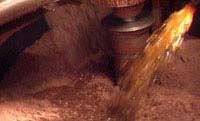 quality of the chocolate being made. Most chocolate is a blend of beans, selected to achieve a specific consistent taste from year to year. As with any agricultural product, the flavor of the product will vary from crop to crop according to the growing conditions. And, different varieties of beans from different growing regions have different qualities and flavors. Thus, unless a single origin chocolate is being produced to highlight a specific terroir, the beans are sorted and blended to produce a distinctive flavor. Large commercial producers like Hershey and Nestlé use up to 12 different varieties of beans from all over the world to achieve a consistency of flavor. quality of the chocolate being made. Most chocolate is a blend of beans, selected to achieve a specific consistent taste from year to year. As with any agricultural product, the flavor of the product will vary from crop to crop according to the growing conditions. And, different varieties of beans from different growing regions have different qualities and flavors. Thus, unless a single origin chocolate is being produced to highlight a specific terroir, the beans are sorted and blended to produce a distinctive flavor. Large commercial producers like Hershey and Nestlé use up to 12 different varieties of beans from all over the world to achieve a consistency of flavor.
Photo courtesy of CocoaTree.org.
At this stage of production, different types of beans are blended in different proportions according to particular recipes. These are “secret” recipes, the manufacturers’ proprietary formulas. Each producer desires to create a distinctive product that no competitor can copy. The exact proportions may be proprietary, along with the sources and proportions of the beans*, but everyone knows what goes into the recipe:
- For milk chocolate, cocoa butter and chocolate liquor are combined in varying proportions; sugar and full cream milk (generally condensed milk) are added.
- Dark chocolate uses the same process but without milk.
- White chocolate is made with cocoa butter, milk and sugar and does not contain chocolate liquor.
The ingredients can be churned together for hours; the resulting is dried to form a crumb which is ground with more cocoa butter in the next phase.
*A small percentage of bars, the very finest, are not made of a blend of beans but are single-origin bars. THis means that 100% of the beans come from a particular area or even a single estate. If a bar specifies that it is Rio Caraïbe, São Tomé or Chuao, e.g. it means that all of the beans in that bar are from that specific growing region. There are also bars made from beans grown on specific estates, e.g. Valrhona’s Gran Couva, Ampamakia and Palmira bars. A bar labeled Porcelana or Nacional, e.g., is made entirely of that subspecies of bean.
11. Refining or Fine Grinding
The second grinding produces a liquid, batter-like chocolate, but it is still gritty (hence, “crumb”). The goal of refining is to make the thick chocolate crumb into a silky chocolate. It travels through a series of five heavy steel refining rollers set at different intervals and different speeds. The gaps between the final rollers are so small that the chocolate components are ground into a thick fluid mass which is then run off. This step reduces the particle size to of the cocoa mass to 25 to 30 microns, both in the chocolate liquor and the sugar. In some cases, extra cocoa butter is added to the chocolate liquor for a smoother, more voluptuous mouthfeel. The smoother the chocolate desired, the more rolling!
Continue To Page 7: Conching
Go To The Article Index Above
|