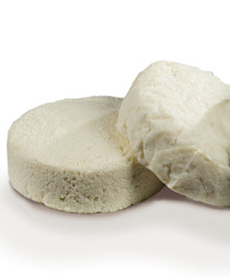
 Queso Fresco vs. Queso Blanco. What’s the difference? Well, that’s Queso Fresco at the left, Queso Blanco at the right. The differences are revealed below. Cheeses from Mozzarella Company. Queso Fresco vs. Queso Blanco. What’s the difference? Well, that’s Queso Fresco at the left, Queso Blanco at the right. The differences are revealed below. Cheeses from Mozzarella Company.
|
STEPHANIE ZONIS focuses on good foods and the people who produce them.
|
|
January 2007
Updated October 2007
|
|
Fresh Cheese: Cultures Of Confusion
Whey To Go ~ January 2007
My name is Stephanie Zonis, and welcome to Whey to Go! for January, 2007. Every month, we’ll delve into a new cheese-related subject, and I’ll offer a recommendation on a cheese I love. This month it’s fresh cheeses: not every fresh cheese made, or you’d be here reading until next month. But, here’s a selection of delicious fresh cheeses that you should get to know better, if you aren’t already on intimate terms.
You’ve heard their names before: quark, fromage blanc, crème fraîche, mascarpone, labné and queso fresco. This is a sextet that makes even lactophiles shake their heads bewilderedly. They’re all more-or-less cheeses, you know that much, but what’s the difference among them? Can they be used interchangeably in recipes? And fat content is a big concern for many people these days; which of these products is lowest in fat? As Yul Brynner once observed in his role as the King of Siam, “Is a puzzlement!”
Let’s start with some of easiest cheeses on the list: mascarpone, and queso fresco and queso blanco: all cow’s milk cheeses.
Mascarpone
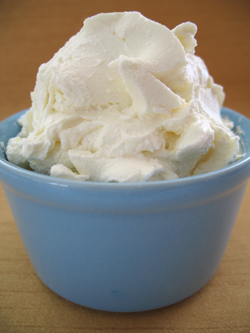
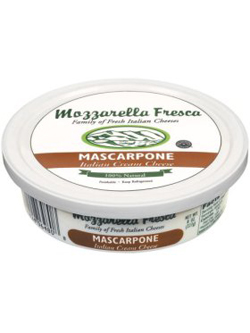
Mascarpone is sometimes referred to as “Italian cream cheese.” It’s softer and richer than American-style cream cheese, to be sure, but genuine mascarpone has less of a tang than does cream cheese made in the U.S. Mascarpone has an extraordinarily high butterfat content, unsurprising given that it’s made from the cream skimmed from cow’s milk. Truly fresh mascarpone has almost a sweet flavor, and this is a cheese with very low or no sodium. Like all of the cheeses discussed here, it’s highly perishable and must be kept cold. While some think mascarpone is the a chief component of cannolis, it is actually ricotta: Mascarpone or ricotta is used in Italian cheesecake.
Queso Fresco and Queso Fresco Blanco
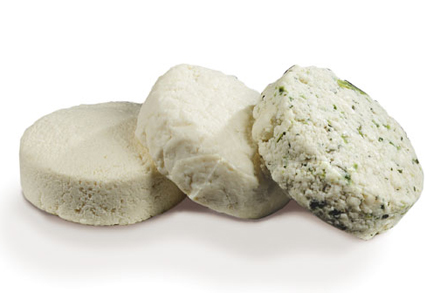
Hispanic foods are becoming increasingly popular in American society (and about time, too!). From these cultures, we get queso fresco, one of the most commonly-used cheeses in Latin America. It’s a soft, mild cheese similar to ricotta in that it’s made from curds. Cultures and rennet are added to pasteurized milk to create the curds, which are scooped into molds, then drained briefly. The resulting queso fresco is crumbly, with a mild and salty flavor and a slightly “grainy” texture. It is often sprinkled over foods, and when heated, it will melt. Queso fresco is most often used crumbled, as a topping for everything from salads to soups to enchiladas, and is melted in quesadillas and casseroles. Queso fresco should not be confused with queso blanco fresco, although the latter is similar. Queso blanco fresco is a fresh cheese that is made by direct acidification (not cultures and rennet) and pressed into blocks. It consequently has a firm texture and softens but does not melt: It can be sliced for pan-frying.
| Outstanding cheeses from Mozzarella Company. Pictured from left to right: Queso Fresco, Queso Blanco, Queso Blanco with Chiles and Epazote. Read our complete review of Mozzarella Company cheeses. |
 |
Recipe: Queso Fresco Mashed Potatoes With Caramelized Onions
We had to digress and share this delicious recipe from Mozzarella Company, one of our Top Picks Of The Week:
Ingredients
- 3 tablespoons butter
- 1 large red onion, thinly sliced
- 2-1/2 pounds Yukon Gold or new potatoes
- 1 teaspoon salt
- 1 to 1-1/2 cups milk
- 8 ounces Queso Fresco, crumbled, divided use
- Salt, to taste
- Freshly ground black pepper, to taste
Preparation
For The Caramelized Onions
- Melt the butter in a medium skillet over medium heat. Add the onion and sauté, separating it into rings, until it begins to turn light brown. Reduce the heat and continue to cook, stirring occasionally, until the excess liquid evaporates and the onions begin to turn dark brown and caramelize. Set aside.
- Meanwhile, wash the potatoes and place in a large saucepan. Add enough water to cover the potatoes by 1 inch. Sprinkle with 1 teaspoon of salt and place pan over high heat and bring to a boil. Reduce the heat and simmer the potatoes for 20 to 30 minutes, or until tender when pierced with the tip of a knife. Preheat the oven to 350°F. When the potatoes are cooked, pour them into a colander to drain. When cool enough to handle, peel and discard the skins. Return the potatoes to the pan and place them in the oven uncovered, to dry out, for 5 minutes. Butter an ovenproof casserole dish.
- Heat the milk to a simmer in a small saucepan. Remove the potatoes from the oven and place in a large mixing bowl. Whip the potatoes with an electric mixer until smooth. Alternatively, pass them through a potato ricer or a food mill fitted with the fine disk. Add the milk and continue whipping the potatoes with the mixer or by hand. Gradually add 6 ounces of the Queso Fresco to the potatoes, while continuing to whip them. Taste and season with additional salt and pepper if necessary.
- Pour the potatoes into the casserole dish. Sprinkle the remaining 2 ounces of Queso Fresco over the potatoes. Cover with the caramelized onions.
- The potatoes may be set aside at this point and later reheated for 45 minutes. If continuing with the recipe, place the casserole directly in the oven and heat for 20 to 30 minutes, until the cheese melts and browns. Serve hot from the casserole dish. Serves 8.
Labné
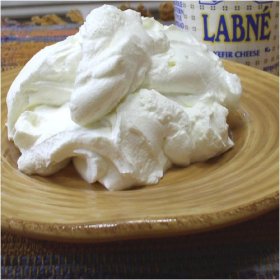
Time to move on to another country and another soft, fresh cheese. It is from Lebanon that we received the gift of labné, also known as kefir, the Lebanese version of cream cheese. In a nutshell, labné is a yogurt cheese, but it is often quite rich. The flavor is slightly tart and refreshing. In its country of origin, it is most commonly viewed as a staple of the breakfast table, but in the U.S. it is more often used as a dip for veggies and/or pita bread—although it spreads wonderfully on toast and bagels and its slight tartness is a delightful complement to jam. As a dip with toasted pita, serve on a plate with a depression in the middle, filled with extra virgin olive oil, sprinkle with chopped fresh mint leaves or thyme, and surround with black Mediterranean olives. Or serve with chopped mint as a side to roast lamb. Popular throughout the Eastern Mediterranean and Middle East, there are Middle Eastern restaurants in which a good labné can be a highlight of the meal.
This thick, rich yogurt cheese is produced by straining yogurt: Once the whey is removed, the firm yogurt solids that remain are called cheese. Labné can be substituted for cream cheese and sour cream in many recipes: It has less calories and, and since it is not heated after incubation, the active yogurt cultures remain live.
|
 |
Crème Fraîche
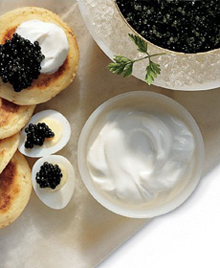
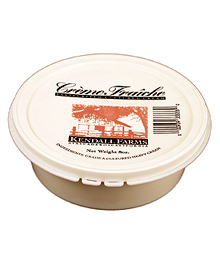
Crème fraîche, a relative of sour cream, is actually not a cheese because it is not made from curd, but it is similar in consistency to products that are curd-based. The regions of Normandy and Brittany in France were the likely birthplace of crème fraîche, one of the true glories of French cuisine. It is cultured cream from cow’s milk, thickened with an acid and treated with mild heat just until it achieves a silken-smooth texture and substantial thickness. Crème fraîche will be tangy like sour cream, but it’s a much more lightweight, elegant product, and like sour cream, it should be perfectly smooth. Crème fraîche embraces everything from the savory (caviar and smoked salmon) to the sweet (fresh berries and the richest chocolate cake), but it isn’t easy on the waistline. It’s so good, you’ll want to eat it by the cupful; but like at 110 calories an ounce, that 8-ounce cup is more caloric than a slice of cheesecake.
If you can’t find it locally, you can purchase this delicious Kendall Farms Crème Fraîche from Dean & DeLuca.
|
 |
 |
So far, everything has been straightforward. You should now be able to distinguish between mascarpone and queso fresco, labné and crème Fraîche, without the aid of a microscope or a lengthy investigation. Hold on to that thought, because now we’re moving to quark and fromage blanc, and it can be far more difficult to tell the difference between these two cheeses.
Quark
We’ll begin with quark, which has a literary relationship to the subatomic particles*, but is first and foremost the German word for curds. The knowledgeable Steven Jenkins, in his outstanding book, Cheese Primer, tells us that quark “can best be described as a cross between yogurt and American curdless or small-curd cottage cheese.” He adds that quark originated in Germany and/or western Austria and is similar to another fresh cheese, called “topfen” (pot cheese—and also is similar to ricotta). It may be made from cow’s goat’s, or sheep’s milk, or a mixture of two or more of those. A white and unaged cheese, it is made by letting lactic acid bacteria (sometimes also rennet) ferment milk, which produces the resulting curd. Some or most of the whey is removed by hanging the cheese in cheesecloth and letting it drip off, to achieve the desired thickness. This gives handmade European quark its distinctive shape of a wedge with rounded edges; in commercial production it is formed into blocks.
*In German, Quark and Topfen, the names of cheeses, are also used to mean “nonsense.” This latter usage is believed to be an inspiration for the passage written by James Joyce in his fanciful novel, Finnegan’s Wake: “Three quarks for Muster Mark!/Sure he hasn’t got much of a bark/And sure any he has it’s all beside the mark.” This excerpt is from a 13-line poem directed against King Mark, the cuckolded husband in the Tristan and Isolde legend. Use of the word “quark” to describe elementary particles of matter was taken from this poem by Murray Gell-Mann, the physicist who received the 1969 Nobel Prize for his work in classifying quarks. The allusion to three quarks seemed perfect to him, since originally there were only three subatomic quarks.
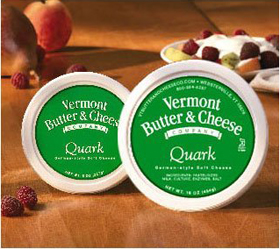
In the United States and Canada, quark is a somewhat different product, often sold in plastic tubs with most or all of the whey. This type of quark has the texture of yogurt or sour cream and is not necessarily low in fat—so if you want a low-fat cheese, make sure to check the product label. While the European, curd-type quark is a mild cheese, the American, yogurt-consistency quarks tend to be on the tangy side. The texture of domestic quarks will also vary by producer: They can resemble thick yogurt or be of a denser, more spreadable consistency.
While American quark has the consistency of yogurt or sour cream, European quark is more like ricotta or pot cheese. Both styles are eaten with fruit like yogurt, but the European type is a common ingredient in European cheesecake and other pastries, soufflés and sauces. Quark is so popular in Germany that it accounts for almost half of Germany’s total cheese production: The average German eats about 10 pounds of quark per year.
If you can’t find quark locally, you can purchase Vermont Butter & Cheese Quark from iGourmet. |
 |
Fromage Blanc
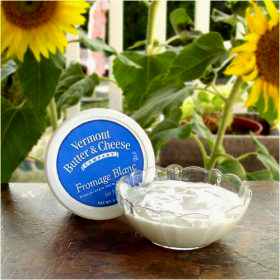
Fromage blanc is a fresh cream cheese that can be very similar to both quark and crème fraîche. Again, the final consistency and flavor is entirely up to the manufacturer. It’s another soft cheese, but how soft, and how tangy a flavor it has, is all in the production. Fromage blanc can have more of a curd than quark, but it doesn’t always. It may or may not be low in fat. Because there is no federal standard of identity for either product in the U.S., one manufacturer’s fromage blanc could be another’s quark! The fromage blanc from Vermont Butter & Cheese, for example, is extremely soft, with the consistency of sour cream and a similar tang, but with a significantly lower fat content and calorie count.
Fromage blanc is often eaten with fruit and sugar as a dessert. It is also very popular in cooking because it heats without separating.
The fromage blanc from Vermont Butter & Cheese is certified kosher by KOF-K.
If you can’t find it locally, you can purchase Vermont Butter & Cheese Fromage Blanc from iGourmet. |
 |
Cooking with Soft Cheeses
How about recipe use? If a recipe calls for mascarpone and you can’t find any, is it O.K. to use quark or crème fraîche? The answer is that none of these cheeses is always interchangeable. Queso fresco is probably going to be the saltiest and crumbliest of the six; mascarpone will likely be the sweetest and richest. You might be able to get away with a dollop of mascarpone instead of queso fresco on top of a serving of bean soup, but I wouldn’t try a reverse substitution in my best chocolate cheesecake! Crème fraîche can sometimes be used instead of mascarpone (as a soup or fruit topping, perhaps), just as quark and fromage blanc may be interchangeable in some food applications (depending upon texture and tartness), but it’s always a bit of a gamble.
Not everyone considers all of these to be “real” cheeses, as some never see separation of curds from whey. To me, that’s splitting hairs. But call them what you like, as long as you try them. There are many brands of most of these cheeses available, and it’s absolutely delightful to find one you really like and will use over and over again. “Genuine” cheese or not, it’s all about expanding your culinary and gustatory horizons.
Cheesemaker Of The Month: Vermont Butter and Cheese Company
When you can find four of the six cheeses I discuss in one edition in one convenient place, you’re doing well for yourself. And when they’re of good quality, you’re doing even better! Vermont Butter and Cheese Company makes crème fraîche, mascarpone, quark, and fromage blanc (in addition to a few aged cheeses, a few goat’s milk cheeses, and a delicious cultured butter). This company has a remarkable story behind it, but, more importantly to my way of thinking, they’ve really kept up their standards through their 20+ years in business. I have never had a product from them that wasn’t well-made.
I haven’t tasted their mascarpone or crème fraîche in some time. Our editorial director uses the crème fraîche (she says it has a subtle lemony note), but tells me that the mascarpone from Mozzarella Fresca is the way to go. But Vermont Butter and Cheese Company makes a gorgeous quark, in addition to a lovely fromage blanc. The latter is a fat-free product, containing a mere 30 calories per 2 ounce serving. I admire the easy-to-spread, smooth texture, and the freshness of the milk used really comes through in the taste. Yes, there’s a definite piquancy to this product, but throw in some dill and you have a luscious topping for cold poached salmon (great for summertime) or add some fresh thyme or chives and you’ll have an instant, guilt-free dip for crudités. |
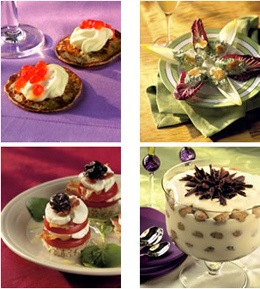
The Vermont Butter & Cheese Company website offers delicious recipes that use their delicious fresh cheeses. |
Alternatively, blend in just a little honey or fruit spread, and presto! a bread spread extraordinaire, or a topping for berries or peaches, or a dip for apple slices. You may never run out of uses for this fromage blanc, and if you’re like me you won’t want to stop eating it. Vermont Butter and Cheese Company can tell you where to find their products locally; if there’s no local retailer, you can order online.
Lifestyle Direct, Inc. All rights reserved. Images are the copyright of their respective owners.
|