These eggs were gathered from different heritage breeds of chickens. These are the natural colors of the shells: The eggs are not dyed, and no color enhancements have been made to this photo. Photo by Hudson Bedell | IST.
January 2008
Updated January 2009
|
 |
Types Of Eggs
Page 2: Egg Terms & Definitions E To G
This is Page 2 of a four-page glossary of egg types and terms. Click on the black links below to visit other pages.
Egg Glossary: Terms E To G
What’s the difference between fertile eggs and free-range eggs? What is a Grade AA egg? The answers lie below.
EGG PRODUCTS
Some food service operations purchase eggs out of the shell for convenience. These processed products can be whole eggs, yolks only or whites only, and are known as egg products. Egg products can be frozen, refrigerated or dried, precooked, preportioned and blended egg. They are subject to strict pasteurization standards and USDA inspections.
EGG SUBSTITUTES
Egg substitutes were developed for consumers who sought alternatives to the cholesterol content of eggs. They don’t have the same flavor as eggs, but have a similar texture when scrambled, made into omelets, etc. One type is a complete substitutes made from soy or milk proteins, and cannot be used in recipes where eggs are required for thickening. The other type of egg substitute contains real albumen, but the egg yolk has been replaced with vegetable or milk products.
EGG WHITE
See albumen.
EGG SHELL
See shell.
EMU EGGS
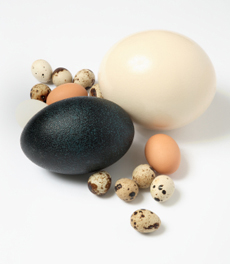
Emu eggs are becoming increasingly available from breeders; they have been spotted at some Whole Foods Markets for $19.99 per egg (compared to a chicken’s daily output, a good breeding pair of emus can produce just 20 to 50 eggs per breeding season). The shells are handsome and can range from teal to dark green (see photo at right). The empty shells are much desired as crafts and objects d’art. The emu is the second largest bird, after the ostrich; a single emu egg is equivalent to about 10 hen’s eggs. The yolk is a paler yellow than a hen’s egg; it accounts for about 45% of the egg, compared with 34% to 35% in a hen’s egg; it contains more fat as well. The flavor is said to be stronger; while they have been a part of the Bushmen’s diet for 30,000 years, in Australia today they are served largely as curiosities. If you want to hard-boil one, it will take about 1 hour 45 minutes for a medium-sized emu egg. |
The large white egg is an ostrich egg; the green-black egg is an emu egg; the light brown eggs are chicken eggs, and the speckled eggs are quail eggs. Photo by Theodore Scott | IST.
|
FERTILE EGGS
Typical chicken eggs are not fertile, i.e., the hen has not had contact with a rooster, and no chick can develop from the egg. Some producers sell fertile eggs because some consumers believe that they are more nutritious or have some hormonal advantage. However, there is no nutritional benefit or other known advantage.
FREE-RANGE EGGS
Free-range eggs are produced by hens that have daily access to an outdoor area where they can peck for worms, grubs and insects, and exercise their legs and wings. Both the natural diet and the exercise is believed to produce better meat in a poultry chicken, and is considered more humane in a laying hen. Generally, the chickens are housed in large barns, and a flap door is raised, weather permitting, for the hens to exit for a period of time each day.
GOOSE EGGS
Goose eggs are four to five times larger than chicken eggs, with a somewhat richer flavor. The eggs can be used in any recipe calling for chicken eggs, substituting one goose egg for two chicken eggs. You can purchase eggs from free-range geese, fed certified organic feed, from LocalHarvest.org (photo at right).
GRADE OR GRADING
Eggs are graded by the U.S. Department of Agriculture (USDA) or a state agency following USDA guidelines. Grades AA, A or B are given based upon the interior and exterior quality, not the size of the egg. Criteria include the appearance of the shell, how the egg spreads when it is cracked open, the appearance of the albumen and yolk, and the overall usability (e.g., any use [Grades AA and A], including frying, poaching and cooking in the shell, versus restriction to baking and scrambling, for Grade B eggs which have slightly abnormal shapes or stained shells). The grade does not define the nutritional value of the egg.
GUINEA FOWL EGG
The guinea fowl egg has an ivory shell flecked with brown; it has a more delicate flavor than that of a chicken egg.
Photo of guinea fowl by Loretta Humble | SXC.
GULL EGGS
The gull egg, or sea gull egg, is considered a delicacy in England and Scandinavia. Small in size, the shell is covered with light to dark brown blotches. It is a small egg; not surprisingly because of the fish diet of the gull, the egg has a slightly fishy flavor.
Continue To Page 3: Glossary Terms H To T
Go To The Article Index Above
© Copyright 2005-2012 Lifestyle Direct, Inc. All rights reserved. Images are the copyright of their respective owners.

|
 |
|
|