|
STEPHANIE ZONIS is Contributing Editor of THE NIBBLE. Having just tasted upwards of 100 strawberry jams, it is an appropriate next step to focus on peanut butter.
|
|
March 2006
Last Updated March 2012
|
|
Peanut Butter Explosion
Page 2: Natural PB, Fantasy Flavor PB
This is Page 2 of a three-page article. Click on the black links below to visit other pages.
Going Natural Versus Trans Fats
Grind-your-own peanut butter is a common option in natural foods stores. Although it isn’t usually possible to choose the grind, it is a good option for consumers who want to know exactly what’s in their food. In a busy natural foods store with high turnover, consumers can be reasonably certain that the peanuts will be fresh. Other likely choices in natural foods stores are natural or organic peanut butters.
The biggest complaints about these products are cost (they’re sometimes significantly pricier than supermarket peanut butter) and the layer of oil that rises to the top of most of these peanut butter types if they stand for any length of time (it’s unaesthetic and must repeatedly be stirred back into the rest of the peanut butter, a genuine sticking point with some consumers).
However, grind-your-own, natural, and organic peanut butters are popular with those wishing to avoid trans fats (hydrogenated and partially hydrogenated oils) in the recent. Hydrogenated and partially hydrogenated vegetable oils are added to many supermarket peanut butters. These oils dramatically increased the shelf life of peanut butter and prevent oil from rising to the top; they also provide for a creamier mouthfeel.
Health warnings have been issued about trans fats in recent years, and most manufacturers have eliminated them. But much discussion ensued as to whether or not the amount of trans fat in a standard supermarket-variety peanut butter was significant in human health. (By FDA definition, the small amount of trans fat in peanut butter, below .5%, allows manufacturers to list it as being trans fat-free. But unless there is no hydrogenated or partially hydrogenated oil in your peanut butter, it does contain trans fat.)
|
|
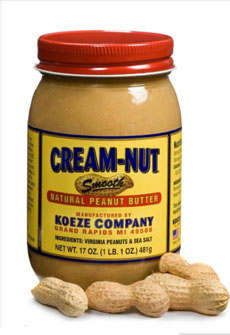 One of our favorite peanut butters, Cream-Nut (equally delicious in crunchy). Photo courtesy Koeze Company. One of our favorite peanut butters, Cream-Nut (equally delicious in crunchy). Photo courtesy Koeze Company.
|
Fantasy Flavors, Blends & Spreads
Another category in the realm of peanut butter is flavored peanut butters. Combining peanut butter with chocolate doesn’t take too much imagination, but companies producing these peanut butters have thrown caution to the wind and offer decidedly unusual flavor combinations—along with some tamer varieties for those who prefer not to go too crazy.
A butterscotch or cinnamon raisin peanut butter might well find wide acceptance.
When this article was first written, in 2006, it was a renaissance for flavored peanut butter: curry, garlic, hickory smoked, hot chile and onion garlic and Thai ginger.
Alas, only the hot chile flavor has survived, thank to America’s love of spicy foods. While we found the other savory flavors to be terrific as sandwich spreads, with cold meat or poultry sandwiches, and on canapes, America voted—for the tamer flavors. Many sweet flavors bit the bullet, too, apricot and raspberry among them.
|
|
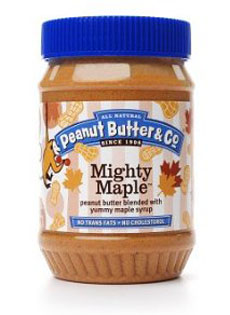
Peanut Butter & Co. makes flavors such as chile, cinnamon raisin, white or dark chocolate, honey and Mighty Maple, above. Photo courtesy Peanut Butter & Co.
|
Had many PB buyers tasted those flavors, we bet they’d have loved them. But the concepts were just too unfamiliar. What a loss!
When Is A Peanut Butter Not A Peanut Butter?
When it’s a peanut butter blend or a peanut spread.
Such products start with peanut butter, but they use other ingredients to an extent that disqualifies them from labeling their products as peanut butters (the FDA standard of identity for peanut butter states that “seasoning and stabilizing ingredients” must not “in the aggregate exceed 10 percent of the weight of the finished food”). These blends and spreads may be lower in calories and/or fat and higher in protein and fiber than peanut butter.
Continue To Page 3: Peanut Butter Health Benefits
Go To The Article Index Above
|