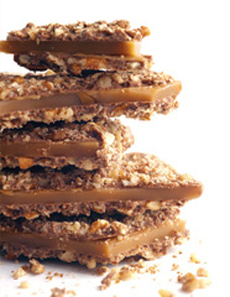
Vosges Haut-Chocolate calls their product toffee, but it’s actually an all-American creation, buttercrunch. Call it what you want, this confection is a nouvelle combination of roasted, salted pecans and walnuts. Dipped in milk chocolate, it’s a combination of salty and sweet.
May 2006
Updated May 2021
|
|
The ABCs Of Toffee
Page 1: The Difference Between English Toffee and “American” Toffee
CAPSULE REPORT: Toffee, one of America’s traditional favorites, is hot and happening. What is toffee? What’s the difference between toffee and buttercrunch? Is there a difference between American toffee and English toffee? And what makes great toffee? We consulted the experts, and tell all here. This is Page 1 of a three-page article. Click on the black links below to visit other pages.
Americans love toffee. At the recent Fancy Food Show in San Francisco, if we noticed any trend it was not the “hot new flavor” (in the past, wasabi, jalapeño, pomegranate, etc.), but the number of new companies specializing in toffee!
Toffee History
Most food historians believe that the toffee we know today, made with caramelized sugar and butter, emerged by the early 19th century.
It may have happened in England, one of the northern European dairying countries that plentiful supplies of butter.
The Oxford English Dictionary first mentions the word “toffee” in 1825; and historians note that words can be in use for decades before they became widespread enough to be included in a dictionary.
English toffee and American toffee diverged with the preferred use of sugar type. English toffee is made with brown sugar, while American-style toffee, known as buttercrunch is made with white table sugar (granulated sugar).
Buttercrunch is typically dusted with crushed almonds or other nuts. Some are enrobed in chocolate.
And sometimes, the candy is flavored with espresso, lavender, spices, etc.
It’s important to note that the use of the terms toffee and buttercrunch are not consistent. Many producers who use granulated sugar and nuts call their products “English toffee.”
Why? Perhaps they aren’t aware of the difference; perhaps “English toffee” has more consumer appeal than “buttercrunch.”
But now, you’re an educated consumer: You know the difference.
Does it make a difference whether it’s called toffee or buttercrunch?
Only if you’re a nit-picking food historian (we are).
The origins of the word toffee are not certain, but some believe it to be a form of the word “tafia,” a West Indies rum distilled from molasses. Possibly, the toffee, which is still made with molasses today, could have been made from the molasses-type syrup skimmed off the liquor during distillation.
The Difference Between English & American Toffee
Toffee is made by caramelized sugar and butter...but follow the trail after that and the story gets confusing.
- Some sources tell you that American toffee is a hard substance, synonymous with brittle; while British toffee is more the consistency of what we call taffy—a hard, chewy candy made of brown sugar or molasses and butter.
- Other sources say that British toffee is hard, and American toffee is softer recipe. (Believe this one.)
These things everyone will agree upon:
- Toffees are hard, chewy candies made by combining some type of sugar (white, brown, molasses) plus water and butter. American recipes can add vanilla and other flavorings, and also add milk or cream. The ingredients are boiled together at a high temperature until the mixture is golden brown and stiff.
- The toffee is then spread into a shallow pan or onto a surface to thicken and cool. The slab is then broken into smaller, irregular pieces. Some toffees are poured into individual molds to create individual square or round pieces.
-
Brits favor a recipe with brown sugar or molasses, which creates a darker flavor. Americans tend to use white sugar, which brings out the buttery qualities; although some American candy makers add some brown sugar to their mixes.
-
What is called English-style toffee in the U.S. is the hard sheet of toffee many candy makers create and then break into pieces with a hammer. If that doesn’t conjure up an image, think of the center of a Heath bar. (The full name of this favorite newsstand candy bar is Heath Milk Chocolate English Toffee Bar—a product first made by the Heath brothers in Robison, Illinois in 1928, and now owned by the Hershey Corporation). And, click to the next page to see a photo of a toffee slab that’s been broken.
|

You can’t have too many ways to eat toffee. Erin’s Fuji Apples, coated in caramel and Belgian milk chocolate and studded with large pieces of toffee, is another good idea. |
- American-style toffee is called Buttercrunch. Typically made with white sugar, it is often dusted with crushed almonds or other nuts. Some are enrobed in chocolate—dark, milk or white. Buttercrunch can also beflavored with espresso, lavender, spices, etc. (See photo at top of page.)
- It’s important to note that the use of the terms toffee and buttercrunch in the U.S. are not consistent. Many American producers who use granulated sugar and nuts call their products “English toffee” or simple, “toffee.”
- Why? Perhaps they aren’t aware of the difference; perhaps because “English toffee” may have more consumer appeal than “buttercrunch.”
Continue To Page 2: Toffee Versus Buttercrunch
Go To The Article Index Above
|