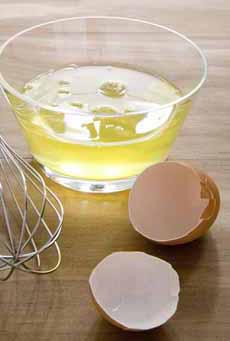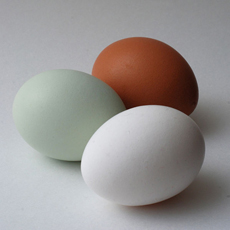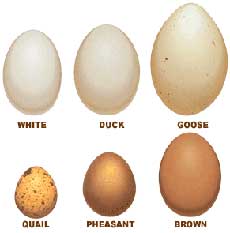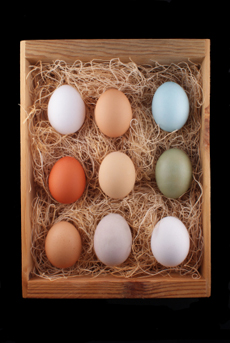
Brown eggs come from brown hen varieties, white eggs from white hens. Photo by Peter Rol| SXC.
January 2008
|
 |
Types Of Eggs
An Egg Glossary, Plus Egg Nutrition & Egg Facts
Eggs: an inexpensive source of protein, a versatile ingredient and an essential component of foods we hold dear, from omelets to cakes and cookies. Just a few years ago, you had a choice of white or brown eggs. (White eggs come from white hen varieties, brown eggs come from brown-feathered hens, and are a bit more expensive because brown hens tend to be larger and consume more feed.)
Today, there are 10 choices to be made. In addition to the regular brown and white eggs of yore, here are eight additional choices—most of which are available in brown or white as well.
Egg Glossary
If you’d like to suggest additional words, click here. Beyond eggs, We have a food glossary for almost every specialty. Click on the link to visit the entire collection.
CAGE-FREE EGGS
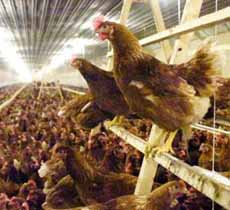
Cage-free and free-range eggs (see below) appeal to people who object to caging animals; however, the cage-free system does not necessary provide optimal safety to the hens. The “free” hens can be very crowded on a henhouse floor, and injury can result. Instead, better standards may come from a United Egg Producers Certified Egg (see below).
FERTILE EGGS
Typical eggs are not fertile, i.e., the hen has not had contact with a rooster, and no chick can develop from the egg. Some producers sell fertile eggs because some consumers believe that they are more nutritious or have some hormonal advantage. However, there is no nutritional benefit or other known advantage.
FREE-RANGE EGGS
Free-range eggs are produced by hens that have daily access to an outdoor area where they can peck for worms, grubs and insects, and exercise their legs and wings. Both the natural diet and the exercise is believed to produce better meat in a poultry chicken, and is considered more humane in a laying hen. Generally, the chickens are housed in large barns, and a flap door is raised, weather permitting, for the hens to exit for a period of time each day.
UNITED EGG PRODUCERS-CERTIFIED EGGS
An organization whose producers voluntarily implement animal welfare standards that improve the care and handling of the hens. Their seal appears on the cartons of eggs produced under their standards.
VEGETARIAN EGGS
These eggs guarantee that the hens are only fed a vegetarian diet—free from meat or fish by-products. The hens are kept in cages and therefore cannot peck any grubs or worms. Vegetarian eggs are of importance to vegetarians, who do not eat any meat products.
VITAMIN-ENRICHED EGGS
Often referred to as “designer” eggs, these are enhanced with a variety of nutrients:
- Omega-3 Eggs. Omega-3 fatty acids are primarily found in oily fish, and therefore, most people do not consume adequate levels of this beneficial fatty acid,
which helps build cell membranes, are primarily components of brain, retina and other nerve tissue, and play a key role in the prevention and management of chronic diseases. Hens that produce omega-3 enhanced eggs are fed a special vegetarian diet that consists of canola, flaxseed and linseed—all rich in omega-3 essential fatty acids. The result is that they produce eggs with higher levels of omega-3 fatty acids than other types of eggs. Depending on how many eggs you eat daily, they may or may not meet your RDA for omega-3s, which can easily be consumed via capsule. They are more expensive because of the higher cost of the feed, and are just an alternative way to get these nutrients into your diet (you can take daily pills or eat salmon and other omega-3 enhanced foods like milk and yogurt).
Photo of egg yolk by Dirk De Kegel | SXC.
- Vitamin-Enhanced Eggs. Similarly, hens are fed higher levels of vitamins such as B6, B12 and E, and lutein (which fights macular degeneration), which results in higher amounts of the vitamins in the egg. Like Omega-3 enriched eggs, these eggs are similarly more expensive, and are an indirect way to take these supplements.
ORGANIC EGGS
Organic eggs follow the USDA organic certification guidelines, and will have the USDA seal on the carton. Like free-range hens, these hens must have daily outdoor access in an area covered with natural vegetation. However, more stringently, the vegetation cannot have been treated with chemical pesticides. Their feed and bedding (straw) must be wholly organic, i.e., free of chemical pesticides, herbicides or fertilizers. They cannot be given any antibiotics or hormones. Should a hen require antibiotics for medical reasons, it cannot be returned to an organic flock. Once the eggs are laid, no artificial coloring or vitamins are added. Thus, the yolks can be paler in color. However, the flavor is much more vibrant. Learn more about organic eggs.
Egg Nutrition
For an average of just 12 cents each, eggs provide varying amounts of 13 important nutrients, including high-quality protein, choline, riboflavin and vitamin B12.
- Calories. A large egg has 75 calories, and packs a lot of protein and other nutrition to satiate hunger. The yolk provides the majority of the 21 vitamins and minerals, including about 40% of the protein. The lutein and zeaxanthin found in the yolk are thought to protect the eye from damage due to aging associated with ultraviolet light exposure, cataract development and age-related macular degeneration. It also contains 6.29g protein, 27g calcium, 6mg magnesium, 96mg phosphorus, 67mg potassium, 244 IU vitamin A and 4.97g total fat.
- Fat. A large egg has just 1.5 grams of saturated fat, and provides 2.6g of healthy mono- and polyunsaturated fats. It contains less than 0.5g of trans fats, which is the acceptable limit for foods to claim no trans fat content.
Health Benefits Of Eggs
According to the American Egg Board, research demonstrates that including eggs in the diet can help prevent common age-related conditions without negatively influencing the risk for heart disease. They can help preserve eyesight and maintain lean body mass as we age.
- Muscle Health. Sarcopenia, age-related muscle loss, generally starts to set in around age 45, when muscle mass begins to decline at a rate of about 1% each year.[1] Regular exercise and high-quality protein foods, like eggs, can help maintain lean muscle mass.
Eyesight. Age-related macular degeneration (AMD) is the leading cause of blindness. Research suggests that lutein and zeaxanthin, two antioxidants found in foods like egg yolks and leafy greens, may help reduce the risk of AMD by increasing macular pigment optical density. In fact, studies show that consuming one egg a day can significantly increase lutein and zeaxanthin levels without negatively impacting blood cholesterol or lipid levels.[2,3] Additional research has found that the lutein in eggs may be better absorbed by the body than it is from other sources, such as dietary supplements or spinach.[4]
Photo courtesy of Wikipedia.org.
- Brainpower. According to a review published in The Journal of Nutrition, omega-3 fatty acids play a protective role against oxidative stress, thereby helping to minimize the loss of cognitive function that is associated with aging.[5] Omega-3 fatty acid-enriched eggs are a good choice for people who want to increase their intake of omega-3 fatty acids, but who do not regularly eat fish or like to take supplements.
[1] “Are you doing all you can to fight sarcopenia?” Health & Nutrition Letter. Tufts University. March, 2003.
[2]Wenzel, A.J., et al. A twelve-week egg intervention increases serum zeaxanthin and macular pigment optical density in women. The Journal of Nutrition. 2006; 136: 2568-2573.
[3] Goodrow E.F., et al. Consumption of one egg per day increases serum lutein and zeaxanthin concentrations in older adults without altering serum lipid and lipoprotein cholesterol concentrations. The Journal of Nutrition. 2006; 136: 2519-2524.
[4] Chung H.K., et al. Lutein bioavailability is higher from lutein-enriched eggs than from supplements and spinach in men. The Journal of Nutrition. 2004; 134:1887-1893
[5] Innis, S.M. Dietary (n-3) fatty acids and brain development. The Journal of Nutrition. 2007;137:855-859.
Egg Facts
- Is there a nutritional difference between brown eggs and white eggs?
No, they have the same nutritional value. The shell color is a function of the color of the hen: White breeds produce white eggs and brown breeds produce brown eggs (simple!). The reason that brown eggs tend to be costlier is that brown breeds are larger and require more feed. The color of the yolk is based on the feed. A diet of wheat and white corn meal would produce an almost colorless yolk; but adding yellow corn meal and/or marigolds produces the deep yellow yolk preferred in the U.S.
Photo by Monika Szczygiet | SXC.
- How long are eggs fresh after purchase?
Eggs can be stored in their cartons in the refrigerator for four to five weeks beyond the carton’s Julian date, which reflects the consecutive days of the year (January 1 is 001 and December 31 is 365). Once an egg begins to age, it loses moisture through its shell, which is porous, and begins to dry out. The membranes that hold the egg structure begin to loosen; that’s why the yolk may not be anchored in the center of the white. An older egg would be most appropriate for a mixed dish, a batter or a hard cooked egg, which should be easier to peel than a freshly laid egg.
-
What’s the best way to store eggs?
Eggs should be refrigerated at 40°F. THe USDA advises that eggs left out for more than two hours may be subject to bacteria growth, and should be discarded. (It is fine to let raw eggs come to room temperature before using—20 to 30 minutes. But they should be used and cooked or re-refrigerated within two hours.) Leave the eggs in their carton on an inside refrigerator shelf where temperature does not vary—not on the refrigerator door. The carton insulates the eggs from loss of moisture.
- What’s the story about salmonella in eggs?
In the 1980s, a specific strain of salmonella bacteria was found growing in the reproductive organs of egg-laying hens. It is rare, but in one in 20,000 eggs, the Salmonella bacteria may infect an egg. Cooking destroys the bacteria, which is why people are advised not to use raw eggs in egg nog, steak tartare, Caesar salad, etc. To use “safe raw eggs” in recipes, the USDA recommends heating the eggs in a liquid from the recipe over low heat, stirring constantly, until the mixture reaches 160°F. Then combine it with the other ingredients and complete the recipe.
Photo of eggs by Rodolfo Clix | SXC.
Egg Tips
- Never use a cracked raw egg. It can easily be contaminated with bacteria.
- Tell a fresh egg from a boiled egg by spinning it on the countertop. The cooked egg will spin easily while the raw egg will wobble due to its shifting liquid content.
- If you have more eggs than you can use, you can freeze them. However, they must be removed from the shell. Whites will freeze well for 12 months. Yolks don’t freeze well, so you may also wish to separate the yolks from whites.
Some information courtesy of the American Egg Board and the USDA.
© Copyright 2005-2008 Lifestyle Direct, Inc. All rights reserved. Images are the copyright of their respective owners.

|
 |
|
|