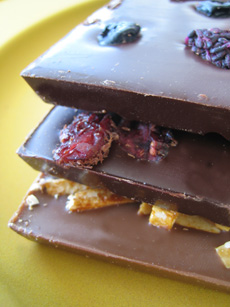
Artisanal bars from Michael Mischer Chocolates of Oakland, California. Photo by Melody Lan.
|
KAREN HOCHMAN’s first word was not cacahuatl...but as her mother will attest, it was pretty close.
|
|
May 2006
|
 |
From Pod to Palate
Part II: The Birth Of The Bar
Introduction
Unlike grinding a roasted coffee bean and brewing it into a cup of coffee, there’s a lot that goes into making a chocolate bar. It can take five days of work from the time the bean arrives at the production facility until the average chocolate bar is ready for your consumption. Valrhona spends five days just conching its grand cru chocolates, eliminating the impurities and creating a silky-smooth mouthfeel.
In the chocolate manufacturing process, chocolate liquor is mixed with cocoa butter and sugar to create a bar. In the case of milk chocolate, fresh, sweetened condensed or powdered whole milk is added, depending on the individual manufacturer’s formula and manufacturing methods. That’s the short story, but there are more than a dozen steps to actually making that bar, whether it is an eating bar, like the beautiful artisan bars in the photo at the left, or couverture, the professional blocks that are melted down by chocolatiers to make the artisan bars, filled chocolates, enrobed chocolates and truffles.
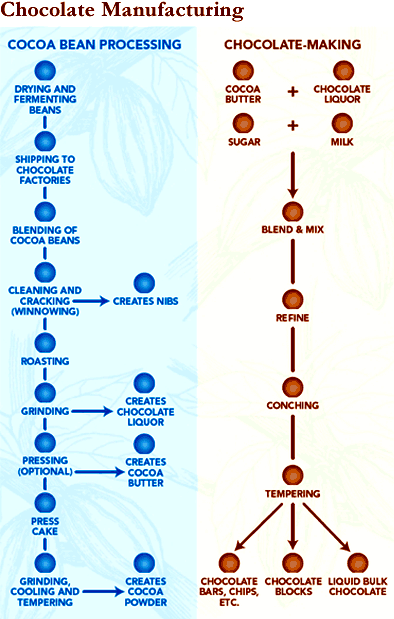
This article will take you through that process, and will introduce you to some of our favorite chocolate bars as well. To start, here’s a charted overview of the process of making chocolate, courtesy of the Chocolate Manufacturers Association. We’ll bring it to life the two major phases—growing and processing the cacao* bean and making the ground nibs into chocolate—with words and photos.
*While Americans say “cocoa bean” instead of “cacao bean,” that tradition came from a misspelling on a ship’s manifest in the 17th century. We prefer the correct international term, cacao, after the name of the plant, Theobroma cacao. We believe that “cocoa” should be reserved for referring to cocoa powder, which is used to make the beverage cocoa, among other things.
Section 1: Growing & Preparing The Beans
1. Growing The Beans
A consistent high temperature, plentiful rainfall, the right soil nutrients, and many large shade trees to protect them from the sun and the wind (known as mother trees) are required to nurture delicate, sensitive cacao trees. Cacao trees grow worldwide in the warm and wet tropical belt that stretches 20 degrees above and below the equator. About 80% of the world cacao harvest is grown in 1- to 2-hectare estates: It’s not big agribusiness, but small farm production. The cacao tree takes 4 to 5 years to produce its first crop but needs 10 years to produce really good fruit. The trees can reach 30 to 45 feet in height but are usually cut to 18 to 20 feet to make harvesting easier. The trees produce fruit twice a year, which is generally harvested before and after the rainy season. The fruit itself is sweet and tart, in the manner of passionfruit. The beans are innocuous, and give no indication that, after many processing steps, they will produce something as wonderful as chocolate. As you can see, the pods grow right from the branches and trunk ot the cacao tree. Photo courtesy of Dagoba Chocolate.
2. Harvesting
Cacao can be harvested throughout the year, but its main seasons are November to January and May to July. The football-shaped pods, also called cabosses (singular, cabosse, pronounced kuh- BAHSS) are hand-harvested by machete. It impossible to use machines for harvesting, because of the varying sizes of the fruit and because of potential damage to the tree, which is continuously producing new flowers and fruit. The pods are cut from the trees and sliced open manually using machetes. The whitish beans (the seeds of the fruit) which are surrounded by milky, sticky, sweet tasting pulp (the fruit) are removed. When ripe, each pod contains 30 to 40 seeds. Photo of cabosses by Keith Weller, courtesy of World Cocoa Association. Each cabosse yields enough beans for one chocolate bar.
3. Fermentation
Fermentation of the beans takes place according to different methods in different countries: wrapped under large banana (plantain) leaves, in baskets, in wooden boxes or in cylinders stored away from light. It is during fermentation that the cacao beans start to develop the typical cacao flavors. Fermentation is a reaction between yeast and the sticky pulp. The fermentation process lasts from 3 days for some Criollo varietals to 6 or 7 days for other varietals. Fermentation reduces the bitter taste, gives the brown color to the bean and breaks down the remaining pulp. Once the yeast has done its work the result is a sweeter, more chocolatey flavor.
Photo of fermentary courtesy of Amano Artisan
Chocolate.
4. Drying
Next, the fermented beans are spread out in the sun to dry, often on bamboo mats, and are turned often to make sure that they dry evenly and do not stick together. Drying can take place for 5 to 12 days, depending on the humidity, during which time the moisture content of the bean is substantially reduced.
Drying can be done by the sun or by artificial techniques. Sunlight drying, which is used for better beans, takes several days but produces better results. Growers of bulk beans use hot air or heat from burning wood to dry the beans. This is fast, but imparts an undesirable, somewhat smoky permanent flavor. Photo courtesy of Amedei Chocolate.
Once dry, the beans are hand-sorted, graded and packed into jute bags weighing about  138 pounds (62.54 kg). These dry beans are referred to as raw cacao. The bagged beans are stored in warehouses prior to being transported for sale at the nearest port or other trading point. The beans are inspected, and then selected by the buyer or agent of the chocolate producer and are shipped to a chocolate manufacturing facility or warehouse anywhere in the world. Photo courtesy of Scharffen Berger Chocolate.
Before The Beans Arrive At Their Destination,
Take A Look At
Some Of Our Favorite Bars.
We’ll never forget the day we had our first Amedei chocolate. We danced with joy, and couldn’t wait to give them to all of our chocolate-loving friends. Get to know one of our favorite artisan producers (Amedei means beloved of God, like Amadeus), made by the brother and sister team of Alessio and Cecelia Tessieri of Pisa, Italy. Click here for our review of this tiny chocolate powerhouse.
 |
 |
 |
| Amedei Chuao Bar. From the legendary Chuao village plantation in Venezuela, this rare chocolate is for the connoisseur. This gold medal-winning chocolate tastes unlike any other, with hints of bread and blueberries. Available in extremely limited quantities, each 50-gram bar is hand-numbered. Click here for more information. |
Amedei Porcelana Bar. The genetically pure Porcelana bean, a rare Criollo, may be the second finest bean on earth. Named for its translucent white color, it produces an intense chocolate of great strength yet enormous delicacy. This 70% cacao bar yields notes of light spice, a hint of dark smoke, and nuances of red wine. A true gourmet’s chocolate produced in a limited edition, each bar is hand-numbered. Click here for more information. |
Amedei I Cru Squares. “I” stands for Ier, or Premier (think 1st in English). Finish your introduction to this great Tuscan chocolatier with six varietal napolitains of pure single origin cocoa, from the finest plantations in Ecuador, Grenada, Jamaica, Madagascar, Trinidad and Venezuela. An outstanding way to experience the variety and virtues of Amedei’s great chocolates. Click here for more information. |
5. Cleaning
When the beans arrive at the factory, they are first inspected and approved by Quality Control. Then they are then sorted by country of origin and type of bean, and cleaned and roasted before they are made into chocolate. When the beans have been received at the processing location, they are inspected and thoroughly cleaned of all extraneous matter as well as any broken beans. The cleaning process involves blowers, which remove items that are lighter or heavier than cocoa beans, and sieves that eliminate items that are too small or too big. A special machine uses air suction, magnetic separators and brushes to remove foreign matter such as jute fibers from the bags; sticks, stones and sand; metal and fragments from closures used in bagging and tagging. Photo courtesy of Michel Cluizel.
6. Roasting
Once the beans are cleaned, they are ready to begin their transformation into chocolate. Next they will be roasted in large, rotating roasting ovens, just like coffee beans. A rotating drum tosses the beans about so they will roast evenly. The producer has the option of roasting them before the shell is removed, or of removing the shell first. In general, chocolate manufacturers prefer to roast the beans before shelling them, while cocoa processors favor roasting the shelled nib; it retains more cocoa butter since cocoa butter can’t migrate from the bean into the shell during the roasting process (chocolate manufacturers can always add in more cocoa butter later in the manufacturing process). Roasting the entire bean in its shell allows for more variety in the degree of roast and development of flavor (i.e., the producer can choose a light roast or a dark roast depending on the desired flavor outcome), but requires beans of a uniform size.
Loading beans into the roaster at Amano Artisan Chocolate.
The beans are roasted at a wide range of temperatures and times—we have seen ranges given from less than 200° to 300°F and from 10 minutes to 2 hours, although this will varies widely based on the producers and the type of beans. Chocolatier Jacques Torres, for example, roasts his beans at 160°F for 30 minutes. The roasting is necessary for the development of the cacao flavor and aroma. It is a very critical process that must be closely monitored. If the beans are roasted at a low temperature and for a brief time, it will preserve the fruitiness of the cacao bean—you’ll notice a red fruit quality in the chocolate flavor. If the beans are treated to a darker roast—higher temperatures and for a longer time—nuttier flavors will develop. It is a preference of the producer, as well as the characteristic of the bean, that dictates the roast. Each type of bean is roasted separately. After the beans are roasted, a machine called a cooler rotates the beans and circulates air to cool the hot roasted beans.
Photo courtesy of Scharffen Berger Chocolate.
Roasting develops the color and is the second stage in the development of the chocolate flavor that began during the fermentation on the estates. It’s food chemistry at its finest: the aroma of roasted cacao is made of a combination of some compounds resulting from fermentation and not involved in roasting, some compounds resulting from fermentation and increased by roasting, and some new compounds which are developed during roasting.
7. Winnowing (Shelling)
Winnowing means shelling, and prior to the Industrial Revolution, this was a manual process (in many third world counties, grain is still winnowed by hand). After the beans have been roasted and cooled, their shells are thin and brittle. They move to a machine called the winnower, which cracks open the shells. Air blows away the cracked outer shell and the husk, and sorts the remaining nibs by size. The nib is the heart of the bean (also called the kernel or the meat), from which the chocolate is made. Nibs (photo above) contain about 400 different chemical compounds responsible for the flavor of the final chocolate product. Modern factories no longer use old-fashioned equipment like the antique at the right, which still gets the job done for the Grenada Chocolate Company.
The roasted nibs are now ready to be ground into a paste that will eventually become chocolate.
Photo of winnower courtesy of Grenada Chocolate Company.
8. Grinding / Mélangeur
There are usually two stages of grinding in the manufacture of fine chocolate. In the first stage, the nibs (photo above) are ground into a thick paste similar to fresh-ground peanut butter, called the chocolate chocolate liquor (photo at right). The latter is a confusing name to anyone outside the industry, as it is neither liquid nor contains any alcohol. To add to the confusion, chocolate liquor is also called cocoa or cacao liquor, chocolate mass, cocoa mass, cocoa solid, or pâté de cacao (cocoa paste or chocolate paste). In the United States Food Standards of Identity, it is known simply as chocolate. Once further refined, it also is called unsweetened baking chocolate. Chocolate liquor is the main ingredient in chocolate. Photo courtesy of Stollwerck.
Since cacao beans are more than half fat, the chocolate liquor is made up of rich cocoa butter (53% to 60% depending on the varietal) with fine cocoa particles suspended in it. The heat and friction generated by the grinding metal plates causes the cocoa butter in the nib to melt into a fluid mass (photo at right), hence the name “chocolate liquor.” The chocolate liquor is not yet officially chocolate, but it smells like it! Photo courtesy of Amano Artisan Chocolate.
For eating chocolate, the appropriate amount of sugar is added (except for 100% cacao bars). The size of the particles in the chocolate mass is now about 100 microns. To avoid a grainy taste in the finished chocolate, another grinding takes place to reduce the particle size to about 18 microns (the tongue can sense grains of 18 microns or larger).
Chocolate liquor destined to be made into chocolate candy and confections then goes to be blended (Step 10). That which will be made into cocoa powder goes to Pressing.
9. Pressing (For Cocoa Powder)
If cocoa powder is being made, the chocolate liquor is further processed into “press cake” or pressed cake, and cocoa butter. The chocolate liquor or mass is put into hydraulic presses and extremely high pressure, 6000 pounds per square inch, is applied to drain off the clear, golden liquid cocoa butter. The press cake that is left is cooled, pulverized and sifted into cocoa powder. Photo of cocoa powder courtesy of CocoaTree.org.
Note that some companies sell “drinking chocolate,” which is sweetened cocoa or sweetened chocolate discs or squares, ready to be mixed with hot milk or water to become a beverage.
Now We’re Ready To Start To Make The Chocolate That Will Turn Into
Bars & Other Goodies. Here Are More Of Our Favorite Bars.
We know that chocolate has valuable antioxidants, but Belgian chocolatier NewTree has taken the cacao benefit one step further. They’ve developed a line of six luscious chocolate bars that have added fruit and botanicals, for an extra-tasty and extra-healthy treats. The ingredients have been thoroughly researched by nutritionists and biochemists for proven health benefits. They come in regular-size bars as well as boxes of 3 individually wrapped 0.32-ounce mini-bars that are just perfect for an invigorating snack. The Bittersweet bars include:
 |
 |
 |
| NewTree “Vigor” Bars. 73% cacao dark chocolate mini-bars enhanced with coffee and guarana, a South American berry known for its revitalizing properties. A peppy blend, Vigor stimulates your mind and body. It’s also a good source of Vitamin D. Box of 3 mini-bars, $3.00. Click here for more information. |
NewTree “Renew” Bars. 73% cacao dark chocolate mini-bars enhanced with blackcurrant and grape extract,which are powerful antioxidants and polyphenols that are known to help reduce the risk of cardiovascular disease. Renew also contains a healthy dose of Vitamin D. Box of 3 mini-bars, $3.00. Click here for more information. |
NewTree “Pleasure” Bars. 73% cacao dark chocolate mini-bars that are a fine source of fiber, iron, magnesium and vitamin D. Pleasure is also high in antioxidants that improve muscle function, plus phosphorous that increases energy and Vitamin D to maintain good bone structure. Box of 3 mini-bars, $3.35. Click here for more information. |
| |
Milk chocolate: |
Milk chocolate: |
 |
 |
 |
| NewTree “Forgiveness” Bars. 73% cacao dark chocolate mini-bars are a zesty lemon-infused chocolate rich in natural fiber from cactus extracts. Like magic, the lemon and cactus help eliminate the fat that is contained in the chocolate. Forgiveness contains enough cactus fiber to decrease the intake of calories by 25% compared with other 73% cocoa chocolates (NewTree or any other brand) that does not contain this ingredient. It’s very forgiving! Click here for more information. |
NewTree “Tranquility” Bars. These milk chocolate mini-bars help you to escape stress by combining the sensuous, smooth silkiness of milk chocolate with essence of lime blossom and the finest lavender from Provence, in sunny southern France. Tranquility transports you at any time of day, but is especially nice before bedtime. Click here for more information. |
NewTree “Rejoice” Bars. These silky-smooth milk chocolate mini-bars contain crisped rice, natural lime blossoms, and bitter orange cultivated around the Mediterranean Sea. Bitter orange and lime blossom are known for their blissful effects, while crisped rice adds a contrasting crunch. Rejoice helps one unwind and relax. Click here for more information. |
Section 2: Making The Chocolate
10. Blending or “Mélangeur”
At this stage the chocolate liquor and other ingredients are kneaded together according to the kind and quality of the chocolate being made. Most chocolate is a blend of beans, selected to achieve a specific consistent taste from year to year. As with any agricultural product, the flavor of the product will vary from crop to crop according to the growing conditions. And, different varieties of beans from different growing regions have different qualities and flavors. Thus, unless a single origin chocolate is being produced to highlight a specific terroir, the beans are sorted and blended to produce a distinctive flavor. Large commercial producers like Hershey and Nestlé use up to 12 different varieties of beans from all over the world to achieve a consistency of flavor.
Photo courtesy of CocoaTree.org.
At this stage of production, different types of beans are blended in different proportions according to particular recipes. These are “secret” recipes, the manufacturers’ proprietary formulas. Each producer desires to create a distinctive product that no competitor can copy. The exact proportions may be proprietary, along with the sources and proportions of the beans*, but everyone knows what goes into the recipe:
- For milk chocolate, cocoa butter and chocolate liquor are combined in varying proportions; sugar and full cream milk (generally condensed milk) are added.
- Dark chocolate uses the same process but without milk.
- White chocolate is made with cocoa butter, milk and sugar and does not contain chocolate liquor.
The ingredients can be churned together for hours; the resulting is dried to form a crumb which is ground with more cocoa butter in the next phase.
*A small percentage of bars, the very finest, are not made of a blend of beans but are single-origin bars. THis means that 100% of the beans come from a particular area or even a single estate. If a bar specifies that it is Rio Caraïbe, São Tomé or Chuao, e.g. it means that all of the beans in that bar are from that specific growing region. There are also bars made from beans grown on specific estates, e.g. Valrhona’s Gran Couva, Ampamakia and Palmira bars. A bar labeled Porcelana or Nacional, e.g., is made entirely of that subspecies of bean.
11. Refining or Fine Grinding
The second grinding produces a liquid, batter-like chocolate, but it is still gritty (hence, “crumb”). The goal of refining is to make the thick chocolate crumb into a silky chocolate. It travels through a series of five heavy steel refining rollers set at different intervals and different speeds. The gaps between the final rollers are so small that the chocolate components are ground into a thick fluid mass which is then run off. This step reduces the particle size to of the cocoa mass to 25 to 30 microns, both in the chocolate liquor and the sugar. In some cases, extra cocoa butter is added to the chocolate liquor for a smoother, more voluptuous mouthfeel. The smoother the chocolate desired, the more rolling!
12. Conching
Now the chocolate is “beaten” and refined by rollers to give it a finished, smooth, silky texture. But it must be kneaded and churned one more time—this time in the conching machine. Conching is a process which removes moisture and acidity from the chocolate, eliminates undesirable odors, fully evolves the desirable flavors and aromas and further smoothes the particles. During conching, the cocoa mass is poured into a stirring and milling machine. It is rolled, turned and aired at a temperature of about 180°F. The rollers can produce different degrees of agitation and aeration in order to develop and modify the chocolate flavors. During this process, friction between the sugar and the cacao particles occurs. This causes further “polishing” of the cacao particles, contributing to the smooth taste of the finished chocolate. Extra cocoa butter is sometimes added to give the chocolate a better mouthfeel. Soy lecithin is also added to stabilize the chocolate, vanilla is added, and milk (if milk chocolate). The chocolate can now be cooled and tempered.
Generally speaking, the longer chocolate is conched, the smoother it will be, assuming the same machine. The process may last for a few hours to three full days, and in the case of coatings, up to six days. The time depends on the bean and the preference of the producer—Valrhona’s grand cru chocolates, Caraïbe, Jivara Lait, Guanaja and Manjari, are conched for about 5 days! However, a key differentiator is the age of the conch. New machines conch much faster than older machines. So, you can’t compare apples to oranges, e.g., how long one company conches its chocolate compared to another.
The term “conching” refers to the shell-like paddles that were originally used (today they are generally rollers, as shown in the photo). The technique was invented in 1879 in Switzerland by Rodolphe Lindt to make chocolate more blendable (the French word is lissage) and smooth. Fine chocolate should melt in your mouth without any grainy feeling on the tongue. Photo courtesy of Scharffen Berger Chocolate.
13. Tempering
There’s one more critical step left before chocolate for consumption can be made: the chocolate must be tempered. Chocolate is not shiny and smooth by nature. Without tempering, large crystals would form; the chocolate would have a gritty texture and a dull appearance and/or the cocoa butter would separate out (as cream separates from milk) creating a greyish-white bloom on the surface. After the conching and before being molded into bars or made into filled chocolates, the chocolate paste must be tempered, a delicate process that involves slowly heating and cooling the chocolate repeatedly to temperatures between 105°F and 85°F. This stabilizes the product and achieves the smooth, shiny texture, pleasant mouthfeel and a sharp “snap” when a piece is broken off. This is a complicated procedure because the various fats in cocoa butter have different melting and congealing points. Chocolate that isn’t properly tempered will turn grey and crumbly as it hardens.
Well-tempered chocolate melts better in the mouth and has a long shelf life. If not tempered properly the finished chocolate will be dull and streaky with a tendency to bloom. In an industrial situation, this is done in large tempering machines. In an artisan’s shop, it is done by hand: the classic tempering method is to melt the chocolate until it is lump-free. Then 1/3 of the chocolate is poured onto a marble slab, spread and worked back and forth with a metal spatula until it becomes thick and reaches a temperature of about 80°F. This chocolate is then added back to the remaining 2/3 of the melted chocolate and stirred. |

This chocolate tempering machine is a
good size for small artisans or home
use. |
The process is repeated until the entire mixture reaches 88° to 92° for semi-sweet chocolate, 84° to 87° for milk or white chocolate. Care must be taken not to over-temper chocolate, which returns it to its original state—grainy and susceptible to bloom.
The resulting chocolate is called couverture and forms the basis of most finished chocolate products. It can be molded into chocolate bars or made into truffles or used to enrobe a box of assorted chocolates. Now, the couverture is ready to be shaped into the end product for you, the consumer.
14. Molding
There are different methods for producing chocolates: enrobing, hollow figure, layer- and-cutting and molding. Molding is the simples: solid shapes like bars and hearts are poured into molds, as shown at the right. The enrobing process (photo below) is the oldest method for producing chocolates: pre-shaped chocolates centers (caramel, creme, croquant, marzipan, nougat, nuts et al) can be hand-dipped by artisan chocolatiers and further ornamented with fruit pieces, nuts, candied violets, cocoa butter transfer designs or other flourishes on top. In larger operations, the centers are placed on a moving wire mesh belt which takes them to a coating machine. A shower of chocolate falls down to cover the centers in chocolate. Photos of molding (above) and enrobing (below) courtesy of CocoaTree.org.
The hollow figure process is used for hollow chocolates (like Easter bunnies) and for chocolates with liquid and semi-liquid fillings. Liquid chocolate couverture is poured into molds; the molds are then rotated so that the excess chocolate can drain away. The thin chocolate layer that sticks to the mold is solidified by cooling. A filling is then dispensed into the mold and covered with another thin layer of chocolate mass.
The layer-and-cut procedure is used for chocolates consisting of various layers such as marzipan, nougat, croquant or fruits. The solid or semi-solid masses are laid on top of another, and after cooling cut into bite-sized pieces, that are often partially or entirely covered with chocolate.
15. Packaging
The finished chocolates solidify in a cooling tunnel. In a large operation, a conveyor belt transports the chocolates to the packing machines or packing lines; the entire manufacturing process occurs without a human hand touching the chocolates. In an artisanal chocolate shop, everything is touched by the chocolatier; bars are wrapped with small mechanical wrapping machines; filled chocolates are hand-placed onto trays or into boxed assortments.
Now that you know all of the work that goes into making your chocolate bar or box of chocolates, take good are of it. Think back to Step 12: tempering—chocolate is very sensitive to temperature extremes.
If you’re not going to eat the chocolate within a few days, it should be stored at a temperature between 54°F and 65°F with a relative humidity between 55% and 60%. The ideal place that meets these requirements is a wine refrigerator! Chocolate melts at about 98ºF, which is body temperature and why chocolate simply “melts in your mouth.” It’s also why one shouldn’t keep chocolate in the sunlight, in a hot room, near a stove et al. With overnight shipping and gel packs, it’s easy (if not inexpensive) to ship chocolate during the summer months. We order it all the time and it arrives in pristine condition (as does ice cream!).
Dark chocolate bars can be kept for two years or more if stored properly: well wrapped in foil in a cool, dark, dry place. Milk and white chocolate have a more limited storage time, but will stay fresh for a year or more under these conditions. Filled chocolates, chocolates with nuts and other additives have less of a shelf life because the additives will break down or go rancid. Commercial companies will use preservatives to extend the shelf-life, but most fine chocolates are made preservative-free. A box of fine filled chocolates or truffles should be consumed within two weeks, the sooner the better. The fine fillings, creams, and purees with which they are made deteriorate quickly: to enjoy them they should be eaten soon after they are made. If you have a question about the shelf-life, call the chocolatier.
And enjoy all of those wonderful chocolates...in moderation.
More Of Our Favorite Bars:
Valrhona Grand Cru Cacao
Valrhona is considered by many chefs and gourmands around the world to produce the finest chocolate. While we’re too impartial to think that there’s any one best, we will affirm Valrhona is up there in the pantheon. An industry innovator, Valrhona was the first to emulate the wine industry and produce single origin cacao—bars where all the beans came from one specific region. These “Grand Cru” bars are among the best you will taste, and you owe it to yourself to try these three. Even people who don’t ordinarily like milk chocolate will find Jivara to be eye-opening. A fourth Grand Cru, Guanaja, is a 70% cacao Criollo and Trinitario mix from the island of Guanaja off the coast of Honduras. It’s an intense bittersweet chocolate, long on the palate.
© Copyright 2005-2008
Lifestyle Direct, Inc. All rights reserved. Images are the copyright of their respective owners.

|
 |
|
|