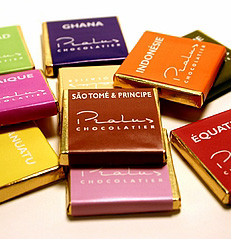
Tasting squares of Pralus origin chocolate.
|
PETER ROT is the chocolate reporter for THE NIBBLE. He welcomes your comments and questions. Click here to e-mail Peter.
|
November 2006
|
|
The Chocolate of François Pralus
Single Origin Chocolate & La Pyramide des Tropiques
CAPSULE REPORT: In the spectrum of fine chocolate, there are all styles. In his expansive article, House Tour: An Overview Of The World’s Great Chocolate Producers, Peter Rot compares and contrasts them. At the far end of the spectrum is François Pralus, known for his dark-roasted beans: he is the espresso of chocolate. The chocolate is serious, stern. It demands that you pay attention and study hard. Pralus provides a convenient “study guide” in the form of his Pyramide des Tropiques: a stack of smaller tastes of all of his single origin chocolate bars. There’s even a miniature bite-size pyramide—the “flash card” version.
Overview
Tasting a chocolate bar from Pralus is like plunging straight into the heart of darkness. His interpretation of single origin chocolate is indeed a dark journey that no other chocolatier has dared to attempt. And Pralus has returned triumphantly.
To define Pralus’ stylistic leaning it is easy to say that he’s a dark roaster, but that is like calling a Burgundy fruity. No, Pralus’ style is so stern and austere that tasting his chocolate simply is an experience that needs to be undertaken firsthand. Whether he is working with a gentle Indonesian Criollo bean or a bold Ecuadorian Arriba, Pralus exacts a dark roast. Whatever the nature of the cacao (i.e. its tone and flavor, whether it’s light and complex or dark and simple), the finished chocolate will always have a deep and brooding nature, a darkened aura that sometimes might subdue fruitiness and highlight darker notes such as coffee or dried fruits.
For a lighter cacao, such as a Criollo from Madagascar or Indonesia, the roast will be all too obvious. The lighter nature of the cacao will stick out in direct contrast to the darker tones and flavors exacted by the heat of roasting. For example, Madagascan cacao is typically very light, but Pralus’ version is cloaked in a dark tone that hovers ubiquitously throughout the length. The same can be said with the rest of the origin bars. However, for darker cacaos, such as the Venezuela or Colombia cacaos, the naturally dark tone is intensified to an all-out extreme and might even overwhelm the meandering palate. Arriba is already a bold cacao, but here the roast exacerbates the tone, and subtle flavor nuances are subdued almost entirely.
Then, there’s that characteristic smoke flavor that permeates a few of the Pralus bars. This is a flavor that’s found in a few of the bars—Indonesia, Java and Vanuatu, for example—and is most likely a result of the roasting process. But don’t be alarmed. Although it might startle and shock at first, it actually fits remarkably well, especially with São Tomé.
Style
Overall, I wouldn’t say that Pralus is a sophisticated chocolate. Over-roasting detracts from sophistication: it can suck the flavor out of cacao. Rather, I would regard Pralus as bold and challenging: the flavors might be so subtle that meticulous attention must be paid in order to extract the full profile from each bar. Pralus also is austere—his chocolate definitely has a quality of seriousness that doesn’t lend itself easily to casual tasting. No, if you wish to fully appreciate Pralus and understand his stylistic leaning, it is necessary to spend an adequate amount of time contemplating each chocolate.
A common thread tying together all of the bars is a dark tone and to some extent, woody notes, especially cedar. This is more noticeable among the Trinitario and Criollo bars, whose tones are already fairly light. As a result, the contrast is much more noticeable. Madagascar, Trinidad, and Jamaïque display this prominently. And São Tomé’s Forastero cacao already bears a natural woody flavor; it thus shines through abundantly clear.
So how do the bars compare on an individual basis? Well, let’s explore them.
The Single Origin Bars
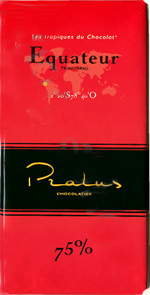
Each single origin chocolate shares a baseline cacao content of 75%. Each also exhibits that omnipresent darkened aura.
 |
- Colombie (Trinitario). A dark delight, but along with Equateur, it just might be too dark. The delicate flavors it possesses are too difficult to detect.
- Equateur (Trinitario). A berry bonanza is exhibited here, classic Arriba bean flavor. But all other delicate notes, i.e. floral, are roasted away. Perhaps the roast is too dark for this origin, but the chocolate is enjoyable nonetheless. One of the darkest offerings.
- Ghana. Probably the weakest offering of the line. Pralus seems to have conceded to Ghana’s simplistic flavor and roasted the hell out of it anyway, thus producing something of very submissive demeanor. Too much cocoa butter also softens the flavor.
- Indonésie (Criollo). More smoke and leather abound on these islands, and the fruitiness is here to match it. Mild tannins hide in the background.
|
- Jamaïque (Trinitario). Impressive chocolate from a locale not often seen in a single origin bar. Pralus delivers one of his best performances here and as with the Trinidad bar, marries a myriad of flavors not often found together. The texture is indescribably creamy, too.
- Java (Criollo). Similar to to the Vanuatu bar, but it shows better balance between the smoke and the fruitiness. The acidity is relatively high, but the grapes and passionfruit that give it identity mediate the tartness and smokiness remarkably well.
- Madagascar (Criollo). Vibrant and flashy, this Madagascar doesn’t exude the same elegance as others on the market and blitzes through with a darkened fruit rage. Inherent cedar notes top the flavor. The overall impression is cedar wood chips soaked in citrus vodka.
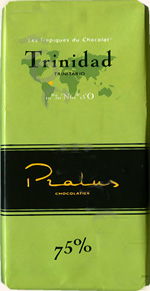 São Tomé (Forastero). This is perhaps the best interpretation of São Tomé on the market. Pralus perfects this oft-attempted origin and gets the most out of what little the cacao can offer. Cedar and red fruits dominate with a surprising addition of acidity to round out the flavor. A superlative texture seals the deal. Magnificent job! São Tomé (Forastero). This is perhaps the best interpretation of São Tomé on the market. Pralus perfects this oft-attempted origin and gets the most out of what little the cacao can offer. Cedar and red fruits dominate with a surprising addition of acidity to round out the flavor. A superlative texture seals the deal. Magnificent job!- Trinidad (Trinitario). A wonderful exploration into this Caribbean locale and perhaps the darkest Trinidadian yet. It’s simply a wonderful chocolate, similar to Jamaïque, but more acidic and vibrant. Wood, fruit, coffee and even floral notes round off this chocolate in a truly bizarre but addictive fashion.
- Vanuatu (Trinitario). From the country of Vanuatu in Micronesia. Definitely the most eccentric and odd chocolate you will ever taste. Leather and smoke preside over tart fruitiness in a tug-of-war struggle for flavor dominance, but the dark tone arbitrates this battle.
- Venezuela (Trinitario). One of the darkest chocolates you will ever taste, Venezuela will hammer you from the moment it enters your mouth. Red fruits and cream barely sneak in, but when you’re being assaulted by pure chocolate like this, who cares about flavor?
At 75% the intensity of cacao is definitely present, but the cocoa butter softens it to a reasonable level. What might come off as startling is the smokiness and darkness. But don’t be put off by this. No, please give Pralus a try, because once you acclimate your palate to his style, a whole new world of flavor exploration is opened for you.
La Pyramide des Tropiques
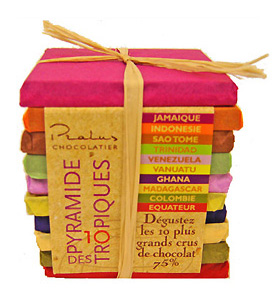 The exotic-sounding “pyramide” is actually a square stack of ten of the single-origin chocolate bars, colorfully wrapped in colorful paper. The cube of 50-gram bars (total 1.1 pounds) includes Colombie, Equateur, Ghana, Indonésie, Jamaïque, Madagascar, São Tomé, Trinidad, Vanuatu and Venezuela. The exotic-sounding “pyramide” is actually a square stack of ten of the single-origin chocolate bars, colorfully wrapped in colorful paper. The cube of 50-gram bars (total 1.1 pounds) includes Colombie, Equateur, Ghana, Indonésie, Jamaïque, Madagascar, São Tomé, Trinidad, Vanuatu and Venezuela.
The same great selection of chocolates found in the Pyramide is made in 5-gram tasting squares—a mini-Pyramide with the entire stack of 10 pieces totaling 50 grams (1.76 ounces), or, the weight of just one bar in the regular Pyramide.
PRALUS
Single Origin Chocolate Bars
- Single Origin Bar
Any Flavor, 3.53 Ounces
$7.99
- Pyramide Des Tropiques
10 Bars, 1.1 Pounds
$47.95
- Mini-Pyramide
10 Tasting Squares
1.76 Ounces
$8.95
Purchase online at
Chocosphere.com
Shipping additional. Prices and product availability are verified at publication but are subject to change.
|
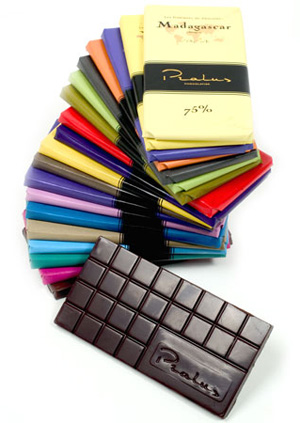 Pralus Single Origin Chocolate Bars Pralus Single Origin Chocolate Bars
|
Lifestyle Direct, Inc. All rights reserved. Images are the copyright of their respective owners.
|