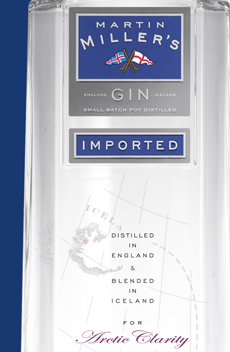
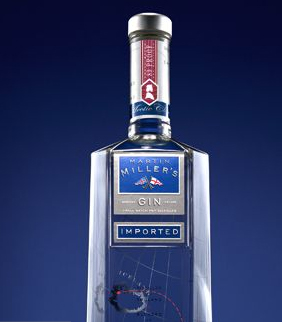
Martin Miller’s Gin is 80-proof—40% alcohol. But it’s 100% delicious and classy gin.
June 2007
|
 |
Martin Miller’s Gin
A Stunning New Gin To Drink Straight...Plus Gin Cocktail Recipes
Have you ever thought of creating your own artisanal spirit: one made to perfection, just the way you like it?
Martin Miller, a London purveyor of antiques and the author of the Miller’s Antique Price Guides, has done just that. One evening in his Notting Hill home, he and two friends were experimenting with different gin cocktails and felt that none of the spirits on hand was quite up to their expectations. What else would a group of affluent, passionate gin-lovers do, but spare no time and expense to create their own, perfect gin.
Distillation is the art and craft of using a still to extract flavors and alcohol as a vapor, which is then captured and condensed back into a liquid. It is similar to boiling a kettle of water, capturing the steam that comes out of it and turning it back into water—only in the case of spirits, the ingredients are turned into an alcoholic beverage.
To make a great spirit, one needs great ingredients and a small-batch still. Martin Miller’s Gin is distilled in the Rolls Royce of pot stills, designed by John Dore & Company in 1903 and called “Grandma.” Batch-distilled like malt whiskey, Grandma aromatizes the small batches of distillate with a proprietary mix of the finest botanicals and aromatics (more about the below). The botanicals are steeped overnight in the spirit to allow a greater infusion of flavor. |
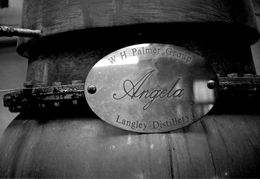
“Grandma,” b. 1903, actually has a name—Angela (possibly the name of Mrs. John Dore). |
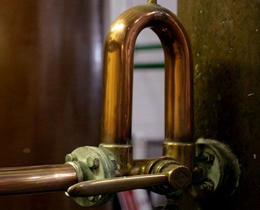
The ancient still is made from beaten copper.
|
Since “Grandma” boils at a lower distilling strength than a continuous still, she gently extracts the aromatic and flavoring oils and compounds from the juniper berries and botanicals to produce a gin with a noticeable degree of smoothness and complexity.
Following distillation, most London dry gins are blended with British spring waters. But Miller wanted a better experience. The distillate then takes a 3,000 mile round-trip to Iceland to make it the best product it can be.
|
In Iceland, the gin is blended with glacial lava-filtered waters, among the purest water on earth (up to 10 times more pure than Evian and Perrier—Read our review of Icelandic Glacial Spring Water.) Martin Miller’s feels that the Icelandic water provides a soft, almost sweet mouthfeel to the finished product, and makes the journey worthwhile. In the small village of Borganes on Iceland’s remote west coast, a final “mystery” ingredient—unknown even to the master distiller—is also added. You’d have to kidnap Miller and deprive him of gin for a long time to get an inkling of what it might be.
Noticeable enough for Martin Miller and friends to rest on the laurels. Try it and see if you agree.
The Components Of Gin
The botanicals to make gin come from around the globe: after acquiring them, the master distiller has to decide how to vary them to get the exact right mix. The key ingredient in gin is juniper, which provides the distinctive flavor and aroma. In fact, while gin is the quintessential British spirit, it was developed in the 17th century in the Netherlands as a medication: Juniper berries are a diuretic and were also thought to be an appetite stimulant and a remedy for rheumatism and arthritis. The name “gin” is derived from either the French genièvre or the Dutch jenever, words for “juniper.*”
*See Wikipedia references for “Juniper Berry.”
But juniper is just one of hundreds of berries, herbs, roots and spices that can be used to make the spirit. That’s why each brand of gin has its unique flavor. Martin Miller’s recipe uses eight ingredients: juniper berries from Tuscany, plus angelica, cassia bark, cinnamon bark, coriander, Florentine orris, lemon peel, licorice root, nutmeg and Seville orange peel.
Angelica Root
The angelica plant (also spelled anjelica) grows in temperate zones worldwide. Every part has a use: The roots and seeds are used to flavor spirits, the leaves are eaten in salads and other dishes, the stems are candied to decorate desserts, the seeds are used in perfume. Angelica is also a remedy for digestion and colds. |
 |
Cassia Bark
Instead of cinnamon, a common gin flavoring, Martin Miller’s uses a cousin, cassia bark, or Chinese cinnamon (sometimes labeled Indonesian Cinnamon), the bark of an evergreen tree native to southern China and Southeast Asia. It has a more assertive cinnamon flavor than true cinnamon. |
 |
Coriander
A member of the parsley family, coriander is the seed of the cilantro plant (“Chinese parsley”). They can be used whole or ground, and provide a sweet, somewhat fruity flavor. Coriander is popular in Indian and Middle Eastern cuisine, while cilantro is often used in Asian and Mexican dishes. |
 |
Juniper Berry
The fruit of the juniper evergreen shrub, the strong-flavored berry is used as a food seasoning. They are usually crushed or ground in like peppercorns to release their flavor. In addition to providing the principal flavor to gin, they are popular in Scandinavian cuisine for meat dishes (particularly game), pickled foods, sauces, sausages, soups, stews and stuffings. |
 |
Licorice Root
Licorice, spelled “liquorice” in the U.K., comes from the root of a southern European herbaceous plant: the word “licorice” is derived from the Ancient Greek words for “sweet root”. The root is boiled to obtain an extract used as a flavoring. Its flavor is similar to anise, star anise, fennel and tarragon. |
 |
Orris Root
Also known as Florentine Iris, this is the root of three species of iris, grown principally in southern Europe. Once important in western herbal medicine, it is now used mainly as an ingredient in many brands of gin and as a fixative and base note in perfumery—it is the substance left out of products that are labeled hypo-allergenic. |
 |
Cocktail Recipes
Start with sipping Martin Miller’s gin on the rocks. While many gins emphasize their juniper roots, Martin Miller’s has created something much more complex, with layers of other fruits. There is a lovely citrus nose: candied citrus peel that carries through on the palate, along with the floral notes of the juniper berries. The gin is very smooth, medium-to full-bodied palate with intensely fruit, citrus peel and somewhat more mild juniper. Interestingly, there are fine, spicy peppercorn notes—we don’t want to get geeky about it, but having just tasted 20 different varietal peppercorns, they remind us of Sarawak. The finish has long citrus and violet notes.
| The Classics |
Modern Twists |
|
|
|
Gimlet
Ingredients Per Cocktail
- 2 shots Martin Miller’s Gin
- 1/2 shot fresh lime juice
- 1/2 shot simple syrup
- 1 bar spoon lime marmalade
Directions
- Shake all ingredients with ice until ice cold. Strain into martini glass.
- Add lime zest to drink to garnish.
|

Martin Miller’s Gimlet. |
Gin Fizz
Ingredients
- 2 shots Martin Miller’s Gin
- 1 shot fresh lemon juice
- 1/2 shot simple syrup
- Dash egg white
- Soda water
Directions
|

Gin Fizz. |
Gin & Tonic
Ingredients
Directions
|

Gin & Tonic. |
Martin Miller’s Martini
Ingredients
-
2 shots Martin Miller’s Gin
-
1/2 shot Elderflower Cordial
(for a regular martini, substitute
Vermouth)
Directions
- Stir the Elderflower Cordial over ice, then discard cordial.
- Add gin to ice and stir 20 times until ice cold. Strain into martini glass.
- Garnish with lemon twist.
|

Martini. |
Mojito
Ingredients
Directions
- Muddle mint and sugar in highball glass, add everything else but the apple juice.
- Fill glass with crushed ice, add apple juice.
- Garnish with mint sprig.
|

Mojito. |
Red Snapper
Ingredients
Directions
- Combine all ingredients. Pour over ice in a Collins glass.
- Garnish with a celery stick.
|

Red Snapper. |
Watermelon Martini
Ingredients
Directions
- Shake and strain into a martini glass.
- Garnish with a watermelon wedge.
|

Watermelon Martini. |
MARTIN MILLER’S GIN
Ultrapremium Gin
- One Fifth
$27.99
Suggested Retail Price
Available at fine liquor stores nationwide.
For more information about Martin Miller’s Gin, visit MillersGin.com.
Prices and availability are verified at publication but are subject to change.
|
 |
|
© Copyright 2005-
2008
Lifestyle Direct, Inc. All rights reserved. Images are the copyright of their respective owners.

|
 |
|
|