Read about wines to serve with the ever-popular chocolate molten lava cake. You can make this one in a jiffy with an amazing cake mix from The King’s Cupboard.
|
Wine columnist R. VERONIQUE FITZGERALD is a wine consultant and writer based in New York City.
|
|
September 2007 |
 |
Product Reviews / Main Nibbles / Wine
Chocolate Molten Lava Cake
And A Great Wine To Enjoy With It
CAPSULE REPORT: We’ve taken one of America’s favorite gourmet chocolate desserts—chocolate molten lava cake—and experimented to find the best wine pairings for a memorable dessert experience. We’ve provided a recipe for chocolate molten lava cake if you don’t have your own favorite. Why not invite some friends over for dessert—it’s the fun part of the meal, and you don’t have to make a complete dinner! As far as the wines, we tried all the “likely suspects” and ended up preferring a wine that most people don’t know of, but you’ll certainly want to try, Luciano Landi Lacrima di Morro d’Alba Passito 2002. Also think of it as a gift for your chocolate-loving friends.
Introduction
Molten chocolate cakes, also known as lava cakes, have been the rage for more than a decade. It’s no surprise—this warm cake served in individual portions is insanely good. It’s not difficult to make at home, but please use a quality brand of chocolate. We used Callebaut bittersweet chocolate this time, but we’ve used other top brands in the past, including Valrhona and Ghirardelli. If you are more comfortable with supermarket chocolate, just do it: This cake waits for no man. But it does wait for dark chocolate—milk chocolate doesn’t produce the same results. The higher the percentage of cacao, the more sophisticated—less sweet and more intensely chocolate—your dessert will be. We personally aim for a cacao percentage in the 70s, although milk chocolate lovers will be happier in the 50% to 60% range.
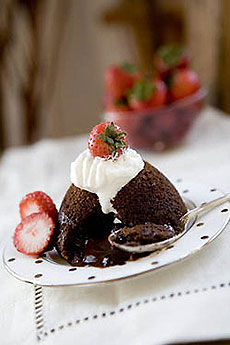
Serve the lava cake hot out of the oven so that when your friends cut into it with a spoon or fork, the chocolate oozes out like hot lava. That’s dessert magic! Any cold leftovers the next day are still pretty darn good.
If you enjoy a dessert wine, what’s the best to pair with your lava cake? We tasted a variety of wines that are known to go with chocolate cake. Some worked, some didn’t. Our report is below. But first, a recipe for this favorite dessert. If you don’t have time to bake, you can order them online from JRDessertBakery.com.
Molten Lava Chocolate Cake Recipe
Because so many people love mint chocolate lava cake, we’ve included a variation with this recipe; however, we only tasted the wines with the basic recipe.
Ingredients
- 8 ounces semisweet or
bittersweet
chocolate, chopped
- 4 large eggs
- ½ pound (2 sticks) unsalted butter,
chopped
- 4 tablespoons unbleached all-
purpose
flour
- ½ cup sugar
- 1 teaspoon ground nutmeg*
- ½ teaspoon ground cinnamon—or
for a mint version, substitute 1¼
teaspoons peppermint extract for the
cinnamon
- Whipped cream for garnish (1 pint
heavy cream, confectioners’ sugar
and vanilla extract)
- Raspberries and mint leaves for
garnish (optional)
|

If you don’t want to bake your own, you can
order these from JRDessertBakery.com. Or, to say that “you made it yourself,” get the delicious molten chocolate cake mix from The King’s Cupboard. Either way, your guests will thank you! |
*We use a nutmeg grinder and a fresh nut; you also can use the nut with a plane grater.
Preparation
- Preheat the oven to 350°F. Grease eight 4-ounce cake molds or ramekins.
- Over a double boiler, melt the chocolate and butter, stirring constantly. Once they are completely melted, set aside and cool.
- Combine the sugar and eggs and whisk until pale and fluffy. Stir the chocolate mixture into the egg mixture until completely blended. Whisk in the flour, nutmeg and cinnamon and mix well.
- Pour the batter into the cake molds and bake for 14 minutes at 350°F.
- While the cakes are baking you can whip the cream. To one pint heavy cream add 2 tablespoons confectioners’ sugar as the cream begins to thicken, plus 1 teaspoon vanilla and a few grains salt. Unsweetened or barely-sweetened whipped cream is also delicious, so feel free to reduce the sugar or add none at all.
- Remove the lava cakes from the oven and cool for 2 minutes. Run a knife around the edges, invert the molds onto individual dessert plates, garnish with raspberries and mint leaves and serve immediately. We prefer to pass the whipped cream in a bowl so guests can help themselves to the amount they prefer.
Wines To Serve With Chocolate Lava Cake
My husband, Chef Shehu, and I tasted a small selection of wines. We drew from recommendations in THE NIBBLE’s article, Pairing Wine with Chocolate, and we threw in a wild card. We found that the alcohol level of some of the recommended wines became an issue, possibly because of the temperature of the cake (piping hot!); wines with higher alcohol levels did not work as well as they might have with chocolate served at room temperature.
Our first group of wines were fortified. Experts often turn to fortified wines with rich chocolate desserts. Chocolate is so rich, even tannic, that it seems to work better with wines that are fuller bodied. A dessert wine like Sauternes is sweet and viscous, but its properties don’t pair well with chocolate, especially chocolate desserts. (See also our article on wine and dessert pairings.)
Port
Port is sometimes referred to as Porto, to distinguish it from imitations made in the U.S., South Africa and countries other than Portugal. The real thing comes from Portugal’s Douro Valley and is named after the country’s second largest city, Oporto, located on the Atlantic coast at the mouth of the Douro river.
Port is a fortified wine made from a melange of indigenous red grapes, the most prominent of which are Touriga National, Tinta Francesa and Tinta Cao. These grapes are picked, crushed, pressed and vinified in the same manner as other wines, but the fermentation is stopped by the addition of grape spirit (brandy); the high alcohol in the spirit kills the yeast cells before all the sugar is fermented out. The resulting wine is sweet and usually weighs in at around 20% alcohol by volume. Here are some good values that are delicious with chocolate molten lava cake—and some that didn’t work.
Tawny Port. Tawny Port becomes tawny as it ages for very long periods in large barrels, and loses some of its color. When an age is indicated (note that this is an age indication rather than a vintage date), the Port is blended from barrels that average that age. Thus, a 10-year-old tawny is a blend from barrels that are variously older and younger than 10 years of age.
Taylor Fladgate 10 year old Tawny Port (around $24.00; best price is $21.00 at Wine Commune in Berkeley, California). Taylor’s is an elegant tawny with nutty, somewhat cheesy (specifically Camembert-like) aromas and flavors. Sadly, it turned out to be too dry to pair well with the cake and might have been happier with some savory foods (we’ll try that in another tasting). Enjoy it after dessert, instead. Niepoort’s 20-year-old Tawny, a sweeter wine, would have made a better match for the sweet, heavy lava cake.
Late Bottled Vintage Port. Like Champagne, vintage Port is not made every year. Late Bottled Vintage, or LBV Ports, are from a single vintage. They are aged in barrels and bottled between the fourth and sixth years after harvest; they are ready to drink earlier than vintage Port. Most are fined and filtered at the winery and so do not require decanting, unlike vintage Ports, which are aged in bottles rather than barrels and are known to throw off lots of sediment in the process. Some LBVs are aged in bottles like vintage Port. These are labeled Envelhecido em Garrafa (“aged in bottle”), have not been filtered and are aged for a minimum of three years in the bottle before release. These do need to be decanted. LBVs are a personal favorite of mine due to their price. For a mere $20.00, you can experience a little of the magic of expensive vintage Port.
Croft 2001 Late Bottled Vintage Port ($17.99). This rich Port is redolent of red berry and cherry flavors. The fruit flavors worked nicely with the chocolate, although the sweetness of the cake made the wine taste dryer than it is. The high alcohol stood out awkwardly and detracted from the experience somewhat. If you have it, drink it; but also try LBVs from Quinta Santa Eufemia, Portal and the venerable house of Dow. Older vintages of Croft’s LBV from the late 1990s are still around at similarly attractive prices.
Muscat
Muscat is a family of grapes,* widely used in various wine styles around the world—from Asti in Italy, where it makes a sweet bubbly that is a mere 5.5% alcohol, to the southern Australian state of Victoria, where it is vinified and fortified to upwards of 16% alcohol by volume. No matter where it shows up, one can always identify it by its heady aroma. When it’s sweet, it is the one wine grape that actually tastes like grape. When it is dry, it is decidedly floral and coy, particularly reminiscent of lavender and bergamot.
- Rutherglen Estates Rutherglen Muscat NV ($22.00, 375ml). Rutherglen is a fortified Muscat from Australia. This Victorian standard was a great match for the Molten Lava Chocolate Cake. At 17% alcohol by volume, it was not too hot to combat the temperature of the cake, and its rich caramel and nutty flavors created a match made in heaven.
*It’s a big family. Muscat Blanc is used to make Asti, Muscat de Beaumes-de-Venise and some Tokaji wines; Moscatel de Setúbal and Moscatel de Favaios are the most widely-grown varieties in Portugal; Muscat of Alexandria or Moscatel, is used for sherry, moscatel or muscatel wines; Muscat Ottonel is used for dry wines in Alsace and Hungary and for dessert wines in Austria and Croatia; Orange Muscat is used for dessert wines in California and Australia, among others.
Banyuls
Banyuls is a vin doux naturel from the Languedoc-Roussillon. A vin doux naturel is a lightly fortified wine typically made from white Muscat grapes or red Grenache grapes. In the case of Banyuls, it is the latter, and by law the wine must contain at least 50% Grenache (although the grape varieties are not usually listed on the label). Despite the classification “doux,” the wine is not naturally sweet, as it is fortified in much the same way as Port, to retain residual sugar. Because the spirit is added while the skins are still in the vat, a great variety of flavors emerge in the wine.
Ey Vigne d’en Traginer Banyuls 2000 ($28.00, 375ml half bottle size). This southern French charmer is rich with aromas and flavors of ripe berries and tangerine and a hint of intentional oxidation. The wine flavors complement the flavors in the cake beautifully, as do a hint of earthiness in the wine. We would have also loved to taste a Maury with this cake, as there are a few rather old ones around (I’ve seen vintages 1925 and 1965 in retail stores—these were held in barrels over the years and bottled only very recently to sell) to be had for a mini-fortune. With age, these wines take on lovely walnut and caramel flavors that might have been great with the Molten Lava Chocolate Cake.
Our Wild Card
We found a wine that is a wild card because
it’s new, different and most people haven't heard of it. We check all of the wines in Wine-Searcher.com: If it shows up, then it is generally available, so we hope you’ll seek it out. It’s grown in the Grown in the Marche, one of Italy’s 20 regions, on the Adriatic coast. Marche is not one of the better-known regions such as Apulia (Puglia, the heel of the boot), Piedmont, Tuscany, Sardinia, Sicily or Veneto; even its capital city, Ancona, isn’t well known. But it’s immediately east of Umbria and south of Emilia-Romagna (home of Parmigiano-Reggiano cheese and Parma ham). The producer of our wild card wine, Luciano Landi, is the grandson of the man who began planting the Lacrimi vines there in 1964, before Marche wines qualified as a D.O.C. (Vino a Denominazione di Origine Controllata, analogous to the French A.O.C.), which guarantees that the wine is produced in a well-defined region, according to specific rules that preserve the traditional wine-making practices of that region. Enjoy this relative newbie!
Map courtesy of Wikipedia.com.
- Luciano Landi Lacrima di Morro d’Alba Passito 2002 ($40.00, 500ml). This is the only wine we tasted that was not fortified, with only 13.5% alcohol. This
turned out to be the favorite! This deep purple, decidedly sweet treat is made from the grape Lacrima di Morro d’Alba. Passito refers to the way the wine is made. Freshly-picked grapes are hung or laid out on mats in the sun (or in a cool, well-ventilated room) so they can partially dry and lose moisture and concentrate their sugar. This way, the resulting wine can be both sweet and of an alcohol level that is on par with dry wines. The wine is long on the palate with well-balanced acidity and alcohol. We had it in glasses, but it would have been just as delicious poured right over the cake as a sauce; its lovely dried cranberry and black cherry flavors would have happily completed the dish.
One of the most popular desserts, chocolate molten lava cake, has found some friendly bottles in the wine world. While you may like it best with a glass of milk, an espresso or a cup of tea, you can keep the buzz going with some of these favorite “stickies,” as sweet wines are called in the trade.
© Copyright 2005-2008 Lifestyle Direct, Inc. All rights reserved. Images are the copyright of their respective owners.

|
 |
|
|