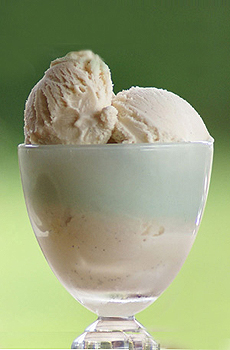
The U.S. dairy industry produces more than 1.6 billion gallons of ice cream a year, according to the International Dairy Foods Association. Americans eat 48 billion scoops of ice cream a year—$20 billion worth. Above, Häagen-Dazs Mango Ice Cream.
July 2006
|
 |
The History of Ice Cream & The Ice Cream Cone
Plus The Sundae, Ice Cream Sodas, Frozen Custard & Frozen Novelties
2000 B.C.: An Ancient Treat
It’s logical to think of ice cream as a modern food because freezing technology is relatively recent. But mankind has been enjoying ice cream for thousands of years: up to 4,000 years ago, the Chinese elite enjoyed a frozen dessert. The earliest may have been a frozen syrup. According to Maguelonne Toussaint-Samat in her History of Food, “They poured a mixture of snow and saltpetre over the exteriors of containers filled with syrup, for, in the same way as salt raises the boiling-point of water, it lowers the freezing-point to below zero."[1] Another variation was made with milk, overcooked rice and spices, packed in snow to harden. Fruit ices were also developed, prepared with fruit juices, honey and aromatic spices. Through trade routes, frozen desserts were introduced to the Persians about 2,500 years ago. (The Persian Empire includes the countries now known as Iran, Afghanistan, Azerbaijan, Turkey and portions of western China and northern Iraq.)
- The Persians drank syrups cooled with snow called sharbat (“fruit ice” in Arabic, thus the derivation of sherbet, sorbet and sorbetto); the Greek Alexander the Great, who battled the Persians for 10 years before finally toppling the Persian Empire in 330 B.C., enjoyed fruit “ices” sweetened with honey and chilled with snow. Three centuries later, Emperor Nero’s famous banquets always included fruit juices mixed with honey and snow.
- In addition, around 400 B.C. the Persians invented a dessert made of rosewater and vermicelli that was a cross between a sorbet and a rice pudding called faludeh. The ice was mixed with saffron, fruits and other flavors. Today, rosewater, lemons and angel hair-thin wheat noodles are still made into a sorbet, which is a favorite dessert and party food.
- Sorbetti and pasta arrived in Italy with the Arab invasions of Sicily in the 8th century (the Marco Polo story is a myth—see the history of pasta). Italian granita was born, flavored with fresh citrus, a wide range of fruits and coffee.
[1] Maguelonne Toussaint-Samat, History of Food, translated by Anthea Bell, Barnes & Noble Books: New York, 1992 (pp. 749-50).
1500s: The Renaissance Gives Birth To Ice Cream
- It took until the 1500s in Florence for architect and set designer Bernardo Buontalenti to invent gelato, the forerunner of today’s ice cream, enriching the sorbetto with cream and eggs. Its spread to the rest of Europe, starting with France, is attributed to another Italian, Catarina de’ Medici, who married the duc d’Orléans, the future King Henri II of France in 1533, and is said to have brought it to the court of France. According to the International Dairy Foods Association (IDFA), a product called “cream ice” appeared regularly at the table of Charles I during the 17th century. The first recipe for flavored ices in French appears in 1674, in Nicholas Lemery’s Recueil de curiositéz rares et nouvelles de plus admirables effets de la nature.[2] In 1694, recipes for sorbetti were published in Antonio Latini’s Lo Scalco alla Moderna (The Modern Steward).[3] Recipes for flavored ices begin to appear in François Massialot’s Nouvelle Instruction pour les Confitures, les Liqueurs, et les Fruits, starting with the 1692 edition. Massialot’s recipes result in a coarse, pebbly texture. However, Latini claims that the results of his recipes should have the fine consistency of sugar and snow.
[2]Reay Tannahill, Food in History, revised edition, Three Rivers Press, (1995)
[3] Cadbury Ice Cream. Cadbury Trebor Bassett (2006)
- However, no historical evidence exists to support either the de’ Medici or Charles I story: both tales begin to be told in the 19th century. But frozen desserts were the pleasures of rulers and royalty. It wasn’t until 1660 that a Sicilian restaurateur named Procopio served an iced dessert to the general (wealthy) public at Café Procope, the first café in Paris. The recipe blended milk, cream, butter and eggs.
- Like most new foods—tea, coffee, sugar, chocolate—ice cream was for the first one or two hundred years a pleasure of the wealthy. Only they could afford to purchase ice that was cut in the winter and stored underground to make ice cream in the warmer months. Only the wealthy had chefs who knew the secrets of making ice cream and staff to undertake the labor. Refined sugar also was very expensive.
- Before the development of modern refrigeration, ice was cut in large blocks from lakes and ponds during the winter and piled up in holes in the ground or in wood-frame ice houses, insulated by straw. Making ice cream was quite laborious. Enough ice had to be chipped by hand and packed with rock salt to fill a large tub, into which another pot of cream, milk, sugar and flavoring was placed (analogous to the construction of the classic crank ice cream machines). The ice cream was stirred by hand. The temperature of the ingredients was reduced by the salt and ice slurry below the freezing point of water, which turned the flavored milk and cream into smooth, frozen ice cream. The ingredients had to be stirred constantly with a long spoon for hours, so they would turn to ice cream but not freeze into ice crystals. There was no refrigeration to keep the final product frozen—it needed to be served shortly after it was finished. This was a half-day of labor so the wealthy could enjoy five minutes of ice cream.
|

18th century ice cream maven Dolley Madison,
wife of President James Madison. She served
strawberry ice cream at Madison’s second
inaugural banquet.
The photo below is Thomas Jefferson’s recipe for ice cream, written in his own hand. It is in the Library of Congress. |
- The first written reference to ice cream in the U.S. is in a letter from William Black, who wrote in 1744 of a dinner at the mansion of Governor William Bladen of Maryland, citing a “rarity” of ice cream with strawberries for dessert. The first advertisement for ice cream in this country appeared in the New York Gazette on May 12, 1777, when confectioner Philip Lenzi announced that ice cream was available “almost every day.” Records kept by a Chatham Street, New York, merchant show that President George Washington spent approximately $200 for ice cream during the summer of 1790. Inventory records of Mount Vernon taken after Washington’s death revealed “two pewter ice cream pots.”
- Thomas Jefferson, a passionate gourmet who brought back many recipes from France, was said to have an 18-step recipe for an ice cream delicacy that resembled a
modern-day Baked Alaska. That has not survived, but his recipe for vanilla ice cream, written in his own hand, is in the Library of Congress; his recipe for Savoy cookies to accompany the ice cream in on the back of the page. A portion of the recipe is shown at the right; click here for the entire document. Dolley Madison (shown above in an 1804 portrait by Gilbert Stuart) was one of the greatest Washington hostesses, arriving during the Jefferson administration when her husband, the future President James Madison, was Secretary of State. She loved ice cream and served it often: records note ice cream served in warm pastry and silver platters holding large domes of pink ice cream. She served a magnificent strawberry ice cream creation at President James Madison’s second inaugural banquet in 1813.”
1851: American Ingenuity Invents The Ice Cream Freezer
- Until 1800, ice cream remained a rare and exotic dessert enjoyed mostly by the elite. As with most foodstuffs, by the 19th century, ingredients and technology, including the development of ice harvesting and the invention of the insulated icehouse (around 1800), had evolved to give the public affordable access. Sugar became more affordable. But it took two other milestones to make ice cream an “industry.”
- In 1843, New Yorker Nancy M. Johnson applied for a patent for the hand-cranked ice cream freezer, with a movable crank and a center paddle to churn the mix
around. After turning the crank for 45 minutes or so (much less labor than stirring with a spoon), the delicious treat emerged. The machine sold quickly, and within a short period of time, there were 70 improvements that made the invention even better, including those by White Mountain, shown in the photo at the left—still a popular brand today. You can purchase the descendant of that freezer and have a family bonding experience, taking turns cranking. Some people swear by it, and White Mountain sells thousands and thousands of machines each year, even though electric versions have been available for 50 years. Click here for information.
- In 1851, a Baltimore milk dealer named Jacob Fussell, with an excess of milk on his hands, became the father of the ice cream industry by turning it into milk that would not go sour: ice cream. He established the first large-scale commercial ice cream plant. This allowed the previously expensive product to be offered at affordable prices. Fussell opened ice cream parlors as far west as Texas. Many were still around well into the 20th century.[4] Fussell later sold his business to Borden. Others followed suit:
Hood’s in Boston, Hydrox in St. Louis, Breyer’s in Philadelphia.
[4] Source: Wikipedia.
- The development of industrial refrigeration by German engineer Carl von Linde during the 1870s eliminated the need to cut and store natural ice. Later, in 1926, the perfection of the continuous-process freezer allowed commercial mass production of ice cream and gave birth to the modern ice cream industry.
1874: The Ice Cream Soda Is Born
- In the late 19th century, ice cream was widely available, through street vendors and at ice cream parlors. In 1874, the concept of the American “soda fountain” and the profession of the “soda jerk” emerged with the invention of the ice cream soda.
- Evanston, Illinois has laid claim to the birth of the ice cream “sundae” on religious grounds: In the late 1890s, it was a very religious place, with the sabbath
restricted to prayer and reading the Bible—even bicycles were chained up. No bubbly, hedonistic ice cream soda could be enjoyed. So, the story goes, a soda jerk left out the carbonated water and invented the ice cream “Sunday”; the religious leaders forced a spelling to “sundae” to remove any connection to the holy day. However, as Michael Turback, author of A Month of Sundaes, reports on icecreamsundae.com, there’s not a shred of evidence to document this. The birth of the sundae goes to Ithaca, New York, which as what is the earliest known documentation via an ad placed by Chester Platt in the Ithaca Daily Journal on April 6, 1892 for the “Cherry Sunday” served at Platt & Colt’s soda fountain. It was born on a Sunday before then when the Reverend John M. Scott of the Unitarian Church visited the Platt & Colt Pharmacy for his usual dish of vanilla ice cream after services; and Chester Platt poured cherry syrup over the top of the usual plain vanilla scoop and dressed it with a candied cherry. As the two men pondered over what to call the delightful new concoction, Scott proposed that it be named after the day on which it was invented. Other people and places may lay claim to the invention, but Chester Platt and Ithaca have it in print.
- “Soda jerks” were the mixologists of their day, inventing treats to excite customers. Malted milks, banana splits and phosphates emerged. Soda fountains were the equivalent of today’s Starbuck’s, where people met for refreshments and socializing.
1903: The Invention Of The Cone
- According to the IDFA, the first ice cream cone was produced in New York City in 1896 by Italo Marchiony, an Italian immigrant who was granted a patent in December 1903 for “small pastry cups with sloping sides.” The bottoms were flat, not conical, much like today’s molded cones.
- An independent creation was accidentally born at the 1904 World’s Fair in St. Louis (also known as the Louisiana Purchase Exposition). But three different vendors were vying for the credit. Ernest A. Hamwi, a Syrian concessionaire, was selling a crisp, waffle-like pastry called zalabia*; as were other concessionaires. Hamwi is generally credited with the invention of the cone. As at any large exposition, there were many vendors of ice cream and waffles; it is reported that approximately 50 ice cream stands dotted the Fair. In a letter he wrote in 1928 to the Ice Cream Trade Journal, he reported that it was either Arnold Fornachou or Charles Menches who ran the ice cream booth next to him. During the day, the ice cream vendor ran out of clean glass dishes.
|

A sugar cone. |
| |
Hamwi rolled one of his wafer-like waffles into the shape of a cornucopia; the fresh-made “cone” cooled in a few seconds and the ice cream vendor was able to put a scoop of ice cream in it. The ice cream cones—known as cornucopias—became a hit of the Exposition. Enterprising locals quickly capitalized on the invention, creating special baking equipment to make cones to supply the crowds. Hamwi himself went on to found the Cornucopia Waffle Company; in 1910, he founded the Missouri Cone Company, later known as the Western Cone Company. |
- Abe Doumar, a Syrian immigrant who sold souvenirs at the Exposition, later claimed that he had invented the cornucopia. Although he was not selling zalabia, he said that in Syria, it was his custom to roll up meat and falafel in round flatbreads, as a cone-shaped sandwich. He said that he freely shared the idea with the zalabia vendors to create a kind of Syrian ice cream sandwich and the idea spread from stand to stand, including Hamwi’s. After the exposition, he moved to New Jersey, developed a four-iron zalabia machine and opened ice cream stands. But Nick Kabbaz, president of the St. Louis Ice Cream Cone Company, said that he worked for Hamwi at the time and that the idea for the cone was Hamwi’s.
*Zalabia are not like Belgian or American waffles; they are flat and most resemble Italian pizzelle, including the grid pattern on the surface.
- The two distinct types of cones we know today emerged. The rolled cone (today called a “sugar cone”) was a waffle, baked in a round shape on a griddle and rolled, originally by hand, later mechanically. It hardened a few seconds after it came off the griddle. The second type of cone was molded, like the example in the photo above.
- By the way, the cone would have been a useless invention had the ice cream scoop not been invented by William Clewell of Reading, Pennsylvania, in 1878. The first scoop was conical-shaped. More than 240 scoop designs were patented in the next 60 years, in all shapes and sizes.
1919: Frozen Custard
Credit for the accidental invention of frozen custard is often given to Tom Carvel. However, the real credit seems to belong to the unheralded Archie C. Kohr, who re-configured an ice cream machine in 1919 and added eggs to the recipe to create a light and fluffy product that “tasted just like a custard.” He was a big success at Coney Island in New York City, and while he did not become a household name, Kohr Brothers is still selling frozen custard made from Archie’s original recipe, and has stores in 10 states. You can read more about it here.
- The history books generally give credit for launching the category of frozen custard, or soft-serve ice cream,
to Thomas Carvellus, who sold ice cream from the back of his vending truck. As the story goes, he got a flat tire in Hartsdale, New York during the 1934 Memorial Day Weekend; his ice cream started to melt so he started to sell it the partially melted, creamy stuff as something new. It was a huge hit and soft ice cream was born—or perhaps, born again. He opened a modest Carvel Frozen Custard store in 1934 in Hartsdale, and in 1936, according to the company website, he opened another ice cream store named Carvel, and went to work developing ice cream machinery. He built his first soft-serve ice cream machine in 1939—20 years after Archie Kohr and his futuristic-looking machine above at left. Carvel was a true innovator: he was the first to offer “buy one, get one free”; the first to franchise an ice cream store; and his patented glass building was copied by McDonald’s. Dairy Queen opened its first soft-serve ice cream store in Joliet, Illinois in 1940. Carvel’s Flying Saucer sandwich was introduced in 1951.
1920s: Novelties Are Born
- In 1920, ice cream novelties arrived on the scene. The first was invented by a high school Latin teacher from Onawa, Iowa, Christian Kent Nelson. Nelson also had a small confectionery store, and was inspired when a boy started to buy an ice cream but switched to a chocolate bar. Nelson inquired as to why he did not buy both, and the boy explained that he could only afford one. Nelson began to work in his home laboratory, and the first 500 I-Scream Bars were a hit at the local village fireman’s picnic. The following year, in a production agreement with Russell Stover, the renamed Eskimo Pie® was introduced. By 1922, Americans were consuming one million bars a year and there were a legion of imitators including the Klondike® Bar. Harry Burt, a Youngstown, Ohio, confectioner who sold a Good Humor lollipop, made a version of the chocolate-coated ice cream bar on a lollipop stick, which made it neater for his children to eat. He sold Good Humor® ice cream door-to-door in a truck outfitted with bells from the family sled.
- In 1923, another iconic product debuted. The Individual Drinking Cup Company, whose founder, Laurence Luellen, had begun creating foldable disposable paper drinking cups for water coolers back in 1908, had found increasing success with its disposable paper Health Kup following the influenza epidemic of 1918. In 1919, to differentiate it from competitors, the product was renamed Dixie Cup after a line of dolls made by Alfred Schindler’s Dixie Doll Company in New York City. Growth required relocation, and in 1923 the company moved from New York City to Easton, Pennsylvania. There, the idea developed to merchandise an individual, portable serving of ice cream in a Dixie Cup. The first experiments were a disaster, but the company soon developed a smaller, more rigid 2-1/2-ounce cup that would not absorb moisture or crumble in the filling process, that would sell for five cents. The cup had a patented, pull-off lid, and the ice cream was eaten with a spade-like wooden spoon. Ice Cream Dixies earned almost instantaneous consumer acceptance. The Company established a franchise plan, permitting only manufacturers of the highest quality ice cream to use their brand name on the Diamond Design Dixie cup. A Dixie-trademarked lid carried the individual ice cream manufacturer’s identification. The Dixie Circus, a highly successful radio show, aired every Friday night on NBC (and later reappeared on CBS) to make the Ice Cream Dixie a household name, along with extensive magazine and newspaper advertising.
From 1930 to 1954, a premium program featured collectible lids—an annual series of photos on underside, beginning with Dixie Circus characters and moving on to movie stars, sports personalities, a "nature series” of animals, exclusives produced for special clients, e.g. the U.S. Presidents lids for the Philadelphia Dairy Products Company, and, in support of the war effort in the 1940s, scenes depicting United States and United Nations forces in action. The picture was protected from the moisture of the ice cream by a thin sheet of paper. Two examples are shown below, and you can see examples here.
| |
 |
 |
Above, an original Dixie Cup lid, “co-branded” with the name of the local ice cream manufacturer. For 24 years, the underside of the lid featured collectible photos. These photos courtesy of Dr. Bruce Tharp, whose family made ice cream and who now teaches others to do the same. You can take his three-day course, On Ice Cream.
- Dr. Bruce Tharp, whose family produced Tharp’s Ice Cream in Shamokin,
Pennsylvania, and was one of the early companies involved with Dixie Cup packaging, recalls that various combinations of the initial series of circus lids could be redeemed for six premiums that assembled into a “circus” that was punched out from a heavy colored cardboard sheet and assembled into a big top, side tents and performers. Dixie supported the program by featuring it on a network radio program. Its objective, of course, was to encourage ice cream manufacturers to use the Dixie cup packaging for their products, thus benefiting from the strong marketing of the concept by the company.
A 1931 ad from The Ice Cream Trade Journal announcing the “Circus Lid Plan.’” Photo courtesy of Dr. Bruce Tharp.
- Up until this point, ice cream flavors were basic and single-note: chocolate, vanilla, strawberry, coffee. In 1929, Edy’s Grand, a Northern California business owned by Joseph Edy and William Dreyer, created one of the first combination of flavors: milk chocolate ice cream with miniature marshmallows and walnuts, which they called Rocky Road. Because only large marshmallows were manufactured at the time, Mrs. Dreyer and Mrs. Edy cut them into pieces by hand. (Cookies and Cream, which has been the fifth top-selling U.S. flavor for the last 20 years, was invented by Edy’s Grand’s John Harrison in 1982 and was the fastest-growing flavor in the history of ice cream.) By the 1930s, Howard Johnson’s restaurants claimed 29 flavors; then brothers-in-law Burt Baskin and Irvin Robbins came up with the idea of 31 flavors—one for every day of the month.
- Whether from a street vendor, the ice cream parlor, or a package picked up at the corner drug store (these were the days before grocery stores had frozen food cases), all of America now had access to ice cream.
1950s: Supermarket Slump
- During the 1950s, supermarkets emerged with big freezer cases they wanted to fill with ice cream. It was during this time that usage of lesser-quality ingredients increased: many producers were using artificial flavorings, fillers, very low percentages of butterfat and pumping large quantities of air (sometimes 100% overrun) into the ice cream to fill out the carton so that supermarkets could sell bulk gallons for $1.99. It was cheap, convenient and ubiquitous, but not necessarily good.
- In 1958, Reuben Mattus of The Bronx, whose family had produced ice cream in The Bronx since the 1920s, saw an opportunity to create a “gourmet” ice cream using fine, all-natural ingredients, 12% butterfat instead of the standard 10%, and a 40% overrun. At the suggestion of his wife, he created a meaningless name that sounded Danish—Häagen-Dazs—and sold it for 75 cents a pint in New York City gourmet shops, about three times the price of supermarket pints. The initial three flavors, chocolate, vanilla, and coffee, were an instant hit.
1970s: “Premium” Ice Cream Debuts
- With the postwar boom, a freezer in every home, and freezer cases in every grocery store, it was easy to enjoy ice cream at home: traditional ice cream parlors and soda fountains began to disappear.
- The 1970s saw a return to quality via the emergence of “premium” boutique brands like Häagen-Dazs, with high butterfat content and low overrun. Thanks to the new electric home ice cream machines—no more hand cranking—more people became interested in making ice cream. In 1976 the first scoop shop opened and in 1977 Ben and Jerry opened their own shop in Burlington, Vermont, making flavors no one had seen before: Chocolate Chip Cookie Dough, Cherry Garcia, New York Super Fudge Chunk.
- With today’s fusion cuisines introducing chipotle fudge chip ice cream and lime wasabi sorbet (both delicious), the number of flavors is endless; estimates of 1,000 flavors are inadequate when local boutique companies that specialize in novelty flavors list 100 rotating choices on their rosters.
- But most of the ice cream sold in America is still vanilla, followed by chocolate. The numbers are based on sales of supermarket half-gallons, not on superpremium pints, which represent just 3.5% of sales (premium brand half-gallons are 51.5%, and regular half-gallons are 45% [source IRI]).
Häagen-Dazs Vanilla Bean ice cream. |
 |
© Copyright 2005-2008 Lifestyle Direct, Inc. All rights reserved. Images are the copyright of their respective owners.

|

 |
|
|