THE NIBBLE (TM) - Great Finds for Foodies (tm)


RSS feed
(What’s this?)

Blue Crab
Blue swimmer crabs are among the prettiest of the crab family. These are Mediterranean crabs, from Piraeus, Greece. Photo courtesy of Wikipedia.org.
MENU


Seafood

Category Main Page
Articles & Reviews


Fish-Seafood-Caviar

Category Main Page
Articles & Reviews


Main Nibbles

Main Page
Articles & Reviews Of Foods From A To Z


Product Reviews

Main Page
Food, Beverages, Books,
News & More


November 2007

Product Reviews / Main Nibbles / Fish, Seafood & Caviar

Crab Types & Grades Of Crab Meat

Understand Crab Meat & Shop Smarter


CAPSULE REPORT: Crabs are enormously popular in many cuisines around the world— only shrimp are a more popular shellfish in the U.S. But when you go to buy crab meat, the popularity can lead to confusion when you face the choices: jumbo lump...backfin...white meat...claw. Read this article and you’ll know where to spend your money. The NIBBLE editors have developed a comparison of crab meat grades and a “crab glossary” to provide an overview of the different types of crabs.

When you set out to buy crab, you may not realize that this simple, four-letter word opens up big can of...crab decisions to be made. Unless you live in a coastal town where a particular type of crab is caught and worshipped, you have choices to make—educated choices—based on what you’re going to do with the crab.

  • Are you looking for fresh crab, to be cooked and served in the shell? Then look for the freshest (and meatiest) that your fishmonger has.
  • If you’re looking for picked crab for a recipe, you’re looking for canned crab. The next decision is: fresh canned, which must be refrigerated (and is extremely costly), or shelf stable, pasteurized crab meat.

When purchasing either fresh or pasteurized crab, there are two things to keep in mind:

  • The grade, based on what part of the crab the meat comes from
  • The species of crab, which tells you something about the flavor of the meat

Of course, not all grades and species of crabs are created equal. Even canned jumbo lump blue crab meat from six different brands will vary in flavor appearance. Learn which brands are the best (and read our review of Miller’s Select, a top brand of shelf-stable canned crab).

Grades Of Picked Crab Meat

There are four parts of the blue crab and blue swimming crab (you’ll read more about them below) that yield distinctly different grades of meat. From the Crab Diagramback of the crab (top of the illustration) forward are the Jumbo Lump, the Backfin Lump, the White and the Claw meat.

All of the meat is removed very carefully to avoid mixing shell with the flesh. (This precise, delicate work is one reason why most of the canned crab industry has moved offshore to the Pacific Rim and South America where there’s a labor supply that specializes in this type of work.)

The four basic types of meat, and their uses, follow. Regardless of what part of the crab the meat comes from, it is almost solid protein, it 60 calories per half cup of meat, 10 calories from fat.

Jumbo Lump or Lump Crab Meat

Jumbo Lump comes from the pair of large muscles that drive the crab's swimming legs. With meticulous care and skill these lumps can be removed intact, resulting in the prized whole Jumbo Lump with its incomparable elegance and visual appeal. Grades identified simply as Lump are from smaller crab varieties.

Use Jumbo Lump when you want to display beautiful white meat:

  • Crab cocktails
  • Solid-meat crab cakes
  • Dishes like Crab Louis (lumps of crab meat and hard boiled eggs on Boston lettuce, with a variation of Russian dressing) and Crab Imperial (a baked dish combining crab with mayonnaise or a sherried white sauce, spooned into scallop shells, sprinkled with Parmesan cheese or bread crumbs and browned).
Jumbo Lump Crab Meat - Miller's Select
Jumbo lump crab meat makes a beautiful
presentation in cocktails and crab cakes.

Lump or Backfin Lump Crab Meat


Lump or Backfin is the preferred grade for many traditional crab dishes. It has the same fine flavor and texture of Jumbo Lump, but is in slightly smaller pieces. It has the same caloric value as Jumbo Lump. Some companies call this grade Lump, some Backfin, and some Backfin Lump. The reason is that many packers include a large percentage of White Crab Meat (body meat—see below) in cans labeled Backfin. If you purchase a can labeled Lump, it will be all lump meat—just not Jumbo Lump.  

Use Lump or Backfin when you want beautiful white crab but don’t need jumbo lumps, for example, in:

  • Crab Benedict (Eggs Benedict
    with crab instead of ham)
  • Gazpacho (add a mound to the) center of the bowl)
  • Pasta (add to a Spaghetti) Carbonara instead of bacon, add a cup to Fettuccini all’Amatriciana)
  • Risotto
Backfin Lump Crab Meat - Miller's Select
Backfin crab meat provides top-quality flavor
for recipes.

White Crab Meat


White crab meat is ideal for crab cake recipes that have multiple ingredients (bread crumbs, vegetables), mixed with mayonnaise and most crab recipes where the size and shape of the crab flake becomes indistinguishable from the rest of the ingredients.

Special White crab meat is a more economical alternative for:

  • Appetizers
  • Bisques and chowders
  • Omelets
  • Pizza
  • Sandwiches and salads
  • Stuffed tomatoes
White Crab Meat - Miller's Select
Special white crab meat is a less-costly white meat alternative.

Claw Crab Meat


Claw Crab meat is the “dark meat” of the crab. The reddish-brown claw and leg meat is actually more flavorful than the white meat, and is preferred by many who like the more robust flavor and appreciate the lower price. Claw meat also stands up to bolder seasonings. Some people mix it with Backfin Lump for added elegance, while keeping the overall price down.

Try claw meat—if you like the flavor, you may have an economical alternative and a reason to enjoy crab more often! You can use it in any preparation, but we enjoyed it in:

  • Cheese melts (try a topping of Jarlsberg)
  • Crab tacos
  • Cioppino (a hearty fish stew)
Claw Crab Meat - Miller's Select
Claw crab meat is fuller-flavored dark meat that can take on more robust spices.

Crab Glossary: Types Of Crabs

Crabs are a large variety of sweet-fleshed crustaceans that have a shell and five pairs of legs, the first pair of which have pinchers. They are found in both cold and warm water, mostly in salt water, although fresh-water crabs are available. Whole hard-shell crabs are available year-round in coastal areas. They can also be found canned as either jumbo lump or lump (which is whole pieces of white body meat) or flaked, also called backfin, which is small bits of meat, both light and dark, from the body and claws. In the U.S., fresh crabs are harvested on both coasts and the Gulf of Mexico. Like most shellfish, crabs are highly perishable, and canned crab meat is available—from domestic sources as well as from the Pacific Rim, South America and other origins.

There are hundreds of species of crabs in the world. Here are the major types most Americans will find in markets and restaurants.

  • Soft shell crabs are not specific to any species; they are a stage in a crab’s growth, just after molting, before the new shell has had time to harden. The hard shell prevents a crab from growing; the only way it can grow larger is to throw off its old shell and grow a new one. The crab grows rapidly within a few days of casting of its shell; then the new shell grows over the larger body. Ideally, crabs must be eaten within four days of molting. They begin to rebuild their shells and are known as “papershells,” with a thin, crunchy shell that is not appealing to many people who enjoy soft shells. In the northern hemisphere, the season is from April to mid-September, and most of the soft shell crabs sold are blue crabs.
  • Crab roe or coral is available only in the spring from female crabs and has been the traditional component of she-crab soup.
  • Picked crab meat refers to meat that is sold picked from the shell. Perhaps 70% of picked crab meat sold in America today is imported, much of it from the Pacific Rim, where the labor force is attuned to the painstaking work. Picked crab meat is available fresh (chilled), frozen and pasteurized, the latter of which is shelf-stable (requires no refrigeration). While some of the pasteurized crab meat brands are good, some have a more canned flavor—you need to find a brand you can trust (see our review of Miller’s Select, the one pasteurized, shelf-stable canned crab with gourmet flavor).  It's also much safer  than fresh or frozen crab meat, which may have been shipped or stored above recommended temperatures.

Atlantic Ocean Crabs. The major Atlantic Ocean crabs are the blue crab from the Atlantic seaboard and Gulf coast, and the stone crab, which is fished from the Atlantic coast from Florida to North Carolina, and in the Gulf of Mexico from Florida to Texas (although Florida is considered the stone crab capital).

  • Blue crab (Callinectes sapidus) and its close cousin, the blue swimmer crab from Blue Crabsthe Pacific Rim (Portunus pelagicus), are typically sold and consumed as picked crab meat, usually canned. Blue crab is the ingredient of choice for  traditional American dishes like crab cakes, crab Imperial, crab Louis and many others. While native to the western edge of the Atlantic Ocean from Nova Scotia to Argentina, it has been introduced (inadvertently, via ballast water) to Japanese and European waters. The Chesapeake Bay, bordered by Maryland and Virginia, is famous for its blue crabs, although demand now exceeds supply. In the Chesapeake Bay area, blue crabs are most often steamed with vinegar and Old Bay Seasoning, then cracked by hand and eaten directly, often with butter and more seasoning. Photo by Michael Thompson | IST.
  • Jonah crab and rock crab are two crabs that have become popular in recent years, as merchants and restaurants seek more economical alternatives to the major crab species. From New England and the Atlantic coast of Canada, they used to be seen as “pest” crabs that competed with lobsters for bait and, when caught, were tossed back into the sea. Now Jonah crabs are fished year-round for both claws and its white body meat.
  • Rock crab (a.k.a. peekytoe crab) is smaller than the Jonah crab (its claws are too small to yield meat), and the flesh has more brownish-red highlights, similar to meat from a Dungeness crab. Chefs are using meat from both Jonah and rock Stone Crabcrabs, but the biggest market is food processors who blend the less-expensive meat with more expensive Dungeness or blue-crab meat.
  • Stone crab (Menippe mercenarius) is a cousin of the Maryland blue crab, and tastes like a cross between the blue crab and the Maine lobster—less definitive than lobster but more so than crab. The part that is eaten, as with the Pacific crabs, is the big, meaty claw, which are very distinctive in appearance with black tips—shown in the photo at the right.

U.S. Pacific Ocean Crabs. The major crabs from the Pacific Ocean are the Dungeness Crab, the King Crab (also called Alaskan King Crab) from the far North Pacific, and the Snow Crab.

  • Dungeness crab (Cancer magister) has been compared by some to the flavor of Dungeness CrabMaine lobster, but more tender. They are named after Dungeness, Washington, but are found from the Aleutian Islands of Alaska to Santa Cruz, California. Their Latin name means “master crab“ because it can measure as wide as 10 inches. The meat is perhaps the sweetest of the Pacific crabs, flavorful and semi-nutty. Perhaps it’s because of its fine diet: It enjoys clams, other crustaceans and small fish.
    Photo courtesy of Wikipedia.org.
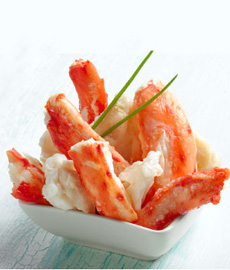
  • King crab is moist and rich, and the claws, or “legs,” are the largest and most impressive. The meat is a bit more firm and coarser than Dungeness meat. The body meat is slightly flakier than the leg meat. Despite its name, it is not a crab but a crab-like crustacean. There are about 40 species and 14 genera in the family Lithodidae. The golden king crab was once a food source for the Lower 48, however most of the long crab served in the U.S. today is imported from Russia.
  • Snow crab or Alaska snow crab or queen crab or spider crab (Chionoecetes opilio) is the primary Snow Crabspecies referred to as snow crab; but there are other crabs in the Chionoecetes genus and they are all marketed as snow crab. Snow crabs live in the cold waters of the northern Pacific and Atlantic Oceans. The meat is sweet and delicate, with more fibrous texture than king crab. The claw meat is more firm than that of the shoulder meat. A more economical crab, it is the species often served at chain seafood restaurants. Photo from the National Oceanic and Atmospheric Administration.

Dungeness, King and Stone crabs are eaten in the shell: Their large, meaty claws are popular.

Asian Crabs

  • Blue swimmer crab or swimming crab (Portunus pelagicus), also known as the blue manna crab Blue Crabflower crab and sand crab, is a cousin of the blue crab (Callinectes sapidus), the Maryland crustacean. Even the most discriminating connoisseurs would be hard pressed to tell the difference when served Portunus pelagicus instead of Callinectes sapidus, although it is much larger than the Maryland crab and some find the meat to be less sweet. The blue swimmer crab is found in the intertidal estuaries of the Indian and Pacific Oceans and the Middle Eastern coast of the Mediterranean Sea. The name “flower crab” is used in east Asian countries while “blue manna crab” and “sand crab” are used in Australia. The crabs are widely distributed in eastern Africa, Southeast Asia, Japan, Australia and New Zealand. The males have bright blue accent colors on their claws (see photo), while the females have a duller green/brown coloring. (Note: When the crabs are cooked, they turn solid red like other cooked crabs.)
  • Japanese blue crabJapanese blue crab or horse crab (Portunus trituberculatus) is harvested off the coast of China and elsewhere. It is the most widely-fished species of crab in the world, served in the soups and hotpots throughout Asia. Photo from the U.S. National Oceanic and Atmospheric Administration.
  • Mangrove crab, mud crab or black crab (Scylla serrata) is found in the estuaries and mangroves of Africa, Australia and Asia. Commonly their shell color varies from a deep, mottled green to very dark brown. They are among the tastiest crab species and have a huge demand in South Asian countries and in the northern states of Australia.

European Crabs

  • Edible CrabEdible crab (Cancer pagurus) is found in the North Sea, North Atlantic Ocean and the Mediterranean Sea. It has the classic look often depicted in graphic representations of crabs: a reddish-brown color and oval carapace (body) with a characteristic “pie crust” edge and black claw tips.
    Photo courtesy of Wikipedia.org.


What To Look For In Canned Crab Meat

When you do a comparative test among different brands of canned crab meat, you can immediately discern differences in the size, color, texture, shell content, scent, and then, the flavor of the meat.  If you want to conduct your own test, here’s a guide:

  • Scent. First drained the can, then sniff. The scent of the crab meat is the first indication of the degree of freshness at the time of processing—how long it took to get the crab from the water to the plant. The scent should be that of a freshly cooked crab—sweet and light seafood, never “fishy.” If you have paid for such a brand, return it to your purveyor and complain. If the product is pasteurized (canned, shelf-stable), it is fully sterile and thus poses no health concern, but quality varies widely. Unless you have purchased your crab meat at a bargain price, you deserve better.
  • Color. The color of canned crab meat is another clue to its quality. An ivory color is the natural and most desirable color. Some processors use chemical inhibitors or bleaches to whiten the crab meat. If the crab meat is bright white, it is a good indicator that additives of this sort have been used (read the label). An occasional blue tinge in the meat is natural in blue and blue swimming crabs, most often caused by trace quantities of minerals in the crabs’ diet. 
  • Size. The size of the intact pieces of crab meat reflects the size of the crabs harvested. Jumbo Lump pieces are from the primary swimming muscles of the crab legs, which yield only two lumps per crab. They are the best gauge of the size of the crab. Lumps smaller than one inch in diameter are typically taken from undersized, juvenile crabs. Harvesting of juveniles of any species, that have not yet had a chance to reproduce, can have disastrous effects on its population and does not indicate a responsible producer.

Now, have a taste.

  • Texture. Top-quality crab meat will have a firm texture with distinguishable muscle fiber—never mushy or mealy. The texture of the crab meat can vary according to a number of factors, including the freshness of the crabs when brought to the plant, and the method of processing. The best processors use a very short canning process and, if pasteurized, a small can (6 or 7 ounces), for minimal “cooking” effect. This best preserves the delicate flavor and texture of the fresh crab meat. “Institution size” cans of crab will not yield the best flavors, because they need to cook longer. 
  • Shell Content. Pieces of shell in the crabmeat add an unpleasant dimension to an expensive purchase. The presence of shell and cartilage is a function of the skill and dedication of the individuals who pick the crab—an incredibly intensive and tedious task, as anyone who has tried can attest. It can only be done successfully by hand. While an occasional shell will be found in any crab meat, like the occasional olive pit, the amount of shell, shell fragments and cartilage should be negligible, and no other foreign objects should ever be present. If you have paid a large sum for crab meat that is crunchy with shell and cartilage, return it to your purveyor and complain. The store should find a better brand.
  • Flavor. At the end of the day, it’s great crab flavor that is the hallmark of quality crab meat. The crab should taste fresh and clean, slightly salty (“of the sea”), with no unpleasant aftertaste. Some additives impart a chemical flavor or aftertaste to the crab meat. Cheaper cans can can contribute a tinny flavor (paper liners are used to try to mitigate this problem). Crab is lighter flavor in than other crustaceans; you should be able to enjoy its nuances.

Each bite of crab meat should be a delight. If it isn’t, you need to find a better brand.

Get The Book About Crab

CrabFor more information about crab, including wonderful recipes, see Crab: Buying, Cooking, Cracking, by Andrea Froncillo and Jennifer Jeffrey. A complete guide to buying, cleaning, preparing and eating crab. The 35 recipes and tantalizing food photos make you want to race to the nearest fishmonger and load up on crab to cook through the book from the beginning to the end. Recipes range from casual to fancy, and any type of crab meat—Alaska snow, blue, Dungeness, etc.—can be substituted.


© Copyright 2005-2008 Lifestyle Direct, Inc. All rights reserved.  Images are the copyright of their respective owners.


Spread The Word: Each icon below links to a site where you can bookmark, share and comment on this article:
Dine52    del.icio.us    ma.gnolia    Newsvine    Yahoo Myweb    BlinkList    simpy    reddit


.