THE NIBBLE (TM) - Great Finds for Foodies (tm)


RSS feed
(What’s this?)


Smoked Salmon
Kendall Brook smoked salmon, from Ducktrap River Fish Farms in Belfast, Maine, is smoked over fruitwoods. Click here for more information or to purchase.
MENU


Seafood

Category Main Page
Articles & Reviews


Fish, Seafood, Caviar

Category Main Page
Articles & Reviews


Main Nibbles

Main Page
Articles & Reviews Of Foods From A To Z


Product Reviews

Main Page
Food, Beverages, Books,
News & More


ABOUT THE AUTHOR
KAREN HOCHMAN is Editorial Director of THE NIBBLE™.


March 2007

Product Reviews / Main Nibbles / Fish, Seafood & Caviar

The Different Types Of Smoked Salmon

Cold Smoked Salmon, Hot Smoked Salmon: Very Delicious But Very Confusing


CAPSULE REPORT:  If you keep buying Nova Scotia Salmon because you don’t understand the rest of the school of salmon, we’ll try to end the mystery. And it won’t necessarily end up on a bagel.

Man has been smoking salmon since before the written record; but now that there is a written record, the variety of terms that are tossed out can be confusing. Folks from the Atlantic smoke Atlantic Salmon and North Atlantic Salmon, but many of them confuse the issue by appending their nationalities to the salmon: Scottish, Nova Scotia, Irish, etc. What’s the difference? Folks from the Pacific get species-happy: they smoke Chinook Salmon, Coho Samon and King Salmon, with an occasional generic Pacific Salmon and some geographical offerings of Copper River (Alaska) Sockeye, Chilean Salmon and Wild Alaskan Salmon.

The Internet choices are overwhelming. But even a simple walk into a specialty store can be overwhelming: How does one decide among all of the choices in the glass case? Those counterpeople slicing sides of salmon behind the counter have long lines of people to take care of, and are rarely disposed to explain the category us. That’s why most people tend to buy the same thing time after time—it’s the most familiar, be it Nova Scotia or Scottish, and it tastes good.

But as with any food or beverage, if we explored, we might actually find something we liked better. It’s not true that everyone smokes fish the same way: national styles differ in saltiness, smokiness, and fishiness; and of course, each producer has its own recipe and quality standards. The only way to find your favorite fish is to taste.

Nova Scotia Salmon
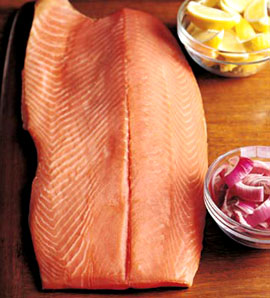
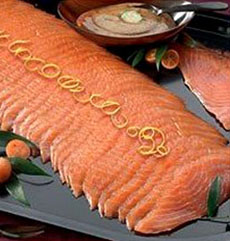
This beautiful side of cold-smoked Nova Scotia salmon comes from Zabar’s in New York City. We
stand in line to buy it at the store, but you can
order it online, 24/7. Yes, it comes sliced.

If it’s sliced-to-order, you can taste at the counter (on a slow day—Mondays are good, weekends rarely). Prepackaged salmon can be just as fine quality as the whole fish in the glass case, depending on manufacturer, and is often less expensive because factory slicing is cheaper than store labor.

Cold-Smoked Versus Hot-Smoked Salmon

Our main focus is cold-smoked salmon, the category of translucent, non-cooked fish. When looking at packages, especially online, it’s easy to confuse cold-smoked with hot-smoked salmons. Sellers often don’t distinguish between the two in their descriptive copy.

  • Hot-smoked salmon produces a thoroughly-cooked fish, by smoking it from 6 to 12 hours at temperatures ranging from 120° to 180°F.* It is eaten just like cooked salmon, but can be used in most of the same preparations as cold-smoked. To the untrained eye, some hot-smoked preparations can look the same in the package. Generally, hot-smoking involves holding the food directly above the fire, or in an enclosure that is heated by the fire (barbecue is a form of hot-smoking). The temperatures reached in hot-smoking can kill microbes in the food.
  • Prepacked cold-smoked salmon is always vacuum-packed in see-through packaging, and must be refrigerated. First the fish are filleted and the sides are covered in a layer of salt for up to six hours to cure. The salt draws out moisture, prevents the growth of bacteria, kills microbes and flavors the fish (ham and bacon are also salt-cured). The fish can then be dried for several hours before cold smoking, a slow process at a low temperature: 70° to 90°F for 1 day to 3 weeks; the food is not held over the fire as in hot-smoking; but rather, smoke is passed by food which is held in a separate area from the fire. Since the fish is not cooked, the interior texture of the food generally isn’t affected: The fish remains smooth.
  • Generally, cold-smoked is sold sliced or in sides, and hot-smoked is sold in fillets, but you can get a 20-ounce fillet that looks like a “side.” If it’s in a decorative box or a gift basket, it’s hot-smoked.

*With both processes, the length of time and degree of temperature depend on the size of the fish, how close it is to the source of smoke and the degree of flavor desired.

Hot smoked salmons can be put on bagels, in salads, pasta or sandwiches and can be packaged to have an unrefrigerated shelf life of up to 5 years. They are great to have in the pantry for an impromptu meal. Read our review of Kasilof hot-smoked salmons.

Types Of Smoked Salmon

Here’s an overview of what’s out there. It is important to emphasize that these are only general categories: quality varies enormously by manufacturer. We purchased one brand of Nova Scotia Salmon at our local supermarket that is a world away in quality (average) from the superior Nova Scotia we buy at Zabar’s, although the price difference is only a couple of dollars. We just don’t have the time to get to Zabar’s. We also tried one organic brand recently—our first—that would put us off of ever trying organic again if we were not food adventurers (plus, it’s our job). So, labels mean nothing, price means nothing: keep trying!

Authentic (naturally) smoked salmon is smoked over wood chips with salt and sugar, with no preservatives. National preferences vary: Scottish salmon is subtle and delicate, Norwegian has a heavier smoky profile. The types of wood and amounts of salt and sugar (and other spices) contribute to the difference.

Cold Smoked Salmon

  • Danish Smoked Salmon tends to be sweeter than Scottish, due to more sugar in the seasoning mix; otherwise it is very similar.
  • Gravlax is not smoked salmon, but its cured cousin from Sweden. Fresh salmon is rubbed with a mixture of dill, sugar and herbs and placed under a weight to cure.
  • Irish Smoked Salmon is naturally smoked Atlantic salmon that uses aromatic oak chips from Irish Whiskey casks.
  • Lox is an old generic term, slowly
    slipping out of usage. It is a Yiddish word for salmon, and a cognate of Swedish lax, Danish/Norwegian laks, German Lachs and Old English læx.

Perona Farms Smoked Salmon
Perona Farms makes specialty salmons in five
flavors: Atlantic smoked salmon in Bacon,
Gravalox, Ming Tsai's Five Spice Chile Tea,
Moroccan and Scampi.


  • Norwegian Smoked Salmon is Atlantic salmon in a smokier style that is more pale and peachy in color.
  • Nova Scotia Smoked Salmon (“Nova”) is a term originally used in the eastern United States to broadly describes cold-smoked Atlantic salmon (originally caught near Nova Scotia), before other types became widely imported.
  • Scottish Smoked Salmon smokes Atlantic salmon using oak and produces a flavorful yet more elegant and silky-style smoked salmon that has a more orange-pink color.

It’s important to note, though, that with artisanal products, standards vary according to what the producer wants to make—what he thinks tastes good. Purchase half a dozen different brands of Scottish Salmons (or any type), and you’ll notice differences. Some Scottish salmons we purchased didn’t specify they used oak, for example, but “hardwood,” which could be common to any number of types of salmon. In the end, though, quality is quality. Depending on what’s available to you, you may find it isn’t the exact style of smoke that wins you over, but the standards of the producer.

Hot-Smoked Salmon

Most hot-smoked salmons are offered “plain”—i.e., cooked and packaged, ready-to-eat. These are specialty sub-categories of hot-smoked:

  • Flavored Hot-Smoked Salmons are made by artisan producers that flavor the fish with pastrami spices, regional flavors (Southwestern, Thai Chili, Ginger Soy), etc.
  • Kippered salmon soaks the salmon in mild brine before hot-smoking. In America it is usually made from chinook salmon fillet that has been dyed red. In Europe a whole salmon is generally split before being brined and cold-smoked.
  • Squaw Candy (which, due to political correctness, is now called Indian Hard Smoked Salmon by some, but not Native American Hard Smoked Salmon) is thin strips of salmon that have been cured in a salt-sugar brine before being hot-smoked until they become jerky-like. Depending on the producer, they can be very sweet.

Hot-Smoked Salmon
A 20-ounce hot-smoked salmon fillet from Kasilof. It’s also kosher-certified. Click here for more information or to purchase.


  • Wood-Smoked Salmon will emphasize a specific wood in the flavor—alder or maple, e.g.— that imparts particular flavor notes to the fish.

Become A Smoked Salmon Expert

The only way to make sense of the category is to start tasting: preferably side-by-side. Have a smoked salmon tasting lunch or brunch: buy some of each and compare. You don’t need bagels: In fact, the bread and cream cheese get in the way of tasting the salmon, although you can have them on the side to enjoy the “leftovers” after the serious tasting is complete.

  • Eat the salmon slices straight from the plate with a fork. See the garnishes below.
  • Once you decide what you like, write it down—they sound so similar, it's easy to forget.

Garnishes

At the finest restaurants, a plate of smoked salmon (generally Scottish) is served as a first course at lunch, dinner or brunch with a sprinkling of dill and capers, a lemon wedge and some crème fraîche. It pairs wonderfully with Champagne, Chablis or any crisp white wine.

  • Capers or caperberries
  • Fresh dill, snipped
  • Lemon or lime wedges
  • Sweet onion or red onion
  • Crème fraîche or sour cream
  • Blini—regular or miniature
  • Pumpernickel—regular or party-size

And sure—stock up on the bagels, cream cheese and sliced tomatoes for later.

© Copyright 2005-2008 Lifestyle Direct, Inc.  All rights reserved.  Images are the copyright of their individual owners.


Spread The Word: Each icon below links to a site where you can bookmark, share and comment on this article:
Dine52    del.icio.us    ma.gnolia    Newsvine    Yahoo Myweb    BlinkList    simpy    reddit


.