A squeeze of lime has virtually no calories, and brings a delicious accent to foods and vegetables. Whether in soft drinks, cocktails (where would the caipirinha, gin and tonic, margarita, mojito, and tequila shot be without lime?) Key lime pie, made from the juice of the Key lime, is one of America’s favorite pies. The leaves of the kaffir lime are an important seasoning in Pacific Rim cuisine, as are dried limes in Persian cuisine. Limes are a popular ingredient in seafood and chicken dishes, desserts and marmalade. You can easily substitute limes for lemons in any dish.
Several of the more unusual varieties can be purchased as houseplants, and will yield fruit. For starters, Logeees.com has calmondin, kaffir, Key lime, limequat and Palestine sweet lime plants, as well as the traditional Tahitian or Persian lime.
We’ll limit the discussion to the two principal limes used in the U.S., the Persian or Tahitian lime, which is the principal supermarket lime, and the Key lime (Mexican lime).
Key Limes or Mexican Limes
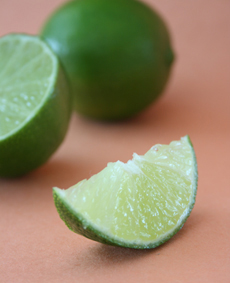
The Key lime originated in southern Asia Indo-Malayan region. It was unknown in Europe before the Crusades and it is assumed to have been carried to North Africa and the Near East by Arabs, across North Africa into Spain and Portugal. It was brought by European Crusaders from Palestine to the Mediterranean countries. In the mid-13th century, the lime was cultivated and well-known in Italy and probably also in France. It was taken to the Americas by Spanish and Portuguese explorers in the early part of the 16th century where it became naturalized in southern Florida, parts of the West Indies, Mexico and other Caribbean countries (it was reportedly commonly grown in Haiti in 1520). Hence, the name Key lime is from the Florida Keys. While there is no documentation of the date of entry to Florida, the tree was popular in yards of private homes. In 1839, cultivation of limes in southern Florida was reported to be “increasing.” By 1883 it was being grown commercially on a small scale in Orange and Lake Counties.* When pineapple cultivation was abandoned in the Florida Keys because of soil depletion and the 1906 hurricane, farmers began to plant the limes as a substitute crop there, as well as on the islands off Fort Myers on the west coast. The limes were pickled in saltwater and shipped to Boston, where they were a popular children’s snack. (Remember Amy in Little Women pining for some pickled limes?) Photo by Scott Liddell |MorgueFile.
The Key lime was our first lime, and in fact, was the first lime enjoyed by Europeans. The reason that the Tahitian/Persian lime became our regular lime, and the Key lime receded as a specialty fruit item, is threefold:
Tahitian limes are easier to cultivate—Key limes are more sensitive and their branches are very thorny and the limes are harder to pick.
Tahitian limes have thicker skins and are easier to transport and store.
Tahitian limes are less tart.
Tahitian or Persian Limes
The origin of the Tahitian or Persian lime is unknown. It is presumed to be a hybrid of the Mexican lime and citron, an unusual citrus fruit whose main value lies in the fragrance and essential oil of its outer peel (the pulp is extremely dry and the thick white rind cannot be peeled). The basic lemon, Citrus × lemon, might also have been the co-parent. However, it was being grown in Tahiti.
It is believed that the Persian/Tahitian lime was introduced into the Mediterranean region by way of Persia (the modern Iran). Portuguese traders probably carried it to Brazil, and apparently arrived in Australia from Brazil about 1824. It reached California by way of Tahiti between 1850 and 1880 and had arrived in Florida by 1883, the same year that Key limes, which had arrived much earlier, were increasing in cultivation. In Florida, the Tahitian quickly took the place of the more sensitive Key lime.
Photo of Persian lime by Missy Redboots | MorgueFile.
Following World War I, the Tahitian lime became a well-established commercial crop. Though it’s hard to believe today since the fruit is so universal, there was market resistance at first, buyers viewing it as a “green lemon.” For some time, Canadians would not accept it because they were accustomed to the more flavorful Key lime. But, it has endured, and many Americans today have never even seen, much less purchased, a Key lime.
Varieties Of Lime
There are both sweet and sour lime varieties (sweet limes are not readily available in the U.S., though they’re a key ingredient in other cuisines). Sour limes contain citric acid giving them an acidic and tart taste. Sweet limes look and smell like acid limes, but lack the citric acid. They thus have sweet flesh and can be eaten like any other sweet fruit.
Australian Limes. There are three principal Australian limes, the Australian desert lime (Citrus glauca), which has been cultivated as the outback lime (shown at right); Australian finger lime (Citrus australasica); and Australian round lime (Citrus australis). The desert lime, a highly prized bushfood used for marmalades, beverages and glacéed fruit, was typically gathered wild, and has a strong lime-like flavor.
Commercial cultivation had begun. The finger lime is long and cylindrical, and fell into vogue as a gourmet bushfood for pickles, maramalade and garnishes. It doesn’t look like anything we’d call a lime, and grows in a variety of colors including black, brown, green, orange, purple, red and yellow. There is much hybridization of limes happening in Australia, including the blood lime (see below). Photo courtesy of CSIRO.
Black Lime. See Omani lime.
Blood Lime. The blood lime is a hybrid citrus fruit developed in Australia, a cross between the red finger lime (Citrus australasica var. sanguinea) and the Ellendale Mandarin, a mandarin and orange hybrid (some sources site this as the Rangpur lime, Citrus x limonia), which has an orange rind and pulp. The tree, which can also be planted as an ornamental tree, produces striking, blood red-colored fruit. It is smaller than most limes, and like the blood orange, somewhat sweeter. Photo courtesy of CSIRO.
Calmondin or Musk Lime (Citrus x Citrofortunella mitis). Also known as calamondin orange; Chinese, or China, orange; Panama orange; golden lime; scarlet lime; in the Philippines, kalamondin, kalamunding, kalamansi, calamansi, limonsito, or agridulce; Malayan names include limau chuit and limau kesturi (“musk lime”); in Thailand, ma-nao-wan. Wedges are served with iced tea, seafood and meats, and were commonly served in Florida before limes became widely cultivated. The calmondin, with acidic juice, has wide culinary use. People with access to calmondins use them in cranberry sauce, chutney and marmalade (Robert Lambert uses them in his five-lime marmalade, and calmondin-kumquat and calmondin-papaya blends are popular). The preserved peel is added as flavoring to other fruits stewed or preserved; the juice is used in beverages, gelatin dishes and custard pie or chiffon pie.
Kaffir Lime (Citrus hystrix). Also called kieffer lime, makrut and magrood. Native to Indonesia, the leaf of the kaffir lime (shown at right) is used in Thai, Malaysian and Indonesian cuisines. It looks like a round Persian lime, but the skin is bumpy instead of smooth. The juice is very strong and tangy/sour and is used in medicine. Kaffir limes are easily distinguished by their extremely bumpy, deep green skin and their slightly elongated neck. The aroma from the aromatic oils, and flavor of this intense lime, produce a unique flavor. Kaffir limes are delicious with savory dishes and add a tangy lift to spicy homemade chili, soup and stews. The dark green glossy leaves are extremely rich in lemon-lime fragrance, which is even more intense when the leaves are broken.
The leaves imbue dishes with a delicate yet bold lemon-lime flavor, which is memorable in Thai curries, sauces and fish. They can be used in American chili and soup recipes as well.
Photo of kaffir leaves above, and the kaffir lime at left, courtesy of Melissas.com.
Kaffir Lime.
Key Lime (Citrus aurantifolia Swingle). Also known as the Mexican lime, West Indies lime and Bartender’s lime, the highly-aromatic Key lime is grown in the Florida Keys, Mexico and the West Indies. It is smaller and round, the size of a ping pong ball, and more fragrant and less acidic. The color can range from a regular lime green to yellow in color, depending on ripeness. Those not familiar with it can mistake it for a lemon, but the skin is smooth, thin-skinned and full of small seeds. It also has a distinct, tart, but less acid, juice than the Persian lime. Both are the only two limes, acid or sour, that are commercially grown.
Key limes. Photo courtesy of
Melissas.com.
The term “Key” lime is an American retronym; this is the same lime brought back to Europe from the Crusades. Its name comes from the Persian, limu. It was later planted in Florida, Mexico and the Caribbean (see the history, above). In addition to making Key lime pie (don’t buy juice in bottles!), add slices to marinades, sauces, fruit salads, and pastries to enliven other flavors.
Limetta. See Palestine Sweet Lime.
Limequat (Citrus x Fortunella). A lime-kumquat hybrid originating in China, and now grown around the world—in the U.S., in California and Florida. The fruit can be found during the fall and winter months. There are three distinct varieties, Eustis, Lakeland and Tavares. The fruit is small and oval like the kumquat, but greenish yellow instead of orange. Like the kumquat, it is entirely edible; the skin is sweet and the pulp tastes like lime. It is eaten whole or used to flavor drinks and dishes and makes for a bittersweet flavor. The rind is fragrant and fairly thin, covering an acidic, fleshy interior. Although the limequat can be served fresh and added to salads, it is more commonly cooked and used to make syrups and preserves.
Limequats. Photo courtesy of
Melissas.com.
Mandarin Lime (Citrus limonia). A group of three similar limes: the Rangpur (Citrus x limonia Osbeck—see below); the Kusiae or Kusiae lime, believed to be a form of the Rangpur, with a more limelike aroma, planted on Kusiae, or Strongs Island, in the Caroline Islands of Micronesia; and the Otaheite, or Otaite, orange, or Otaheite Rangpur (Citrus otaitensis Risso or Citrus taitensis Risso et Poit), thought to be a non-acid form of the Rangpur. Its origin is unknown, but it was introduced to the West (England and France) from Tahiti in 1813.
Omani Lime. A small lime with a very strong flavor and fragrant aroma. It is grown in the Middle Eastern country of Oman, it is preserved by boiling in salt water and then dried. It is then used as a seasoning called amani, black lime, dried lime, loomi, lumi or omani. Strongly flavored, with a slightly bitter, fermented flavor, it tastes typically sour and citrusy, but lacks the sweetness of a fresh lime.
Palestine Sweet Lime (Citrus limettioides or Citrus lumia Risso et Poit.). The Palestine sweet lime or limetta is a hybrid. It is not known where or how the sweet lime originated. It is thought to be a hybrid between a Mexican lime and a sweet lemon or sweet citron, and believed to be native to India. It is chiefly cultivated in central and northern India, northern Vietnam, Egypt and the Mediterranean coast. It arrived to the U.S. from Saharanpur, India, in 1904; there is modest cultivation in California. In the West Indies and Central America, it is eaten by cutting off the stem end, piercing the core with a knife and sucking out the juice. The fruit is eaten fresh in India, as well as cooked and preserved. It is called limettier doux in French; lima dulce in Spanish; mitha limbu, mitha nimbu, or mitha nebu, in India (mitha meaning “sweet”); quit giay in Vietnam; limun helou, or succari in Egypt; laymun-helo in Syria and Palestine. It is often confused with the sweet lemon, Citrus limetta Tan., which, in certain areas, is referred to as “sweet lime.” See also Sweet Lime/Limetta. Photo courtesy of Logee’s Tropical Plants, Logees.com.
Persian Lime. See Tahitian Lime.
Rangpur Lime (Citrus x limonia Osbeck). From the Pacific Rim, the Rangpur lime has an orange rind and orange fruit. It is also called the Mandarin lime. The name can be misleading because there are few similarities between the Rangpur and true limes—it is probably a lemon x Mandarin orange hybrid. However, the Rangpur is highly acidic and can be used as a substitute for commercial limes. Other names include the Canton lemon (in South China), the Hime lemon (in Japan), the Cravo lemon (in Brazil), the Tahitian Orange in the U.S., the Mandarin lime. The Rangpur lime is generally candied or pickled. In the West, it is made into marmalade (it makes a superb marmalade, superior to the Seville, or sour, orange commonly used). The Rangpur is believed to be of Indian origin. It was introduced into Florida in the late 19th century from seeds obtained from India. Photo courtesy of Melissas.com.
Spanish Lime (Melicoccus bijugatus). This fruit has many other names, depending on the country in which it grows: chenet, genip, ginep, ginnip, gnep, guaya, quenepa, guinep, kenèp, limoncillo, mamón, mamoncillo and skinnip. It is not a citrus, but a fruit tree in the soapberry family, Sapindaceae. It is native to a wide area of the American tropics including the Caribbean, Central America, Colombia, Venezuela and Surinam. The fruit is similar to its cousin, the lychee. The seeds can be roasted and eaten. Photo courtesy of Wikipedia.
Sweet Lime or Limetta (Citrus limetta). This fruit, native to Eurasia and North Africa, is also cultivated in the Mediterranean region. It goes by many names, including Mediterranean sweet lemon, sweet lemon, and sweet lime and sweet limetta. In India, it is known as mosambi, mousambi or musamb. The fruit is edible, and contains essential oils; the tree is used for ornamental purposes. Sweet limes are thought to be a cross between Mexican limes and sweet lemons. They are extremely sweet when ripe. As a sweet variety, they lack citric acid. They are very aromatic and juicy.
Sweet Lime. Photo courtesy of
Melissas.com.
Sweet limes look very similar to regular limes, but are more yellowish-green in color. They make a wonderfully, edible garnish on iced tea, soft drinks and cocktails (in fact, they make a sweet limeade); and are added to to relishes, sauces and breads. The citrus in the sweet lime highlights the rich, deep flavors of meat and poultry.
Tahitian Lime (Citrus x latifolia), also known as the Persian lime and the Bearss lime after T.J. Bearss of Porterville, California, who created one of the principal cultivars in 1895. The Persian/Tahitian is one of the principal commercial limes grown in the U.S. It is the basic supermarket lime, large and thick-skinned. See the detailed history above.
Wild Lime (Adelia ricinella). The wild lime is not a citrus, but a flowering shrub. While called “wild,” it is cultivated outdoors as well indoors, as a houseplant.
Nutrition and Factoids
Limes are low in cholesterol, saturated fat and sodium, and high in dietary fiber, vitamin C, calcium, iron and copper.
Limes are an excellent source of Vitamin C (29 mg per 100 grams), but they have even more calcium (33 mg). They also provide 8 mg of folate and 10 mg of vitamin A.
A tablespoon of lime juice has 25 calories; a whole, peeled lime has about 40 calories (depending on size).
Limes have antioxidant properties: they contain flavonoids called flavanol glycosides, including many kaempferol-related molecules. These flavonoids have been shown to stop cell division in many types of cancer cell lines, and also to have antibiotic effects.
In the late 18th century, a Scottish naval surgeon, Sir James Lind, discovered that citrus fruits were the remedy to scurvy, a fatal disease we now know is caused by a lack of Vitamin C. Scurvy had killed more British sailors than any enemy. Along with their daily ration of rum, British sailors were required to consume a daily ration of lime juice, which is how they became known as limeys. Why not lemons? Since Britain was often at war with Mediterranean countries who exported lemons, limes imported cheaply from the British colony of Jamaica became the better choice.
Limes are picked and sold green, yet they will turn yellow if left on the tree to ripen naturally.
Recent Articles From Our NutriNibbles™ News Feed:
Subscribing notifies you whenever
there are
new additions
to the NutriNibbles™ section.