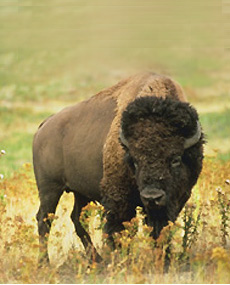
Don’t call me buffalo—I’m a bison with a wooly head, short horns and a humpback. Photo by Jack Dykinga | U.S. Agricultural Research Service.
|
|
KAREN HOCHMAN is Editorial Director of THE NIBBLE.
|
|
June 2006
|
 |
Product Reviews / Main Nibbles / Meat & Poultry
The Difference Between Buffalo & Bison
Wooly Head + Short Horns + Hump = Bison
CAPSULE REPORT: The most misidentified creature in the animal kingdom must be the poor bison. Unless some billionaire leaves funds for a reeducation campaign, it will forever be called the buffalo by most people—due in no small part to the song, “Home On The Range.” The beast, an American native, was misnamed by the Europeans who first saw it and likened it to the buffalo of Asia and Africa. It’s not even a close relative, but zoologists didn’t have a chance to correct even the government, which minted the “buffalo” nickel...and doesn’t want to be corrected. But, the term “buffalo” has become part of the vernacular.
When you see the meat in the stores or on restaurant menus, do you wonder what the difference between bison and buffalo? The answer is: a species, an ocean and two continents. The meat you see is, properly, bison meat. Why it is called buffalo by many—even those who produce it—is a story that will unfold here. The [incorrect] term has become so colloquial, it is accepted. Our own government minted the buffalo nickel, after all. But, calling a turkey a peacock doesn’t make it so. So let’s take a look at the how the poor bison ended up with something else’s name...and then take up your own grassroots movement to give it its due by sharing the story.
Introducing The Bison
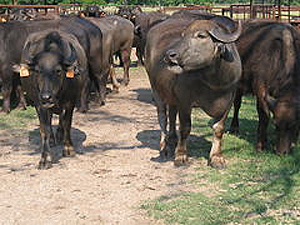
The animal that inhabits North America is a bison of the genus and species Bison bison; “buffalo” is a misnomer, although the word is pervasive and even articles about bison refer to “buffalo.” Although both bison and buffalo belong to the same family, Bovidae (as do domesticated cattle*), they are distinctly different animals. True buffalo, the African or Cape Buffalo (Syncerus caffer) and the Asian Water Buffalo (Bubalus bubalis, of the family Bovidae) are native only to Africa and Asia, respectively, and are not closely related to each other. That delicious mozzarella di bufala, water buffalo mozzarella, is made from the milk of the Asian Water Buffalo (photo at right), which was brought to Italy from Asia in the 1400s. |

These are the animals that are properly called buffalo— Asian Water Buffalo. They have smooth, not wooly,heads, and long, curved horns. It is known as the “water buffalo” because it has adapted to, and enjoys being in, water. Photo courtesy of Wikipedia.org. |

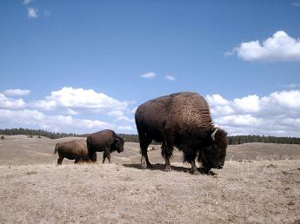
Probably the most misidentified creatures in the animal
kingdom, these are BISON, not buffalo. Photo of Plains
bison in Montana by Craig Johnson. |
Within the Bison genus, there are two subspecies of bison in North America, the Plains bison (mainly in the U.S. and Canada) and the Wood bison (mainly in Canada). There is also a European bison, Bison bonasus, called the wisent, (pronounced WEE-sent), that lives in the Caucasus region of Russia and in Poland in the Bielowesz Forest.
*Domesticated cattle, for those who wish to keep track, belong to the genus Bos and the subgenera Taurine. All breeds of European cattle like Angus and Hereford, which comprise American herds, belong to the Tarus species.
|
The bison is the largest land mammal to roam North America since the end of the Ice Age. It is a descendant of ancient animals that crossed the Bering Strait land bridge some 300,000 years ago. Historians speculate that early European explorers who first discovered the North American species likened the unknown bison to the more familiar African and Asian buffalo. While a misnomer, the term “buffalo” has been used interchangeably with “bison” ever since and is entrenched as a colloquialism in our culture and language. But that doesn’t make it correct! The popular folk song, Home On The Range, “give me a home where the buffalo roam” romanticizes the American frontier was all about. Who wants to take on history? And, who in the U.S. government will accept responsibility for creating the buffalo nickel instead of the bison nickel?
Bison Facts
So who (or what) is this bison?
- Bison are much smarter and more interesting than cattle. They are not domesticated† animals, but wild animals that can’t be tamed. As a result, they are harder to handle and more powerful than cattle. In spite of all their shoulder bulk, they are surprisingly nimble, and have been accorded the agility of goats. Bison can jump fences that would contain most cattle, and, when startled, can jump over another bison to make their getaway.
- Like cattle, bison are herbivores and eat grass. Production methods are similar to those for cattle, except the use of growth hormones is illegal on bison. Plus, bison are generally not castrated: because they grow at a slower rate than cattle, to castrate them would be cost-prohibitive for meat production.
- Today there are about 350,000 bison in the U.S.; about 40,000 are slaughtered each year for consumption. By comparison, about 125,000 beef cattle go to market each day in the U.S. alone.
†Cattle are one of the first animals domesticated by man, tamed to provide milk, meat, hides and for draft purposes. They were probably first domesticated in Europe and Asia about 8,500 years ago.
The Near-Extinction & Resurgence Of Bison
Most American students have studied the tragedy of the bison: how the great natural herds were slaughtered to the brink of extinction by commercial hunters and sports hunters—which simultaneously starved off many Native American tribes, who relied on the bison for food, clothing, coverings for their lodges, sinew for bow strings, tools and fuel. Bison once ranged over most of the continent, from the Rockies east to almost the Atlantic Ocean (hence Buffalo, New York); and from Mexico to as far north as Canada’s Great Slave Lake. A prominent naturalist, artist and author of Wild Animals I Have Known, Ernest Thompson Seton, working in the mid- to late-1800s, made a scientific estimate of 75 million bison. (His 1898 book is still in print—click here for more information.) Native Americans, using only bow and arrow, killed only what they needed to live on; beginning in the 1870s, white hunters with rifles began a mass slaughter of herds to sell the hides. The bison herds began to deplete. The great wealth of bison was almost completely wasted by men who wanted only the hides and tongues, and left the meat and other valuable parts to rot in the sun.
Around 1870, Argentina, the main source for fine leather used in Europe, had extinguished its own source of leather, the wild Pampas cattle. Bison skins quickly became the new source for fine European leather: hides were more valuable than ever and the fate of the bison was sealed. With zealous hunting, their end was in sight by 1880. The thundering herds that a few decades earlier were so vast they could not be counted (a train on the Kansas Pacific Railroad in 1868 traveled 120 miles through one continuous herd), had disappeared. The last great herds of 1881 and 1882 were surrounded by hunters blocking their migration routes. Records show that 200,000 hides were shipped east in 1882, a figure that dropped to 40,000 in 1883, and to just 300 hides in 1884. By then the bison were gone: the most extensive hunt of a single species of mammal in the history of the world had wiped them out. Ernest Thompson Seton, in 1895, said he could verify only 800 bison existing in all of North America.
By 1889, the few remaining animals were saved by the combined efforts of William Hornaday, Director of the New York Zoological Park (now the Bronx Zoo) and a small group of ranchers. In 1905, the American Bison Society was formed to save the bison and protect rangeland for the animals. Private ranchers kept significant numbers of bison from certain slaughter in the wild. Texan Charles Goodnight had captured bison calves and raised them on his ranch as early as 1876. In 1910 he had 125 animals and had already sold some to zoos and to Yellowstone Park. Offspring of wild bison captured in western Oklahoma in 1883 ended up in the New York Zoological Park in 1904. Three years later some of them were shipped back to their original Oklahoma range, and became the nucleus of the present-day herd of 600 in the Wichita Mountains Wildlife Refuge.
Today, more than 100 years later, most of North America’s 350,000 bison are found on commercial ranches. Over the last several decades, the search for heart-healthy and gourmet meats has led to commercial ranching of bison, which has led to a resurgence of the herds. The National Bison Association has more than 2,400 members in 50 states and 20 countries; the Canadian Bison Association has 1,400 members. The industry is showing strong growth of 15 to 20 percent a year. The federal government is not involved: it is supply and demand—the interest of consumers in purchasing bison meat—that will restore the bison herds to the plains
Final Tally
Here’s how to tell them apart:
| American Bison |
Asian Water Buffalo* |

Photo by Robin Hindle| SXC.
|

Photo by Gabor Palla | SXC. |
Head: Large and wooly
Horns: Short and curving up
Back: Humped
Wild Habitat: North America
Scientific Classification:
Kingdom: Animalia
Phylum: Chordata
Class: Mammalia
Order: Artiodactyla
Family: Bovidae
Subfamily: Bovinae
Genus: Bison
|
Head: Small and smooth, look like cattle
Horns: Long and curved (“longhorn cattle horns”)
Back: Normal bovine
Wild Habitat: Bangladesh, India, Nepal, Bhutan and Thailand; has been domesticated in Europe, the U.S. and elsewhere
Scientific Classification:
Kingdom: Animalia
Phylum: Chordata
Class: Mammalia
Order: Artiodactyla
Family: Bovidae
Subfamily: Bovinae
Tribe: Bovini
Genus: Bubalus
Species: B. bubalis
|
| |
African Buffalo or Cape Buffalo |
*The photo above is of European water buffalo descended from Asian water buffalo. The Cape water buffalo looks similar. These are domesticated water buffalo; the wild species, such as the ones seen in Africa, have longer horns.
|

Photo by Stephan Ehrbar | Wikipedia Commons. |
Note About African Buffalo
Of the three animals highlighted in this article—bison, Asian Water Buffalo and African Buffalo—only the Asian Water Buffalo has been domesticated.
However, bison have adapted to ranching, and while they are wild animals, are not considered extremely dangerous. The African buffalo, on the other hand, are one of the “top five” killer animals in Africa. They are known to gore and kills several people a year.
|
Head: Small and smooth, look like steer or moose
Horns: Long and curved (“longhorn cattle horns”)
Back: Normal bovine
Wild Habitat: Botswana, Ethiopia, Kenya, Mozambique, Namibia, Somalia, South Africa, Sudan, Tanzania, Zambia, Zimbabwe
Scientific Classification:
Kingdom: Animalia
Phylum: Chordata
Subphylum: Vertebrata
Class: Mammalia
Order: Artiodactyla
Family: Bovidae
Subfamily: Bovinae
Genus: Syncerus
Species: Caffer
|
© Copyright 2005-
2008
Lifestyle Direct, Inc. All rights reserved. Images are the copyright of their respective owners.

|
 |
|
|