|
KAREN HOCHMAN is Editorial Director of THE NIBBLE™.
|
|
May 2007
|
 |
The History Of Salsa
Ancient Condiment And Contemporary Dance
CAPSULE REPORT: Salsa, which has been America’s favorite condiment since 2000—supplanting ketchup—actually has been a favorite condiment for thousands of years. The chile has been domesticated since about 5200 B.C.E., and tomatoes by 3000 B.C.E. both in Central America. The two were combined into a condiment, which the Conquistadors named “salsa,” or sauce. The spicy sauce gave name to a hot and spicy late 20th century dance related to the mambo...but that’s just the tail end of the story.
Overview
Salsa is the Spanish word for sauce, but the food predates the Spaniards by many centuries. Tomato is the base of salsa: The wild tomato is indigenous to Ecuador and Peru, but the Aztecs and other Central American nations were the first to domesticate it. The tomatillo—which is not a green tomato but a member of the nightshade family[1] that includes the cape gooseberry (their closer relation) as well as the tomato—also originated in the Andes, in the area that is now Ecuador, Colombia and Peru.
[1] Nightshades are members of the Solanaceae family of flowering plants, many of which are edible, while others are poisonous (some have both edible and toxic parts). The name of the family comes from the Latin Solanum, “the nightshade plant.” Other edible members include capsicum (the chiles), Chinese lanterns, eggplants, garden huckleberry, ground cherry, naranjilla, pepinos, peppers, potatoes and the tree tomato. One thing that sets these nightshades apart is their alkaloid content. Alkaloids are harmful nitrogen compounds which, in high quantities, are toxic, causing nausea, diarrhea with vomiting and headaches. In extreme cases they lead to unconsciousness and convulsions to the point of respiratory paralysis. That’s why the tomato was considered poisonous by Europeans and not eaten for 200 years following its discovery. Alkaloids exist in tiny, non-harmful quantities in the nightshade foods we eat. Tobacco and the petunia are also members of the family, as well as the Datura or Jimson weed, the mandrake and the deadly nightshade or belladonna.
The making of a sauce by combining chiles, tomatoes and other ingredients like squash seeds and even beans has been documented back to the Aztec culture. We know this from Bernardino de Sahagún, a Franciscan missionary sent to “New Spain” (Mexico) in 1529, after the Aztec Empire was conquered by Hernando Cortes. He remained there for the rest of his life, 60 years. In addition to his missionary work, he undertook extensive scholarly work, including what is now known as the Florentine Codex, one of the richest surviving sources of information on Aztec life before the conquest. His extensive writings documented every food common to the culture. In this excerpt, describing the food vendors in the large Aztec markets, he describes many of the ingredients in modern salsas:
“He sells foods, sauces, hot sauces, fried [food], olla-cooked, juices, sauces of juices, shredded [food] with chile, with squash seeds, with tomatoes, with smoked chile, with hot chile, with yellow chile, with mild red chile sauce, yellow chile sauce, sauce of smoked chile, heated sauce, he sells toasted beans, cooked beans, mushroom sauce, sauce of small squash, sauce of large tomatoes, sauce of ordinary tomatoes[2], sauce of various kinds of sour herbs, avocado sauce.”
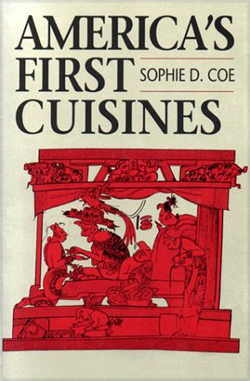
[2] Believed to be the tomatillo. Cited in America's First Cuisines, by Sophie D. Coe.
Salsa Chronology
To go back to the beginning:
|
 |
- Chiles are first domesticated in Latin America in the period 5200 B.C.E. to 3400 B.C.E. [3]
- In 1494, Dr. Diego Álvarez Chanca brings the first chiles to Spain, after traveling to the West Indies on Columbus’ second voyage. He writes of their medicinal effect. [3] Little is known about Dr. Álvarez Chanca, other than the fact that he was a physician-in-ordinary to Ferdinand and Isabella, King and Queen of Spain, and was appointed by them to accompany Columbus on his second voyage west in 1493.
- In 1529, Bernardino de Sahagún arrives and begins to document Aztec culture, which includes foods (and salsa).
- Aztec lords combine tomatoes with chiles and ground squash seeds and consume them mainly as a condiment with seafood, turkey and venison. This combination is subsequently called salsa in 1571 by Alonso de Molina, a Spanish priest and missionary (c. 1510-1584) who is taken by his parents to Santo Domingo, and goes on to Mexico in 1523, after the conquest, where he learns the Aztec language, Nahuatl. Afterward he serves as interpreter to the first Franciscan friars. [7]
- In 1807, the first bottled hot sauces, made with cayenne chiles, appear in Massachusetts. [3]
- In 1868 on Avery Island, about 140 miles west of New Orleans, Edmund McIlhenny packages an aged Tabasco pepper sauce in 350 used cologne bottles and sends it to prospective buyers. The sauce is immediately popular and demand is overwhelming. [3]
- In 1898, Trappey and Sons markets its own brand of hot pepper sauce, also using the name Tabasco. In the same year, Marie Sharp begins bottling hot sauce in Belize. [3]
- Also in 1898, according to GourmetSleuth.com, a cookbook published in the U.S. (although apparently in Spanish) contains two recipes for salsa fresca. Encaracion Pinedo’s El Cocerina Español (The Spanish Cook) includes recipes for Salsa Picante de Chile Colorado, a spicy red chile sauce, and well as Salsa de Chile Verde, a green chile sauce.
|

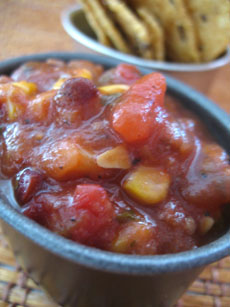
Peach salsa, the top seller in the U.S., was unknown to the Aztecs: the peach tree originated
in China and moved west via Asia Minor. It came
to the Americas with the colonists. |
- In 1916, Charles E. Erath of New Orleans is the first person to manufacture a salsa product, “Extract of Louisiana Pepper” Red Hot Creole Sauce—but it is a pepper sauce or hot sauce product, not a dippable salsa. A year later, La Victoria Foods starts Salsa Brava in Los Angeles. [4][7]
- In Louisiana in 1923, Baumer Foods begins manufacturing Crystal Hot Sauce and in 1928, Bruce Foods starts making Original Louisiana Hot Sauce, two sauce brands that are still in existence. [4]
- In 1941, Henry Tanklage forms La Victoria Sales Company to market a new La Victoria salsa line. He introduces red and green taco and enchilada sauces, the first salsa hot sauces in the U.S. He takes over the entire La Victoria operation in 1946, which manufactures ten different hot sauces now covering the entire salsa spectrum, including Green Chili Salsa and Red Salsa jalapeño. [4]
- Salsa manufacturing in Texas begins in 1947 with David and Margaret Pace, founders of Pace Foods, and their Picante Sauce. In 1952, La Victoria Foods introduces the first commercial taco sauce in the U.S. and in 1955, La Preferida launches a line of salsas. [4]
- In the 1970s, a new food trend, sometimes called the “whole foods movement,” sweeps the country, emphasizing cooking with fresh, unadulterated ingredients. “California cuisine” is born, vegetarianism increases in popularity, health food stores and gourmet retailers (specialty food stores) spring up to sell specialty foods that are not available in supermarkets.
- In 1975, Patti Swidler of Arizona launches Desert Rose Salsa. Four years later, in Austin, Texas, Dan Jardine begins producing D.L. Jardine’s Salsa, giving Austin the reputation as the hot sauce capital of America.
- 1980, Norma and W. Park Kerr launch the El Paso Chile Company in Texas. In 1986, Miguel’s Stowe Away in Vermont launches a salsa line. In April, 1986, Sauces & Salsas Ltd. begins manufacturing the Montezuma brand of hot pepper sauces and salsas in Ohio. [4]
- In 1987, Pace, the market leader, sees major competition as Hormel & Co., licenses the Chi-Chi’s restaurant name and introduces the Chi-Chi’s brand, which will eventually capture a large share of the market. The same year, Robert Spiegel, Dave DeWitt and Nancy Gerlach found Chile Pepper magazine for fiery food lovers.
- In 1988, Lisa Lammé opens Le Saucier in Boston, believed to be the first retail shop specializing in hot sauces.
|

Salsa verde is an early salsa made not from the
tomato but from the tomatillo, a member of the same family as the tomato (the Nightshades) but closer in relation to the cape gooseberry. |
- Between 1985 and 1990, Mexican sauce sales grow 79%. Between 1988 and 1992, the percentage of American households buying salsa increases from 16% to 36%.
- By 1992, the top eight salsa manufacturers are Pace, Old El Paso (owned by Pet Foods), Frito-Lay, Chi-Chi’s (Hormel), La Victoria, Ortega, Herdez and Newman’s Own. Pace commands 32.3% of the market, according to a study by Information Resources, Inc., and published in The New York Times. [5]
- In 1994, the number one salsa manufacturer, Pace Foods, sells to Campbell Soup Company for an astronomical $1.1 billion on sales of $220 million. In even a larger deal, Pillsbury announces that it will purchase Pet Foods, maker of Old El Paso Mexican Foods, for $2.6 billion. Together, Pace and Pet Foods control about half of the market for Mexican sauces. [4]
- By 2000, more households buy salsa than bought ketchup.[6]
From a health standpoint, that’s good. Ketchup is loaded with sugar; salsa generally has none (except for fruit salsas, which typically have no added sugar). Salsa is low in calories and contains little to no fat. Tomatoes, chiles and cilantro contain vitamins A and C; tomatoes also have potassium.
[3] http://www.hotsauceblog.com/hotsaucearchives/salsa-spices-dishes/
[4] http://www.buzzle.com/editorials/6-20-2006-99913.asp
[5] http://www.fiery-foods.com/dave/history.html
[6] http://www.davespepperpalace.com/
[7] 21 May 1931 New Orleans Times-Picayune,
http://listserv.linguistlist.org/cgi-bin/wa?A2=ind0306d&L=ads-l&P=1729
Salsa, The Dance
In 1933 Cuban songwriter Ignacio Piniero wrote the song “Echale Salsita” (“Throw On Some Sauce”) after tasting food which lacked Cuban spices. But it was in 1962 that Jimmy Sabater’s tune “Salsa y Beme” suggested that dancers spice it up by adding a little “salsa” to their movement when they danced. Sabater is a bilingual vocalist, percussionist and composer, born of Puerto Rican parents in the El Barrio section of Harlem (Spanish Harlem).
As salsa denotes a spicy or hot flavor, salsa is a hot and spicy dance to a variety of Afro-Latin rhythms driven by the clave (two wooden sticks struck together). Many of the salsa dance patterns are closely related to those of the mambo. Salsa is the national music and dance of Puerto Rico.
WANT TO BECOME A SALSA (THE FOOD) EXPERT?
Take a look at our Salsa Glossary, with more than
30 different definitions and types of salsa! |
© Copyright 2005-2008 Lifestyle Direct, Inc. All rights reserved. Images are copyright of their respective owners.

|
 |
|
|