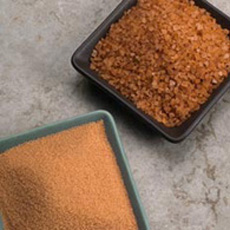
Alaea Sea Salt is a traditional Hawaiian table salt used to season and preserve. Alaea is a natural mineral volcanic baked red clay, added to enrich the salt with iron oxide. Photo courtesy of Saltworks.
June 2006
|
 |
Product Reviews / Main Nibbles / Seasonings
A Brief History of Salt
From Prehistory To Gourmet Sea Salts
CAPSULE REPORT: Looking for information about salt? You’ll learn about it here. The world history of salt is fascinating: What we take for granted in the ubiquitous salt shaker has been as precious as gold to people throughout the ages. It engendered wars and caused Marie Antoinette to lose her head.
Salt Origins: A Brief History Of Salt
What seems like such an inexpensive commodity has been used since pre-historic times as currency, medicine and an enhancer and preservative of food. In cooking, salt enlivens the taste of food, intensifying and balancing flavors. Salt has long been used in pickling and in curing vegetables, meats, fish and cheese. Salt has played a prominent role in religious ritual in many cultures, symbolizing purity. There are more than 30 references to salt in the Bible, from expressions like “salt of the earth” to Lot’s wife (although given what we now know to be the expense of salt in earlier times, she was turned into a pillar of extreme value). Salt is also an essential element for the living: life itself would be impossible without it, since the human body requires salt in order to function properly. (For instance, that thousands of Napoleon’s troops died during his retreat from Moscow is attributed to their wounds not healing due to a lack of salt.) And salt is also used in some 14,000 commercial applications, from manufacturing pulp and paper to setting dyes in textiles and fabric, producing soaps and detergents to making icy roads safe.
- Salt was in general use long before recorded time. Its use in pickling predates the 5000-year written Chinese history. Around 2,700 B.C. in China, the earliest known treatise on pharmacology, the Peng-Tzao-Kan-Mu, devoted a major portion to a discussion of more than 40 kinds of salt. Profits from the sale of salt financed the Great Wall. More “recently,” in 1450 B.C., Egyptian art depicts salt-making (ancient Egyptians also used salt for mummification). By 200 B.C., people discovered that adding salt to food kept it from spoiling.
- The ancient Chinese used salt to make a fermented fish sauce. So did the ancient Romans: garum was the Roman equivalent of catsup, a condiment that was used on nearly everything. Royal purple dye was discovered by accident when a garum-maker tried to cook a particular variety of shellfish in the sauce. Reacting with the salt, the shellfish exuded the reddish-purple dye.
- Since currencies in different countries have always differed, salt was an international currency: it was an important trading commodity carried by explorers. Greece, involved in a far-reaching slave trade, exchanged salt for slaves, giving rise to the expression, “not worth his salt.”
- Special salt rations given to Roman soldiers along with their wages were known as salarium argentum, the term from which our word “salary” is derived. As an essential ingredient in food, the Latin word “sal” found its way into salsa and salami.
- Merchants in 12th century Timbuktu valued salt as highly as books and gold. In Venice, whose economic strength was not just as a seaport but as a major salt-producer, the immense salt evaporation pans were referred to colloquially as “the Seven Seas.” The phrase “sailing the Seven Seas” derived from the challenge of navigating one’s craft among the bars that enclosed these evaporation ponds.
- Salt was traditionally expensive, and thus used to bestow social standing. In Medieval and Renaissance European kingdoms, salt cellars would be placed on the table within reach of those deemed worthy. At any noble table, to be seated “below the salt” was to be seen as unworthy of access to such luxury seasoning.
- Throughout history, the necessity of salt has subjected it to governmental monopoly and special taxes. Salt taxes long supported British monarchs; thousands of Brits were imprisoned for smuggling salt. French kings developed a salt monopoly by selling exclusive rights to produce it to a favored few, who exploited that right to the point where the scarcity of salt was a major cause of the French Revolution.
- Americans have been fortunate to have had a plentiful natural salt supply that has not been appropriated for the privileged or taxed. It is one of our least expensive necessities; although in times of shortage, like the Civil War, the Union army was quick to blow up Confederate saltworks to further starve the South, and profiteers (including the founders of the McIlhenny Company, makers of
Tabasco, who owned brine wells in Louisiana) used the shortages to their advantage.
- As you’ll read in the final section, salt in the 21st century means a steady supply of deliciously flavored sea salts from all over the world. The basic necessity has gone gourmet.
For more information, read the definitive book on the topic, Salt: A World History, by Mark Kurlansky (photo at right). Combining the historical with the contemporary, the practical with the whimsical, this is a delightful treatise on salt. Click on the link to get a copy.
The Chemistry of Salt
Sodium chloride, or common table salt, is the chemical compound NaCl—one sodium ion bound to one chlorine ion (chemically, it is 60.663 percent elemental chlorine [Cl] and 39.337 percent sodium [Na]). Saltiness is a taste produced by the presence of sodium chloride (and to a lesser degree other salts). The ions of salt, especially sodium, can pass directly through ion channels in the tongue.
In chemical terms, salt is one of the most basic molecules on earth. It’s also one of the most plentiful: it has been estimated that salt deposits under the state of Kansas alone could supply the entire world’s salt needs for the next 250,000 years. Salt occurs naturally in many parts of the world as the mineral halite (rock salt) and as mixed evaporites in salt lakes. Underground salt deposits are found in both bedded sedimentary layers and domal deposits (hence salt mines). Some salt is on the surface, the dried-up residue of ancient seas (like the famed Bonneville Salt Flats in Utah). Seawater contains an inexhaustible supply of salt (salt represents about 77 percent of the Total Dissolved Solids in the water). Photo of Salar de Uiuny, Bolivia by Gabriella Silvestrini.
Sodium chloride crystals are cubic in form—the salt crystal is often used as an example of crystalline structure. It varies in color from colorless, when pure, to white, grey or brownish, depending on what trace minerals are in the salt deposits...as we’ll see in the next section.
Information from the Salt Institute and Cargill Salt.
Splendid Sea Salts
Growing up, most of us were familiar with table salt and perhaps kosher salt for cooking (margarita salt is simply a coarse grind of salt, like kosher salt). If you made ice cream at home with an older-style machine, you used rock salt. Ten years ago, few people in America beyond French chefs had heard of sea salt; those who did were educated though European travel or French cooking.
Today, sea salt is perhaps one of the biggest national gourmet obsessions since balsamic vinegar. Led by a new generation of American chefs who have been using it in dishes sweet and savory and as a garnish on everything from heirloom tomatoes to desserts and petit fours (read our article on salt caramels), it’s a logical evolution. After all, the classic margarita juxtaposes sweet Triple Sec with a salty rim; and fruity margaritas add that much more sugar to contrast with the salt.
These days, a restaurant worth its salt will have a cellar of sea salt on the table: no 20th century salt shaker will do. Each sea salt has a distinctive taste and texture, based on trace mineral content, crystal shape and size. The complex salt flavors and textures, so different from common table salt, add a distinctive dimension to food, actually acting as a condiment (and some salts are so beautiful, they serve as a garnish as well—a sprinkling on the food or on the plate enhances the beauty of the presentation).
With so many salts and so little time, we predict the coming of a “salt of the month” approach at fine dining establishments: “Good evening madame. This month’s salt is Anglesey, harvested from the Atlantic waters that surround the Isle of Anglesey, off the west coast of Wales. Anglesey has a soft, flaky texture. Why not begin your tasting by sprinkling some on the butter with your bread?”
Salt is one of the four or five flavors which human taste buds recognize. You know about sweet, sour, salty and bitter; the fifth flavor, umami or “savoriness,” focuses on a “brothy” taste equating to the taste of the common food flavoring monosodium glutamate, or MSG. A concept considered basic in Japanese and Chinese cuisine, it was recently explained to Westerners in a scientific-yet-entertaining book with great recipes so you can fully understand the concept: The Fifth Taste: Cooking with Umami, by Anna Kasabian and David Kasabian (photo above). Click here to read more about the book. You’ll learn to recognize umami not only in fermented Asian foods such as soy sauce, fish sauce, miso and black bean sauce; but in some vegetables, soup stocks, anchovies, parmesan and Roquefort cheeses, tomatoes, (including tomato sauce and ketchup), walnuts, grapes, broccoli, mushrooms, and to a lesser degree in meat (although sometimes the umami flavor is referred to as “meaty”).
Sea Salt (also called sal del mar [Portuguese], sel de mer [French], and sale marino [Italian]). Sea salt is a broad term that refers to unrefined salt derived directly from a living ocean or sea. It is harvested by channeling ocean water into large, shallow clay trays or other receptacles and allowing the sun and wind to evaporate it naturally. The finest artisan salts are natural or organic and are not treated or washed. Even lesser-grade sea salts are typically not refined as much as other kinds of salt, so they still contain traces of other minerals, including iron, magnesium, calcium, potassium, manganese, zinc and iodine. While all table salts are sodium chloride, there is a night-and-day difference between the flavor of sea salts, which are an artisan product, and common table salt. Because different bodies of water have different mineral contents, salts will look and taste different: some have flowery nuances, some are strong, some delicate, some have sulfuric notes, some can taste sweet, et al. For the convenience of chefs and consumers, sea salt is produced in coarse, fine and extra fine grain sizes. Since there are different qualities of sea salt, for a finishing salt or garnish, buy the best. A little lasts a long time, and you’ll taste the difference.
Grey Sea Salt (also called grey salt, Celtic sea salt and sel gris [French]). Grey sea salt is a “moist,” unrefined sea salt harvested along the coastal areas of France. Its light grey color sometimes has a purplish hue, depending on the amount of clay found in the salt flats. One of the most famous salt ponds, in the salt marshes around the town of Guérande in Brittany, France, is lined with natural clay and produces very grey salts. The clay contributes valuable minerals and nutrients that add to both the nutritional value and flavor of the salts. Grey salt is collected by hand with wooden rakes by artisan paludiers (salt harvesters or salt rakers) who sweep the top of the evaporating sea water (this is an ancient Celtic method which earns the salt its name). For centuries a mainstay of French cooking, grey salt has gained great popularity in the mainstream culinary world over the last few years and is considered by many to be the best quality salt available. Fleur de Sel is a particular kind of grey salt.
Fleur de Sel (also called flower of salt, flor de sal [Portuguese]). The name comes from the aroma of violets that develops as the salt dries. Perhaps the best known artisan sea salt, it is comprised of “young” crystals that form naturally on the surface of salt evaporation ponds—only the premium, top layer of the salt bed is used. French Fleur de Sel is hand-harvested by paludiers under specific weather conditions, on especially warm days that abet the evaporation of the salt crust on the surface of the salt pool. It is choice, less salty and more delicate than sel gris as a whole. Like wine regions, different areas produce salts with their own unique flavor and aroma profiles. The Guérande region of Brittany, which produces grey sea salt, produces a fine Fleur de Sel de Guérande. Fleur de Sel de Camargue, from the Mediterranean salt marshes of Camargue in Provence, is also highly respected. Fleur de Sel is the favorite of many chefs to season salads, cooked fresh vegetables and grilled meats; as well as for chocolates and other dessert applications.
The photos above are courtesy of Saltworks.
Favorite Salts From Around The World
 |
 |
 |
Alaea Hawaiian Sea Salt. Alaea is the traditional Hawaiian table salt used to season and preserve. It is rich in trace minerals, all of which are found in sea water. A small amount of harvested reddish Hawaiian clay (alaea) enriches the salt with iron-oxide. Click here to purchase or for more information. |
Black Cyprus Flake Sea Salt. A distinctive, flaky pyramid-shaped salt that stimulates the imagination. Garnish hors d’oeuvres; chicken and veal; white fish, arctic char and other seafood; tomatoes and other vegetables; eggs and much more. The beauty and drama of the salt as well as the delicate flavor makes an everyday dish into a gourmet presentation. Click here to purchase or for more information.
|
Hawaiian Black Lava Sea Salt. Although less well known than the traditional red alaea salt, hawaiian black sea salt, or lava salt, is a dramatic, glossy black sea salt with a sulfur nose. The unique color comes from lava, which adds minerals and activated charcoal, resulting in a sulfuric aroma. Delicious on all seafoods; use as a finishing salt. Like the red salt, a dramatic garnish and plate decor. Click here to purchase or for more information. |
 |
 |
|
Fleur de Sel de Camargue. Hand gathered from the Mediterranean salt marshes in the Camargue region of Provence, France and carefully dried without processing or refining, this sea salt is a favorite of connoisseurs around the world. The container has a cork top and is labeled with the salt harvester’s name (as each harvest is considered a unique art form). Fleur de Sel is wonderful atop meats, potatoes and poultry; sprinkle it atop your favorite foods just prior to serving. Click here to purchase or for more information. |
Smoked Fleur de Sel. It’s rare to find a naturally smoked Fleur de Sel de Guérande. After harvesting, the salt is smoked over the wood of select French oak wine barrels that were used to age French chardonnay wine. During smoking, the Fleur de Sel turns a pale brown and absorbs the complex flavor combination of smoke, oak and chardonnay. An exceptional finishing salt for meats, seafood, pasta, salads and eggs. 6. Click here to purchase or for more information. |
|
 |
 |
|
Maldon Sea Salt. From the banks of the River Blackwater in Essex, England, Maldon is known for its pyramid-shaped crystals, soft texture and delicate, clean taste. It is the ideal complement to meat in flavor and in forming the desirable crust on seared cuts. Maldon often wins taste tests over Fleur de Sel and other sea salts. When it won in a Cook’s Illustrated test, “Tasters loved the crunch of the large sea-salt flakes or crystals when sprinkled over slices of roast tenderloin.” Click here to purchase or for more information. |
Murray River Pink Flake Sea Salt. This pink flake salt is from the Murray River, the largest river in Australia. It empties into the Murray Darling Basin, where low rainfall leads to a high concentration of salinity. The delicate flakes dissolve quickly on food. As a finishing salt, it is well suited for beef and game. Click here to purchase or for more information. |
|
© Copyright 2005-2008 Lifestyle Direct, Inc. All rights reserved. Images are the copyright of their respective owners.

|
 |

|
|