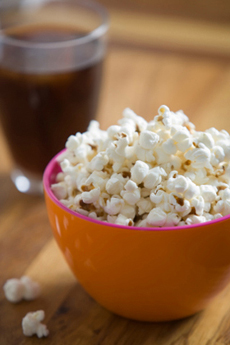
Ancient snack on modern glass. Photo by Andre Veron.
|
MELODY LAN is a member of THE NIBBLE editorial staff. |
|
July 2006
|
 |
The History Of Popcorn
The Indigenous Snack Of the Americas
Popcorn is now a popular snack food all over the world. As one of America’s indigenous snack foods—corn is native to Mesoamerica—popcorn has always been a part of our lives. It’s not only a household snack but it is ubiquitous in recreation—at amusement parks, circuses, fairs, sporting events, and at every movie theatre. It’s hard to imagine a time and occasion when we don’t have the crunchy popped kernels to munch on.
Origins of the Popped Snack
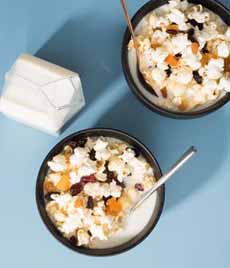
The oldest popcorn known to date was discovered in 1948 by anthropologist Herbert Dick and botanist Earle Smith in the “Bat Cave” in west central New Mexico. The popcorn ears, which ranged from 1/2 inch to 2 inches long, are carbon-dated to be more than 5,600 years old. Archaeologists deduce that popcorn was first made by throwing corn kernels on sizzling hot stones tended over a campfire, or onto heated sand, causing the kernels to pop. It was not eaten as a snack food: the corn was sifted and then pounded into a fine, powdery meal and mixed with water. This same cooking technique was used by the early Colonists, who mixed ground popcorn with milk and ate it for breakfast as a kind of cereal.
A 4th century A.D. Zapotec funeral urn found in Mexico depicts a maize god with symbols representing primitive popcorn in his headdress. Ancient popcorn poppers, shallow vessels with a hole on the top and a single handle, have been found on the northern coast of Peru and date back to about 300 A.D. Peruvian Indians called the popcorn pisancalla. A 1,000 year old popped kernel of popcorn was found in a dry cave inhabited by predecessors of the Pueblo Indian in southwest Utah. Native Americans flavored popcorn with herbs and spices.
Popcorn was introduced to Europeans via exploration of the New World. Spanish explorer Hernando Cortes first learned of it during his 1519 of what is now Mexico. He cataloged in his travel journals that the Aztecs used the popped corn, or momochitl, as decoration for ceremonial wreaths, necklaces and ornaments on the statues of their gods. A few decades earlier, in the late 15th century, Christopher Columbus also noted that the Native Americans made popcorn corsages and headdresses for dance rituals, which were also sold to his sailors. Around 1612, French explorers in the Great Lakes region documented use of popcorn by the Iroquois Indians who popped corn in pottery using hot sand (pottery filled with sand was placed over a campfire and the kernels were mixed in to pop). The explorers also reported that during an Iroquois dinner, popcorn soup and popcorn beer were consumed.
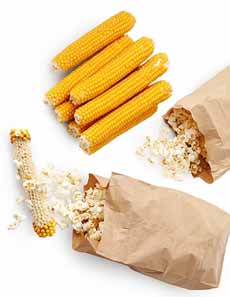
Photo of maize by Jonathan Ruchti
How Corn Kernels Become Popcorn
Not all corn can be popcorn: there are six types of corn commonly grown, and while some while some wild types will pop, only popcorn pops on command. Popping corn is a special type of maize that puffs up when it is heated in oil or by dry heat. While the strain was first developed by precolumbian Native Americans, special varieties have been developed by agriscientists that improve popping yield.
As with all cereal grains, each kernel of popcorn contains a certain amount of moisture in its starchy endosperm. Unlike most other grains, the outer hull of the popcorn kernel is thick and impervious to moisture.
- As the kernel is heated past the boiling point, water in the kernel begins to turn to steam, generating an internal pressure of about 9 atm. In kernels of other grains, this steam escapes through the hull as fast as it forms, but in the tightly sealed popcorn kernel, the steam is held in by the hull. The pressure starts to build until the hull suddenly ruptures, causing a small explosion. The starch in the endosperm (the core) bursts to about 40 times its original size, turning the kernel inside out. The average popping temperature for popcorn is around 347°F.
Because the moisture is evenly distributed throughout the starchy endosperm, the sudden expansion turns the endosperm into an airy foam which gives popcorn its unique texture. Photo by Leonardo Morales
- Kernels which do not pop, known as “old maids,” are believed to have not enough moisture to create enough steam for an explosion; or perhaps they have a leaky hull.
The ideal popcorn kernel contains approximately 14 percent moisture; without enough water, the kernel will not pop at all, which is why old kernels don’t pop. Popcorn kernels should be kept in tightly sealed containers to prevent them from drying out.
Popcorn In The “Modern” U.S.
It is said that Native Americans brought popcorn to the first Thanksgiving and that the way to eat popcorn at that time was to hold an oiled ear of corn on a stick over the fire, and then chew the popped kernels off the cob. After learning about popcorn, colonists began enjoying the first puffed breakfast cereal—a bowl of popcorn served with cream or milk. In the 18th century, after the corn harvest, rendered fat would be thrown into a cast iron pot sitting over an open fire. When the fat was hot, farmers would toss in corn kernels, a little molasses or other sweetener, and then wait for the corn to pop into a sweet, hot treat. These days, in place of rendered fat, corn oil and sugar are used to make kettle corn.
By the 1840s, corn popping had become a popular recreational activity in the U.S. By the 1870s, the treat was sold in grocery stores and at concession stands at circuses, carnivals and fairs. In 1885, Charles Cretors, founder of the Chicago snack equipment company C. Cretors and Co., inventeded the first commercial popcorn machine, and in 1993 he introduced the first mobile popcorn machine at the Midway of Chicago’s Columbian Exposition. It was reported by the Scientific American that the apparatus weighed about 400 or 500 pounds, and could be easily drawn by a boy, pulled by a small pony or mounted on trucks. The photo of the popcorn wagon at the right is of the improved 1900s version of the original model. The Cretors popper allowed vendors to follow crowds, especially ones near movie theaters, lending itself to the tradition of enjoying the golden fluffs at the cinema.
Because of the mobile popper, popcorn was very popular from the 1890s onward. Street vendors pushed steam or gas-powered poppers throughout the nation, selling both popped (by the bag or shaped into balls or squares) and unpopped kernels. At about the same time, flickers—or movies—were making their debut. By the early 1920s, popcorn was available at most movie theaters across the country, as much a part of the enjoyment as watching Charlie Chaplin and Greta Garbo.
At about a nickel per bag or a penny for a popcorn ball, people of all ages enjoyed popcorn and even continued to use the puffed snack as festive decorations.
Smaller machines were developed, and commercial poppers in theatres appeared in 1912. By 1945, nearly half the popcorn consumed in the United States was consumed in the soft glow of a movie screen, and by 1951, 96 percent of all U.S. cinemas sold popcorn in their lobbies. Riding the popcorn wave, home-cooks were inspired to develop recipes for everything from popcorn pudding, fritters and Cracker Jacks to chocolate-covered popcorn and popcorn brittle.
During the Depression (from 1929 through most of the 1930s), popcorn, at 10 cents a bag, was one of the few luxuries poorer families could afford; so while other businesses failed, the popcorn business thrived. When sugar was sent overseas for U.S. troops during World War II (1939 to 1945) and there was so little of it in the States to make candy that Americans ate three times as much popcorn as usual.
Popcorn went into a slump during the early 1950s, when television became popular and movie attendance dropped, but when the public began eating popcorn at home, the new relationship between television and popcorn led to a resurgence in popularity.
Recovery of the movie industry, which saw its annual admissions double between 1971 and 2002 also helped. In 2004, cinemas sold about 60 million pounds of popcorn, and the average American ate 70 quarts.
Today, Americans consume about 17 billion quarts of popped corn each year, with much of it coming from Indiana, with Nebraska producing a large crop as well.
Flavored Popcorn
Today’s popcorn lovers can enjoy much more beyond the basic plain, salted or buttered varieties.
- Buttered Popcorn. The first and most popular, butter, or butter-flavored soy mixes, are the number-one favorite popcorn flavor.
Caramel Corn (also called toffee popcorn) is popcorn covered in caramel or molasses and often contain nuts, like peanuts or almonds. Certain types of caramel corn are made with a white sugar-based caramel rather than the traditional brown sugar versions, for a lighter and more buttery flavor. The commercial candy Cracker Jacks, sold in a box, is caramel corn with peanuts. Invented in 1896 by F.W. and Louis Rueckheim, the name, a then-current term for “cool,” was bestowed by a salesman. The inexpensive toy “prizes” for which the product is famous were added in 1912. Photo courtesy of Palace Corn.
- Cheese Corn. Popcorn flavored with cheddar, parmesan or other cheeses is a savory favorite. Dale and Thomas makes a Buffalo Blue as well as a Southwest Cheddar-Chipotle.
- Chocolate-Covered Popcorn, including milk, dark and white chocolate, peanut-butter-blended chocolate, Aztec (spicy) chocolate, and other variations including chocolate-caramel combines two or more of America’s favorite snack flavors. (Click here to read our article on chocolate-covered popcorns.)
- Kettle Corn, a sweet-and-salty variety now made with granulated sugar, salt, and oil. A Colonial invention, the corn was popped in iron kettles and then sweetened with sugar, honey, and sometimes molasses before adding salt. It is less sweet than caramel corn and appeals to those who like a sweet-and-salty profile.
Spicy Corn. Garlic and jalapeño are two flavors that work well with corn. We buy them when we find them—and we like them. Barbecue-flavored corn, like Dale and Thomas’s Sweet & Spicy BBQ is another favorite. Photo of jalapeño popcorn courtesy of Popcorn Palace.
- Wild Frontier of Flavors. There are popcorn companies out there that make almost anything—Pickle Popcorn, Banana Popcorn, Blueberry Popcorn, Cherry Popcorn, Peppermint Popcorn, Root Beer Popcorn and flavors that sound more like potato chips than popcorn, i.e., Salt and Vinegar Popcorn and Loaded Potato Popcorn. We’ll try anything—we just haven’t gotten around to them yet. If you get there before we do, let us know. Places to start: JuliesPopcorn.com, PopcornPalace.com.
Popcorn Palace has 27 flavors of popcorn, including Cookies & Cream, Spiced Apple and Sour Cream & Chives.
Flavor Your Own: Popcorn Recipes
Place eight cups of popped corn in a large bowl and melt 3 tablespoons of melted butter or margarine.
- Easy Cheesy Corn. Mix 2 teaspoons finely chopped or snipped thyme into the melted butter and drizzle over the corn. Toss to blend. Sprinkle with 1 cup grated quality parmesan or cheddar cheese. Taste and add up to 1/2 teaspoon salt, plus pepper. Toss to blend.
- Taj Mahal Munchies: Mix 2 teaspoons curry powder into the melted butter and drizzle over the corn. Toss to blend. Sprinkle with 1/2 teaspoon each kosher salt and sugar. Toss to blend. Then 1/2 cup each of coconut, golden raisins and sliced almonds. Toss to blend.
- Wasabi Popcorn. Mix 2 teaspoons of prepared wasabi
into the melted butter and drizzle over the corn. Toss to blend. Sprinkle with 1/2 teaspoon kosher salt to taste. Toss to blend.
Learn More About Popcorn
 |
 |
 |
| Popped Culture: A Social History of Popcorn in America,by Andrew F. Smith.
This informative book traces the history of one of America’s most beloved snacks. With information on popcorn development, marketing, and more (including 160 recipes published before 1924), this book leaves no kernel of popcorn information unpopped! Click here for more information or to purchase. |
The Pippity-Poppity Popcorn Book, by Victor E. Cheer. This collection of over 50 old-fashioned popcorn recipes, including Choco-Hot-Hot-Hot, Crumb-Crunchers Popcorn, and Onion Patch Popcorn offers countless ways to doctor this classic snack. A fun and tasty addition to any cookbook collection. Click here for more information or to purchase. |
Popcorn!, by Frances Towner Giedt. More than 50 fabulous recipes that transform everyday popcorn into a truly gourmet treat! No matter if your tastes are sweet or savory, Popcorn! is the perfect resource. Click here for more information or to purchase.
|
© Copyright 2005-2008 Lifestyle Direct, Inc. All rights reserved. Images are the copyright of their respective owners.

|
 |
|
|