Whole Milk, Low Fat, Nonfat, Grass-Fed, Cream-Top And Most Definitely, With Active Cultures!
CAPSULE REPORT: What if you could taste every organic yogurt and then decide which brands to pursue? We’ve tried to do it for you. Of course, we couldn’t get our hands on every one—but we made a good start. We tried the vanilla yogurts of seven different brands, but with different variations—whole milk, cream top, low fat and nonfat—we present a dozen different yogurt lines for your consideration. The majority are certified kosher.
My name is Stephanie Zonis, and welcome to Organic Matter for July, 2007.
Even within the organic sector of grocery products, which has enjoyed spectacular growth of late, demand for organic dairy products has been meteoric, sometimes increasing by more than 20% per year. Much of this demand stems from consumers who believe that organic foods are safer, although the USDA insists that organic foods are no safer than their conventionally-produced equivalents. Often parents, especially new parents, make their first forays into organic food for their children. Parents are concerned about a number of factors in conventionally-produced foods, including the large amount of synthetic pesticides used in the U.S., potential links between chemicals and developmental or behavioral issues, or antibiotics and hormones in some foods. Given that organic foods purchased by these parents are for very young children, many are dairy products, including milk and yogurt. Yogurt can be introduced early in a child’s life, usually between the ages of 8 and 12 months (milk, of course, is often introduced much earlier).
Yogurt is perceived as a healthy food, and not only by parents. Genuine yogurt, made from milk with live, active cultures, provides probiotics (and sometimes, prebiotics as well—read more about both of these in our extensive article on probiotic foods), in addition to calcium, protein, and other nutrition. And it’s become extremely popular. According to a January 2006 article in USA Today, yogurt sales totaled more than three billion dollars for the one-year period ending in December 2005. Many adult consumers, even those without children, are troubled by the same issues confronting parents and have turned to organic yogurt as a solution.
Making Organic Yogurt
As milk (sometimes a mixture of milk and cream) makes up the bulk of any batch of yogurt, it follows that organic yogurt would be made from organic milk (or organic milk and organic cream). But if you think all organic milks and dairy products are the same, there’s a report you need to check out. The Cornucopia Institute is an organization whose mission is to promote economic justice for family-scale farms. The Institute’s Organic Integrity Project acts as a corporate guard, attempting to eliminate compromises within the organic system or the further diluting of organic standards.
In 2006, Cornucopia issued an organic dairy report, complete with a scoring system, on 68 organic dairy brands and private-label products located across the U.S. A survey of nineteen questions, ranging from ownership structure to farm size to hormone treatments, was sent to the dairies. Based on their answers and some further validation, organic dairies were scored from five cows (the top rating, shown at right; these dairies have a hands-on relationship with their cows and complete control over their milk and other dairy ingredients, plus all profits go back to the farming family) down to one cow (brands that the Cornucopia Institute considers ethically challenged, with the sources of milk unknown or strongly suspected to be factory-farm-produced based on industry sources and a lack of survey participation). Not all of the dairies surveyed make organic yogurt, but the questions yielded some very interesting results. Just by way of comparison, for instance, Butterworks Farm, Trader’s Point Creamery, and Seven Stars Farm all received a five cow rating. Stonyfield Farm, Wallaby Yogurt, and Straus Family Creamery received a four cow rating. Horizon, which belongs to Dean Foods, received a rating of one cow. If you’d like to see more of the Cornucopia report and scorecard for yourself, you can find them by clicking on the link.
Live Active Cultures
I mentioned “genuine” yogurt a little earlier; what exactly does that mean?
The U.S. Food and Drug Administration (FDA) mandates that refrigerated yogurt be produced by culturing allowable dairy products with a bacterial culture, containing at least the bacteria Streptococcus thermophilus and Lactobacillus bulgaricus. Other food-grade bacterial cultures that have been deemed safe and suitable by the FDA may be added, as well (if you have any questions about these bacterial cultures, see the article on probiotics).
Here’s the tricky part: Even if your yogurt is made with live cultures, it may not have any by the time you consume it. Some yogurts are heat-treated after they’re cultured; this heat kills the friendly bacteria, robbing you of their benefits. Unfortunately, this heat-treated product is still allowed to be called “yogurt.”
What can you do to be sure you’re receiving live, active cultures?
First, ignore any label that reads “made with active cultures.” All yogurts must be made with active cultures, and this is no indication that the yogurt has not been heat-treated after the culturing process.
Look for the “Live & Active Cultures” logo developed by The National Yogurt Association. It guarantees that a minimum level of friendly bacteria remain through the yogurt’s expiration date. Note, though, that use of this seal is voluntary; not all yogurts with live, active cultures will have it on their label. For instance, Stonyfield Farm yogurts, the largest organic brand, which contains living cultures, does not use the logo.
If your yogurt does not carry the LAC seal, check the ingredient list. You should see phrasing such as “contains active, live cultures” or “living yogurt cultures.” If you’re still not sure, don’t hesitate to contact the manufacturer by phone or e-mail. You have a right to know what’s in your food! Remember, too, that including active, live cultures in a yogurt means that the yogurt must be kept refrigerated and will have a relatively short shelf-life. Finally, the fresher the yogurt, the more live cultures it will contain, so buy a product dated as far ahead as possible.
Grass-Fed Yogurt
After active cultures, grass-fed milk is the next hot topic in organic yogurt. Grass feeding of cattle (as opposed to grain feeding) is a growing movement in the U.S. Some argue that the milk from grass-fed cows is superior in both taste and nutrition to the milk from grain-fed bovines. Farmers in northern climes can’t grass-feed cows year-round: Depending on location, cows graze on pasture for half or more of the year; when there’s no green pasture, they are fed what’s called silage (SIGH-lij).
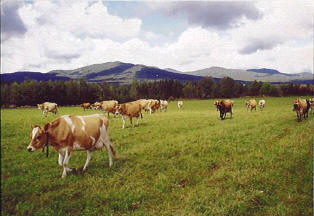
Silage is a mixture of green forage plants converted to cattle feed via anaerobic fermentation by storage (often in a silo). David Griffiths, co-proprietor of Seven Stars Farm, notes that traditionally, “grass-fed” was a term reserved for beef animals; only recently has it begun to be applied to dairy products. Griffiths explains that “grass-fed” can be a misnomer, as well. The term implies that animals eat nothing other than grass and legumes, but that doesn’t mean the cows are outdoors in a bucolic setting; such food could be brought indoors to the animals, too. “Grass-fed” can also be used to describe where animals get their food, that is, that they actually graze in pasture. To the shame of the USDA, small-scale organic farmers have a fight on their hands in trying to keep federal standards for organically-raised cattle from reading that cows don’t need to graze. Photo: Cows out to pasture at Butterworks Farm in Westfield, Vermont.
Cream-Top Yogurt
Another issue deals with the homogenization of milk. Homogenization is a process whereby, through high pressure, the fat in the milk becomes suspended in tiny particles and remains evenly distributed within the milk, instead of rising (as a layer of cream) to the top, which is what happens if the milk is left to its own devices. Homogenization was introduced in 1932; prior to then, everyone had to shake their milk bottles to get a glass of the “whole milk” we take for granted. What they had, in essence, was a bottle that was 85% full of the equivalent of 2% milk with a layer of light cream at the top—and that’s how people got their cream in those days (according to our editor’s mother, there could be quite a fight in a household of children over sneaking that cream). Thus, non-homogenized milk is sometimes called “cream-top.”
Homogenization is not mandatory and confers no nutritional or health benefit. It does change milk’s taste, as well as the way it’s digested in the human system. With the emergency of artisan creameries, some dairies have chosen to offer milk products in their original form (often alongside homogenized products). These “retro” milks and yogurts appealed to quite a few consumers. As with cream-top milk, some manufacturers do not homogenize the milk used for their yogurts, which causes a layer of rich yogurt cream to rise to the top of the carton. Homogenization would not technically be required in the milk used to make any nonfat yogurt, as there is no fat left to rise to the top.
Brown Cow offers cream-top yogurts in 11
flavors. However, the line is not organic, although it is rBGH-free and has live active cultures.
Closed Herd Yogurt
Dairies with closed herds are in the minority in the U.S., but they seem to be increasing in number. A closed herd is one in which cattle cannot be brought into the existing herd, either by purchase or by loan; resident cattle must also not come into any contact with cattle from other farms. Cows can’t be returned to the herd if they go to shows, for instance; bulls cannot be introduced (even temporarily for breeding purposes).
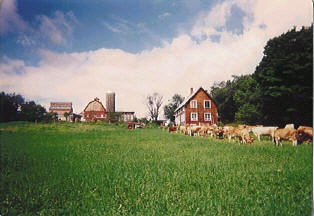
Why would a farmer go to all this trouble? Some farmers have closed herds for quality-control reasons: A closed herd gives farmers control over breeding, and they believe they can breed better cattle for their needs than they can buy. But closed herds are also a great help in preventing infectious diseases among cattle, and biosecurity (protecting herds from contact with infectious diseases) is an enormous concern on America’s farms these days. Cows are subject to a number of diseases contagious to other bovine, everything from bovine viral diarrhea to hairy heel warts. Vaccinations help with some of these, but they have their limits. Preventing your cattle from coming in contact with any who don’t live on your farm is an effective method of controlling the spread of diseases from cow to cow. Note, though, that even in a closed herd, additional milk can be brought in from other farms. Photo: The Butterworks Farm herd enjoying the tender spring pasture.
Organic Yogurt Report
To level the playing field, I tasted only vanilla yogurt, noting the cultures used, the amount of sugar and fiber in a serving, the vanilla flavor source, and any particularities of each brand. Unfortunately, one of our favorite brands of yogurt (organic or otherwise), Sky Top Farms, doesn’t make vanilla, so couldn’t be included in this report. The same was true with some other producers.
More brands of organic yogurt seem to be showing up all the time, so look upon this as a “starter” list. By all means, try as many local or regional brands as you can! The brands below tend to have wider-scale distribution, but they may not be available everywhere.
You’ll note that four brands are sold only in 32-ounce containers, while many kids and adults prefer to take an individual 6- or 8-ounce carton to school or work, or buy one as an on-the-go snack. Without question, it would be to a company’s economic advantage to sell yogurt in the higher-margin, single-serve cartons. But individual plastic yogurt cartons generate a tremendous amount of unrecyclable waste.
According to the Straus Family Creamery website, the HDPE #2 plastic from which many yogurt cartons are made, is usually colored white (or some other hue). But despite the fact that these cartons are accepted in some recycle bins, they are not recycled. Colored #2 plastic is actually looked upon as a contaminant by many recycling businesses. PP #5 plastic, which seems to be the one current alternative, is not recyclable (although it is lighter in weight, using less plastic to form a container of the same size.
By restricting yogurt containers to 16- or 32-ounce cartons, or 32-ounce glass bottles, the packaging for the yogurt will either generate much less waste or be recyclable. Robert Brewer, of Straus Family Creamery, notes that Straus would love to sell its yogurt in single-serving cartons, but to date the company has been unable to find biodegradable packaging made from a non-GMO (genetically modified organism) source.
Butterworks Farm Nonfat Vermont Vanilla Yogurt. Profile~Tart. Contains L. acidophilus, L. bulgaricus and S. thermophilus. There are 18 grams of sugar in an 8-ounce portion; the yogurt is sold in 32-ounce containers only. Flavor source: “pure vanilla.” A slightly thicker, more custard-like consistency than most of the others sampled and a much more tart flavor than most, almost to the point where the tartness overwhelms any other taste. Milk is from a closed herd; this farm is entirely self-sufficient.
Cultural Revolution Vanilla Complete 5%.Profile~Tart.Cream Top. Kosher. Contains S. thermophilus, L. acidophilus, Bifidus and L. bulgaricus. There are 10 grams of sugar in a 6-ounce portion; the yogurt advertises itself as “low sugar” and “low carb.” Flavor source: organic vanilla. Milk for this yogurt is not homogenized; company emphasizes milk’s “gentler” pasteurization process, in which milk is heated to minimum temperature necessary for pasteurization. More tart than some, but less so than the “minimalist” use of sugar would indicate. Vanilla presence somewhat less strong than in the lowfat version; here, it hits your taste buds at the end. Certified kosher by the Union of Orthodox Jewish Congregations.
Cultural Revolution Vanilla Lowfat 2%.Profile~Tart.Cream Top. Kosher. Contains S. thermophilus, L. acidophilus, Bifidus and L. bulgaricus. There are 7 grams of sugar in a 6-ounce portion; the yogurt advertises itself as “low sugar” and “low carb.” Flavor source: organic vanilla. Milk for this yogurt is not homogenized; company emphasizes milk’s “gentler” pasteurization process, in which milk is heated to minimum temperature necessary for pasteurization. More tart than some but not as much as would be expected given the small amount of sugar used. Definite vanilla presence. Certified kosher by the Union of Orthodox Jewish Congregations.
Horizon Fat Free Vanilla.Profile~Sweet But Not Vanilla.Kosher. Contains L. acidophilus, Bifidobacterium lactis, S. Thermophilus, L. bulgaricus and L. casei. There are 24 grams sugar in a 6-ounce carton. Flavor source: “natural vanilla flavor.” Milk for this yogurt is homogenized. Definitely on the sweeter side with a subdued tang. Slight, almost cornstarchy mouthfeel, though no cornstarch in product. No vanilla presence. Certified kosher by the Union of Orthodox Jewish Congregations.
Seven Stars Farm Original Vanilla.Profile~Tart, Vanilla Cream Top. Contains S. Thermophilus, L. bulgaricus, L. acidophilus and Bifidus.There are 14 grams sugar in an 8-ounce portion; yogurt is sold in 32- ounce containers only. Flavor source: organic vanilla extract. Milk for this yogurt is not homogenized. Yellower color than most other yogurts, especially in the cream layer atop; co-proprietor David Griffiths believes this is due to his cows currently grazing, as they do from April to roughly the end of November. Thinner consistency than many, with a more tart flavor but a good vanilla presence. Farm (but not yogurt) is certified biodynamic. Milk is from a closed herd.
Stonyfield Farm Lowfat Vanilla Yogurt.Profile~Sweeter, Vanilla. Kosher. Contains L. acidophilus, Bifidus, L. casei, L.reuteri, L. bulgaricus, and S. thermophilus. There are 23 grams of sugar in a six ounce carton. Flavor source: “organic natural vanilla flavor.” Milk for this yogurt is homogenized. Not as creamy or voluptuous as its whole milk cousin. Sweeter than most with a slight yogurt tang. Moderate vanilla presence. Certified kosher by the Union of Orthodox Jewish Congregations.
Stonyfield Farm Whole Milk French Vanilla Cream on Top Yogurt.Profile~Sweeter, Vanilla. Kosher. Contains L. acidophilus, Bifidus, L. casei, L. reuteri,L. bulgaricus, and S. thermophilus. There are 24 grams of sugar in a six ounce carton. Flavor source: “organic natural vanilla flavor.” Milk for this yogurt is not homogenized. It has a subdued tang and is rather sweet overall. Good vanilla flavor. Certified kosher by the Union of Orthodox Jewish Congregations.
Straus Family Creamery European Style Vanilla Nonfat Yogurt. Profile~Tangy, Moderate Vanilla. Kosher. Contains L. acidophilus, L. bulgaricus, S. thermophilus, and bifidus. There are 33 grams of sugar in an 8-ounce portion; the yogurt is sold in 16- and 32-ounce containers only. Flavor source: organic vanilla extract. The initial gentle sweetness is quickly replaced by deep yogurt tang, with tangy afternotes. Reminiscent of a thin custard in texture. Clean finish, with a moderate vanilla presence. Distribution is throughout the West Coast; yogurt may also be ordered at DdiamondOrganics.com (32-ounce containers only). Closed herd, but supplemental milk is brought in from other local dairies. Certified kosher by Kosher Supervision of America.
Straus Family Creamery European Style Vanilla Whole Milk Yogurt.Profile~Tangy, Moderate Vanilla. Kosher. Contains L. acidophilus, L. bulgaricus, S. thermophilus, and bifidus. There are 32 grams of sugar in an 8-ounce portion; the yogurt is sold in 16- and 32-ounce containers only. Flavor source: organic vanilla extract. Milk for this yogurt is homogenized. A trifle less sweet than its nonfat cousin, with a gentler tang and less of a tangy aftertaste. Very creamy texture. A moderate vanilla presence. Distribution is throughout the West Coast; yogurt may also be ordered at DiamondOrganics.com (32-ounce containers only). Closed herd, but supplemental milk is brought in from other local dairies. Certified kosher by Kosher Supervision of America.
Traders Point Creamery Grassfed Low Fat Vanilla Yogurt (photo below). Profile~Sweet, Drinkable. Contains L. bulgaricus and S. thermophilus. There are 24 grams of sugar in a 6-ounce portion; yogurt is sold in 32-ounce glass bottles only. Flavor source: organic vanilla extract. Milk for this yogurt is not homogenized. This is designed as a drinkable yogurt, so it’s thick, but pourable. Sweet, but well-balanced components of both sweetness and tartness and a good vanilla flavor. The company notes that the yogurt’s slightly yellow color is due to milk from 100% grassfed cows. Voted America’s best yogurt at the 2005 and 2006 American Cheese Society competition.
In the barn at Traders Point Creamery, the award-winning, drinkable yogurts greet their fans.
Wallaby Yogurt Company Australian Style Lowfat Vanilla Yogurt. Profile~Sweet-Tart. Kosher. Contains L. acidophilus, L. bulgaricus, S. thermophilus, and bifidus. There are 20 grams of sugar in a 6-ounce carton. Flavor source: organic vanilla extract. Milk for this yogurt is homogenized. The tartness hits first, followed by a considerable sweetness. Not much vanilla flavor. Website claims that this yogurt is “made in the traditional Australian style” and that it’s also “low in acidity.” Certified kosher by the Orthodox Rabbinical Council of San Francisco. Read our full review of Wallaby Yogurt.
Wallaby Yogurt Company Australian Style Vanilla Bean Nonfat Yogurt. Profile~Sweet-Tart. Kosher. Contains L. acidophilus, L. bulgaricus, S. thermophilus, and bifidus. There are 22 grams of sugar in a six ounce carton (more than the lowfat variety). Flavor source: organic vanilla beans. Vanilla bean specks are plainly visible in yogurt—nice visual appeal. As with its lowfat cousin, the tartness in this yogurt hits your taste buds first, followed by substantial sweetness. There is some vanilla presence, much of it as an aftertaste. Certified kosher by the Orthodox Rabbinical Council of San Francisco. Read our full review of Wallaby Yogurt.
I was unable to obtain the following organic vanilla yogurts: Horizon Whole Milk Vanilla, Nancy’s Vanilla Nonfat, Oikos Greek Yogurt (Vanilla).I’ll update this article if I come across them.
READ ABOUT MORE OF OUR FAVORITE YOGURTS IN OUR YOGURT SECTION



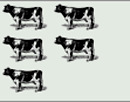 validation, organic dairies were scored from five cows (the top rating, shown at right; these dairies have a hands-on relationship with their cows and complete control over their milk and other dairy ingredients, plus all profits go back to the farming family) down to one cow (brands that the Cornucopia Institute considers ethically challenged, with the sources of milk unknown or strongly suspected to be factory-farm-produced based on industry sources and a lack of survey participation). Not all of the dairies surveyed make organic yogurt, but the questions yielded some very interesting results. Just by way of comparison, for instance, Butterworks Farm, Trader’s Point Creamery, and Seven Stars Farm all received a five cow rating. Stonyfield Farm, Wallaby Yogurt, and Straus Family Creamery received a four cow rating. Horizon, which belongs to Dean Foods, received a rating of one cow. If you’d like to see more of the
  Cultures” logo developed by The National Yogurt Association. It guarantees that a minimum level of friendly bacteria remain through the yogurt’s expiration date. Note, though, that use of this seal is voluntary; not all yogurts with live, active cultures will have it on their label. For instance, Stonyfield Farm yogurts, the largest organic brand, which contains living cultures, does not use the logo.
 Farm, notes that traditionally, “grass-fed” was a term reserved for beef animals; only recently has it begun to be applied to dairy products. Griffiths explains that “grass-fed” can be a misnomer, as well. The term implies that animals eat nothing other than grass and legumes, but that doesn’t mean the cows are outdoors in a bucolic setting; such food could be brought indoors to the animals, too. “Grass-fed” can also be used to describe where animals get their food, that is, that they actually graze in pasture. To the shame of the USDA, small-scale organic farmers have a fight on their hands in trying to keep federal standards for organically-raised cattle from reading that cows don’t need to graze.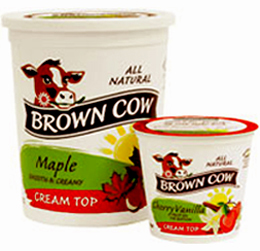
 they can breed better cattle for their needs than they can buy. But closed herds are also a great help in preventing infectious diseases among cattle, and biosecurity (protecting herds from contact with infectious diseases) is an enormous concern on America’s farms these days. Cows are subject to a number of diseases contagious to other bovine, everything from bovine viral diarrhea to hairy heel warts. Vaccinations help with some of these, but they have their limits. Preventing your cattle from coming in contact with any who don’t live on your farm is an effective method of controlling the spread of diseases from cow to cow. Note, though, that even in a closed herd, additional milk can be brought in from other farms.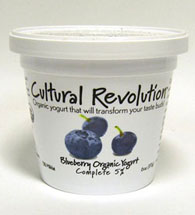
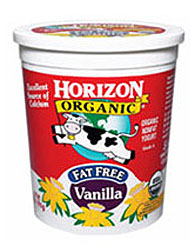 Horizon Fat Free Vanilla
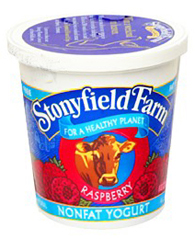 Stonyfield Farm Lowfat Vanilla Yogurt
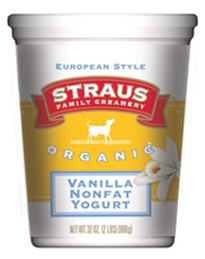 Straus Family Creamery European Style Vanilla Nonfat Yogurt
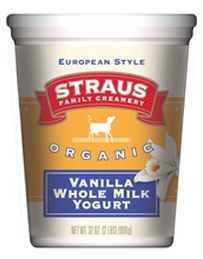 Straus Family Creamery European Style Vanilla Whole Milk Yogurt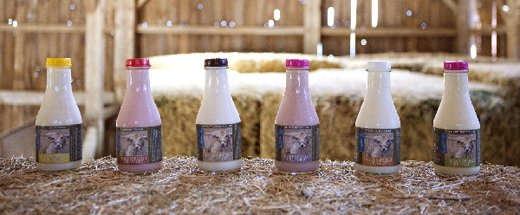
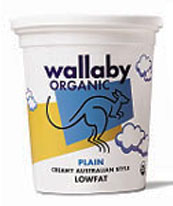 Profile~Sweet-Tart. Kosher. Contains L. acidophilus, L. bulgaricus, S. thermophilus, and bifidus. There are 22 grams of sugar in a six ounce carton (more than the lowfat variety). Flavor source: organic vanilla beans. Vanilla bean specks are plainly visible in yogurt—nice visual appeal. As with its lowfat cousin, the tartness in this yogurt hits your taste buds first, followed by substantial sweetness. There is some vanilla presence, much of it as an aftertaste. Certified kosher by the Orthodox Rabbinical Council of San Francisco. Read our full review of