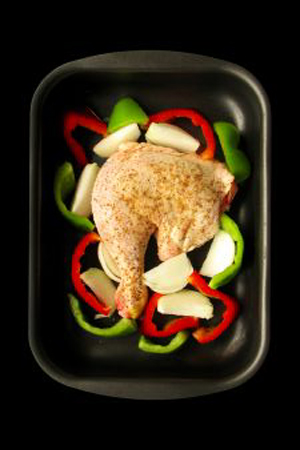
Ready to roast: chicken sprinkled with cayenne, known as “red pepper.” However, cayenne is a chile, not a red version of peppercorns. Photo by Agata Urbaniak | SXC.
| WHAT IT IS: Varietal peppercorns—20 different pepper types and counting. |
|
WHY IT’S DIFFERENT: Each origin of the world produces pepper with different aromas and flavors—just like coffee beans and chocolate.
|
| WHY WE LOVE IT: Another way to vary food accents—and it has no calories! |
| WHERE TO BUY IT: Pepper-Passion.com, Kalustyans.com. |
Last Updated January 2026
|
|
|
KAREN HOCHMAN is Editorial Director of THE NIBBLE.
|
|
|
|
Varietal Peppercorns: Spice Up Your Life
Page 5: Pepper Glossary C To I
This is Page 5 of an 11-page article. Click on the black links below to visit other pages.
Varietal Pepper Glossary C To I
CAYENNE PEPPER
Cayenne is a hot red chile, a cultivar of the Capsicum annuum genus in the nightshade family (Solanaceae). See our Chile Glossary.
CHASTEBERRY
See moula.
CRACKED PEPPER
Cracked pepper is partially broken peppercorns that are crushed using a mortar and pestle. Because it has more flavor and texture than ground pepper, cracked pepper is used to coat steaks, chops, and fish prior to cooking. It is also used in marinades, as a garnish, and a seasoning, where a heavier pepper flavor is desired (the coarser the grain, the stronger the taste).
CUBEB BERRY (or Tailed Pepper or Java Pepper)
If you see what look like peppercorns with stems (tails) attached, you’re looking at cubeb, Piper cubeba, a cousin in the same family, Piperaceae, as Piper nigrum. Cultivated for its fruit and essential oil, it is grown on the Indonesian islands of Java and Sumatra. The fruits are gathered before they are ripe and carefully dried. The dried, wrinkled fruit can be grayish-brown or black. The seed is hard, white, and oily.
Cubebs are pleasantly aromatic; the taste is pepper-like with a refreshing anise quality and a long finish. Cubeb came to Europe via India through Venetian trade with the Arabs. It is one of the spices in ras el hanout, a popular blend of herbs and spices that originated in Morocco and is used in other parts of North Africa.
During the Middle Ages, cubeb was one of the most valuable spices in Europe: It was ground as a seasoning for meat, used in sauces (Sauce Sarcenes was made of almond milk, cubeb, and other spices), and candied whole as a confection. It might still be popular today, but was banned around 1640 by the King of Portugal, who had a vested interest in promoting the sale of Piper nigrum, which grew in Portuguese colonies.
|
|
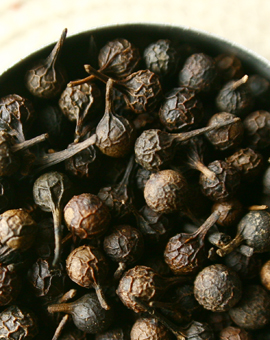 Cubeb Berries: exciting flavor for sweet and savory dishes. Photo by B.A. Van Sise | THE NIBBLE. Cubeb Berries: exciting flavor for sweet and savory dishes. Photo by B.A. Van Sise | THE NIBBLE.
|
Use cubeb in savory and sweet Moroccan dishes, in Indonesian gulés (curries), in stews, and in marinades. The aromatic qualities of cubeb would pair well with cheese, meat, and vegetable dishes; in spice mixtures such as quatre-épices for patés, sausages, gingerbreads, and cookies; and in place of allspice. We love the quality of the cubeb berries in our sampler kit from Chef Stefan: we have been grinding them on fruit salads and look forward to using them in fruit sorbets.
GREEN PEPPERCORN
These are immature black Piper nigrum peppercorns, picked long before maturity while still unripe and actually green in color.
They are then steamed and quickly dehydrated, freeze-dried, or pickled in brine to prevent fermentation. Because of the extra processing and the smaller yield, they tend to be more expensive; the freeze-dried version, which has superior appearance and flavor, is the most expensive. The corns are brightly aromatic with a piquant, fresh flavor, but are milder and fruitier, lacking the pungency of more mature black and white varieties of Piper nigrum. Green peppercorns offer a light, clean flavor and can be ground, but they are a softer peppercorn and are generally soaked and rubbed into the food, or added with their soaking liquid into a sauce.
|
|
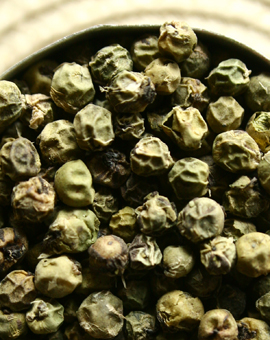 Green Peppercorns: mild, fresh, and fruity. Photo by B.A. Van Sise | THE NIBBLE. Green Peppercorns: mild, fresh, and fruity. Photo by B.A. Van Sise | THE NIBBLE.
|
Use green peppercorns with very fresh or fruity-tasting foods. They’re frequently used in French, Creole, Thai, and other Asian cuisines; they are the peppercorns used in a traditional pepper steak sauce. Try them ground on salads, steamed vegetables, salsas, and in sauces. Use them in steak au poivre instead of the traditional black pepper, and mix with black, white, and pink peppercorns as a coating for seared tuna. Chef Trosch uses them in an olive oil marinade for shrimp. They are delicious with poultry, vegetables,s and seafood.
GRAINS OF PARADISE (or Melegueta Pepper or Paradise Nuts or True Grains Of Paradise)
Native to Ghana and Liberia in West Africa, grains of paradise are related to cardamom; the seeds, or grains, of the plant are hot and spicy. See melegueta pepper for detailed information.
There are numerous references in the literature to two different species of the “grains of paradise” spice, a.k.a. the melegueta pepper, that are cited by writers (including botanists and culinary authors). They are Aframomum melegueta and Aframomum granum paradisi, both of the family Zingiberaceae.
However, the dozens of references to melegueta pepper we have read exactly describe the cardamom-like spice that is Aframomum melegueta: We have seen no description of a second type of spice. One old reference says that they are the same spice, that had been given different botanical names at different times. We’ll update this listing if we learn more. Current scholarship leans toward Aframomum melegueta as the appropriate botanical name.
|
|
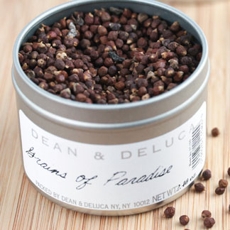
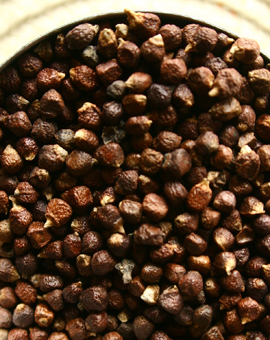 Grains of paradise, related to cardamom. Photo by B.A. Van Sise | THE NIBBLE. Photo below © Dean & Deluca. Grains of paradise, related to cardamom. Photo by B.A. Van Sise | THE NIBBLE. Photo below © Dean & Deluca.
|
|
ISOT PEPPER* or URFA BIBER or URFA CHILE
Biber is Turkish for chile. From the Urfa region of Turkey, the Urfa chile is Capsicum annuum that develops sweet and smoky flavors, with notes of dried fruit (often prunes/raisins) and scents of chocolate and tobacco, thanks to its terroir.
Ripening from red to a purple-black color, the chiles are prepared through “sweating”: sun-dried during the day and wrapped tightly at night to keep in the moisture. The result is a less spicy chile with a more lasting heat.
The medium-heat chile (5 on a scale of 10) has the same moderate heat as the Marash and Aleppo chiles grown in the same part of the world. Urfa biber is known to have a more lasting build of heat.
They’re used to give deep color and flavor to foods, particularly meat, poultry, and fish.
Outside of the Middle East, the chile is most often found in crushed flake form; the flakes are oily.
Add them to rice dishes, stews, chocolate recipes, or to spice up raisiny foods like oatmeal-raisin cookies.
|
|
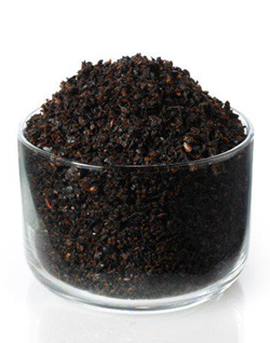
Dried, crushed Urfa biber chiles (photo courtesy LezzetSpices.com.
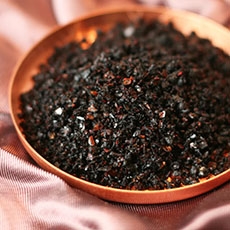
Ready to add some heat to your next recipe (photo © Silk Road Spices).
|
*What about isot? The word isot (pronounced ee-soht), which the Urfa biber chile is sometimes called, is a portmanteau of two Turkish words that describe its unique production process of sweating: Isı (meaning heat or warmth) and Ot (meaning herb or grass). Literally translated, it means “heat-herb.”
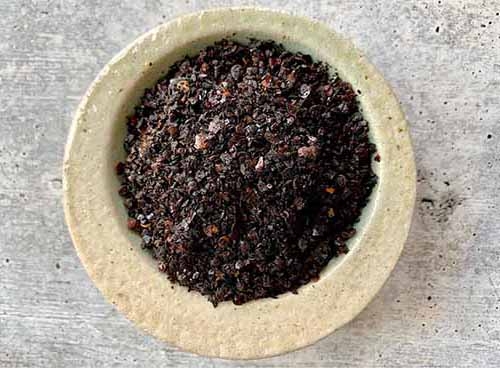
Urfa biber (photo © Regalis Foods | Victoria Jamey).
Continue To Page 6: Peppercorn Glossary J To L
Go To The Article Index Above
|