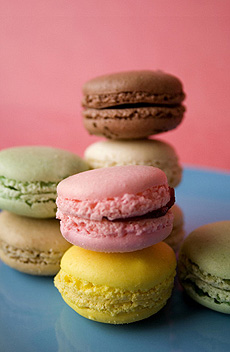
 Mad Mac Macarons, a NIBBLE Top Pick Of The Week, are one of our favorite gifts. Photo by Claire Freierman, THE NIBBLE.
July 2010
Last Updated December 2025
|
|
Cookie Variety Glossary
Page 6: Macaroon, Madeleine & Other Cookie Types Beginning With M
This page of our cookie glossary features cookie types beginning with the letters M, including macaroon, madeleine, meringue, and meltaway. See our many other informative food glossaries—especially the Cake Glossary and Pastry Glossary. There are thousands of different cookies in the world; this glossary’s objective is to highlight those found in the U.S. Please use the Contact Us link to report any missing entries.
Click on a letter to go to the appropriate glossary section.
a b c d e f g h i j k l m n o p q r s t u v w x y z
This glossary is protected by copyright and cannot be reproduced in whole or in part. You are welcome to link to it.
MACAROON or MACARON
There are several varieties of macaroon: the original almond macaroon, the coconut macaroon, and the French meringue sandwich, or macaron. Some people insist that “macaron” is the meringue-like French cookie sandwich and “macaroon” is the coconut variety; however, the English translation of “macaron” is “macaroon,” so the argument will have to rest. Some culinary historians claim that macaroons can be traced to an Italian monastery. The first macaroons were almond meringue cookies similar to today’s amaretti, with a crisp crust and a soft interior. They were made from egg whites and almond paste.
|
|
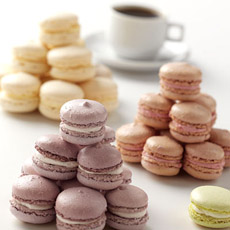
French macarons from L.A. Burdick are meringue sandwich cookies. |
The name of the cookie comes from the Italian word for paste, maccarone (the same base as the word for pasta and dumplings, and the English “macaroni”). Maccarone came to France in 1533 with the pastry chefs of Catherine de Medici, wife of King Henri II. Two Benedictine nuns, Sister Marguerite and Sister Marie-Elisabeth, seeking asylum in the town of Nancy during the French Revolution (1789-1799), paid for their housing by baking and selling macarons, and thus became known as the “Macaroon Sisters” (les Soeurs Macaron). See the history of the macaroon.
MADELEINE
A sponge cake-like cookie baked in a special pan that produces elongated shell shapes. While madeleines are technically cake, the small size enables them to be served with cookies. This French delight is named for Mary Magdalen (the French name for Magdalen is Madeleine). Legend has it that the recipe originated with nuns from a convent once dedicated to her; nuns traditionally raised money by baking and selling sweets. Many people liken the madeleine to pound cake, although it is actually a dense sponge cake (génoise). Madeleines are easy to bake, requiring only a special madeleine pan with shell-shaped depressions. Here’s a madeleine recipe made with a touch of orange liqueur.
|
|
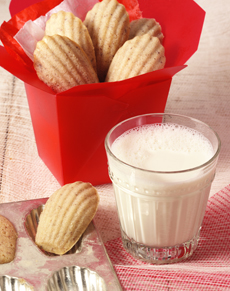
Madeleines, fresh from the pan. Photo courtesy California Milk Advisory Board. |
MALLOW or MARSHMALLOW COOKIE
Mallows are marshmallow cookies; the classic Mallomar from Nabisco is a chocolate-covered marshmallow cookie. The marshmallow is set on a shortbread base or other cookie base; the unit is then covered with chocolate. A layer of caramel can be added between the marshmallow and the cookie.
Mallomars, our favorite store-bought cookie, are only available from September/October through March/April, and never in hot climates, because the chocolate covering will melt. (That’s why the cookie at the right can be enjoyed year-round.)
|
|
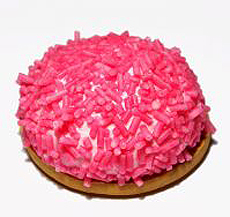
This marshmallow cookie is an Eti Puf Marshmallow Biscuit, a popular Turkish snack consisting of a marshmallow layer on a biscuit base, covered with colorful sprinkles (photo by Jonathan Ruchti | SXC). |
Mallomars were launched by Nabisco in 1913 as a retail alternative to their popular Marshmallow Crème cookies, which were only sold in bulk. The chocolate-covered marshmallow patty on a graham base became a seasonal sensation.
However, here’s a recipe that you can make at home any day of the year (photo © Saveur).
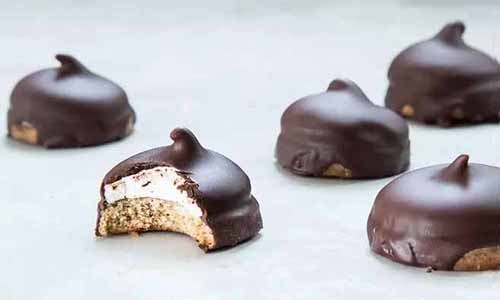
Similar cookies include:
- Fløodebolle, a similar chocolate-covered marshmallow treat that has existed in Denmark since the 19th century. The name is Danish for “cream ball.” A light, marshmallow-like meringue filling sits on a wafer or marzipan base, all coated in chocolate and often topped with coconut flakes or sprinkles.
- Whippets, a Canadian version produced as early as 1901. They remain a popular Canadian treat, especially in Quebec. A soft cookie, marshmallow center, and real chocolate coating is currently available in eight flavors.
- Moon Pie, with its two graham crackers sandwiching marshmallow and coated in chocolate, was also introduced in 1917. It was conceived by Earl Mitchell, a salesman for the Chattanooga Bakery, after a coal miner in Kentucky asked for a large, filling snack “as big as the moon” for his lunch pail.
MANDELBROT or
MANDELBROYT or
MANDELBREAD
Mandelbrot, Yiddish for almond bread, is a relative of the British rusk, the Italian biscotti, and the Ukrainian kamishbrot—all hard dunking cookies sliced from a loaf of dough, then baked.
It’s believed that Ashkenazi Jews from Eastern Europe brought biscotti back from Italy (it was originally made in Prato, Tuscany, Italy during Roman times, as a durable food to take on journeys).
Jewish bakers added fat to the fat-free biscotti to make the dough easier to work with and the cookie not as hard.
- With biscotti, only the eggs bind the dough, and the lack of fat extends the shelf life.)
- However, the fat makes mandelbrot richer and more pleasant to eat on its own without a drink.
The difference between mandelbrot and biscotti:
- The flavoring for biscotti is often anise or almond, while mandelbrot adds sliced almonds, chocolate chips, cinnamon, or walnuts. Sometimes the cookies were dipped in chocolate (our favorite!).
- While biscotti are eaten with coffee or vin santo (sweet wine), Jews swapped the vin santo for tea.
|
|
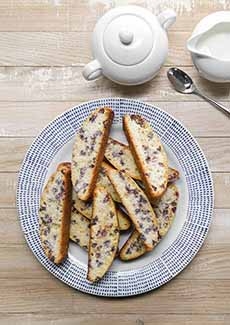
Chocolate chip mandelbrot. Here’s the recipe (photo © Taste Of Home).

Almond mandelbrot. Here’s the recipe (photo © Cooking With Nana Ling). |
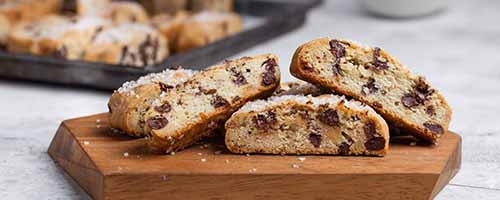 Here’s the recipe
 for this chocolate chip-walnut mandelbrot (photo © King Arthur Baking). Sparkling sugar has been added as a garnish, but it isn’t necessary unless you have a particularly sweet tooth.
MANTECADITO or ALMOND
SHORTBREAD COOKIE
Mantecaditos are butter cookies that are traditional Puerto Rican Christmas fare. They are flavored with almond and vanilla extracts and fresh-ground nutmeg, and decorated with a piece of maraschino cherry. They may also be made with a thumbprint, filled with guava paste or sprinkles. The name comes from the Spanish word for lard (manteca), although modern versions use butter, shortening, or even cream cheese for a richer flavor.
|
|
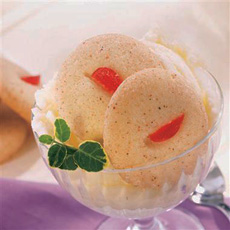
Mantecadito. Get the recipe from McCormick.com. |
MERINGUE
Meringues are airy delights made of egg whites and sugar, baked at a low temperature until crisp. Some modern versions add mini chocolate chips or other flavor accents. According to Larousse Gastronomique, meringue was invented by a Swiss pastry chef named Gasparini, who lived in the small German town of Meiringen. Until the early 19th century, meringues cooked in the oven were shaped with a spoon. It was the great French chef Antoine Carême (1784– 1833) who first had the idea of piping meringue through a pastry bag.
|
|
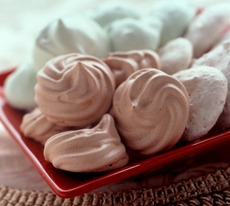
Pink sprinkle marshmallow cookie. Photo by Jonathan Ruchti | SXC. |
MELTAWAY
A meltaway is a delicate, buttery shortbread-style butter cookie made with powdered sugar and also dusted with it. It has a very soft, crumbly texture and actually does melt in your mouth.
A meltaway is a classic “tea cake.” Mexican wedding cakes are examples of meltaways, as are butter balls and pecan balls.
|
|
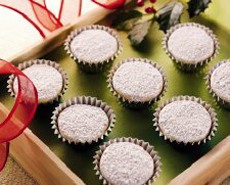
Key lime meltaway cookies. Photo courtesy Wisconsin Milk Marketing Board. |
MEXICAN WEDDING CAKE or COOKIES
A soft, round butter cookie made with powdered sugar, flour, and minced walnuts, and flavored with vanilla. The warm cookies are coated in more powdered sugar. They melt in your mouth.
Mexican wedding cookies are part of a global family of crumbly, buttery “shortbread” cookies that are usually rolled in powdered sugar. Because they are easy to make and travel well, almost every culture has its own version.
|
|
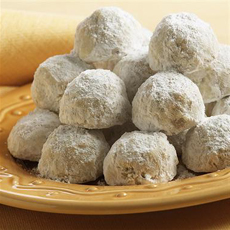
Mexican wedding cake cookies melt in your mouth. Get the recipe from McCormick.com. |
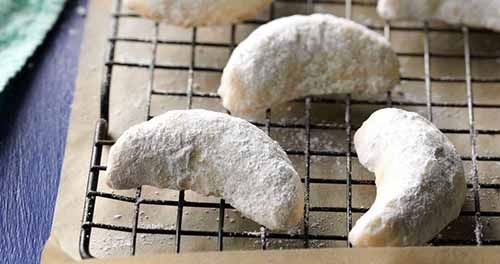
Kourabiedes can be ball-shaped or crescent-shaped. Here’s the recipe (photo © Taste Of Home).
- Kourabiedes (Greek Almond Cookies) are the Greek version, often served at weddings and baptisms. They are typically made with toasted almonds. A key difference is that they are sometimes scented with rose water or brandy (Metaxa). They can be round or crescent-shaped.
- Kurabiye is a broad term for various types of shortbread cookies found throughout the Middle East, Turkey, and the Balkans. Like the others, they are butter-heavy and often include nuts like pistachios or almonds.
- Polvorones, common in Spain and Latin America (including Mexico), are often considered the ancestor of the Mexican wedding cookie. The name comes from polvo, the Spanish word for dust, referring to their crumbly, powdery texture. They are often made with almonds or walnuts and can sometimes include cinnamon or pig lard for a more traditional texture.
- Russian Tea Cakes are virtually identical to Mexican wedding cookies.
- Snowball Cookies or Butterballs are popular in many American households, especially during the holidays.
- Viennese Crescents (Vanillekipferl), popular in Austria and Germany, use a very similar dough but are shaped into crescents rather than balls. They are usually made with ground hazelnuts or walnuts and are coated in vanilla-scented powdered sugar.

Russian tea cakes. Here’s the recipe (photo © Taste Of Home).
MIGNARDISES
Mignardises (min-yar-DEEZ), from the French for “preciousness,” belong to the group of after-dinner cookies called petit fours (French for “small baked pastries”). Friandises (free-yon-DEEZ), from the French for “delicate,” are another interchangeable term. Non-baked confections such as glazed or chocolate-dipped fruit, marzipan, and nut clusters, among others, are also added to the plate. See petit fours.
|
|
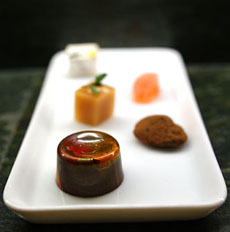
Mignardises. Photo courtesy KevinEats.com. |
MILAN or MILANO COOKIE
A chocolate-filled sandwich cookie; the “Milano” is trademarked by Pepperidge Farm, so the style must be referred to a Milan cookie when created by anyone else. The Milano evolved from Pepperidge Farm’s Naples cookie, a single vanilla finger cookie with dark chocolate icing. In warmer climates and seasons, the stacked cookies would stick to each other. The problem was solved by sandwiching two Naples cookies together. The thin, finger-shaped butter cookies are made with powdered sugar and flavored with lemon and vanilla. Gael Gand has a recipe that you can find on the Food Network website.
|
|
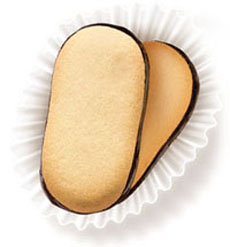
Put the chocolate inside and solve the sticking problem. Photo courtesy Pepperidge Farms. |
MOLASSES COOKIE
A simple drop cookie, molasses cookies are sweetened with molasses and light brown sugar, and flavored with cinnamon, cloves, and ginger. Depending on the recipe, they can be hard (like gingersnaps) or soft and chewy. Learn more about molasses in our Sugar & Syrup Glossary.
|
|
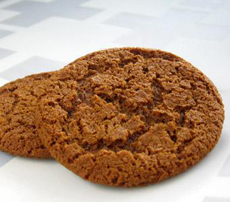
Molasses spice cookies from WannaHavaCookie.com. |
MOLDED COOKIE
One of the eight basic types of cookies, molded cookies are made from a stiffer dough that is molded into balls or other shapes (wreaths, for example, as shown in the photo) before baking. Almond crescents are an example of molded cookies.
MONSTER COOKIE
This cookie is not called “monster” because of its size, but for its lumpy appearance (or perhaps the monster number of ingredients). Take the basic Toll House cookie recipe and add a jar of peanut butter, a half cup of M&Ms, and 1/4 cup of raisins.
|
|
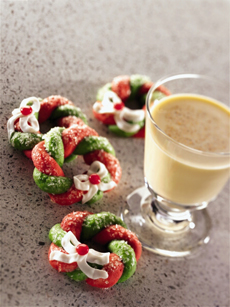
Molded wreath cookies from Wisconsin Milk Marketing Board. Recipe. |
MORAVIAN COOKIE
Moravian cookies deserve the title “wafer-thin”; they are the thinnest cookies to be had. They surfaced centuries ago in the kingdom of Moravia, located in what is now the Czech Republic. The dough is rolled to an almost-transparent thickness; the baked cookies are very fragile. The cookies are made in a number of flavors.
Continue To Next Page: Terms With N
Go To The Article Index Above
|
|
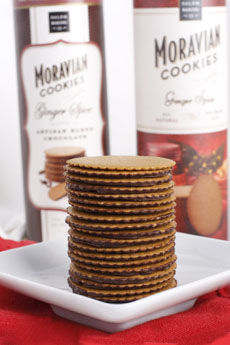
Find Moravian cookies at Amazon.com. Photo by Jaclyn Nussbaum | THE NIBBLE. |
Lifestyle Direct, Inc. All rights reserved. Images are the copyright of their individual owners.
|