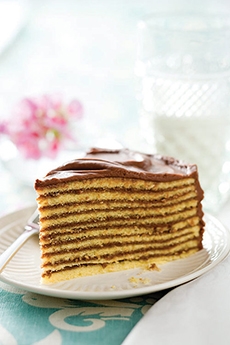
 A Smith Island Cake means lots of layers, lots of frosting (photo © CB Crabcakes).
June 2008
Last Updated June 2026
|
|
Different Types Of Cake
Cake Glossary Page 7: Sacher Torte & Other Cake Terms With S
See the different types of cake on Page 7 of our eight-page glossary, featuring cake terms beginning with S, including Sacher Torte, savarin, and streusel. Click on the letters below to visit other pages.
Click on a letter to go to the appropriate glossary page.
a b c d e f g h i j k l m n o p q r s t u v w x y z
This glossary is protected by copyright and cannot be reproduced in whole or in part.
You are welcome to link to it.
SACHER TORTE or SACHERTORTE
Sacher torte is perhaps the most famous pastry of pastry-rich Vienna. A chocolate sponge cake cut into three layers and filled with apricot jam; the whole cake is iced with a velvety chocolate ganache. Because tortes are wider and shorter than cakes, the three layers are generally shorter than a two-layer gâteau or American cake. Sacher torte was invented in 1832 by a 16-year-old apprentice to pastry chef Franz Sacher (1816-1907), who held his wits under duress.
|
|
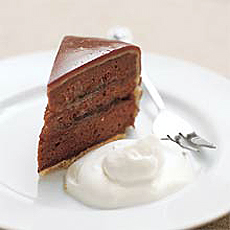
Sacher torte from Burdick Chocolates.
|
The Austrian State Chancellor, Prince Metternich (1773-1859), sent orders to the kitchen to create a new cake. The head chef was out sick, the cooks panicked, and young Sacher rolled up his sleeves and got to work, creating an instant and eternal success. In the U.S., raspberry jam is often used instead of apricot jam.
SALLY LUNN'S CAKE
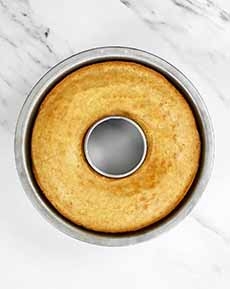
One of the older cakes, baked since the 1600s, Sally Lunn is a sponge cake-like sweet bread that can be baked as a loaf, a tube cake, or buns.
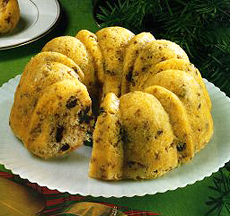
The recipe for this Orange Rum Savarin, originally from the American Egg Board, is no longer on that site, but you can see the recipe here.
SCHAUM TORTE
Virtually unknown outside of Wisconsin, a Schaum Torte is the German equivalent of the Pavlova that originated in Australia. Schaum Torte (meaning "foam cake") is a German/Austrian dessert that consists of baked meringue topped with whipped cream and fresh strawberries. The concept was brought to Wisconsin by German immigrants in the early 1900s.
While the dessert is called a cake (torte), it actually is not. It belongs to its own category, along with Pavlova and Vacherin, called meringue-based desserts or meringue confections. See the discussion under Vacherin.
The main differences between Schaum Torte and Pavlova:
|
|
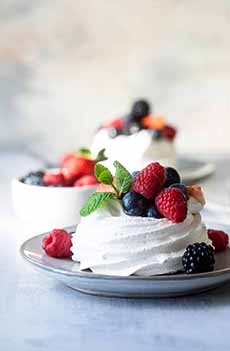
Schaum tortes look like individual Pavlovas. Here's the recipe (photo © Culinary Hill).
|
- Shape: Schaum Torte is often baked as a single large shell in a pan, while Pavlova can be made as one large cake or individual portions, often free-form with peaks and swirls.
- Texture: While both have that crispy-outside, marshmallow-inside quality, Pavlova recipes often include cornstarch and vinegar, which help create its characteristically soft, pillowy center.
- Fruit: Schaum Torte in Wisconsin uses strawberries specifically, while Pavlova is more flexible with fruit, often featuring tropical fruits, berries, or passion fruit in Australia and New Zealand.
- Cultural context: Schaum Torte remains a specifically German-American Wisconsin tradition, while Pavlova has become an iconic national dessert in both Australia and New Zealand.
Also see Vacherin.
SEAFOAM FROSTING
Seafoam frosting is a cloudlike, marshmallow-like boiled icing made from egg whites and brown sugar. It's a brown sugar variation of seven-minute frosting. The brown sugar gives it a light tan color, a glossy sheen, and a subtle caramel or molasses flavor. The name may be a reference to divinity candy, which is sometimes called seafoam candy.
SEVEN-LAYER CAKE
A variation of the Hungarian Dobos Torte, a cake made of five, six, or seven thin layers filled with chocolate buttercream. Also see the Smith Island Cake below, another variation.
SEVEN-MINUTE ICING
A classic, fluffy white frosting made from egg whites, sugar, cream of tartar, light corn syrup, vanilla extract, and water. Since it is not cooked, it has fallen somewhat out of favor with those who are concerned about salmonella; pasteurized meringue powder can be substituted for the fresh egg whites.
SHEET CAKE
A single-layer cake baked in a large, rectangular pan, frosted, and generally decorated. Sheet cakes are baked for large crowds and can be cut into larger squares or into small enough pieces to be served as finger food.
|
|
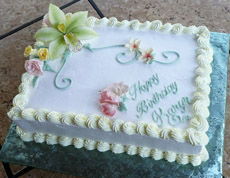
A sheet cake. Photo courtesy of VanillaOrchidCakes.com
.
|
SHORTCAKE
The original shortcake concept, from the U.K., is a sweet, baking soda- or baking powder-biscuit or scone, split in half, piled with fruit (berries and stone fruit are most popular) and whipped cream, and topped with the other half, often with more fruit and whipped cream on top. As the concept evolved, many "shortcakes" are not traditional shortcakes, but sponge cakes or even corn muffins. Compare this biscuit shortcake to the sponge cake shortcake below.
|
|
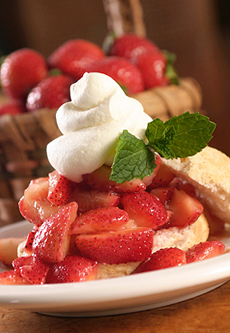
Strawberry shortcake. Photo by Justine Gecewicz | IST.
|
SIMNEL CAKE
A simnel cake is a light fruit cake with marzipan, traditionally made during Lent or at Easter, in the U.K. and elsewhere. It is made from white flour, sugar, butter, eggs, spices, dried fruits, zest, and candied peels; then covered in marzipan, with a layer of marzipan or almond paste baked into the center of the cake. The top is covered with marzipan and decorated with 11 marzipan balls around the rim, representing the true disciples of Christ; Judas is omitted. In some variations, Christ is represented by a marzipan ball in the center. The cake dates to medieval times. The word "simnel" may be derived from the Latin word similia, meaning "fine."
|
|
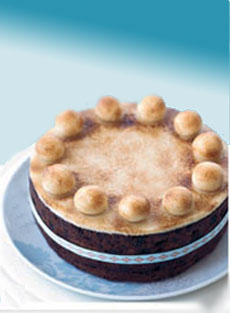
Simnel cake. Photo courtesy Wikimedia.
|
SKILLET CAKE
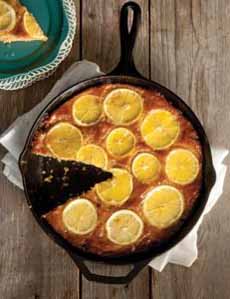
Cakes baked in a skillet were common in the centuries before cake pans and ovens. Batter was poured into the skillet, a lid was added to keep in the heat, and the cake was baked over a campfire or fireplace. While the technique is still used today, to see how primitive these cakes could be, here's a listing from an 1851 cookbook, via Food Timeline:
There was no flour to be had, and corn was ground on a handmill. The meal was carefully emptied from one sack to another, and fine meal dust clinging to the sack was carefully shaken out on paper; the sack was again emptied and shaken, and the process was repeated labouriously time after time until two cupsful of meal dust was obtained. The rest of the ingredients were as follows: 1/2 cup of wild honey, 1 wild turkey egg, 1 teaspoonful of homemade soda, 1 scant cupful of sour milk and a very small amount of butter, to all of which was added the meal dust. The batter was poured into a skillet with a lid, and placed over the open fire in the yard, the skillet lid being heaped with coals.
|
|
|
SMITH ISLAND CAKE
Like chocolate icing? This may be the cake for you. Smith Island, off the shore of Maryland in Chesapeake Bay, is well-known throughout the state for its Smith Island Cake, 6 to 12 thin layers of yellow cake sandwiched with chocolate fudge icing. In fact, it's the official state cake of Maryland!
Originally, the cake (which may date back to the settlers of the late 1600s) had four layers, but through one-upsmanship, the island's bakers piled them up; they are now 10 layers.
Both the cake and the icing use evaporated milk.
Today, they're also available in lemon, chocolate peanut butter, coconut, and lemon from Smith Island Bakery, and in original plus seasonal lemon, strawberry, and pumpkin from CB Crabcakes.
|
|

Smith Island cake (photo © Mackenzie Ltd).
|
SPONGE CAKE
A sponge cake is a light-textured cake made of eggs, sugar, and flour; there is no fat or leavening, but it is critical to beat air in at key stages of preparation. It is baked in cake pans, tube pans, or sheet pans; after it is baked, the airy cake is still flexible and can be used to make rolled cakes such as Bûche de Noël.
The basic sponge cake recipe is also used to make ladyfingers and madeleines; slices are also used instead of biscuits to make strawberry shortcake. Since sponge cakes are not leavened with yeast, they are often enjoyed during Passover, made with matzo meal instead of wheat flour. Sponge cake is a very versatile cake and can be variously flavored and filled. See fillings.
There are some 17 different types of sponge cake. See them all here.
SPONGE ROLL or ROULADE
A sponge cake recipe that is rolled up with a filling. Examples include the jelly roll and Bûche de Noël, or Yule log. See roulade.
|
|
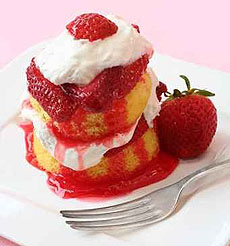
A strawberry shortcake made with sponge layers instead of a biscuit (photo © Barbara Helgasonake | Fotolia).

A classic American sponge cake. Here's the recipe (photo © Taste Of Home).
|
SPICE CAKE
A category of casual cakes that is flavored with one or more of a group of spices that include allspice, cinnamon, clove, ginger, and nutmeg. The cakes are generally darker due to the inclusion of brown sugar and/or molasses.
SQUASH CAKE
A rustic cake with a large crumb that is usually made as a simple loaf or bundt, sometimes with cream cheese frosting. Zucchini cake is an example of a squash cake, although winter squash such as acorn, butternut, sugar pumpkin, and kabocha are also used. Winter squash is cubed, cooked, and pureed, whereas summer squash, like zucchini, and other vegetables such as carrots and beets, are moister and generally grated and added to the batter. The difference between a recipe called "cake" and one called "bread" is that bread is slightly drier (less butter or other fat) and baked in a loaf pan. See our Squash Glossary for the different types of squash. FOOD TRIVIA: While squash is thought of as a vegetable, it is botanically a fruit, defined by carrying its seeds inside. Strawberries are the one exception to the rule.
|
|
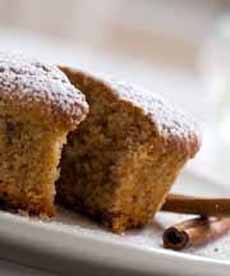
Squash cake. Photo courtesy WholesomeSweeteners. Get the recipe.
|
STACK CAKE
Stack cake is an old-fashioned, rustic layer cake from the Southern Appalachian Mountains. Buttery layers of cake are filled with preserves or cooked fruit, dusted with confectioners' sugar, and served with whipped cream. It is best when made the day before and refrigerated overnight. Then, it's ready to garnish and serve. Stack cake originated as a wedding cake replacement in this economically challenged region. Each guest would bring a layer for the cake, and the bride's family would provide the filling: apple butter or apple preserves were common.
|
|
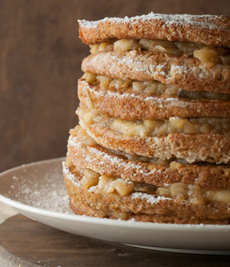
Apple-filled stack cake. Photo courtesy TaylorTakesATaste.com.
|
Go To Next Page: Terms With T - Z
Go To The Article Index Above
|