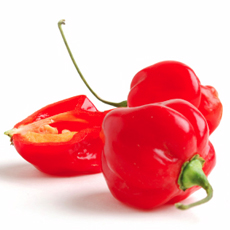
 Hotter by design: The Savina habanero was bred from the habanero to be hotter and larger. Photo by Avriette | Wikimedia.
October 2005
Last Updated July 2026
|
|
Product Reviews / Main Nibbles / Seasonings
Chile Pepper Type
Chile Glossary Page 8: Types Of Chiles ~ R To Z
This is Page 8 of an eight-page article. Click on the black links below to see other pages. See all of our delicious food glossaries.
This glossary is protected by copyright and cannot be reproduced in whole or in part. You are welcome to link to it.
RED BELL PEPPER
See bell pepper.
|
RED SAVINA CHILE
See savina habanero, below.
ROCOTO CHILE
The rocoto comes from the Capsicum (chile) species, C. pubescens, found primarily in Central and South America. The name pubescens means hairy in Latin; it refers to the hairy/furry leaves of the plant.
|
|

Rocoto chile. Photo by Joe Carrasco | Wikimedia. |
|
SAVINA HABANERO CHILE
The savina is a cultivar of the habanero chile (Capsicum chinense jacquin). At 577,000 Scoville Heat Units (SHUs), it is 65 times hotter than the jalapeño; typical habaneros range from 200,000 to 300,000 SHUs. The savina was the record holder as the world’s hottest chile until the discovery of the bhut jolokia, and was featured in the Guinness Book of Records as the “World's Hottest Spice.” The savina habanero was developed and cultivated by GNS Spices of Southern California. It was selectively bred to produce hotter, heavier, and larger fruit. Why? Because of the consumer demand for hotter and hotter.
|
|
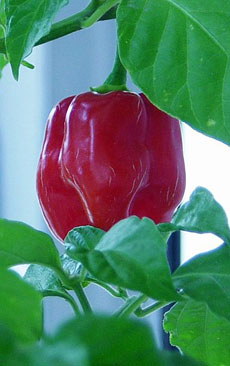
The savina habanero chile. Photo by Avriette | Wikimedia. |
|
SCOTCH BONNET CHILE
A variety of chile similar to, and of the same species as, the habanero. It is found mainly in the Caribbean islands, with a shape resembling a Scot’s bonnet. Most Scotch bonnets have a heat rating of 150,000 to 325,000 Scoville Units. They are used in many different sauces worldwide. If eaten raw by those unaccustomed to eating hot chiles, they can cause dizziness, numbness of hands and cheeks, as well as severe heartburn.
|
|

Woo hoo hot: cute but hot! You can grow your own with these seeds from Burpee (Burpee photo). |
| SCOVILLE UNIT or SCOVILLE HEAT UNIT or SHU
A unit measuring the concentration of capsaicin, the “hot” ingredient in chiles. A measurement of 50,000 Scoville Units means that an extract from the chile can be diluted 50,000:1 with sugared water, and the “burn” of the capsaicin will be barely detectable by the human tongue. The methodology was invented in 1912 by the American pharmacologist Wilbur L. Scoville, who was working on the use of capsaicin in the muscle pain-relieving ointment Heet.
Chiles have capsaicin concentrations from zero (or negligible), i.e., bell peppers, to 580,000 Scoville units, i.e., red savina habanero chiles. More about Scoville heat units and the Scoville Scale.
|
|

Wilbur Scoville, an American pharmacist renowned for developing the Scoville scale to measure the heat of chili peppers (Public Domain photo). |
|
SERRANO CHILE
The serrano chile originated in the mountains of the Mexican states of Hidalgo and Puebla. The name is a reference to the mountains (sierras). The plants have distinctly fuzzy leaves and stems. Unripe serranos, like most chiles, are green when unripe; at maturity, they can be brown, green, orange, red, or yellow. The serrano is a hot chile—8 on a scale of 10. Small and thin, it is popular for its hot, clean flavor with notes of citrus. It can be used cooked or raw, chopped or ground, and is popular in salsas, stir-fries, and particularly with seafood. Serrano is a good choice with Asian dishes, as its flavor blends well with cilantro, garlic, lime, mint, onion, and vinegar.
|
|

Serrano chiles (photo © White Harvest Seed). |
SHIMLA MIRCH
The term for capsicum in India.
SHU
Scoville Heat Unit. See above.
SPORT PEPPER / CHILE PEPPER
Sport peppers are small, slender, pickled green chili peppers that are famous as one of the toppings on a Chicago-style hot dog and on Italian beef sandwiches, another Chicago specialty. At 10,000 to 23,000 Scoville Heat Units (medium heat), the tangy vinegar helps cut through rich meat. About 1 to 1.5 inches long with a pointed tip, they are almost never sold fresh but brined in jars. Pickled Serrano chiles are a good substitute.
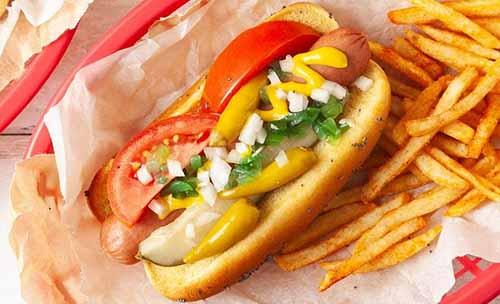
Chicago-style hot dog with sport peppers. Here’s the recipe (photo © Taste Of Home).
TERROIR
Terroir (tur-WAH) comes from the French word for land, terre. It is loosely translated as “a sense of place.” Originally used in the wine industry, the term refers to the special characteristics that each unique climate, microclimate, geography (from latitude and longitude down to the slope of the particular piece of land), and geology (the soil components) can be found in agricultural products grown in the area. The same rootstock planted in different terroirs produces distinctly different flavors and aromas. Conversely, agricultural sites in the same area share similar soil, weather conditions, and so forth, and thus produce similar flavors and aromas.
TRINIDAD MORUGA SCORPION CHILE
One of the two ultra-hot chiles of Trinidad and Tobago. See Moruga scorpion chile. Other local chiles include the Congo Black (chocolate habanero), Congo Red, Scotch Bonnet, Trinidad Bird, and Yellow Habanero.
|