
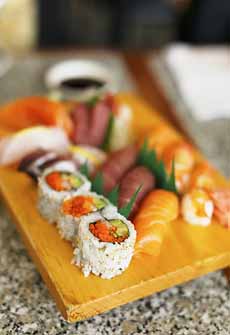
 A geta is the classic wood plate with legs, created for sushi. In recent years the wood, which gets banged up, has been widely replaced by ceramic and glass plates. Photo courtesy TJ Disick | Tumblr.
July 2007
Last Updated August 2025
|
|
Different Types Of Sushi & Sashimi
Page 3: Terms With F & G
Different types of sushi, continued. If you enjoy this Sushi Glossary, we have a food glossary for almost every category of food. Check out the Seafood Glossary, too.
| |
Click on a letter to go to the appropriate glossary page.
a b c d e f g h i j k l m n o p q r s t u v w x y z
This glossary is protected by copyright and cannot be reproduced in whole or part. You are welcome to link to it.
|
|
|
FATTY TUNA (TORO)
Toro, the belly of the bluefin tuna, is the most expensive cut of fish. Interestingly, in the days before refrigeration, it would decompose more quickly in the heat. It was thus considered inferior, and the only people who ate it were impoverished manual laborers.
There are two cuts of toro, otoro and chutoro. Otoro is the fattiest part, found near the head, with a high lipid content and a melt-in-your-mouth texture. Chutoro, located further back on the belly, is less fatty than otoro, offering a balanced flavor and texture with a pinkish hue.
Here’s more about toro.
|
|
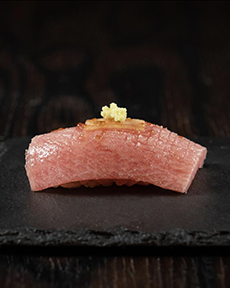
Bluefin o-toto, the fattiest of the fatty tuna cuts (photo © Sushi by Scratch Restaurants). |
FDA REQUIREMENTS TO SERVE RAW OR UNDERCOOKED
FISH PRODUCTS
The FDA Food Code (3-402.11-12) requires that fish that is served raw or undercooked be frozen for the destruction of parasites. The FDA guidelines recommend freezing at or below -4°F (-20°C) for at least 7 days (168 hours), or freezing at -31°F (-35°C) or below until solid and storing at that temperature for at least 15 hours, or freezing at -31°F (-35°C) or below until solid and storing at -4°F (-20°C) for at least 24 hours. These freezing protocols are meant to kill parasites like nematodes or Diphyllobothrium tapeworm larvae, which can be harmful if ingested raw.
Aquaculture—the raising of fish in controlled, land-based operations (like ponds or tanks) or in net pens in open water—may be exempt from these freezing requirements, as they pose a reduced risk of parasites.
|
FISH CAKE
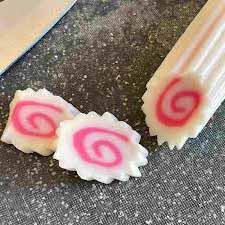
Fish cakes are made in different styles, from plain white to white with a pink border to the fancy style in the photo, at right: a scalloped white cake with a pink swirl. See kamaboko.
Kamaboko/fish cake is a type of surimi, a paste made from fish, and kamaboko is a specific Japanese fish cake made from surimi.
Kamaboko is a traditional form of surimi that is steamed or boiled, often with a pink and white coloring, and has a firm, slightly rubbery texture. Imitation crab, also called crab stick and crab leg, is perhaps the most familiar form of surimi in the U.S.
FORBIDDEN RICE
See black rice.
|
|
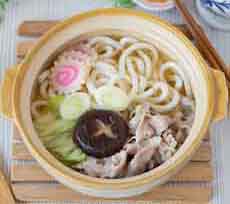
Udon noodle soup is often served with fish cake, the pink and white slice at the top, and in the photo below from Honest Food Talks. Here’s the recipe from Noob Cook.
|
|
FUGU
Blowfish or puffer fish. Its innards and blood contain a deadly poison, tetrodotoxin. In Japan, only licensed fugu chefs are allowed to prepare the fish. It is illegal to import fresh fugu into the U.S.; only frozen fugu is allowed, as any toxins would be killed by freezing. The attraction of fugu is not so much an outstanding flavor, but the novelty of the “near-death adventure.” A master sushi chef will serve every edible part of the fugu—not just the flesh (toro, back, and tail meat) but the liver, intestines, skin, and sperm sac (fugu no shirako). Learn more at JustHungry.com.
|
|
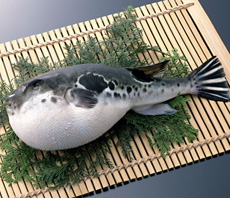
Fugu or pufferfish. Photo courtesy JustHungry.com. |
|
FUKUSA-SUSHI
A style of sushi in which the rice is wrapped in a paper-thin egg crepe.
Fukusa means a parcel or a silk square. Silk fabric squares have long been used in Japan to wrap presents or precious articles—elegant parcels, indeed. Also called chakin-sushi.
It is easy to mistake fukusa-sushi for tamagoyaki, stuffed pieces of tamago. The latter is made as an omelet and is much thicker.
|
|
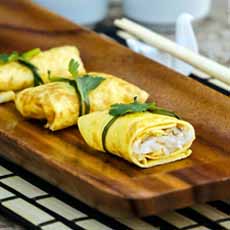
Crepe-thin cooked egg filled with rice and other ingredients. Find the recipe at Sandra’s Easy Cooking. |
|
FUNAMORI
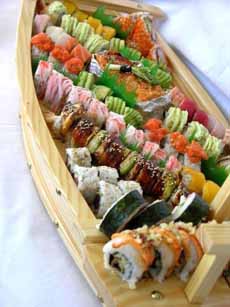
Funamori is a wooden serving piece in the shape of a boat. It is used for large and elaborate presentations of sushi and sashimi.
An alternative design, also carved from wood, is a traditional Japanese foot bridge. (Both shapes have been created in plastic for lower-end sushi bars.)
There is also a boat sushi, a wrap used to contain more fluid items that won’t stay straight on a pad of rice—ikura, tobiko, and uni, for example. See gunkan-maki.
|
|
Fugo or pufferfish. Photo courtesy JustHungry.com. |
|
FUNA-ZUSHI or FUNAZUSHI
Funa-zushi is a type of fermented sushi made using a type of carp (preferably female carp with roe) from Lake Biwa, Japan’s largest lake, which is located in Shiga Prefecture. This regional specialty is characterized by its funky aroma—like ammonia—and flavor like a sharp cheese. Originally made by rice farmers for themselves, it’s the product of fermentation by lactic acid. Written records date to 927 C.E. The dish was also paid as tribute to the Imperial Court. The fish is salted for 2-3 months, layered with cooked rice, and then pickled for another six months, during which time the flesh and bones inside the skin become soft (i.e., rot). This fermentation method, without the use of vinegar, is called nare zushi, the earliest form of sushi. To consume, the rice is removed if preferred, and the fish is sliced thinly.
|
|
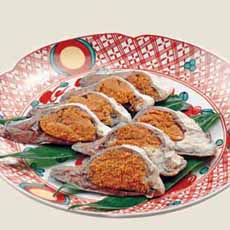
Funazushi from the Shiga Prefecture (photo courtesy Kikkoman). |
|
FUTOMAKI
Japanese for “large roll,” these are oversized rolls, three times the diameter of a standard maki. Sushi bars in America traditionally offer a single “futomaki” often consisting of tamago (omelet), kampyo (sweetened gourd), kanikama (crab stick), and spinach, shiitake, or cucumber, plus a sprinkling of a sweet, pink fish powder called oboro or denbu. However, any sushi can be made as a “large roll.” A former chain of sushi restaurants in the New York City area, called Monster Sushi, has a menu of jumbo sushi rolls for people who prefer their makis “futo.”
|
|
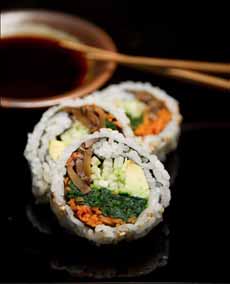
Futomaki, or “ large roll.” Photo courtesy Haru Restaurant | NYC. |
|
GAI
The word for clam. There are many types of clams served at sushi bars; akagai, aoyagi, bakagai, hokkigai (surf clam), and mirugai (geoduck) are often found in the U.S.
GARI
Pickled ginger, served as a palate cleanser between tastes of different sashimi or sushi fish. The word for the ginger root itself is shoga.
|
|
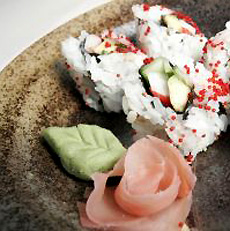
A sushi roll with ari, artistically presented as a rose, with wasabi, artistically presented as a leaf (photo courtesy SXC).
|
|
GEODUCK
Pronounced gooey-duck (photo at right). The neck of the clam, which is sliced and served, can be a foot long or longer. Also called mirugai, a giant clam.
GETA
The block of wood that is traditionally used as a plate at a sushi bar. The original “sushi bars” were portable wagon carts in front of movie theatres, requiring serving pieces that were not breakable (however, they do get dented and otherwise banged up). They can still be found today at sushi bars, although the trend is to replace them with more durable and attractive glass or ceramic plates. See the photo at the top of the page.
|
|
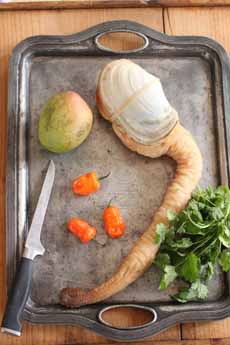
Geoduck, also called mirugai, is a giant clam—as you can see when comparing it to the knife and habaneros. Photo courtesy Japan Times.
|
|
GETO or GHETTO SUSHI
Geto sushi, more commonly spelled "ghetto” sushi, refers to a type of home-made, affordable, or unconventional sushi created with readily available, less expensive, or non-traditional ingredients, like canned tuna, imitation crab, or Spam. It can incorporate ingredients such as cream cheese, different meats, and even leftovers.
It is made without the expensive, high-quality fish typically associated with sushi restaurants. It’s a gun approach that also embraces resourcefulness and creativity to make sushi accessible outside of restaurants.
|
|
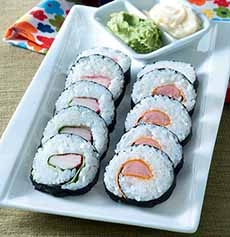
No expensive fish here! These rolls are crab sticks and sausage. Here’s the recipe (photo © Yummy | Philippines).
|
By the way, we think the name is disrespectful and think it should be renamed.
No one is credited with inventing the term; however, a 2008–09 era LiveJournal bento post calling a homemade roll “ghetto sushi,” and a New York Magazine blurb from that same era joked about eating “ghetto sushi from Whole Foods.”
Not funny, folks.
|
GOBO
Burdock root—a long, slender vegetable that looks like a tiny carrot. Often part of an order of oshinko (pickles), it is also an option for a vegetarian sushi roll.
GOHAN
Plain boiled rice (not sushi rice).
GOMA
Sesame seeds, which are sprinkled on particular rolls at the discretion of the chef, are notably kappa maki and uramaki. Shiro-goma are white sesame seeds, and kuro-goma are black sesame seeds.
GOMOKU SUSHI
Another term for chirashi sushi.
|
|
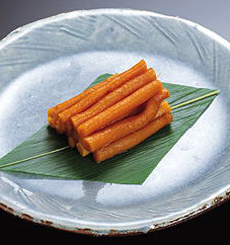
Gobo, or burdock root. Photo courtesy Tenzan.
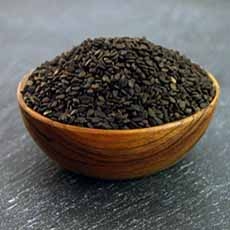
Kuro-goma, black sesame seeds (photo © Marietta Spice Mill).
|
GRADE OF FISH (FOR SUSHI OR SASHIMI)
This is a marketing term referring to top-quality, fresh fish; you need to ask if it has been frozen for parasite control (more about that in a moment). There is no official FDA Standard of Identity for a “sushi grade” or “sashimi grade” of fish. The FDA does, however, have guidelines for the handling of raw or undercooked fish, including sushi and sashimi as well as ceviche, cold-smoked fish, drunken crabs, green herring, herring roe, lomi lomi, poisson cru, and cooked dishes that are served with raw interiors (see FDA, above).
It suggests that food handlers ensure the destruction of microscopic parasites that can cause gastrointestinal infection by freezing the seafood (there are options, e.g., at -4°F (-20°C) or below for 7 days, at -31°F (-35°C) or below for 15 hours, or at -31°F (-35°C) or below for 24 hours. You can read the details here. The irony is, most people think that “sushi-grade” fish is the absolute freshest fish. But it isn’t, because to protect the consumer from parasites, much of it has been frozen. Some fish—mackerel and salmon, for example—are known to harbor higher levels of parasites than others, but these days almost all fish served raw are frozen first.
|
GUNKAN-MAKI
Literally “battleship roll,” the nori is rolled around the pad of nigiri rice to form an oval-shaped cup (which vaguely resembles a battleship) to contain neta, the “liquid” sushi that can otherwise fall off (for example, ikura, oysters, quail eggs, tobiko and uni). Also known as funamori and kakomi sushi.
|
|
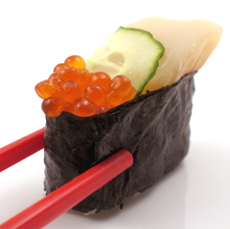
Gunkan-maki, or battleship roll, by Jeanette Lambert | IST.
|
|
GYU TATAKI
Beef nigiri that is thinly sliced and quickly seared at a high temperature to create a slightly cooked exterior while leaving the interior rare. It is typically served with a citrus-based dipping sauce like ponzu.
High-end establishments create it with Wagyu beef.
Wagyu nigiri can also be served raw, without searing.
Continue To Page 4: Definitions H To I
Go To Alphabet Index Bar Above
|
|
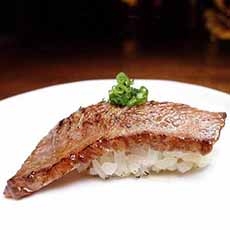
Gyu tataki (photo © O-Ya | Boston).
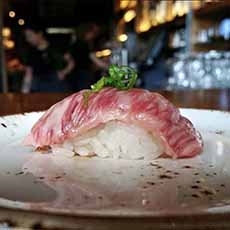
Uncooked wagyu nigiri (photo © Bamboo Sushi | Portland).
|
|


