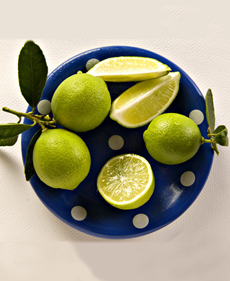
The Bearss lime, which has been largely replaced in supermarkets by the Persian lime. Photo courtesy Whiteflower Farm.
January 2008
Last Updated March 2025
|
|
Learn Your Limes In This Comprehensive Overview & Glossary
Page 2: Lime Varieties ~ A To J
This is Page 2 of a five-page article. Click on the black links below to visit other pages.
Varieties Of Lime ~ A To C
There are both sweet and sour lime varieties (sweet limes are not readily available in the U.S., though they’re a key ingredient in other cuisines). Sour limes contain citric acid giving them an acidic and tart taste. Sweet limes look and smell like acid limes, but lack the citric acid. They thus have sweet flesh and can be eaten like any other sweet fruit.
AUSTRALIAN LIMES
There are three principal Australian limes, the Australian desert lime (Citrus glauca), which has been cultivated as the outback lime (shown at right); Australian finger lime (Citrus australasica); and Australian round lime (Citrus australis). The desert lime, a highly prized bushfood used for marmalades, beverages and glacéed fruit, was typically gathered wild, and has a strong lime-like flavor. Commercial cultivation had begun. The finger lime is long and cylindrical, and fell into vogue as a gourmet bushfood for pickles, marmalade and garnishes. It doesn’t look like anything we’d call a lime, and grows in a variety of colors including black, brown, green, orange, purple, red and yellow. There is much hybridization of limes happening in Australia, including the blood lime (see below).
BEARSS LIME
See the photo on the top of this page, plus Tahitian lime.
BLACK LIME
See Omani lime.
|
|
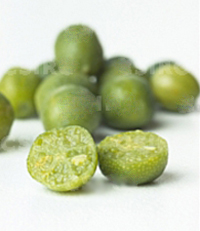
Australian limes (photo courtesy CSIRO | Wikipedia).
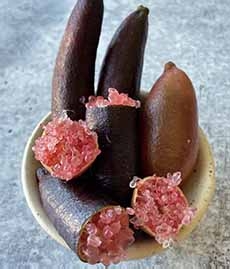
The finger lime, which is filled with caviar-like beads inside, is used as a luxury garnish. There are both green and red varieties (photo © Regalis Foods).
|
|
BLOOD LIME
The blood lime is a hybrid citrus fruit developed in Australia. It is a cross between the red finger lime (Citrus australasica var. sanguinea) and the Ellendale Mandarin, a mandarin and orange hybrid (some sources cite this as the Rangpur lime, Citrus x limonia), which has an orange rind and pulp).
The tree, which can also be planted as an ornamental tree, produces striking, blood-red-colored fruit. It is smaller than most limes and like the blood orange, somewhat sweeter.
|
|
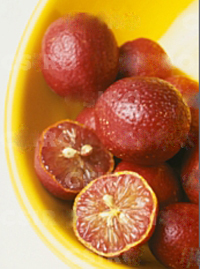
Blood limes (photo courtesy CSIRO).
|
|
CALAMONDIN, CALMONDIN, KALAMANSI or MUSK LIME
Citrus x Citrofortunella mitis is also known as the Chinese, or China, orange; the Panama orange; golden lime; scarlet lime; in the Philippines, kalamondin, kalamunding, kalamansi, calamansi, limonsito, or agridulce; Malayan names include limau chuit and limau kesturi (“musk lime”). In Thailand, it is ma-nao-wan.
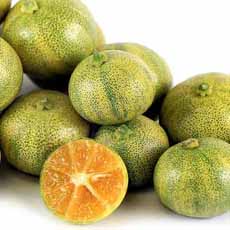
The rind color can be green or orange, even variegated (see second photo); but the flesh inside is orange in color.
The calmondin, with acidic juice, has wide culinary use. People with access to calamondins use them in cranberry sauce, chutney, and marmalade (Robert Lambert uses them in his five-lime marmalade, and calmondin-kumquat and calmondin-papaya blends are popular). Wedges are served with iced tea, seafood, and meats, and were commonly served with beverages in Florida before limes became widely cultivated.
The preserved peel is added as flavoring to other fruits stewed or preserved; the juice is used in beverages, gelatin dishes, and custard pie or chiffon pie.
|
|
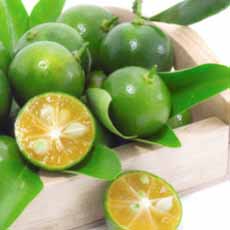
Above Calamondin orange, an orange of many other names (photo Fotolia). Below, a variegated skin (photo courtesy Specialty Produce).
|
Continue To Page 3: Lime Varieties K To L
Go To Article Index Above
|