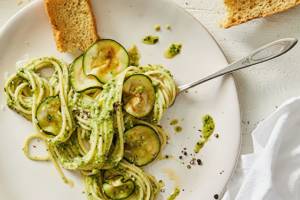
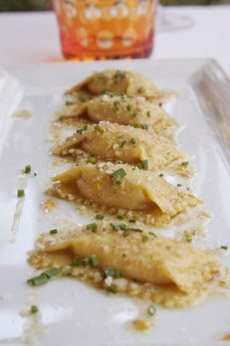
 Agnolotti are stuffed pasta in half-moon shapes. In this fancy creation, the half-moon has been superimposed on a ravioli rectangle. Photo courtesy of MushroomInfo.com (the recipe is on the website).
Last Updated April 2026
|
|
Pasta Types: A Pasta Glossary
Pasta Terms From A (Agnolotti) to Z (Zitone):
A Vast World Beyond Linguine
If you love pasta, you’ll love learning the terms you don’t already know. For a visual chart of the different pasta shapes in this glossary, see our article on pasta shapes.
While this glossary includes international pastas, from Asian rice sticks to Polish pierogies, most of it focuses on Italian pasta. Think of Italian pasta in these general categories:
- Long-form pasta or strand pasta. Anything spaghetti-like that you can twist around your fork. These pastas are made in varying widths, from the thinnest angel hair to the plumpest bucatini. They can be round or flat (see ribbon pasta, the next bullet), solid or hollow, like bucatini.
- Ribbon pasta. A sub-category of long-form (strand) pasta. These are the flat cuts. Fettuccine, lasagna, linguine, and tagliatelle are the better-known ribbon pastas.
Short-form pasta takes several forms:
- Tubular pasta. From tiny to jumbo, smooth or ridged (“rigati”), straight-cut or diagonally cut [in this category, the seemingly same size pasta will have a different name if the ends are straight-cut versus diagonally cut]. Elbows, manicotti, penne, and rigatoni are well-known cuts.
- Shaped pasta. Farfalle (bow ties), fusilli (corkscrews), and ruote (wagon wheels) are prominent examples. There are endless ways to twist and curl and shape pasta, hence the hundreds of regional varieties.
- Stuffed pasta. This group includes agnolotti, mezzelune, ravioli, tortellini, and “dumpling” pasta like gnocchi.
|
The more unusual pasta shapes are available from companies like AGFerrari.com, IsolaImports.com, and PiccoloGastronomia.com. Specialty fresh pasta can be ordered from AlfonsoGourmetPasta.com. For the widest variety of flavored linguini and fettuccine, see RossiPasta.com. For a large number of pasta shapes seldom seen here, visit Food-Info.net.
Each region of Italy developed its own specialties. We have identified them by region as much as possible and provided some information on the main regions whose pasta we’ve highlighted. Here’s a map of all of Italy for reference.
|
|
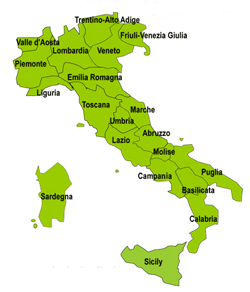
Map courtesy of Olio2Go.com. |
If you enjoy this Pasta Glossary, we have a food glossary for almost every category of food, including Italian favorites like cheese, espresso, and olive oil. Plus, find reviews of our favorite brands of pasta and sauces, pasta recipes, and informative articles about pasta in our Pasta Section.
| |
Click on a letter to go to the appropriate glossary section.
a b c d e f g h i j k l m n o p q r s t u v w x y z
This glossary is protected by copyright and cannot be reproduced in whole or in part.
|
|
ACINI DI PEPE
The name literally means “peppercorns,” referring to small balls of pasta used in broth.
AGNOLOTTI
Pronounced ah-nyo-LUH-tee, the shape is from the Piedmont region of Italy. It is made with small pieces of flattened dough folded over a filling of cheese, meat, or vegetables. Agnolotti is the plural of the Italian word agnolotto. The origin of the name may come from Angelot, a chef from the town of Montferrat, who is credited with creating the shape.
|
|
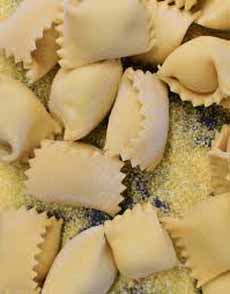
Agnolotti: Here’s a recipe from The Kitchn. Also, see the photo at the top of the page. |
AL DENTE
The famous phrase, pronounced ahl-DEN-tay, literally means “to the teeth” in Italian. Pasta is considered cooked to an ideal degree of doneness where it is firm but not hard. The term refers to the need to chew the pasta due to its firmness.
AL FORNO
Literally, “in the oven,” this term refers to baked dishes. These include cannelloni, lasagna, macaroni and cheese, manicotti, stuffed shells, and others. The pasta is boiled first, then stuffed (as appropriate), sauced, and finished in the oven.
ALPHABETS or ALFABETO
Small pasta in the shapes of the alphabet, used for children’s soups.
AMATRICIANA SAUCE
Amatriciana sauce, or sugo all’amatriciana (ah-mah-tree-CHYA-na), is a traditional Italian tomato sauce that incorporates guanciale (dried pork cheek—pancetta can be substituted) and pecorino cheese. It originated in the town of Amatrice in central Italy (in the Lazio/Latium region in which Rome is located. While Rome is close to the west coast of Italy, Amatrice is right in the center of the country, between the two coasts. See the photo below.
ANELLINI
Literally, “small rings,” tiny rings of pasta for soup.
|
ANGEL HAIR or CAPELLI D’ANGELO
Angel hair is the thinnest of all pasta—long, fine, delicate, round strands. It is best used with thinner, more delicate tomato-based and broth-based sauces (or simply tossed with butter or olive oil). It is used in Asian dishes as well (for example, mai fun). Because it is so thin, it cooks in just two minutes. Use angel hair for light entrees and side dishes. Neapolitans serve it with shrimp and vegetables. Ligurians like it with basil pesto; Venetians serve it with creamy asparagus sauce. Any additions—vegetables, seafood, poultry—should be finely chopped to match the delicacy of the strands.
|
|
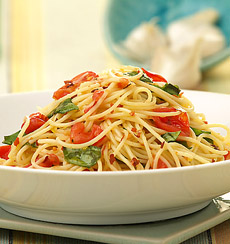
Angel hair pasta is the thinnest cut of strand pasta (photo © Barilla). |
|
ANIMA
Literally the “soul” of the pasta, the white uncooked core. If the anima is large, the pasta is not thoroughly cooked. If it is a small dot, the pasta is al dente and ready to be eaten.
ARMONICHE RIGATONI
These ridged cylindrical pasta, pronounced ahr-moe-NEE-kay, are one of the most interesting and attractive shapes, excellent for catching sauce. It was given its name, which translates to “harmonica,” because the ruffles are reminiscent of the ridges and grooves in the instrument.
|
|
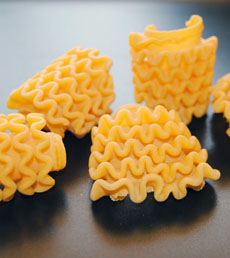
Armoniche (photo © Gastronomia y Cia. |
|
ARABBIATA
A classic spicy tomato sauce preparation, often found as Penne all’Arrabbiata, that includes garlic, basil, and a hot chile pepper. Arrabbiata means “angry” in Italian; the hot chile provides the “anger.”
|
|
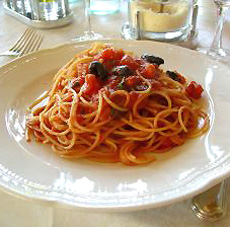
Photo of Spaghetti all’Arrabbiata, courtesy of SXC.
|
ARTISAN PASTA or ARTISANAL PASTA
While artisanal producers, making small batches of higher-quality pasta, use the same basic ingredients as larger commercial producers, there are two key differences that create a better-tasting, “connoisseur” product. First, they extrude their pasta through bronze dies that leave microstriations (ridges, grooves, etc.) to capture and hold the sauce. Second, they dry the pasta at lower temperatures. While this takes longer, it preserves the fine flavors of the wheat.
|
ASIAN NOODLES
Asian noodles are available in a wide variety of shapes and sizes. They can be made of wheat, rice, or buckwheat flour, mung bean threads, arrowroot starch, bean curd skin, sweet potato starch, and tofu. Some Chinese noodles contain eggs, e.g., Chinese egg noodles, although the majority of Asian noodles do not. Unlike Italian noodles, Asian noodles are generally not eaten with sauce on top, but are stir-fried or used in soups and salads.
The types of Asian noodles and the difference between noodles and pasta.
|
|

Soba noodles, made from buckwheat, are a Japanese specialty. Here’s a recipe for this soba and edamame bowl (both photos © Taste Of Home). |

Pad Thai can be eaten as a vegetarian dish or with your protein of choice. Chicken and shrimp (in photo) are the most popular. Here’s the recipe. National Pad Thai Day is celebrated annually on November 7th.
The year’s 20+ pasta and noodle holidays.
BLÉ NOIR
The French term for buckwheat flour (see below). Buckwheat is a whole grain flour.
BLUSH SAUCE or PINK SAUCE or ROSÉ SAUCE
Blush sauce is a rich, velvety Italian pasta sauce made by blending a tomato-based sauce with cream. They merge to create a pink-colored sauce that combines the acidity of tomatoes with the richness of the cream. In addition to pasta, it’s often used with chicken or shrimp.

Blush sauce on penne pasta. Here’s the recipe (photo © Taste Of Home).
BOLOGNESE SAUCE
Ragù alla bolognese (pronounced rah-GOO ah-lah boe-loe-NYAY-zee), as it is known in Italy, is a tomato-based sauce made with ground pork, beef, and pancetta.

You can make bolognese sauce with other meats, like this Turkey Bolognese. Here’s the recipe (photo © Taste Of Home).
BOW TIE PASTA
See farfalle.
BRONZE CUT PASTA
Pasta extruded (pushed out during the shaping process) through special bronze dies, which is the old-fashioned method. High-production methods use steel dies. Bronze dyes leave a rough surface on the pasta that helps sauces cling better. The more textured mouth feel is also appreciated by connoisseurs.
|
BUCATINI
From “buco” for hole, hollow, bucatini (boo-cah-TEE-nee) are spaghetti-like strands of pasta that are thicker than spaghetti, with a thin, drinking straw-like hole down the center. They can be ridged (bucatini rigati). Bucatini originated in central Italy, but became popular in Rome, especially in the classic dish, Bucatini alla’Matriciana, which has a light, spicy sauce made of tomatoes, pancetta, red pepper flakes, and grated Pecorino cheese.
|
|
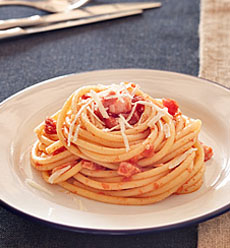
Bucatini with Amatriciana Sauce. Photo courtesy Barilla. Get the recipe. |
|
BUCKWHEAT
Neither a wheat nor a grain (because it is not a member of the grass family), buckwheat was first cultivated in Southeast Asia. The flour is noticeably darker than wheat flour and has been known as blé noir (pronounced blay nwahr, French for “black flour,” an exaggeration). The flour is produced from the seed. Buckwheat pancakes are known as blini in Russia, galettes in France, and ployes in eastern Canada. In Europe and Eurasia, the seed is also made into buckwheat groats, also called kasha. Buckwheat is gluten-free and can be eaten by people who have adverse reactions to gluten.
|
|
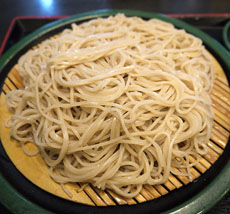
Soba noodles are the most prominent buckwheat noodles. Photo by TopPot | Wikimedia. |
Buckwheat is also a good honey plant, yielding a dark honey that captures the distinctive, earthy buckwheat flavor.
Continue To The Next Page: Pasta Terms C & D
Go To The Glossary Alphabet Index, Above
© 2005-
|