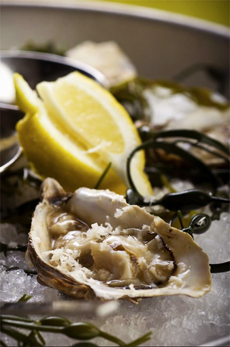
Oysters on the half shell garnished with fresh grated horseradish. Photo courtesy Arch Rock Fish | San Francisco.
July 2007
Last Updated July 2014
|
|
Types Of Oyster
Oyster Glossary Page 6: Oyster Types Beginning With J To N
CAPSULE REPORT: This is page six of a nine-page article about the types of oyster. Here, oyster types beginning with J to N. Click on the black links below to visit other pages. Also visit our many other food glossaries that focus on other favorite foods, including a 13-page Seafood Glossary.
JAPANESE OYSTER
See Pacific oyster.
KUMAMOTO OYSTER
Crassostrea sikamea is originally from only one bay, Kumamoto Bay off Kyushu, in the Kumamoto prefecture, the southernmost island of Japan. It was brought to the West Coast for cultivation in the early 20th century. In the U.S. it is grown only on the West Coast, in California, Oregon and Washington. In the past, few farms grew the Kumamoto, as it grows quite slowly. While Pacific and Virginica oysters are called by numerous other names based on region, Kumamotos are always known as Kumamotos (or “kumos” for short). An immensely popular variety, Kumamotos are known for their small size, deep cup, creamy texture and cucumber-melon finish. |
|
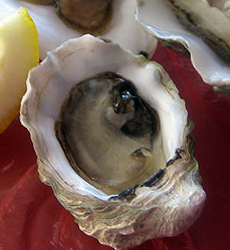
Kumamoto oyster. Photo by Melody Lan | THE NIBBLE. |
As with any oyster, Kumamotos vary from region to region and the differences can be noted among Kumos from Baja California, Humboldt Bay and Puget Sound. Because of their popularity, many oyster farmers have adapted a farming method known as tumbling to make Pacific oysters more like Kumamotos in shape, size, and even flavor.
LYNNHAVEN OYSTER
A variety of Virginica oyster named after an area of Virginia Beach, Virginia that runs across Chesapeake Bay, where it is harvested.
MALASPINA OYSTER
This thick-shelled Pacific oyster is grown on the beach on an isolated part of Canada’s Sunshine Coast, about 150 miles north of Vancouver, and farther up the coast from Fanny Bay. Like Fanny Bay, the water is very cold, imparting saltiness to the flesh. The water is nutrient-rich, so the flesh is robust. The first bite is salty, then the flavor moves to sweet and ends with the familiar Pacific northwest cucumber finish. Available from September to July.
MALPEQUE OYSTER
A variety of Virginica oyster that grows wild in Malpeque Bay on Prince Edward Island, a Canadian province north of the Nova Scotia peninsula and east of New Brunswick. It is considered to be one of the saltier oysters due to the coldness of the water. It is very popular in Europe, where it has won many awards for its flavor and texture. Its very delicate texture is said to almost dissolve in your mouth. The meat has a very crisp, lettuce-like flavor with a clean finish. It is available from May to November.
MARENNES OYSTER
Known as “les vertes” (the green ones), the famous emerald green-tinged oyster of France is designated as the most superior quality oyster. It spends months in special refinement basins, called “claires,” where it feeds on a micro-algae species called the Blue Navicula (Navicula ostrea or Haslea ostrearia). In addition to color, this refinement gives it a sweeter, more flavorful meat. Marennes-Oléron, located on the Bay of Biscay in the middle of the Atlantic coast of France, is by far the largest oyster cultivation area in Europe, accounting for approximately 45% of the entire French oyster industry. Only a small portion of production comprises the costly “les vertes.” Originally home to the European (or flat) oyster, a population that is now decimated, Marennes-Oléron now grows the Pacific oyster.
|
|
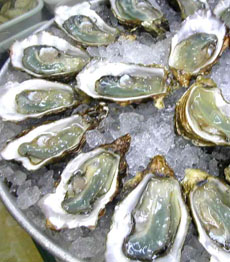
It’s not easy being green. That’s why only Marennes oysters have green-hued flesh. Photo courtesy Sashimi.eu.com. |
MERROIR
A riff on terroir, merroir refers to the flavors imparted to the oyster by different areas of the sea, including the types of seaweed it eats.
MIGNONETTE SAUCE
A light, elegant sauce for oysters on the half shell. It is easily to make. For three dozen oysters, reduce by half in a saucepan 1/2 cup dry white wine and 1 tablespoon of sherry vinegar. Turn off the flame and add one finely-chopped shallot and fresh-cracked white pepper. Some people add salt; others don’t, as oysters have natural salinity. Serve in small ramekins. Mignonette sauce is typically spooned on top of the oysters, rather than used as a dipping sauce.
|
|
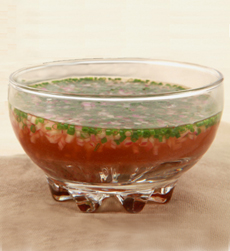
Mignonette sauce. Photo courtesy CBC. |
MIYAGI OYSTER
Another name for the Pacific oyster or Japanese oyster, Crassostrea gigas, native to the Pacific coast of Asia. It has been introduced to Australia, Europe, New Zealand and the West Coast of North America. Miyagi oysters are beach-farm raised, growing to thee inches in length. A classic Pacific oyster, they have heavy fluted shells with with deep cups, full and crisp meats. Pacific oysters are the most widely farmed oysters in the world, since they adapt to new environments readily and are easy to grow (and fast growing). They are more robust than the Japanese Kumamoto and Kusshi oysters.
MOUNTAIN ISLAND FLAT OYSTER
A flat oyster (Ostrea edulis), cultivated in the narrows of Blind Bay, Nova Scotia, Canada raised in the traditional French manner called rack and bag, like the Belon. Very firm in texture and slightly salty with sweet meat, these oysters have distinctive mineral finish. They are available year-round.
NOOTKA OYSTER
Nootka Sound is located a bit more than halfway up the west coast of Vancouver Island, British Columbia—an extremely remote, rugged and windswept location where these thick-shelled Pacific oysters are cultivated on the beach. They are trucked over a logging road across a mountain range to the ferry to the mainland, so that some lucky people can enjoy an oyster with flesh that is salty, plump and rich, sweet with a cucumber finish. Available from September to July.
Continue To Page 6: Types Of Oysters Beginning With J To N
Go To The Article Index Above
|