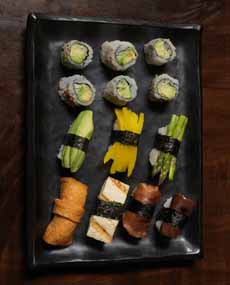
 Nigiri isn’t just made from fish. This plate is all vegetarian/vegan. Underneath the avocado roll at the top are avocado, takuwan, inari, tofu, mushroom, and kampyo nigiri (photo © Haru Sushi | NYC).
July 2007
Last Updated March 2026
|
|
Sushi Sashimi
Page 6: Nigiri Sushi, Oskinko, Philadelphia Roll Other Terms With N, O, P
If you enjoy this Sushi Glossary, we have a food glossary for almost every category of food. Check out the Seafood Glossary, too.
| |
Click on a letter to get to the appropriate glossary page.
a b c d e f g h i j k l m n o p q r s t u v w x y z
This glossary is protected by copyright and cannot be reproduced in whole or in part. You are welcome to link to it.
|
|
NAMA
A prefix that means raw. (The same prefix applied to beer, nama-biiru, means draught.)
|
NAMA-TAKO
Fresh or raw octopus. Most octopus served in sushi restaurants in the U.S. is frozen. Since it is too chewy to be eaten raw, it is lightly cooked.
NANAMI TOGARASHI
A table spice made of seven ingredients: black hemp seeds or white poppy seeds, dried mandarin orange peel, ground sansho pepper pods (which provide heat), nori seaweed bits, red pepper (togarashi), and white sesame seeds. You can buy it at Asian grocers or online.
|
|
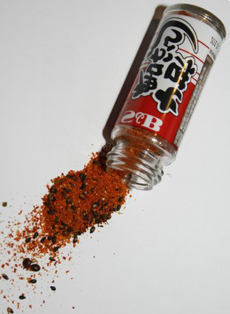
Nanami togarashi is a spice made from seven ingredients (photo © Spice World).
|
|
NARE-ZUSHI or NAREZUSHI
The earliest form of sushi, known today as nare-zushi (“fermented sushi”), was developed in Southeast Asia before the common era (B.C.E.). It was a preservation technique that enabled the storage of fish, an important source of protein. Salted fish was packed with fermented rice in alternating layers in a wooden box. This preserved the fish for six months to a year [source]. The lacto-fermentation of the rice prevented the fish from spoiling. The rice, which was by then inedible, would be discarded before serving the fish. The fish had a sour and umami flavor profile and is still made in Japan.
This type of pressed sushi was reserved for the wealthy due to the time and labor involved in preparation.
The technique spread to South China and arrived in Japan in the early 8th century C.E. (source). Vinegar began to be added to the preparation during the Muromachi period (1336–1573), the period of shogun rulers. By the 1600s, pressed sushi in vinegared rice enabled the rice to be eaten, rather than discarded. This practice reached Edo (modern Tokyo) by the 18th century.
The vinegar both shortened the fermentation process and enhanced the flavor of the fish. Each region of Japan developed its own style, based on local fish and climate. Over centuries in Osaka, it evolved into oshi-zushi: fish pressed with vinegared rice into wooden molds (square, rectangular, round), then sliced and served.
It was in Edo that contemporary sushi was created by Hanaya Yohei (1799–1858), at the end of the Edo period (which spanned 1603 to 1868). He bypassed all fermentation to prepare sushi very quickly, on a hand-molded pad of rice with a swipe of wasabi. It was shaped for convenient eating as finger food. This street food is sold in stands in marketplaces and other gathering spots. The niceties of chopsticks came when sushi became restaurant food (Yohei opened his own restaurant). The style, originally called edomae zushi: edo for the city and mae* for the freshly caught fish from Tokyo Bay.
|
|
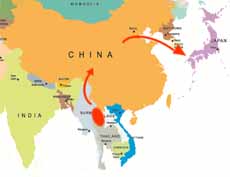
The origin of nare-zushi is somewhere in the area of what is now modern Burma and Laos (image © Livedoor Japan).
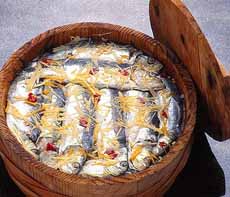
Nare-zushi, here sardines are stored in fermented rice. Photo via Kotaro Tashiro | Pinterest.
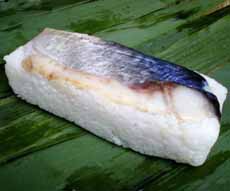
Narezushi was preserved on fermented rice, which was not edible (photo Otlob Blog | WordPress).
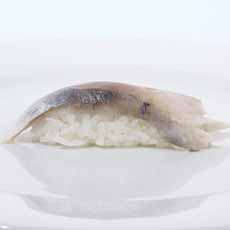
Modern nigiri zushi on a pad of edible rice.
|
After the Great Kanto Earthquake leveled Tokyo in 1923, its sushi chefs spread throughout the country and set up establishments. Sushi was no longer street food, but a special restaurant meal.
_____
*Mae means “front,” and “caught in the front” refers to the waterfront of Tokyo Bay.
|
NASU
Eggplant.
NATTO
Natto is boiled, fermented soybeans. It is a traditional food usually consumed along with miso soup, fish, and rice. The soybeans are used in sushi rolls, gunkan maki, and inari sushi pockets, shown in the photo, where they are mixed with scallions. (Get the recipe from ShizuokaGourmet.com.)
Natto has a very strong taste and aroma that is a challenge for some Westerners to appreciate. However, as a fermented food, it is rich in macronutrients and micronutrients.
|
|
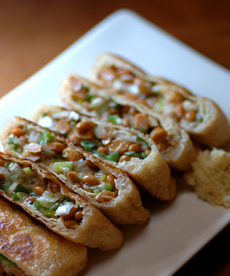
Natto and scallions in a bean curd wrap (inari sushi). Photo © Shizuoka Gourmet.
|
|
NARUTO
A roll (maki) wrapped in cucumber instead of nori seaweed. See the photo at right. Naruto is also the word for the white fish cake with a pink swirl, called kamaboko. The cucumber rolls are called naruto because the cucumber wrap resembles the swirl or “whirlpool,” which is often associated with the fish cake
NEGI
Scallion or green onion. It is typically minced for sushi and sashimi.
|
|
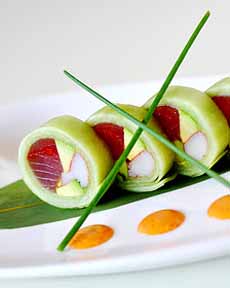
A naruto (cucumber wrap) roll with maguro, crab stick, and avocado. Photo courtesy Okko | Hilton Head.
|
|
NEGI-TORO
Chopped toro and scallions are a popular mixture for rolls and hand rolls. Given the price and delicacy of toro, however, it’s better to eat it as sashimi or sushi without the scallions. Most sushi bars in the U.S. serve negi-maguro, the dark red tuna called tekkamaki when in a roll. The word tekka means hot iron, alluding to the color of maguro (photo at right).
NETA
Neta refers to sushi made with varied ingredients: seafood, vegetables, and sometimes, fruits.
|
|
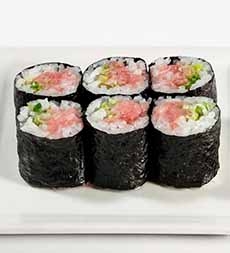
Negitoro: chopped toro tuna and scallion (photo © Blue Ribbon Sushi). |
|
NIGIRI-SUSHI
A pad or “finger” of vinegared rice upon which a slice of fish or other topping is layered. This style was developed in Tokyo, then known as Edo, at the beginning of the 19th century, and was served at food stalls. It is also known as Edo-style sushi or Edomae-zushi.
Modern sushi was created by Hanaya Yohei (1799–1858) at the end of the Edo period. Previously, fresh-caught fish from Tokyo Bay was fermented in rice before consumption.
In this era before refrigeration, Yohei prevented spoilage by slightly cooking or marinating the fish in soy sauce (shoyu) or vinegar (su). He placed the fish on pads of vinegared (su) rice (shi), the style that became known as nigiri sushi. This new sushi could be prepared very quickly and eaten with one’s fingers.
|
|
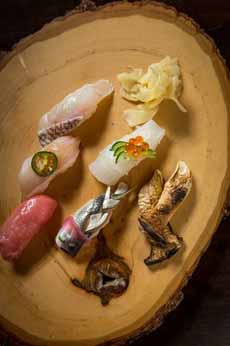
Nigiri-sushi is artistically displayed on a wooden slab. On the right are grilled king trumpet mushrooms(photo courtesy Sushi Seki | NYC).
|
One of the first big consumer groups was gamblers, who could roll the dice with one hand and eat with the other. Those with more finesse used chopsticks (hashi).
Tidbit: The word nigiri derives from the Japanese verb “to grasp.” Unlike slicing sashimi or rolling a maki, the sushi chef has to grasp and squeeze the pad of rice before topping it with fish.

One of our favorite foods: a beautiful nigiri platter (photo © Chef’s Plateform).
NIJIMASU
Rainbow trout. Regular trout is masu.
|
NORI
These dried sheets of purple laver seaweed (a highly nutritious, edible red seaweed of the Porphyra species, P. yezoensis and P. tenera) are known for their savory, umami-rich, and slightly nutty flavor. They’re used in the preparation of sushi rolls, known as norimaki, and onigiri (see below).
The seaweed is harvested, washed, spread to dry, shredded, and pressed into thin sheets (like the process for making paper), typically 8 x 8. The sheets are then toasted to enhance the flavor, texture, and color of the seaweed. When toasted, the seaweed becomes black with green highlights.
Low in calories and fat and a source of fiber, protein, iodine, and omega-3 fatty acids, it is also packaged as a snack food.

Salmon futomaki (photo © Choi).
|
, |
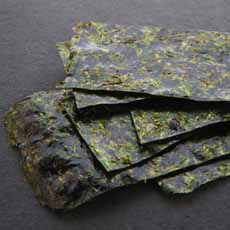
Strips of nori are typically sold in packages of 8-inch squares, which are cut into strips to wrap around sushi. Photo © RDNZL | Fotolia.

Sushi rolls (maki) are almost always rolled in nori. The exception is naruto roll, (see above), which uses a thin cucumber wrap.
|

Without nori, there’d be no sushi rolls (photo © Choi | Dae Chun Foods).
|
NORI-TAMA (TAMAGO)
Nori-tama is a slice of tamago sushi wrapped in a strip of dried seaweed (nori). See tamago for how it is prepared.
Each sushi bar makes its own tamago, and recipes can vary in small ways: the amount of sweetness, doneness (the piece in the photo has darker marks in the yellow, indicating “well done”), and the degree of artistry in which the omelet is folded.
Tamago is also served in slices as sashimi.
|
|

This creative recipe has bits of red pepper (photo © Max Griss Unsplashi). |
 Here’s a recipe
 to make your own (photo © Japanese-Cooking 101).
|
OCHA
Tea. In Japan, this is implicitly green tea. There is no single green tea. As with black tea, there are different origins, and different ways to treat the leaves to engender different flavor notes. Here’s more about green tea.
ODORI-EBI
“Dancing shrimp” are ama-ebi served and eaten alive. A Japanese custom, they are generally not served in U.S. establishments catering to Americans.
OHBA
Another word for the Japanese beefsteak plant, shiso.
|
|
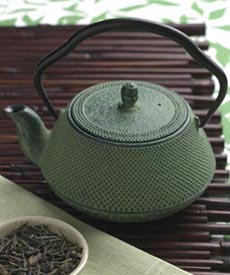
Serving ocha—tea—in a tetsubin, an iron Japanese teapot (photo © Harney Tea). |
|
OHITSU
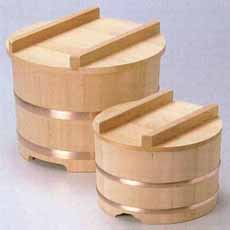
Ohitsu is a special container to keep the sushi rice warm: a traditional round wood tub with a lid. The cooked rice is said to taste substantially better when placed in the ohitsu. Different regions use different styles originated by local craftsmen.
The style in the photo is from Sawara, a town in the Chiba Prefecture that prospered during the Edo Period (1603-1867) as a transport hub for rice shipments.
Today, some sushi bars and home cooks use electric rice warmers.
|
|
A gorgeous omakase from an artistic sushi chef. Photo © Japan Arts And Crafts. |
OHYO
Halibut.
|
OMAKASE
Chef’s choice—pronounced o-MAH-kah-SAY. The chef prepares a selection based on the available fish of the day and his personal preferences. See the photo at the top of the page. In addition to sushi, other courses—oshinko, tsukemono, a fruit dessert, etc.—are part of the meal. The Western equivalent is the tasting dinner.
|
|
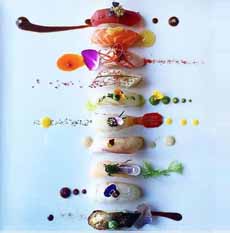
A gorgeous omakase from an artistic sushi chef. Photo © Chefs of Instagram.
|
OKONOMI
The practice of ordering sushi a few pieces at a time. The opposite is moriawase† (mo-di†-a-WAH-say), ordering a full plate of sushi. Also see omakase, above.
__________
†The flipped “r” is best pronounced like “d” for English speakers.
|
ONIGIRI or OMUSUBI
Rice balls or other shapes (squares, triangles) are made with plain steamed rice and packed with various seasonings and stuffings: cooked fish and vegetables, ume (plum paste), roe, shredded nori, sesame seed, and others (in the U.S., tuna salad with mayo is often found, as well as cooked chicken).
They are often purchased as convenience food, although some restaurants make artistic variations, as in the top photo.
Some can be wrapped in nori or decorated with shredded nori, as in the photo of the ume rice ball, shown with two slices of pickled radish (takuwan).
In the early days of sushi, the fish was placed over balls of rice before the technique of flattened pads of rice (nigiri) was developed. However, modern rice balls are not sushi, because they are made with steamed rice—the kind served with sashimi—instead of vinegared sushi rice.
|
|
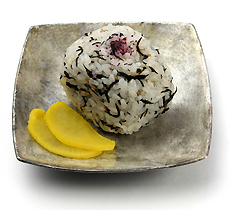
Onigiri, or rice ball. Photo © Aryu | Dreamstime.
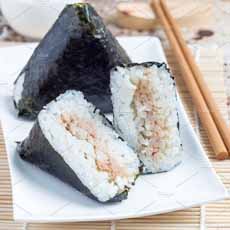
A machine invented in the 1980s turned rice balls into rice triangles (photo Juliia N | Creative Market).
|
In the 1980s, a machine was invented that made triangular onigiri (second photo). Rather than rolling the filling inside by hand, the flavorings were inserted into a hole in the rice triangle, and the hole was hidden by the nori. Think of them as rice sandwiches wrapped in nori.
Also see temari sushi, beautifully decorated rice balls, and musubi, for a different type of “sandwich.”
|
OSHIBORI
The moistened, heated towel that is offered to cleanse the hands before a sushi meal.
OSHIWAKU
A wooden box with a top that’s used to make pressed sushi. The rice is topped with any variety of fish, roe, or vegetables, then pressed with the lid to adhere the ingredients. The pressed “cake” is then cut into squares or rectangles. See pressed sushi and oshi-zushi, below.
|
|
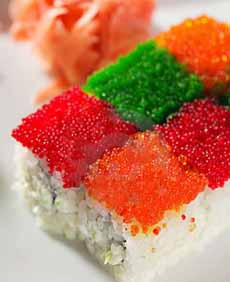
Boxed sushi (photo © Sushi FA). |
|
OSHINKO
Assorted pickled vegetables, which can be very salty. Another term for pickled vegetables is tsukemono. The latter is more accurately sliced and marinated, like a cucumber salad. Depending on the restaurant, the latter can refer to a salad of marinated cucumbers or bean sprouts. There are different types of tsukemono for sushi and cooked dishes. The oshinko, typically served with sushi and sashimi, includes:
- Benishoga, julienned strips of pickled ginger, colored red.
- Gobo, pickled burdock root.
- Kabu, pickled turnips
- Kyurizuke, Japanese cucumber.
- Nasuzuke, pickled eggplant.
- Shibazuke, a mix of chopped, salted cucumbers and eggplant, brined with red shiso.
- Takana, pickled mustard leaf.
- Takuan, pickled daikon, is colored bright yellow (photo at right).
- Umeboshi, pickled plum.
- Yami-kurage, pickled stem lettuce.
Other vegetables are pickled as well, including Chinese/nappa cabbage and scallion bulbs. The pickled vegetable that everyone gets is gari, the pale pink pickled ginger served with sushi.
|
|
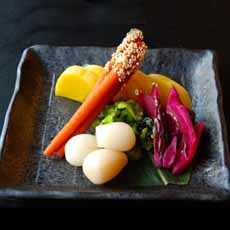
Oshinko, pickled vegetables. From the rear, clockwise: daikon (radish), shibazuke (eggplant blend), scallion, and gobo (burdock root), with cucumber in the center (photo courtesy Nobu Lanai | Hawaii).
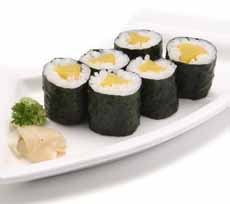
An oshinko-maki made with takuan (photo courtesy Bento.com).
|
|
OSHI-ZUSHI or PRESSED SUSHI or BO-SUSHI
Osaka-style sushi, squares of pressed rice topped with vinegared or cooked fish. The sushi is prepared in a wooden box called an oshiwaku (the second photo at right), which can be square or rectangular in shape. It is then unmolded and cut into bite-sized squares or rectangles.
In older times, the cut pieces were wrapped in bamboo leaves for travel (the leaves have anti-bacterial qualities). These days, it is a meal more often sold as ebiken, a type of boxed bento meal sold on trains and in train stations, to eat on the go.
There are different styles of pressed sushi, including:
- Battera (topped with mackerel or gizzard shad and cut into squares or rectangles).
- Bozushi (pressed into a long candy bar shape and cut into bite-sized pieces).
- Hazushi (layered with plant leaves), hakozushi (cut into squares or rectangles, Osaka style).
- Masuzushi, traditionally made of vinegared trout on top of sushi rice.
- Tazunazushi, with toppings placed on at a slant, resulting in “candy cane” stripes.
|
|
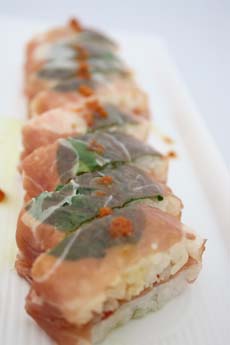
Oshi-zushi. Photo © Mai Cuisine.
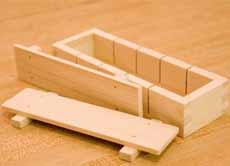
An example of oshizushi, the wood mold used to make pressed sushi.
|
|
OTORO
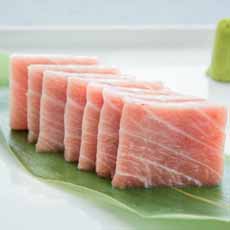
This is the same as toro; the “o” is an honorific prefix used to give respect to an object or person. Of all fish, toro, the fattest and most prized portion of the tuna, deserves it. It is from the lower belly of the tuna. As with beef, the marbling of fat makes the cut more tender. It is the priciest of sushi bar fish.
If otoro is the filet mignon of the tuna, then:
- Chu-toro is the sirloin.
- Akami is the chuck.
- Kiriotoshi is the end of the chuck, cut into chunks.
History: The high-fat content means the fish spoiled quickly before the days of refrigeration. Everyone turned up their noses at the toro, and it was practically given away to impoverished laborers to eat.
|
|
Above: Hazushi, with persimmon leaves. Photo © Encyclopedia Of Sushi.
|
|
PANKO
A crispy wheat breadcrumb used in Japanese cuisine. It is made in small flakes rather than ground into crumbs like traditional breadcrumbs, so it provides a crunchier coating.
Panko is used to provide crunch in some sushi rolls, either mixed in with chopped fish, sprinkled on other ingredients before they are rolled, or used on top as a garnish, as in the photo at right. More about panko.
|
|
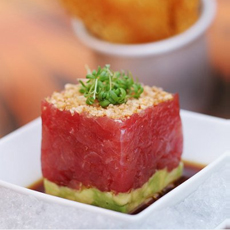
Tuna tartare on a bed of avocado with a topping of panko bread crumbs and scallions. Photo courtesy Payard Restaurant | New York City. |
PERILLA LEAF
See shiso.
|
PHILADELPHIA ROLL
A roll created in America, made of cream cheese (hence the “Philadelphia” brand reference) and either regular raw or smoked salmon.
Philadelphia Roll was created by Madame Ai Saito, “the queen of sushi,” at her restaurant in Philadelphia. She was born in Kobe, Japan. She adopted the name Madame when she was living in Paris.
In the 1980s, then-Mayor William J. Green III asked her to create a signature sushi roll for the city. Since most of her non-Japanese regular customers at the time were Jewish, she thought of lox and bagels, then combined salmon and Philadelphia cream cheese.
|
|
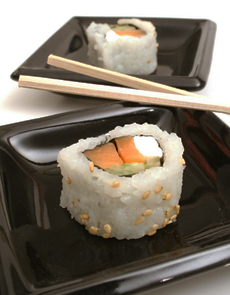
Philadelphia Roll: smoked salmon and cream cheese, with optional cucumber. Photo by Andi Berger | Dreamstime.
|
|
POKE
Poke is a raw fish and vegetable dish served as an appetizer or snack (pupu) in Hawaiian cuisine. The most popular modern adaptation is the poke bowl, where poke is served over a bed of rice (or greens, or quinoa) and topped with items like avocado, edamame, and pickled ginger. Poke nachos are another adaptation.
A relative of ceviche, crudo, tartare, and tataki, it’s a combination of raw fish and vegetables that becomes a salad appetizer.
Pronounced poe-KEH, it is mispronounced POE-key by enough people that the latter pronunciation is becoming an accepted alternative. Here’s more about it, plus recipes.
|
|

A classic poke bowl at Dons Bogam in New York City.
|

A poke bowl “fully loaded” (photo © Mega Mex Foodservice).
|
PONZU
A sweet dipping sauce made with Japanese citron (yuzu). Here’s more about it, and a recipe to make your own. Here’s more about it, including a recipe to make your own.
PRESSED SUSHI
See oshi-sushi, above.
PUFFERFISH
See fugu.
|
|

Ponzu sauce (photo © Fotoos Van Robin | Flickriver)
|
Continue To Page 7: Definitions Q, R S
Go To Alphabet Index Bar Above
|