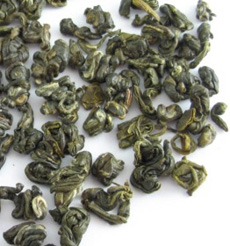
 Gunpowder tea, a Chinese green tea. Photo courtesy TeaCuppa.com. Gunpowder tea, a Chinese green tea. Photo courtesy TeaCuppa.com.
March 2005
Last Updated December 2013
|
|
Type Of Tea & Tea Terminology
Tea Glossary Page 6: Terms With G
This is Page 6 of a 15-page glossary focusing on type of tea, tea flavors and other terms relating to gourmet tea. Click on the links below to visit other pages. This Tea Glossary is one of our many delicious food glossaries. Learn more about your favorite foods!
Click on a letter to go to the appropriate glossary section:
a b c d e f g h i j k l m n o p q r s t u v w x y z
This glossary is protected by copyright and cannot be reproduced in whole or part.
You are welcome to link to it.
GAIWAN
A gaiwan is a bone china lidded bowl used for steeping tea: The lid is gai, the bowl is wan and the saucer is die. The large bowl allows the leaves to expand and steep properly to release the full aromas and flavors. The lid holds the steam inside the bowl to efficiently steep the tea. The saucer enables one to hold the hot bowl.
|
|
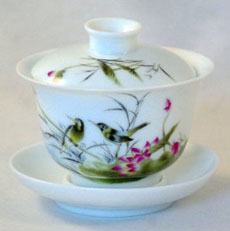
Gaiwan available from Bana Tea Company. |
GARDEN
The name originally given to tea growing plantations or estates. The Japanese cultivated tea gardens within their temples and palace grounds and had copied this idea from the Chinese. Today, the term estate has largely replaced garden and plantation. “Tea garden” was also used to describe London pleasure gardens in the 18th century where tea was served to both sexes.
GENMAICHA
A Japanese green tea mixed with toasted brown rice and popcorn. While widely popular today, it was originally drunk as an inexpensive option by poor Japanese peasants, since the rice and popcorn served as a filler and reduced the price of the tea. It has a toasty aroma and a complex, toasty flavor.
GOLDEN
Denoting the orange-colored tip present in high quality black tea leaves.
GONE OFF
Tea that’s been spoiled by improper storage or packing, or is simply past its prime and stale.
|
|
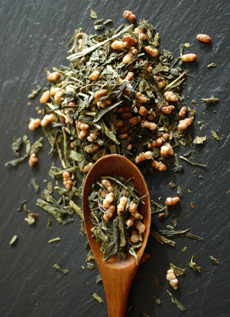
Genmaicha tea. Photo courtesy Sugarbird Sweets. |
GONGFU or GONG FU
Meaning “performed with care,” this is a style of brewing with many repeated short infusions of leaf in a miniature pot.
GOVERNMENT STANDARDS
Any foods imported into the U.S. must comply with the standards of purity, quality and fitness for consumption as defined by the tea examiners of the Food and Drug Administration (FDA) of the U.S. Department of Health, Education and Welfare.
GARDE
The term used to describe a tea leaf or particle size of leaf.
GRAINY
A term used to describe high quality CTC teas.
GREEN
When applied to black tea it means an immature, raw character. Either the leaves were under-fermented, or were plucked from immature bushes and result in a raw or light liquor. Greenness can also be caused by poor rolling and underwithering during manufacture.
GREEN TEA
Green tea is non-oxidized (un-fermented) tea: in preparation, the goal is to avoid any fermentation. It goes through three processes: roasting, rolling and firing. Almost immediately after being picked, the leaves for green tea are heated or roasted to kill the enzymes that cause fermentation. They are heated to 100°C (Chinese) or steam-cooked (Japanese) for 30 seconds to 5 minutes in large, shallow pans over a wood fire. This makes them soft and pliant. They are then hand-rolled or folded on a table into balls, sticks or coils. This process removes moisture. They are then dried on racks with circulating hot air for two or three minutes.
|
|
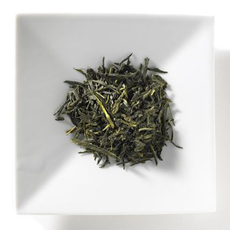
Sencha, a popular green. Photo courtesy MightyLeafTea.com. |
After brewing, the tea is green or yellowish in color and has nutty taste and a woody aroma. The principal grades of green tea are Twankay (the poorest kind); Hyson skin (the refuse of Hyson); Hyson, Imperial, and Gunpowder, all fine varieties; and Young Hyson, a choice tea made from young leaves gathered early in the spring. Because of the antioxidant levels and other suspected health benefits, green teas have been growing in popularity in the West. Varieties based on provenance and processing include dragon well, genmaicha, green peony, gunpowder, hojicha and sencha. The water-extractable polyphenol content of green tea ranges from 30% to 40%; black tea has between 3% and 10%. Green tea should be brewed with water at 195°F.
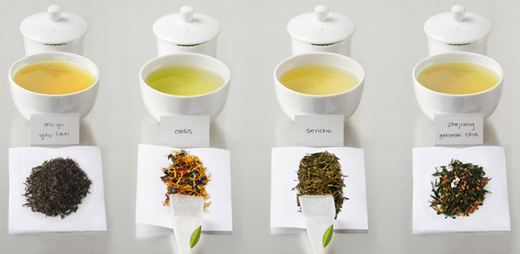
Green teas: Yu Lan, Oasis (a proprietary blend of green tea, spring flowers and citrus), Sencha and Genmai Chai (with roasted brown rice). Photo courtesy of TeaForte.com.
GUAYUSA
Pronounced why-YOU-suh, guayusa. This energizing morning hot drink is a more than 4,000 years-old tradition among the Kichwa people of the Ecuadorian Amazon. It is grown under the canopy of the Amazon rainforest. Guayusa is completely unrelated* to Camellia sinensis, the plant that produces black, green, oolong and white teas; and it has has a different chemical structure. However, as a hot, tea-like drink, its benefits are even more impressive.
- Guayusa’s balance of caffeine, antioxidants, vitamins and amino acids provides an energizing effect similar to coffee or yerba maté. Like yerba maté, to which it is closely related, guayusa is packed with antioxidants and provides a jitter-free caffeine-induced energy because the natural caffeine is released more slowly into the bloodstream. Its unique combination of caffeine, theobromine, and theophylline enhances mental acuity.
|
|
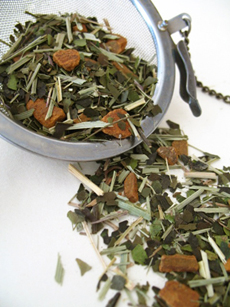
Spice flavored guayusa from Runa.com. Photo by Leah Hansen | THE NIBBLE. |
- Guayusa is considered to have 50% more antioxidants than Camellia sinensis.
- Guayusa’s health benefits meet and exceed those of those of any other tea, including yerba maté. Unlike yerba maté, guayusa has a naturally smooth, crisp taste and is never bitter.
- Here’s more about guayusa.
| *Taxonomy |
Kingdom |
Order |
Family |
Genus |
Species |
| Guyausa |
Plantae |
Aquifoliales |
Aquifoliaceae |
Ilex |
I. guayusa |
| Yerba Maté |
Plantae |
Aquifoliales |
Aquifoliaceae |
Ilex |
I. paraguariensis |
| Tea |
Plantae |
Ericales |
Theaceae |
Camellia |
C. sinensis |
GUNPOWDER TEA
A green Chinese tea which is rolled into a small, pellet-size ball and then dried. The finished tea has a grayish appearance similar in color to gunpowder. The pellets unfurl in hot water into a sweet and slightly smokey tea. The tight roll helps this and other pellet tea (like jasmine pearls) remain fresher longer. See photo at top of page.
GURICHA TEA
Guricha is a famous and unique form of Japanese green tea, created with a method that makes it look and taste similar to the pan-fired teas of China. “Comma”-shaped leaves are obtained by omitting the final kneading process.
GYOKURO
The top-grade Japanese green tea produced by a special process in the Uji district, which produces some of the finest green teas in Japan. Gyokuro is made from tea grown on shaded bushes so the tea leaves absorb more nutrition from the fertile soil. It can only be hand-harvested in certain areas of Japan once each year. After harvest, the top grades are held in cold storage for about six months before the final stages of processing are completed. Gyokuro has a rich jade-green color, a distinguished aroma, a rich, silky mouthfeel and a sweet taste. The name means “pearl dew” or “precious jade dew.” |
|
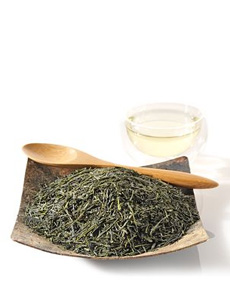
Imperial gyokuro tea from Teavana.com. |
Continue To Page 7: Tea Terms Beginning With H
Go To The Alphabet Index Above
Lifestyle Direct, Inc. All rights reserved. Images are the copyright of their respective owners.
|