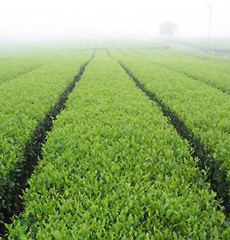
 A tea estate. Photo by Fabel Nard | SXC. A tea estate. Photo by Fabel Nard | SXC.
March 2005
Last Updated December 2013
|
|
Tea Types & Tea Terminology
Page 14: Tea Types Beginning With T
This is Page 14 of a 15-page glossary of tea types. Click on the links below to visit other pages. This Tea Glossary is one of our many food glossaries.
Click on a letter to go to the appropriate glossary page:
a b c d e f g h i j k l m n o p q r s t u v w x y z
This glossary is protected by copyright and cannot be reproduced in whole or part.
You are welcome to link to it.
TAIWAN
Teas produced on the island off the Chinese coast now known as Taiwan, which include oolong, pouchong and black teas made in the traditional style.
TANNIN
A term erroneously describing the astringent polyphenols of tea, which are unrelated to tannic acid polyphenols of other plants (e.g., grape tannins).
TANZANIA
An African tea-producing country.
TARRY
A smoky flavor characteristic of lapsang souchong tea.
TASSEOMANCY
The art of reading tea leaves.
TAY
The word for tea in the Hokkien language of the Fujian (Hokkien) province of China. Xiamen (also known as Amoy), in the Fujian province, was the port of trade first used by Europeans (mainly the Portuguese) in 1541. Near the end of the Ming Dynasty, in 1644, British merchants set up trading posts there; in the nineteenth century, it was China’s main port for exporting tea. This is why Europeans use variations of the word “tay” to describe tea. Easterners and Middle Easterners use the word cha or variations. Read more about it.
TEA
The beverage brewed from the leaf of the Camellia sinensis plant, or tea bush. It is generally brewed by pouring boiling water over dried tea leaves and allowing the leaves to steep for three to five minutes. The boiling water releases the volatile oils in the leaf which provide the flavor. Tea can also be steeped using the sun tea method. The term tea is also used to describe afternoon tea and is the term for a reception or party at which tea is served. Tea is consumed by more people worldwide, and in greater quantity, than any beverage except water. |
|
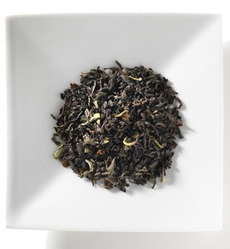
Earl Grey tea from Mighty Leaf Tea. |
As with all agricultural products, the flavor of tea is affected by its terroir: altitude, soil composition, aspect, hours of sunlight, rainfall and humidity, among other factors. The same rootstock will produce different tea flavor and quality when grown in different places. Elevation is key: whether the plants are low-, medium-, or high-grown. The higher the altitude, the thinner and cleaner the air and the closer to the sun the tea plants are; although good teas are grown in lower elevations.
TEA BAG
The original tea bags were handmade, hand stitched muslin or silk bags. Patents for tea bags exist as early as 1903. Thomas Sullivan, a tea merchant from New York, is often credited with inadvertently creating the first commercial tea bag concept in 1908. He created the pouches to send samples of tea to commercial customers instead of using expensive tin canisters. Recipients loved them and demanded tea in bags. The bags were first made of silk, then muslin, then paper.
TEA BUSH
The plant Camellia sinensis, grows the tea leaves that are plucked and dried into the tea that is brewed. The plant is native to China, which remains the largest tea-producing nation, followed by India and Sri Lanka (Ceylon). Tea is also cultivated extensively in Africa. In its native state, the plant grows to a height of about 30 feet, but in cultivation it is pruned to three to five feet. The most desirable leaves are those near the growing tip. The best teas use only the two terminal leaves.
TEA FACTORY
The premises where the plucked leaves are manufactured into black, oolong, green or white tea.
|
|
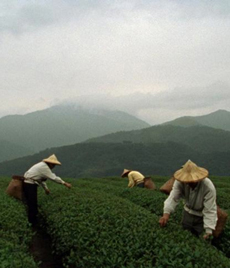
Plucking tea leaves from a tea bush. Photo courtesy The Meaning Of Tea. |
TEA GARDEN
Alfresco London gardens dating back to the 18th century where tea, biscuits and cakes are served.
TEA SERVICE or TEA SET
The appurtenances or utensils required for a tea table. When of silver these sets comprise only the teapot, sugar bowl and cream pitcher.
TEA TABLE
A table on which tea furniture is set, or at which tea is drunk.
TEA TASTER
A professional who is an expert judge of leaf and cup quality tea at all stages of production, brokerage, blending and final packaging.
TEA TREE
A tea bush or plant which has been allowed to return to its wild state and grow back into a tree.
TENCHA
Gyokuro tea leaves that have not been rolled into needles. They are used to make matcha tea.
TERROIR
Terroir, pronounced tur-WAH, is the French word for soil, land or terrain. It can be loosely translated as “a sense of place,” the sum of the effects that the environment has on the creation of what is grown there. It has long been used in wine and coffee analysis to denote the special characteristics of soil, geology, aspect and altitude that give the grape or bean its individuality. The term is now being used, appropriately, to describe other agricultural products.
THIN
No acidity, a lifeless flavor due to underbrewing.
TI KUAN YIN
“Iron Goddess of Mercy,” a distinctive type of oolong tea, typically longer-fermented and possessing a darker-colored and fragrant brew. Chinese oolongs tend to be more green and floral (orchid aromas come to mind; Ti Kuan Yin, a type of oolong, is often described as smelling like orchids).
TIP
The bud leaves on a tea bush.
TIPPY
Teas with white or golden tips, indicating high quality.
|
|
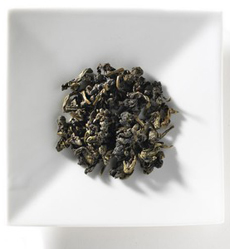
Ti Kuan Yin oolong tea from Mighty Leaf Tea. |
TISANE
An herbal tea, from the French, “a medicinal infusion of herbs.” The word is often used to refer to fruit-based and floral-based teas as well.
TOUAREG or TUAREG TEA
A strong green tea made with nana mint, prepared by Arab peoples of North Africa and the Middle East. See mint tea.
TULSI TEA
Also known as holy basil tea, tulsi is an herbal tea steeped from the leaves and blossoms of the tulsi basil plant. It is high in antioxidants and has been drunk in India since about 5000 B.C.E. to promote wellness and longevity. In India, the tulsi plant is referred to as the “queen of herbs” and has been an integral tonic in the practice of Ayurvedic medicine.
|
|
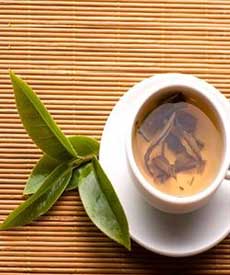
A cup of brewed tulsi tea and some tulsi basil leaves from which it is brewed. Photo courtesy TulsiPlant.org. |
TWIST
Before fermentation, the leaves are crushed to initiate oxidation, which imparts the curl to the finished leaf.
TWO LEAVES AND A BUD
Tea leaves are harvested mainly as buds and young leaves. Top quality plucked tea consists of the new tea shoot and the first two leaves—the “two leaves and a bud.” Depending on the variety, there is the choice of harvesting “one bud one leaf,” “one bud two leaves” or “one bud three leaves.”
Continue To Page 15: Tea Terms U To Z
Go To The Alphabet Index Above |
|
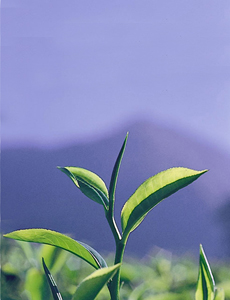
The top two leaves and the bud—the unfurled leaf in the center—are the only three leaves picked from each branch of the tea plant. Photo courtesy DilmahTea.com. |
Lifestyle Direct, Inc. All rights reserved. Images are the copyright of their respective owners.
|