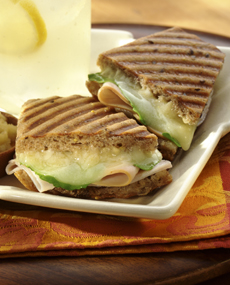 
A turkey and Swiss on whole wheat becomes elevated into a turkey panini, courtesy of the Italian concept of grilling sandwiches. See eight panini recipes (photo © Sargento).
September 2009
Last Updated April 2026
|
|
Sandwich Glossary
Page 1: Types Of Sandwiches A ~ C
CAPSULE REPORT: We are indebted to our friends at Mezzetta for creating the base of this Sandwich Glossary, to which we’ve added an even greater number of types of sandwiches. We haven’t detailed every type of ingredient: Avocado sandwich and chicken sandwich are self-explanatory. But if we’ve left something out, use the Contact Us link on this page to let us know. Also see our Bread Glossary and some 100 other food glossaries. This is Page 1 of a five-page glossary. Click on the black links below to visit other pages.
> The history of the sandwich.
> The year’s 27+ sandwich holidays.
AMERICAN SANDWICH
The club sandwich was invented in London, but classic American sandwiches include cream cheese (cream cheese was invented in Philadelphia), the cheesesteak, the hamburger, the peanut butter (an American invention/PB and jelly) sandwich, the sloppy joe, and the American-born mega-sandwich, the submarine (a.k.a. hoagie, grinder, etc.). You’ll find many more inventions in this glossary. While the sandwich was first popularized in England, it is America that has taken this food to heart, embracing it for breakfast, lunch, and dinner and creating as many types of sandwiches as there are ingredients.
|
BANH MI
A Vietnamese baguette made from wheat and rice flour, and also the name of the sandwich that is served on the baguette. A fusion food from French colonial Indochina and Vietnamese cuisines, bánh mì combines French ingredients such as baguettes, pâté, and mayonnaise with native Vietnamese ingredients such as coriander, hot peppers, fish sauce, pickled daikon, and carrots. They are sold at small bánh mì and noodle (phó) shops in areas with a Vietnamese immigrant community. Here’s an easy bánh mì recipe and the history of the French-Vietnamese fusion sandwich.
National Banh Mi Day is celebrated on October 10th
The history of the bành mì sandwich.
|
|
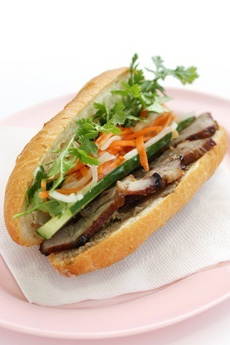
Bánh mì, a Vietnamese version of a submarine sandwich. See the Cuban version below.
|
BARBECUE SANDWICH
A sandwich of shredded beef or pork plus barbecue sauce on a roll.
|
BEEF MANHATTAN
Also known as a Manhattan hotshot or hot beef sandwich, this open-faced sandwich layers roast beef and mashed potatoes over a slice of Texas toast. The name comes from workers at the Naval Ordnance Plant in Indianapolis, Indiana, who enjoyed a similar dish while training in Manhattan during World War II. It quickly became a diner favorite in Indiana, and the recipe spread throughout the Midwest.
The Turkey Manhattan variation substitutes turkey and is perfect for Thanksgiving leftovers.
|
|

Bánh mì, a Vietnamese version of a submarine sandwich. See the Cuban version below.
|
BLT
The BLT, bacon, lettuce, and tomato sandwich, is often served as a triple-decker sandwich on toast. While toast, bacon, and lettuce were enjoyed at the table since Roman times, tomatoes came from the New World in the 1600s and were considered poisonous, and enjoyed only as houseplants until the 1800s.
|
At the same time, there was no mayo for the BLT: Mayonnaise sauce was invented in 1756, but it was not until years later that the great French chef Marie-Antoine Carême (1784-1833) lightened the original recipe by blending the vegetable oil and egg yolks into an emulsion, creating the mayonnaise that we know today. The ingredients finally came together: We know that BLTs were served as tea sandwiches in the late Victorian era (late 1800s). The earliest recipes for BLTs were listed under different names in cookbooks. The abbreviated name most likely came from diner slang: “Give me a BLT on a raft,” i.e., a bacon, lettuce, and tomato sandwich on toast.
National BLT Day is celebrated on July 22nd. The history of the BLT sandwich.
|
|

A conventional BLT—bacon, lettuce, and tomato sandwich—uses two slices of bread. With three slices, it becomes a double-decker. With turkey, it’s a club sandwich (photo © Unsplash). |

A club sandwich is often served with potato chips or French fries (photo © Flavor & The Menu).
|
BREAKFAST SANDWICH
Eggs Benedict—eggs and Canadian bacon atop an English muffin—may have been the first official, open-face breakfast sandwich, followed by the bagel with lox and cream cheese. Eggs and sausage patties or ham have found their way atop English muffins ever since (popularized by McDonald’s Egg McMuffin in the 1960s).
In the 1970s, the concept evolved to the breakfast croissant sandwich, and in the 1990s, the breakfast burrito—scrambled eggs and sausage or bacon inside a tortilla wrap.
|
|

A classic breakfast sandwich: English muffin, egg, cheese. Photo © Aero Farms. |
BUTTWICH
A halibut sandwich, in the local Alaskan vernacular. The name is a playful shortening of “halibut” to “butt.” Here’s a recipe for the fancy version in this photo.
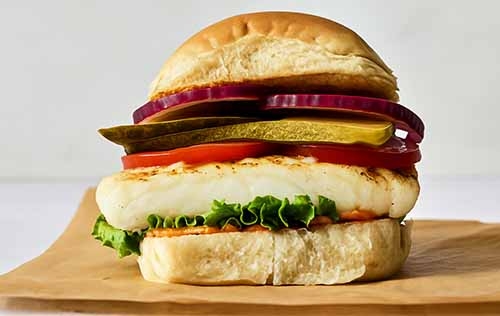
Halibut sandwich (photo © Wild Alaska Company).
|
CAPRESE SANDWICH
A vegetarian Italian sandwich made with the ingredients of the popular Caprese salad: fresh mozzarella cheese, sliced tomato, and fresh basil, typically seasoned with olive oil, flaky sea salt, and pepper. The sandwich is built on a crusty, firm bread to keep the sandwich from getting soggy: baguette, ciabatta, or focaccia are common. Sourdough is also a good option, especially for a grilled version.
Additions include spreading pesto on the bread, adding a drizzle of thick balsamic glaze, and some fresh arugula for a slightly peppery crunch.
|
|

Here’s the recipe for this yummy Caprese sandwich (photo © Somewhat Simple). |
National Caprese Day is celebrated on July 2nd. The history of the Caprese salad.
CHEESESTEAK, CHEESE STEAK, or PHILLY CHEESESTEAK
This sandwich, which originated in Philadelphia, is made of thin slices of grilled steak covered in melted cheese on a long roll. Traditionally, it is accompanied by hot cherry peppers or grilled peppers and onions. National Cheesesteak Day is celebrated on March 24th.
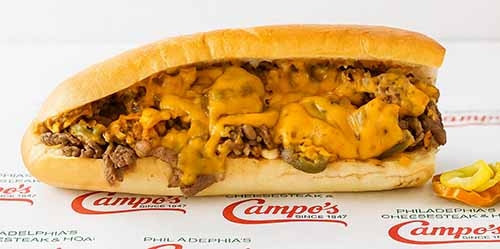
By the way, both cheesesteak and cheese steak are correct spellings, but the compound none, cheesesteak, is more common. Plus, it’s the form used in its birthplace, Philadelphia (photo © Campo’s Deli). The history of the cheesesteak.
CHEESE TOAST or CHEESE ON TOAST (UK)
Cheese toast is a simple open-face sandwich of Cheddar or other cheese melted onto a slice of toasted bread, often made under a broiler or grilled in a pan. The bread is often buttered, sometimes with mayonnaise or Worcestershire sauce added for extra flavor. It's similar to grilled cheese but without the top slice of bread.

Here’s a recipe to make cheese toast in an air fryer (photo © Florida Dairy Farmers).
CHEESE TOASTIE
See grilled cheese. Technically, there is a difference between grilled cheese and toasted cheese. To grill means to cook by direct exposure to radiant heat, as when food is placed under a broiler. To toast means to cook by placing in front of dry heat: pressed (e.g., panini pan), a stovetop pan, or a toaster oven, for example.
CHIP BUTTY
Popular in the U.K., this sandwich consists of chips (French fries) on buttered, untoasted white bread. Condiments are typically brown sauce, ketchup, or malt vinegar.
Chef Nigella Lawson created her own version: buttered white bread with crisps (potato chips)—no mayonnaise.
The chip butty originated in British fish and chip shops in the 19th century. The original is believed to have been a simple stall in Oldham, Lancashire, in 1863 that quickly became known for its large “chip barms*.”
The chip butty is strongly associated with British working-class culture, and while Lancashire is generally considered its birthplace, other places with prominent working-class communities like Liverpool and Yorkshire have also laid claim to it over the years.
__________
*A barm (also called a barm cake) is a type of soft, round bread roll that’s popular in Northern England, particularly in Lancashire and surrounding areas.
|
|

Chip butty (photo © SmarterPix).

Nigella Lawson’s crisp (i.e., potato chip) sandwich (photo © SmarterPix). |
CIABATTA SANDWICH
A sandwich made on slices of ciabatta bread or a ciabatta roll. Its fermentation process adds a bit of tangy flavor that doesn’t conflict with the sandwich filling. The crust is crispy and chewy, while the interior is soft and light to give the sandwich a satisfying bite. Despite its airy interior, ciabatta is actually quite sturdy and holds up well to moisture from sandwich fillings like tomatoes, dressings, or oils without becoming soggy as quickly as other soft breads might. The holes in the crumb (the area inside the crust) are perfect for soaking up olive oil, balsamic vinegar, or juices from ingredients like roasted vegetables or grilled meats.
|
|

Turkey sandwich on a ciabatta roll (photo © Fillmore Room | NYC [now closed]). |
Ciabatta works well with both Italian-style and American-style sandwiches. We particularly like it for hero-style sandwiches, instead of those bland “submarine” rolls.
CLUB SANDWICH
Cooked chicken or turkey breast with bacon, lettuce, and tomato on toasted bread with mayonnaise. Traditionally made with three slices of bread, this sandwich was popularized in gentlemen’s clubs, hence the name.
One legend tells of a man who came home hungry after the family and servants had retired and searched the pantry for a snack. He toasted some bread and, as he looked in the ice chest for butter, found cold broiled bacon, chicken, and mayonnaise. He also found a tomato, added it to the sandwich, and was happy with his creation. He spoke of it to friends at his club, and they had it recreated there, where it went onto the menu as the “club sandwich.”
|
|

Club sandwich (photo © Peteer | SmarterPix). |
According to FoodTimeline.org, most food historians agree that the club sandwich was probably created in the United States during the late 19th/early 20th century. There is no printed record, so the where and who remains a matter of culinary debate. The most popular theory points to the Saratoga Club in Saratoga, New York.
The history of the club sandwich.
COWBOY OMELET SANDWICH
See Denver omelet sandwich.
CORDON BLEU SANDWICH
The Cordon Bleu sandwich is related to the Croque Monsieur sandwich (below). Both are French sandwiches that feature ham and cheese. Cordon Bleu, despite its fancy-sounding name, is more rustic. It uses a heartier roll or bread, substantial enough to hold the filling, while Monsieur uses pain de mie, quality white bread, or brioche. While Bleu uses a Swiss cheese, Monsieur specifically uses Gruyère (which can be French or Swiss). Croque Monsieur is almost always finished with topped with béchamel sauce and then broiled or griddled to produce its signature creamy, gratinéed top. While Cordon Bleu can have breaded or fried elements (like the original Cordon Bleu dish), it has no topping or sauce. In sum, Croque Monsieur is more refined and sauced, while Cordon Bleu is heartier and more rustic.

Both Arby’s and Hardee’s have Chicken Cordon Bleu sandwiches, adding their fried chicken to the French ham-and-cheese (photo © Arby’s).
CROISSANT SANDWICH
A sandwich made on a halved croissant instead of a traditional roll or bread. The filling can be savory or sweet. It can be served for breakfast or lunch, cold or warm.
National Croissant Day is celebrated on January 30th.
The history of the croissant.
|
|
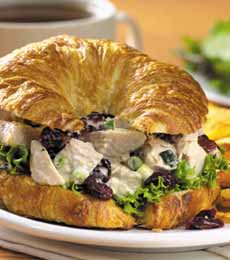
Chicken salad and dried cherries on a croissant. Photo courtesy Cherry Marketing Institute. |
CROQUE MADAME
Croque Madame is a French grilled chicken and cheese sandwich that is dipped into beaten egg, then sautéed in butter, and topped with a creamy béchamel or Mornay sauce and a fried or poached egg. It's a richer version of the Croque Monsieur (which is just the ham and cheese sandwich) and is typically made with white bread, Gruyère cheese, and Dijon mustard, then grilled or baked until golden and bubbly. It got its name from its perceived resemblance to a woman's hat.
CROQUE MONSIEUR
A French grilled ham and cheese sandwich that is dipped into beaten egg, then sautéed in butter—a grilled cheese sandwich elevated with a creamy béchamel sauce and Gruyère cheese, then baked or fried until golden and bubbly. The American version of this sandwich is called a Monte Cristo and is served with a side of jelly (see photo below).
National Monte Cristo Day is celebrated on September 17th.
The history of Croque Monsieur and Croque Madame.
|
|

A Croque Madame sandwich (photo © Adam Bartoszewicz | Unsplash).

A Croque Monsieur sandwich (photo © Dovecote Orlando [now closed]). |

A Monte Cristo sandwich. Here’s the recipe (photo © Kikkoman).
CRUNCH SANDWICH
A sandwich that includes a layer of potato chips or tortilla chips. The idea of putting crunchy chips in sandwiches appears to have emerged organically in American food culture, likely starting in the mid-20th century after potato chips became widely available. People discovered that adding chips to sandwiches provided a satisfying textural contrast to the softness of the bread. It’s related to the chip butty (see above), a British working-class sandwich of chips (fries) on buttered bread, though this is different from your potato chip version
|
|

Crunch sandwich. Here’s the recipe (photo © Umami Recipes).
|
CUBAN SANDWICH
A variation of a ham and cheese sandwich enjoyed by workers in Cuba and then in the immigrant community of Ybor City in Tampa, Florida. Sometimes called a “mixto” or “Cuban Pressed” sandwich, it is made with ham, roasted pork, Swiss cheese, pickles, and mustard on lightly buttered Cuban (or French or Italian) sliced loaf bread. The ingredients are layered and toasted on a plancha, a sandwich press similar to a panini press but without the ridges. Sometimes, salami, lettuce, tomato, or mayonnaise are added, but this is not considered traditional.
|
|
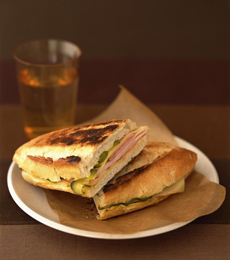
A pressed Cuban sandwich. Photo courtesy Jarlsberg USA. |
National Cuban Sandwich Day is celebrated on August 23rd.
The history of the Cuban sandwich.
CUCUMBER SANDWICH
See tea sandwich.

Cucumber sandwich. Instead of the classic butter spread, this one uses whipped goat cheese. Cream cheese is another option (photo © Nata V. Kusidey | iStock Photo).
Continue To Page 2: Sandwich Terms D To G
Go To The Article Index Above
Lifestyle Direct, Inc. All rights reserved. Photographs are the copyright of their respective owners.
|