THE NIBBLE (TM) - Great Finds for Foodies (tm)


RSS feed
Cheese plate
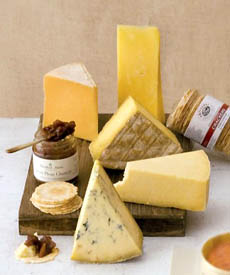
Let them eat cheese! Invite your friends over for a party that is sure to delight the senses. Photo Courtesy of Onmyplate.org.
MENU


Cheese

Category Main Page
Articles & Reviews


Cheese, Butter & Yogurt

Category Main Page
Articles & Reviews


Main Nibbles

Main Page
Articles & Reviews of Foods
From A to Z


Product Reviews

Main Page
Food, Beverages, Books,
News & More


June 2005
Updated May 2006

Product Reviews / Main Nibbles / Cheese-Butter-Yogurt

A Cheese Tasting Party

Hold a Fromage Soirée

Discover New Cheeses and be the Toast(ed Big Cheese) of the Party!


So many food-lovers love cheese that we actually see people waiving the tempting desserts at great restaurants, in favor of the beckoning sirens of the cheese cart. You don’t have to throw a lavish dinner party to be popular with your food friends: just have everyone over for a cheese tasting. There’s so much to taste, you can do it once a month and have people clamoring for invitations.

Planning

Balance the tasting. Carefully choose your cheeses. Look for contrasts in:

  • Textures (soft, semi-soft, hard)
  • Flavors and Ages (mild to strong)
  • Milk Types (cow, sheep, goat, although if you’re planning regular tastings, you can do “verticals” focusing on a different milk each time and focusing on different ages instead)
  • Colors (more of an aesthetic presentation rather than a gustatory mandate)
  • Shapes (another aesthetic—plates look more interesting with varied shapes)

Limit the number of cheeses.  Cheeses should be savored: go for quality, not quantity: a large number of cheeses will tax your mind and your palate.

  • For a dinner party, three or four is a good number to explore different flavors and textures. One or two spectacular cheeses with appropriate garniture is equally impressive.
  • For a cocktail party or a cheese tasting, five or six provides a good variety.
  • If you’re new to cheeses, start with a classic assortment: a chèvre, a brie or camembert, a blue (Gorgonzola, Roquefort or Stilton), a washed rind cheese (Munster, Pont L’Eveque or Taleggio), and a classic hard cheese (Asiago, Manchego, Parmigiano-Reggiano).

Work with a knowledgeable fromagier. An expert at cheese shop or specialty food store can help you reduce many decisions to a few. A number of these tips came from Murray’s Cheese in New York City, and Great American Cheese Connection of Chicago.

Determine how much cheese you need. If it’s the cheese course of a dinner party, figure two ounces of cheese per person. If it’s a cocktail party, one ounce per person. If the focus of the evening is a cheese tasting, four to six ounces per person. You may have leftover cheese, but that’s not a tragedy.

Keep Notes. If you’re not planning to take tasting notes, at least keep notes on what you purchased so you can plan a different assortment next time. It’s logical to want to keep buying what you enjoyed, but do that for your regular dining and entertaining, and keep tasting events as group learning experiences.

Serve the cheeses at room temperature. Cold cheeses do not showcase their textures, aromas and flavors. The cheeses should be out of the refrigerator at least one hour before serving.

Have the right tools to slice the cheeses. After all your hard prep work, you don’t want things to crumble at the appointed hour.

  • Soft, crumbly cheeses like chevres and blues can fall apart when cut, with even the sharpest knife. Professionals use a wire to ensure accurate, straight cuts (see examples below). Wire substitutes include guitar strings (the thin, treble clefs) or unflavored dental floss pulled tight between your thumbs and forefingers.
  • Soft, ripe cheeses with rinds like bries and camemberts require a sharp, thin paring knife. Dip the knife in hot water before cutting.
  • Hard cheeses like cheddar and parmesan require a large chef’s knife.

The goal in slicing cheese is to cut equal portions and avoid giving someone an end piece that’s mostly rind.

  • With round cheeses that’s easy: just cut the wheel into pie-shaped wedges.
  • With rectangular pieces, slice lengthwise so that each person has a piece of the rind at the tip, like the tip of a matchstick.

Serving

Depending on the size of the group, you can create individual plates, pass one cheese plate around the table, or have people serve themselves from a buffet.

Select Cheese Condiments. Some people are purists: they believe nothing should be eaten with the cheese to get in the way of its flavors. Others believe that serving accompaniments with cheese is as important as serving condiments or sides with other great foods.

  • These can be fresh and dried fruits and fruit pastes, chutneys, nuts, honey, mostardas and a variety of spreads. Aged balsamic is a classic pairing with parmesan and other aged, hard cheeses. Breads and crackers run the gamut from bland (baguette and water biscuits) to flavorful (currant and walnut breads, raisin semolina, wheatmeal biscuits).
  • There is so much to choose from, we’ve written an entire Guide to Cheese Condiments.

Choose A Serving Platter. In less creative times, cheese was served on a “cheese board.” Today, a cheese board is anything you wish to serve the cheese on—whether an official cheese board, an all-purpose platter, a wooden cutting board, a slab of granite, a straw mat. Just be sure the surface can bear the blade of a knife without damage.

Tasting

Tasting Order. Taste mild cheeses first, and progress to the stronger ones. Finish with blue and “stinky” cheeses. This is one of the most important steps in tasting, whether wine or cheese. Two other rules of thumb:

  • Taste goats first, sheep second, cows last. This is very important, especially with French cheeses. There are exceptions with non-French cheeses.
  • Taste soft cheeses before hard cheeses. This is a “sometimes” rule because alternating textures can make for interesting contrast.

Taste each cheese beginning at its center; then work your way to the rind where the cheese is most aged and stronger in flavor.

  • Start from the tip of your tongue and working towards the back of your mouth. This brings the cheese in contact with all of the taste receptors and sense areas: sweet, salty, acidic, and bitter.

Evaluate Each Characteristic. Sniff the cheese just as you would a glass of wine, to understand and appreciate its aroma. Notice and evaluate these characteristics:

  • Texture (smooth, grainy, crunchy, etc.)
  • Density/weight (how compact the cheese feels in your mouth)
  • Intensity (how flavorful the cheese is)
  • Acidity (tartness, lemoniness)
  • Fruit (fresh dairy tones, sweetness)
  • Saltiness
  • Flavors (earthy, nutty, roasty, toasted, musty, mushroomy, meaty, et al)
  • Finish (how long the flavors remain in the mouth)

Pair Matching Wines And/Or Beers. A cheese tasting also affords the opportunity to taste different wines with your cheeses. Your fromagier may be able to make recommendations; if not, your wine store advisor may; or you can do research to find many recommended pairings. Don’t feel obligated to like the textbook matches: this is your opportunity to let your palate be your guide.

Try Variations On A Theme. If you and your friends are sophisticated cheese lovers, consider a pot luck tasting: tell everyone to bring his/her favorite cheese and a matching wine or beer, along with a hand-out sheet of background information on each. A group of 6 or 8 can have an enjoyable time around the table discussing both the cheeses and the wines/beers. Serve with fruits and nuts, interesting breads (don’t forget the walnut or currant and walnut), charcuterie and a large salad, and you have a great dinner party with very little muss and fuss.

Take notes. As much as you’ve enjoyed certain cheeses or wines, the likelihood that you’ll forget several of them is high: festive occasions tend to dull the mind for academics. Keep a food journal with all of your notes, preferences, places purchased (we still are trying to figure out where we purchased certain seemingly irreplaceable items), etc. We keep a large Filofax® in the kitchen sectioned with all of our entertaining, cooking, and food planning notes. If we’re out at a tasting, we need only bring the note paper and add our notes to the binder when we return.

Share. When you find something truly special, e-mail your tasting notes to your foodie friends. That’s how THE NIBBLE™ newsletter got started, way back when.

Nibble Tip

Consider a vertical cheese tasting. Explore the variety of cheeses from a certain region or a particular milk, e.g. five different kinds of goat cheese. From fresh goat to aged goat to parmesan- and cheddar-like goat cheeses, it will be a wonderful voyage.

Photo courtesy of FrenchGoatCheeses.com.

Goat Cheese

Cheese Lover’s Library

Cheese of the World French Cheeses All American Cheese
Cheese of the World: An illustrated guide for gourmets. The photos in this book are so gorgeous you might be tempted to eat the page. $31.50. Click Here for more information. French Cheeses: 350 cheeses all from France available, at-a-glance. $13.60. Click Here for more information. All American Cheese and Wine: They're meant for each other. You may know the classics, but there are a myriad more to discover. $23.62. Click Here for more information.

Slice In Style

Stainless Steel Cheese Markers Prodyne Beechwood Cheese Tray Henckels Twin Select
Stainless Steel Cheese Markers: These stainless steel cheese markers identify your cheese in an attractive fashion. $11.00. Click Here for more information. Prodyne Beechwood Cheese Tray with Cracker Well: This attractive cheese slicer and serving tray features a handy recessed well for serving crackers. $19.99. Click Here for more information. Henckels Twin Select Cheese Slicer: This beautiful stainless steel Twin Select cheese slicer offers superior craftsmanship and performance. $9.99. Click Here for more information.


© Copyright 2005-2008 Lifestyle Direct, Inc. All rights reserved. Images are the copyright of their respective owners.


Spread The Word: Each icon below links to a site where you can bookmark, share and comment on this article:
Dine52    del.icio.us    ma.gnolia    Newsvine    Yahoo Myweb    BlinkList    simpy    reddit


.