Advertisement
THE NIBBLE (TM) - Great Finds for Foodies (tm)
  Sign Up | Contact Us | Email To A Friend  
       
RSS feed What’s This?


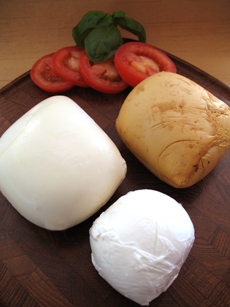
Mozzarella FrescaThree fresh mozzarellas from Mozzarella Fresca. From top left: vacuum-packed, vacuum-packed smoked, and water-packed, which has the most fresh-made-this-morning-flavor. Photo by Melody Lan.
MENU


Cheese

Category Main Page
Articles & Reviews


Cheese-Butter-Yogurt

Category Main Page
Articles & Reviews


Main Nibbles

Main Page
Articles & Reviews Of Foods From A To Z


Product Reviews

Main Page
Food, Beverages, Books,
News & More


ABOUT THE AUTHOR

STEPHANIE ZONIS focuses on good foods and the people who produce them. Click here to contact her.


May 2006

Product Reviews / Main Nibbles / Cheese-Butter-Yogurt

Whey To Go! ~ May 2006

Incomparable Mozzarella


My name is Stephanie Zonis, and welcome to Whey to Go! for May, 2006. Every month, we’ll delve into a new cheese-related subject, and I’ll offer a recommendation of a cheese I love.

Incomparable Mozzarella

Mozzarella has become a culinary darling of late, and it’s about time! For too long, at least in the U.S., mozzarella was relegated to the role of second-class cheese citizen, as the good-quality stuff was available only to the lucky/knowledgeable few who lived in or near communities where the real deal was still being made. The rest of us, in our ignorance, settled for the mass-produced mimic and thought mozzarella was no big deal.

But times have changed. Fresh mozzarella is now more readily available (though you still have to be careful of this claim); it’s even possible to get the legendary mozzarella di bufala, the mozzarella made from water buffalo milk. Burrata is becoming a hot item among cheese cognoscenti. And I’ve even heard rumors of a mozzarella bar opening in the L.A. area, though to date I can’t confirm those. Let’s take a closer look at this formerly-neglected cheese.

Historical Mozzarella

Mozzarella’s name derives from the Italian verb “mozzare”, meaning “to cut off,” from the action of cutting the curd into smaller, less unwieldy pieces. Mozzarella production began…well, nobody knows exactly when this happened, but this cheese has been around for centuries. There appears to be a print reference to mozzarella in the twelfth century in connection with a monastery in Capua, but a better-documented reference is found in a 1570 cookbook, written by the cook of the Papal Court, Bartolomeo Scappi. Most sources indicate that mozzarella was being made sometime after the introduction of the water buffalo into the Campania area in southern Italy (although one source tells me mozzarella was made from cows’ milk before it was made from the milk of the water buffalo). And when did the water buffalo arrive in Campania? Again, no one is sure. There’s some thought that this might have happened in the sixth century A.D. (one account specifies the year 596); other historians believe that water buffalo were introduced into Italy by Hannibal, no later than around 200 B.C.

No matter whether you believe that mozzarella was originally a cow’s milk or buffalo’s milk cheese, regions of Italy outside of Campania didn’t often raise water buffalo, so their mozzarella would have been made with cows’ milk.

Interestingly, water buffalo milk has an advantage over cows’ milk when one is making cheese. The milk given by water buffalo is so high in fat and protein that it is too rich for many people to drink, but it is precisely this richness and quantity of protein that renders it ideal for cheesemaking.

Mozzarella
Mozzarella Di Bufala imported from Italy has a
D.O.P. (Denominazione d’Origine Protetta, the Italian and European Union certification of authenticity of origin).

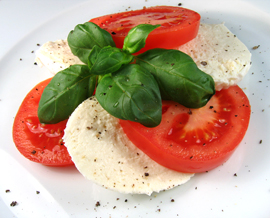
Made from real buffalo milk, this wonderfully elastic versatile Mozzarella creates the most mouth-watering pizzas and appetizers...or in the classic Caprese salad, above, with tomato and basil. Photo of the classic Caprese salad—mozzarella, tomatoes and fresh basil—by Rose Vita.

Prior to the 1860’s, mozzarella was a raw milk cheese by virtue of the fact that pasteurization had not yet been invented. Mozzarella has always been a fresh (as opposed to an aged) cheese, thus making it especially perishable. Because of this, it does not seem to have been especially common. Only the very wealthy (who could afford to pay for the cost and transport of fragile delicacies), or people who lived in or near the communities where it was made, could enjoy mozzarella. In fact, mozzarella doesn’t seem to have become widely known until the later part of the 18th century.

Making The Cheese

Production of mozzarella is swift in comparison to that of many other cheeses. Virtually all mozzarella is made from pasteurized milk these days (because the cheese is not an aged one, U.S. law requires all mozzarella sold here to be made from pasteurized milk—raw milk cheeses must be aged for 60 days prior to sale).

Through a combination of acidification and/or heat and enzymes, the milk is curdled, then drained of whey. The curd is broken into smaller parts, then ground into crumbly bits. These bits are combined with hot water, and they are stirred until they become one mass of rubbery texture. Following this, a cheesemaker stretches the mass of curd with his hands, a key step requiring both knowledge and skill. Stretching (often called “kneading”) for too short or too long a time will adversely affect the quality of the finished cheese. When it is finished, the curd should be smooth and shiny. A “rope” of the curd is pulled from the rest of the mass, cut off (remember the definition of “mozzare”), and shaped, usually into a ball.
Mozzarella
These gleaming balls of mozzarella are from The Mozzarella Company in Texas, which ships its products nationwide. Perishable cheeses like mozzarella should be kept refrigerated; generally they will remain fresh for two to three weeks. If the cheeses are vacuum-packed they may be stored for up to three weeks prior to opening. Once opened they will last 7 to 14 additional days. In a pinch, mozzarella can be frozen; it should be defrosted slowly in the refrigerator.

The ball is placed in cold water so it cools rapidly and holds its shape. This is followed by a quick soak in brine, where the mozzarella absorbs some salt. Remember that mozzarella does not require aging, so it’s ready for consumption after the brine soak. The entire process usually takes about 8 hours. Ideally, fresh mozzarella should be consumed within a day or, at most, two days. A fresh mozzarella is soft and moist, mild and milky-tasting, almost oozing with watery butterfat. But what happens when highly perishable fresh cheese meets ever-increasing consumer demand and industrialization? Modern production techniques, including pasteurization and vacuum sealing, allow mozzarella made from both cow and water buffalo milk to be shipped long-distance and have a far longer shelf-life, but as with corn fresh-picked from the field hours earlier versus corn that reaches you the next day, a sharp palate can perceive a diminution.

But you’ll be assured of good quality if what you buy is labeled as “fresh” mozzarella, won’t you? Nope. A lot of today’s “fresh” mozzarella is industrially produced; this is often the cheese you find vacuum-sealed. It’s also possible to purchase ready-made mozzarella curds that one can place in hot water and stretch/knead to a “fresh” mozzarella state. This mode of “making” mozzarella is popular with some lunch counters or delis, and, in some cases, produces a cheese I find very good. There’s even a business that will sell you a mozzarella-making kit, although I had very poor results with this. The number of companies producing mozzarella via more traditional methods remains limited, however, and I can find only two companies in the U.S. making mozzarella di bufala (and of those two, only one ships directly to consumers).

Types of Mozzarella

There are different types of mozzarella, too, other than the variations that will result from using cow’s or buffalo’s milk. The cheese is available salted or unsalted, in low moisture or high moisture varieties (although the latter two types are usually significant only for commercial use). Many brands of industrial mozzarella are sold in either whole milk or reduced fat classifications (sorry, the fat-free stuff just ain’t cheese). At least one cheesemaker in the U.S. makes a mozzarella out of cow’s milk mixed with goat’s milk; that same cheesemaker produces Queso Oaxaca, a mozzarella stretched into a long, flat ribbon and “rolled up like a ball of yarn.”

And then there’s the aforementioned burrata, a 20th century invention and surely one of the most indulgent cheeses going. The exterior of a ball of burrata is made from stretched mozzarella sheets. But the interior has a very soft, buttery texture, as it combines fresh cream with mozzarella curds. When the burrata is cut open, the center oozes out. Traditionally, a burrata is wrapped in the leaves of the asphodel plant; these leaves are an indication of the freshness of the burrata. As long as they remain green, the cheese is still fresh. (Exterior leaves are not always used today, however.)
Burrata
Burrata has a creamy, molten, oozing center. Enjoy  it with fresh tomato, olive oil and cracked black pepper. Toss it on top of drained penne, spaghetti or other pasta. This burrata from Bedford Cheese Shop has an extra gift: a center that’s filled with black truffles.

Obviously, burrata is extraordinarily perishable. It used to be the case that it had to be flown to the U.S. from Italy, but these days there’s at least one American producer, the Gioia Cheese Company in southern California. Regardless of origin, burrata is not a “keeping” cheese.  There’s burricotti, a fresh mozzarella filled with ricotta and similarly perishable. And then there’s manteca* or mantega. I can find no indication that this product is still made in the U.S., but mozzarella authority Carmine Chirico tells me he once worked for an establishment that made butter out of the water left from making a batch of mozzarella. When you make mozzarella, you lose a good deal of butterfat into the water. He and his co-workers would let the water remain undisturbed for a few minutes so the butterfat floated to the top; they’d then collect the butterfat and refrigerate it overnight. Next day, the butterfat would be solid; they hand-knead it to rid it of any remaining water, make small balls of butter, and stuff those inside freshly-made mozzarella.

When Carmine first tried this product, he thought the flavor of the unsalted butter didn’t go with the taste of the mozzarella at all, and he couldn’t understand why anyone would buy it. But it was pointed out to him that the manteca consumers were invariably elderly Italians, who regarded the interior of the manteca as a folk remedy. They believed that the butter made as a by-product of mozzarella-making was a good liniment for arthritis pain (what it does to the cholesterol count is another story entirely).

*If it sounds familiar, manteca is the Spanish word for lard or shortening.

Smoke ‘Em If You Got ‘Em

Smoked Mozzarella
Smoked Mozzarella from Mozzarella Fresca.

There’s also smoked mozzarella, a very popular cheese that goes by different names. Some call it scamorza, though Carmine points out that technically, scamorza is a slightly aged mozzarella, a drier, more yellow cheese, which is also called provola (I’ve seen it referred to as provoletta, as well). Scamorza can be smoked, but isn’t always. But, as Carmine says, there’s “no rhyme or reason” in cheese nomenclature; different cities call cheeses different names. If you’re confused (and who wouldn’t be?), just ask your source exactly what you’ll be getting.         


Below, Scamorza from The Mozzarella Company.

Multitasking Mozzarella

Please don’t think that mozzarella’s use is restricted only to pizza. It is the consummate pizza cheese, as far as I’m concerned, but if you’ve never tried a Caprese salad—fresh mozzarella; fresh, perfectly ripe tomatoes; and fresh basil—you owe it to yourself to do so. Drizzle the above with a little good olive oil and or balsamic vinegar, grind on a bit of fresh pepper, and devour.

Mozzarella is great in a sandwich or just as a table cheese, preferably with some good crusty bread and perhaps a nice bottle of a delicate wine. I like to wrap prosciutto around mozzarella and a slice of ripe tomato, dip that into a “sauce” of olive oil and balsamic vinegar, and eat the whole thing as a finger food. Messy? But of course, that’s part of the fun of it.

Smoked Scamorza

Carmine advises that refrigerated mozzarella isn’t genuinely “fresh” anymore, and that a truly fresh mozzarella should never get cold. Most of us, lacking the advantage of proximity to a maker of truly fresh “mozz,” as it’s sometimes abbreviated, won’t have a choice; we must refrigerate our mozzarella. If you do so and are not planning to heat the cheese, be sure to allow it to come to room temperature before you eat it. The flavor will be much fuller and the texture, more delicate.

Well-made mozzarella is a joy. With just a bit of looking around, you can break free of the industrialized, boring pretender that goes by the same name, and try some of the genuine article. I promise you, it will be worth any extra effort.

I am indebted to Tom Pedersen and especially to Carmine Chirico for their help with this article. Mr. Chirico has been making fresh mozzarella since he was a young teenager living in The Bronx (he insists that the real “Little Italy” in New York City is located in The Bronx, not in Lower Manhattan). He’s currently passing on his knowledge to the folks at Central Market in Austin, Texas; his next venture will be Harmoni Artisan Market in Orlando, Florida. 

Product Search

The following is a list of mozzarella producers, suppliers, or supplies. This is a random national list, and it doesn’t take into account any local producers. I strongly urge you to look for such producers, especially if you live in or near a community with a large Italian population. Look at cheese stores, specialty food markets, and ask at your local Italian restaurants—they’ll know for sure who’s making mozzarella. A locally-made mozzarella will always be fresher (and therefore, better) than anything you purchase online.

I have not tried products from most of these companies, but where I have, that is so indicated. 

  • Bubalus Bubalis. The Latin name for the water buffalo. One of the two companies in the US producing real mozzarella di bufala. Mozzarella, provoletta, scamorza.
  • Gioia Cheese Company. Fresh mozzarella, smoked mozzarella, burrata and burricotti. I’ve been assured this California-based company will ship to individual retail consumers. There is no website as of this writing, but call and ask to speak to Monica or Vito: 1.626.444.6015.
  • Golden Age Cheese Company. Fresh mozzarella, smoked mozzarella and mozzarella curd so you can “stretch your own” at home if you want to try your hand.

  • Ideal Cheese. Mozzarella di bufala and burrata (both imported from Italy), also fresh and smoked mozzarella produced in the U.S.
  • TenerellaIGourmet. Click on “cheeses” and do a search for mozzarella; you’ll come up with a number of different choices, including tenerella with white truffles (photo at right), a product very similar to burricotti.
  • Maplebrook Mountain. Mozzarella, very limited amount of smoked mozzarella. This company buys their curd from a supplier in Wisconsin. That’s enough to cause most purists to frown, but their attitude just means there will be more for me. Delicate, sweet, supple, a trifle briny, and good enough to bring tears of joy to my eyes. The product that made me decide I needed to write this article. At present, available only on the East Coast.  
  • Mozzarella Company. Delicious fresh mozzarella. Also, mozzarella curd, smoked (fresh) mozzarella, scamorza (defined by this company as an aged mozzarella that’s been smoked, with a denser and slightly firmer texture than fresh mozzarella), a mozzarella that’s a 50-50 blend of cow’s and goat’s milk, and the above-mentioned Queso Oaxaca.
  • Mozzarella Fresca. A NIBBLE Editor’s “Top Pick of the Week.” Fresh and smoked mozzarella (the water-packed is as close as you’ll get to fresh-made), divine ricotta and mascarpone, and a heavenly product called Dolce, which is mascarpone mixed with Caramel Sin. No online ordering, but there’s a store locator on the website.
  • Murray’s Cheese. Fresh and smoked mozzarella, as well as domestic and imported.
  • Woodstock Water Buffalo Company (the company used to be called “Star Hill Dairy”; they’ve changed their name but kept their URL). The other producer of authentic mozzarella di bufala in the U.S., though it can be hard to find. Better known for their very good buffalo milk yogurt. Click here for our review.

© Copyright 2005-2008 Lifestyle Direct, Inc. All rights reserved. Images are the copyright of their respective owners.


.