![]() |
|||
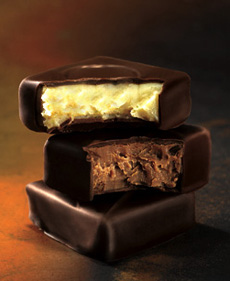
Ganache, a blend of cream and chocolate, can be additionally enhanced with any flavor in the rainbow. The ganache-filled chocolates above, from John & Kira’s, are a NIBBLE Top Pick Of The Week.
March 2005 |
Product Reviews / Main Nibbles / ChocolateChocolate Glossary ~ G-ZLearn The Language Of Chocolate With These Terms, Definitions & Explanations
Master the terms in this “chocolate dictionary,” and you’ll be able to hold your own with any chocolate professional. Our glossary of chocolate terms and definitions is more like a Chocolate 101 course. This glossary contains mostly original source material written by Editorial Director Karen Hochman and Chocolate Reporter Peter Rot, plus edited compilations and revisions of materials from their files. Its goal is to provide the most comprehensive resource for consumers who want to become better educated on the topic of chocolate. As with any dictionary, five different sources will yield five slightly different definitions. If you think we should consider chocolate terms and definitions other than those we have provided, or you’d like to suggest additional words for inclusion, click on the link. Also enjoy our other food glossaries—more than fifty! This glossary is protected by copyright and cannot be reproduced in whole or part. You can click on the letter of the alphabet in the bar below to get to a term g h i j k l m n o p q r s t u v w x y z Find Chocolate Terms From A to F GANACHEA velvety smooth blend of chocolate and cream, often with butter added, that is usually dipped in chocolate and rolled in cocoa powder and sugar or other coatings to make a truffle. It is often used as a center for bonbons. Ganache can be made from dark, milk, or white chocolate and flavored with chocolate, coffee, liqueurs, extracts—virtually any flavor that inspires the chocolatier. Using more chocolate than cream yields a firmer ganache, whereas more cream than chocolate yields a softer more velvety mixture. Ganache can be beaten with butter and used to fill and frost cakes and pastries (ganache beurre or ganache soufflé), and in its liquid state can be poured over cakes and pastries as a glaze. GARNISSAGEThe French term for filling a chocolate shell using a piping bag. GERMAN CHOCOLATE or GERMAN’s CHOCOLATEA sweet baking chocolate developed by Sam German for Walter Baker & Company, manufacturer of Baker’s Chocolate, in 1852. In 1957 a Texas homemaker submitted the recipe for German’s Chocolate Cake, today generally called German Chocolate Cake, to a Dallas newspaper. A chocolate sour cream layer cake with a coconut pecan topping and filling, it has become a popular recipe. GERMPLASMThe collection of genetic resources of an organism—a plant’s “DNA.“ GHANAA prime growing region for cacao that is bold, assertive, and dark-toned. Most of it is Forastero, but with a low level of bitterness. Common flavors are pure cacao, coffee, and tobacco. GIANDUJA or GIANDUIAAlso called hazelnut praliné, a smooth nut paste made of roasted and finely ground hazelnuts and chocolate and sugar, conched together. It can also be made of almonds. Gianduja was invented in the 19th century Turin, in the Piedmont region of Italy (not surprisingly, the Piedmont is the major hazelnut-producing area of Italy). History says that because of the Napoleonic blockade, chocolatiers were unable to obtain enough cacao from South America. What was available was extremely expensive. So they started to incorporate bits of roasted hazelnuts to make the chocolate more affordable. The first gianduioto, later called gianduja, was produced in 1865. Gianduja was originally made with cocoa powder although today, milk and dark chocolate are used. GOURMANDISESThe French word for “sweets,” gourmandises (goor-mun-DEEZ) can include the non-chocolate items sold by a chocolatier (i.e., not bonbons, truffles or chocolate bars), such as chocolate-dipped fruit, dragèes, marshmallows, mendiants, nougatine, pâte de fruits and other items we might think of as gourmet candy. GRAND CRU CHOCOLATEChocolate created with beans from a particular area or region, i.e., single origin chocolate. It can either be a blend (e.g. Criollo and Forastero) or a single variety of beans, as long as the beans come from the one origin. The origin can be closely defined geographically, e.g. the island of Trinidad, or more broadly, e.g. the Caribbean. The term was coined by Valrhona, which launched the first single origin bar in 1986, Guanaja 70%, a mix of Criollo and Trinitario beans, and defined the origin as South America. Their Jivara Lait milk bar is also from South American beans; their other Grand Cru bars come from Caribbean and Madagascan beans. What Cluizel calls 1er [Premier] Cru chocolate, from specific plantations, is called Estate Grown by Valrhona. To add to the confusion, in the wine industry, from which this terminology is taken, a Grand Cru wine is better-quality than a Premier Cru wine. But the reverse is true given these chocolate definitions: Cluizel’s 1er Cru chocolate, which is single estate, is of higher quality than Valrhona’s Grand Cru, which is only single origin. See also 1er Cru and Single Origin. GRAIN(1) The pattern of crystallization of a chocolate bar’s components (cocoa butter, cocoa liquor, sugar), which can be observed on a cross-sectional basis, when a bar is broken in two. (2) Another term for the cacao bean or seed. GRINDINGAfter the beans leave the roaster, they go to the grinding room for the mechanical process of pulverizing the roasted cacao nibs into the chocolate liquor. The nibs, which are about 53% cocoa butter, pass through a millstone which extracts the fat (the cocoa butter) and separates the cocoa mass, or chocolate liquor. GRIOTTE(Gree-UT) French for Morello cherry. HACIENDAA plantation or estate where cacao is grown. HARVESTCacao is harvested throughout the year; but the main growing seasons are November to January and May to July. HAZELNUT PRALINÉSee Gianduja. HEALTH BENEFITS OF CHOCOLATECacao has a high concentration of antioxidant-rich phytochemicals called flavanols, but once that cacao is converted into chocolate, it acquires a substantial amount of sugar and fat that are not exactly heart-healthy; plus, the amount of flavanols in the chocolate are diluted with the addition of sugar and milk. Although research indicates that cacao may improve blood flow and even reduce the formation of clots, 2,300 calories a pound is a high price to pay for prophylactic measures. Cocoa powder made with lowfat milk and a minimum of sweetener is the best way to consume cacao antioxidants. Choose a cocoa powder that has not been “Dutched”: Dutching destroys phytochemicals. HOT CHOCOLATEHot chocolate, as first served by the Swiss, is different from hot cocoa. The latter is made with defatted cocoa powder; the former is made by pouring hot milk over shaved chocolate. Since chocolate contains cocoa butter, hot chocolate is a much richer beverage. IER CRUActually 1er Cru, not ier Cru, an abbreviation for Premier Cru: 1er is French for 1st, or premier growth. The term, originally applied to the best vineyards in Bordeaux, has been adopted by growers of cacao and coffee beans to designate their finest-grown beans. INFUSEInfusion is a method of flavor extraction that incorporates flavors such as fruits and nuts into chocolate by steeping and removing. For example, orange zest is added to melted chocolate and then the chocolate is strained to remove the zest. The chocolate retains the orange flavor without actually possessing any of the orange itself. INTERIORA term describing the insides or centers of confections that are enrobed with chocolate. JAVAA prime growing area for quality beans, often used in milk chocolate because they usually offer bold flavors that can withstand the dilution of the milk solids and the relatively low cocoa content. Javanese beans are usually characterized by a dark tone of leather and smoke, although lighter flavors are sometimes found, such as lemon and sweet spice. KAKAWAThe word for cacao used by the Olmec civilization, the first cultivators of cacao and the earliest known name for the plant. The word survives in Mixe-Zoquan the language of the people native to what is now Honduras. KASTANJESPronounced kas-TAN-ya, a molded, chestnut-shaped chocolate. It may or may not have a chestnut-flavored fillin; most often, it is filled with ganache. The preferred chestnut confection is marrons glacés, candied chestnuts. LECITHINLecithin can be extracted from egg yolks or soybeans (when it is called soya lecithin, and is generally the type of lecithin used by most chocolate makers). It is a natural product used as a thinner in chocolate. As an emulsifier, it helps maintain an emulsion (attachment) between the cocoa butter and the sugar. It also increases the chocolate’s fluidity (pliability) through the reduction of viscosity. (Cocoa butter is also added to for this purpose.) When no lecithin is added, the chocolate is dense and thick and tends to keep air inside the bar, which can create a rough surface texture including air bubbles. However, some of the finest chocolatiers, including Domori and Michel Cluizel, elect not to emulsify their chocolate, as they believe it interferes with nuances of taste in the cacao. Their chocolate is outstanding because of the overall care and quality of their production process. LIMITED EDITION CHOCOLATE BARSome companies, such as Amano and Scharffen Berger, produce “Limited Edition” bars. This means that there aren’t enough beans to warehouse for future batches, and the small crop has an unusual flavor that can’t be guaranteed to be duplicated in next season’s crop—assuming the beans are available at all. Hence, only a limited number of bars that taste like this can ever be produced. LIQUID CHOCOLATENot real chocolate but a product developed for baking convenience, made with vegetable oil rather than cocoa butter. It comes in individual one-ounce squeeze packages and requires no melting. However, it delivers neither the flavor nor the texture of regular chocolate. MALTITOLA natural sugar substitute that provides the most natural sweetness in sugar-free chocolate. Made from malt extract, it is more expensive than other non-sugar sweeteners but used in the finer sugar-free chocolates. MADAGASCARA growing region and cacao often associated with a vibrant and crisp citrus tartness. Grape and pineapple-like tones are common as well. Vodka and white wine notes sometimes accompanies these flavors. Although not as common, spice, cedar, and other woody tones are appearing in more Madagascan chocolate. It is a slightly lighter style, sharp on the palate but with no bitterness.
MARRONS GLACÉSPronounced mah-RAWN glah-SAY, candied chestnuts (also called glazed chestnuts or crystallized chestnuts). In an elaborate process, cooked chestnuts are are candied in a glucose syrup flavored with vanilla. The glucose creates a crystalline effect that sugar does not.
MEAT MENDIANTS MEXICAN CHOCOLATE or CHOCOLATE MEXICANO This term has two definitions: (1) a chocolate beverage similar to cocoa, or (2) a semi-soft cinnamon-scented sweet chocolate, also called Oaxaca Chocolate. The cacao beans are ground and MILK CHOCOLATE Along with white chocolate, the sweetest eating chocolate. Made of chocolate liquor, cocoa butter, some form of milk, sugar, and flavorings. Today, fresh, sweetened, condensed or powdered whole milk, depending on the individual manufacturer’s formula and manufacturing methods, is blended with the sugar and added to the chocolate liquor during the crumb or flake process. It is then dried on heated rollers to produce the flavor more typical of European chocolate or mixed with slightly acidified milk to produce the flavor preferred in the U.S. The milk often brings out cream, caramel or butterscotch flavors in the chocolate. All milk chocolate made in the United States must contain at least 10% chocolate liquor and 12% whole milk (usually in dried form). Bars of fine milk chocolate generally contain between 30% and 45% cacao. The most inexpensively made, commercial cacao can have as little as 5% cacao. Since the higher the cacao content, the more “snap” a bar has, milk chocolate has less snap than dark chocolate. Milk chocolate was first made successfully in 1879 after Daniel Peter*, a Swiss chocolate manufacturer, had the idea to substitute powdered milk for the whole milk or cream that had been unsuccessfully attempted previously. Powdered milk had been invented by his neighbor, Swiss chemist Henri Nestlé, in 1867, after eight years of experiments. So while the Spanish were responsible for bringing cacao to Europe from the New World and Englishman Joseph Fry created the first chocolate bar, the Swiss have full ownership of milk chocolate. Today, the trend among chocolate connoisseurs is toward dark milk chocolate. *Peter was a candle maker who fell in love with and married the daughter of a chocolatier. He converted his candle factory into a chocolate plant—to great success. His original formula using powdered milk is still in use today. In 1879 Peter and Nestlé founded the Nestlé Company. MOCHAThe flavor combination of chocolate and coffee. MOLDED CHOCOLATEChocolate shaped in a mold, including classic treats like chocolate Easter bunnies, Easter eggs, and Santas. Tempered chocolate is poured into a mold, cooled, and unmolded. Molded chocolates can be solid or hollow. Chocolates that are not molded are enrobed. Chocolates that were both molded and filled first appeared in 1913. They were developed by Swiss confiseur Jules Séchaud of Montreux, who created the machine and the process. MOLDINGMolding has two meanings: (1) In the chocolate-making process, after conching, the chocolate is tempered, poured into the molds, passed through the refrigerated tunnel and then unmolded. This creates the large blocks of couverture from which all chocolates are made, and can also create the producer’s individual chocolate bars. The chocolate bars are left to rest for a few days so their flavors will age and to insure stability. Then the chocolate is packaged. (2) In making molded chocolates, the tempered chocolate is poured into molds and the molds are turned so the chocolate creates a fine coat (the shell). The shells are subsequently filled with ganache, praline, whipped cream, or other filling; then closed with a layer of chocolate and cooled. The molds are tapped to remove the finished chocolates. MOLINILLO MOLEA spicy, unsweetened chocolate sauce. The classic Mexican dish mole poblano, composed of turkey in mole sauce, is said to have been invented by nuns in the convent of Puebla, outside of Mexico City. MOUTHFEELThe texture and other sensations of the chocolate in the mouth. In general, a good chocolate will be smooth and dissolve into liquid in the mouth. A less good chocolate will be grainy, gritty, or waxy (the latter may indicate that cheaper vegetable fat has been substituted for the cocoa butter). NACIONAL or ARRIBA NACIONAL CACAONacional cacao is predominantly grown in Arriba Mocache, Los Rios, Ecuador, with some stock grown in Colombia. Overall, it is a cacao that shares the hearty flavor of Forastero and nuances of Criollo, and could be viewed as the best of both worlds. Some people consider it a Forastero, while others argue that genetically it’s a fourth subgroup of cacao altogether—it has the same fragility and high disease susceptibility as a Criollo. It regarded as a flavor cacao, though not quite as delicate or fine as Criollo. Typical Nacionals possess a delicate cacao flavor, accented by a perfumed floral scent and lovely floral tones including a dominant jasmine note and nutty after-tones. However, others can be quite hearty and bear flavors of coffee, vanilla, soft red fruits and spice. Unlike most Forasteros, which can be harsh and bitter, the bitterness level of these beans is practically nil—its flavor is smooth, which further adds to its unique character. In fact, it is a “sweeter” bean, and in higher percentage cacao products—75% and up—it produces a sweeter, smoother chocolate given the same amount of sugar as a different bean.
NATURAL PROCESS COCOA or NATURAL COCOA POWDER or NON-ALKALIZED COCOACocoa in its natural state, that is not dutched—i.e., cocoa processed without an alkaline treatment. Early chocolate was mostly consumed in a liquid form as a drink. Cocoa butter was originally removed from chocolate by boiling and skimming until the early 1800s, when Dutch chemist Coenrad van Houten developed a hydraulic press to remove the cocoa butter and produce cocoa. There were two problems with this early cocoa: it didn’t easily mix well with water and it had an acidic taste. So van Houten treated the powder with alkaline salts (potassium or sodium carbonate). The process became known as Dutch-processed cocoa. The process darkens the color and eliminates the acid notes. Natural cocoa powders are usually yellowish-brown in color and have a fruity flavor with an acidic backbone. Their sharper flavor may give certain recipes a slightly harsher taste, but generally it is not very noticeable. When added as an ingredient to various recipes, it will add a pale brown color to the food. Dutch cocoa powder, on the other hand, provides a richer flavor and a deeper brown coloring to the food or beverage. As recipes are prepared using one or the other, is generally best not to substitute natural process cocoa for Dutch unless baking powder or baking soda is added to the recipe. In a top quality cacao, it may not be necessary to Dutch the cacao to remove the acid; whereas in an average quality cacao, it is.
NUTThe cacao pod. Also called the cabosse. OAXACA CHOCOLATEA chocolate made in Oaxaca, Mexico. See Mexican Chocolate. OCUMARE 61 and OCUMARE 67Criollo and Trinitario hybridized blends originally from the Ocumare de la Costa valley of Venezuela. Ocumare 61 has a sharp punch. Flavors vary, but earthy spiciness, peaches, red fruits, and fresh dairy are common. Ocumare 67 is darker in tone, more robust and assertive, and lacks 61’s sharpness. Flavor notes include cashews, peanuts, spice, pepper, and sometimes dairy. 1ER CRU CHOCOLATEORGANICOrganic refers to how foods and other products are produced. Organic production is based on a system of farming that maintains and replenishes the fertility of the soil and the health of plants, animals and people. Organic foods are produced without the use of chemical pesticides and fertilizers and are processed without artificial ingredients, preservatives or irradiation. Organic chocolate contains a minimum of 95% naturally grown and certified raw materials. Organics produced in the United States are under the authority of the Organic Foods Production Act, and can apply for official certification. ORIGIN CACAO or ORIGIN CHOCOLATESee Single Origin Cacao. PALET D’OR
PARTICLE SIZEThe basis by which chocolate smoothness is measured. The particles of the cacao beans and sugars are broken to such a small-scale microscopic magnitude that the tongue is unable to detect individual particles. Generally, particles sizes of 14-18 microns are desirable. PASTILLEThe word has evolved to mean many things over time. In candy and confections, it PASTYSee Thick. PÂTE DE CACAOSame as chocolate liquor.
(1) The amount of cacao solids in a bar compared to other ingredients (e.g. sugar). Cacao is a combination of cacao mass, cocoa butter and cocoa powder. The higher the percentage of cacao in a bar, the more depth of chocolate flavor, and the less sweet the chocolate. A recipe for chocolate includes cacao, sugar, vanilla and emulsifier, plus milk if it is milk chocolate. The higher amount of cacao replaces the corresponding amount of sugar in the recipe (an average milk chocolate has about 20% milk solids, and most chocolate contains 1% vanilla and emulsifier). Thus, 70% cacao chocolate has less sugar than 60% chocolate. Cacao percentages range from 30% cacao for some milk chocolates to 100% cacao, which has no sugar but is still enjoyable by some people for eating. Cacao percentage is only one factor in taste. Other variables include the type and quality of the bean, how the beans are roasted, how the chocolate is processed, the amount and type of sugar or other sweetener, added flavorings, extra cocoa butter, etc. A higher percentage of cacao solids is not a guarantee of a better product. Good chocolate depends on the quality and origin of the beans and the manufacturer’s production techniques and blend (recipe); as well as the freshness of the chocolate. (2) According to the Chocolate Manufacturers Association, “% cacao” refers to the total percentage of ingredients (by weight) which come from the cacao bean (or cocoa bean) such as chocolate liquor, cocoa butter, and cocoa powder found in a chocolate product. (3) White chocolate has no cocoa solids (chocolate liquor): The “% cacao” refers to the cocoa butter. The higher the percentage, the creamier the white chocolate. The use of the “% cacao” designation originated in Europe, where chocolates must be labeled to indicate the minimum total cocoa solids. “Cocoa solids” are often stated as “% Cacao” (France, Spain), “% Kakao” Germany) or “% Cocoa” (U.K.). In the U.S., chocolate manufacturers are not required to declare the percentage. However, due to the increased consumption of fine imported chocolate bars bearing the designation, and consumer interest in learning more about chocolate, a trend has begun among American producers of better chocolate to add the designation.
The inside of a pod reveals a pulpy
white fruit which is removed to get to the seeds, a.k.a. the cacao beans. Photograph courtesy of Amedei. PODThe oblong fruit of the cacao tree. Pods measure six to 12 inches and ripen in five to six months. Inside are 30 to 40 half-inch-long, almond-shaped seeds, or beans, from which chocolate is made. Pods are harvested and cut open with a type of machete and are left as is to ferment. The beans are then scooped out and spread out in the sun to dry. Dried beans are graded and sold to chocolate producers. PORCELANAOne of the rarerst beans in the world, a genetically pure strain of the Criollo bean from the Andean region of Venezuela. It is named Porcelana for the pale, almost white-
According to the story, the duc’s cook, Clément Lassagne, invented pralines in 1636 by dropping almonds into a cauldron of boiling sugar. After retiring from the duc’s service, Lassagne founded the Maison de la Praline, a confectioner’s shop that still exists in the town of Montargis in the same location, operated by a family named Mazet. They sell pralines made with the original recipe (you can find their products online). In the centuries since, the marketplace has taken the word praline and used it to describe multiple products. Whenever you see the word praline, nuts are involved; but the word often does not refer to the original caramelized almond.
PRALINE PASTE or PRALINÉPraline paste, also called praliné (prah-lee-NAY) is a ground nut paste generally made from almonds or hazelnuts and sugar (the paste can be made from any nut; pistachio paste also is popular). It has been used in French patisserie since the 16th century to make pastries and to flavor mousse, buttercream and ice cream. Hazelnut praliné is a roasted and caramelized nut paste invented during a chocolate shortage in the 19th century in Turin, Italy. In Italy it is known as gianduja (jon-DOO-ya). It is popularly combined with chocolate and used in other confections. PREMIER CRU CHOCOLATEThe term Chocolat Michel Cluizel and some other chocolatiers use for their estate-grown chocolate. PRESS CAKE or PRESSED CAKE or TOURTEAU DE CACAOAn interim product in the production of chocolate, that remains after most of the cocoa butter has been pressed from the chocolate liquor by using massive hydraulic pressure. The resulting press cake is later pulverized into cocoa powder. The cocoa press was invented by Coenrad Johannes Van Houten, a Dutch chemist who took out a patent for it in Amsterdam on April 4, 1828. Van Houten also invented the alkalizing process known as Dutching. PRESSINGThe stage of chocolate-making where the chocolate liquor is carried through hydraulic presses and the melted cocoa butter is extracted from the paste. PRESTIGE CHOCOLATEThe most expensive category of chocolate. In the confectionary industry, chocolate is categorized by its price per pound at retail. The categories include Mass Market, less than $15 per pound; Mass Market Premium, from $15 to $25 per pound; Gourmet, from $25 to $40 per pound; and Prestige, at $40 per pound and higher. PUGGINGThe first rudimentary form of chocolate, after the mixture has been kneaded with the addition of vanilla, cocoa butter and (if milk chocolate) powdered milk. PURE ORIGIN CHOCOLATEChocolate created with beans from one particular area or region. Also known as single origin chocolate. RAW CACAOThe harvested, fermented and dried cacao beans, hand-sorted, graded, packed into jute bags and ready for processing. The bags weigh about 139 pounds (62.54 kg). RIO CARIBEA Trinitario bean grown near the Rio Caribe, in the Sucre State of Venezuela. This cacao has a slight dark tone and a refreshing bitterness. Common flavors are coffee, almonds, slight red fruits, and pure cocoa. ROAST, LIGHTSome brands opt to roast cacao beans for a shorter time. This light roast imparts a sharp, fruity tone to the finished chocolate. ROAST, DARKA dark roast indicates that the beans have been roasted longer to further mellow the cacao’s flavor. As a result, flavors tend to have “dark” tones with traces of caramel, woods, and coffee. ROASTINGThe first step in producing chocolate from cacao beans. Similar to roasting coffee, the heating process fully develops the chocolate flavors and aromas of the cacao beans. Roasting times vary by producer, but a typical roasting time is 30 minutes. After roasting, the nibs go to the grinding room to be ground. ROCHERIn French, rocher is a rock. In chocolate, rochers are slivered almonds, coated in chocolate to create clusters that are poetic chocolate “rocks.” RUSTICIn positive terms, “rustic” chocolate refers to a pre-industrial style of chocolate, before conching was invented. Beans were minimally processed and less refined sugar was used. The texture was rougher and crunchier. Today artisans like Italy’s Claudio Corallo choose to make chocolate in the old style. However, chocolate that was not intended to be made in such fashion, but which has an inferior texture and mouthfeel, can be termed “rustic.” SÃO TOMÉAn island republic in the Gulf of Guinea off the west coast of Africa, that is a prime growing area for the Amelonado subspecies of high quality Forastero. São Tomé cacao can be bitter with flavors of pure cocoa, sharp red fruits, cinnamon, and vanilla. It is a good base for blended chocolate. SEEDAnother word for the cacao bean; also called grain.
SHELF-LIFESee Storage. SINGLE ESTATE CHOCOLATEChocolate created with beans from one particular estate, plantation or hacienda (these terms are interchangeable). Single estate does not necessarily mean only a single variety of beans is used in the chocolate: it can be a blend (e.g. Criollo and Forastero) or a single variety of beans, as long as the beans come from the same estate. SINGLE ORIGIN or ORIGIN CACAO or PURE ORIGIN CACAO or MONORIGIN CACAOBeans grown in one particular area or region,or the chocolate made from these beans (which can be called called single origin chocolate). This can either be a blend (e.g. Criollo and Forastero) or a single variety of beans. In fact, the origin of the bean can be a more important flavor determinant than the species of the bean (Criollo, Forastero or Trinitario). Seek to identify flavors of chocolate by the origin of its beans (Costa Rica, Madagascar or Venezuela, e.g.) rather than by whether it is Criollo- or Forastero-based. See also Grand Cru and 1er Cru. SINGLE ORIGIN CHOCOLATESee above. SNAPThe clear, crisp sound made from breaking a piece of chocolate from a bar. A good, clean snap is indicative of high cacao content and well-tempered chocolate. Milk chocolate which has lower levels of cocoa solids, and white chocolate which has no cocoa solids and is softer, don’t have the same clean snap (the higher the cacao content, the harder the chocolate). The opposite of snap is crumbly. SOYA LECITHINLecithin extracted from soybeans. Soy, not egg lecithin, is used in the manufacture of chocolate. It increases the pliability of the chocolate. See lecithin. STORAGETop chocolatiers are concerned about the freshness of their product, and recommend that chocolate bars be consumed within three to six months after production. However, while they will not be as perfect as if consumed within six months, dark chocolate bars can be kept for two years or more if stored properly—well wrapped in foil in a cool, dark, dry place. A wine cellar is the ideal location because of its temperature and humidity. Milk and white chocolate have a more limited storage time, but will stay fresh for a year or more under these conditions. Filled chocolates, chocolates with nuts and other additives (including bars) have less of a shelf life because the additives will break down or go rancid. Commercial companies will use preservatives to extend the shelf-life, but most fine chocolates are made preservative-free. A box of fine filled chocolates or truffles should be consumed within two weeks, the sooner the better. The fillings, creams, and purées with which they are made deteriorate quickly: To enjoy them, they should be eaten soon after they are made. If you have a question about the shelf-life, call the chocolatier. SUGAR BLOOMSugar bloom is generally the result of a temperature shock—most often, storing chocolate in the refrigerator (which should not be done) and removing it to serve. When the chocolate is taken out of the refrigerator and condensation collects, a rough irregular texture forms on top of the chocolate. This is the sugar bloom. The condensation dissolves the sugar in the chocolate; when the water evaporates, the sugar recrystallizes into rough, irregular crystals on the surface which gives the chocolate an unattractive appearance. If chocolate has been stored in a cold place, allow it to come to room temperature slowly before opening the package, thus minimizing the condensation. Bars with sugar bloom can be re-melted and re-tempered, or used in baking or in sauces where the texture is not a factor. Bonbons with sugar bloom cannot be restored. SUR DEL LAGOSur Del Lago is one of the two distinct cacao growing regions of Venezuela (the other is Andean). It produces beans called Sur Del Lago Clasificado, a mixture of Criollo and Trinitario. This cacao is hearty and robust, and bears an extreme dark tone with flavors of butter, hazelnuts, and red fruits plus floral tones. SWEET CHOCOLATESweet chocolate is a cooking and baking chocolate. It is made by mixing chocolate liquor with sugar and extra cocoa butter. SWEETENERFine chocolate is sweetened with cane sugar. Mass-produced chocolate can substitute high-fructose corn syrup. Fine chocolates labeled “sugar free” generally use maltitol, where mass-distributed chocolates can use saccharine, sorbitol or other less expensive sweeteners. SWISS-STYLE CHOCOLATEOf the three styles of bonbons—Belgian, French and Swiss—Swiss chocolates are the most creamy, smooth, soft and velvety and have a greater focus on milk chocolate. This is based on the heritage of the Swiss chocolate. In 1879, Daniel Peter, a Swiss chocolate manufacturer, successfully created milk chocolate by substituting powdered milk for the whole milk or cream that had been unsuccessfully used previously. In that same year, another chocolate manufacturer, Rodolphe Lindt, invented conching, the process that makes chocolate smoother and more velvety. And, the quality of the milk used in Swiss chocolate, which comes from alpine cows, contributes its own creaminess. TABLETTE or CHOCOLAT EN TABLETTEThe French word for a chocolate bar for eating. See also bâton. TEMPERINGChocolate is not shiny on its own: It needs to go through a process called tempering to achieve its glossy appearance and a pleasant mouthfeel. This involves an alternating process of heating, cooling, and heating again to specific temperatures to stabilize the mixture to obtain the smooth, shiny texture and a good “snap” when broken. Well-tempered chocolate melts better in the mouth and ages better. The word “temper” refers to the way chocolate solidifies. Only the cocoa butter particles become melted: Sugar and cocoa powder remain solids suspended in the fluid cocoa butter. When the melted chocolate cools and becomes solid again, the cocoa butter particles form a crystalline structure. The evenness of distribution of cocoa butter, and the type of crystals they form, comprise the temper. Chocolate is in good temper if the cocoa butter is mixed thoroughly and evenly throughout and the particles have cooled uniformly and completely. If not tempered properly the finished chocolate will be dull and streaky with a tendency to bloom. The classic tempering method is to melt the chocolate until it is lump-free. Then 1/3 of the chocolate is poured onto a marble slab, spread and worked back and forth with a metal spatula until it becomes thick and reaches a temperature of about 80°F. This chocolate is then added back to the remaining 2/3 of the melted chocolate and stirred. The process is repeated until the entire mixture reaches 88° to 92° for semi-sweet chocolate, 84° to 87° for milk or white chocolate. Care must be taken not to over-temper chocolate, which returns it to its original state—grainy and susceptible to bloom. TERROIRTerroir, pronounced tur-WAH, is the French word for soil, land or terrain. It can be loosely translated as “a sense of place,” the sum of the effects that the environment has on the creation of what is grown there. It has long been used in wine and coffee analysis to denote the special characteristics of soil, geology, aspect and altitude that give the grape or bean its individuality. The term is now being used, appropriately, to describe cacao beans. THEOBROMA CACAOThe botanical name for cacao tree, a tropical evergreen in the family Byttneriaceae. It i Criollo cabosses growing on the Theobroma cacao tree. It is not possible to determine the variety from the exterior pod; the beans inside need to be inspected. Photo courtesy of Amano Chocolate.
THEOBROMINEA stimulant, one of the more than 400 compounds that comprise chocolate. THICKAlso called pasty. Refers to texture. In order to achieve optimum smoothness and avoid being thick, some brands add extra cocoa butter. Thickness can be due to different factors: (1) The the lower fat content of the beans. Generally, higher grade beans do not require a great amount of added cocoa butter due to their already higher level of fat. (2) Some purist brands don’t use lecithin for added fluidity because it can mask some subtle aromas and flavors. As a result, the chocolate will not melt as smoothly in the mouth and will seem “thicker” in texture. (3) Chocolate of high cacao content, 80% and above, will have a thicker texture due to the higher amount of cocoa liquor. This feature is virtually unavoidable unless extra cocoa butter is added.
However, an insignificant amount of coumarin would be ingested from food, and experts say it is not considered a health risk. It is used in perfume, and prior to being banned by the FDA in 1985, it was used to make vanilla extract and to flavor cigarettes. TORRONEPronounced toe-ROW-nay, the Italian word for nougat.
Since Trinitario beans can take their flavor characteristics from either their Criollo or Forastero descendants, experts recommend that you look at the origin of the bean—the single origin characteristics—to understand the flavor of cacao, rather than look at the Trinitario bean as having a specific flavor profile. This is true with Criollo and Forastero beans as well, both because of prolific crossbreeding of the cacao trees, and because there are few “pure species” cacao farms: In many farms, trees from two different species will grow side by side due to nature.
Today’s truffles can be coated in nouvelle spices like peppercorns, sweet curry and paprika and can be enrobed in couverture. In 1912, the Belgian chocolatier Jean Neuhaus invented the first hard chocolate shell, enabling chocolates with soft fillings. While he called them pralines (see the dual meaning above), other chocolatiers referred to them as truffles because early filled chocolates were filled with ganache. As words evolve, the term truffle is often used to in America to describe any filled chocolate, and it becomes very confusing: chocolate cremes or assorted chocolates, e.g., would be more accurate. If the term is applied to a filled, hard-shell chocolate, the use should be limited to round shells filled with ganache, like the truffle from Vosges Chocolate shown above.
Among our favorite truffles are these, made in the classic French style by Belgian UNSWEETENED CHOCOLATESolid chocolate made from 100% chocolate liquor, with no sugar or emulsifiers added. Top quality 100% cacao bars are excellent for eating if one likes intense cacao flavor. Note: some people in the trade refer to chocolate liquor as unsweetened chocolate. VANILLAThe flavor extract derived from the vanilla bean, the pod of a tropical orchid. The pods are harvested green and cured, turning brown when heated in ovens. Each pod contains numerous seeds. Vanilla extract is made by chopping or macerating beans, then mixing them with ethyl alcohol and water, aging the solution, and filtering out the solids. Pure vanilla extract must be 35% alcohol by volume. Vanilla is native to southern Mexico, although the majority of today’s supply comes from Madagascar (known as bourbon vanilla); secondarily from Tahiti (the finest and rarest); Mexico is the third largest source. Almost all fine chocolate is enhanced with vanilla. Just as with cacao beans, vanilla from different parts of the world has different flavor complexities, and specific vanillas are paired with specific chocolates to achieve different results. The Madagascar bean (Bourbon bean) is very thin and very rich in sweetness. It has a thick oily skin that covers many small seeds that provide a strong vanilla aroma. The Mexican bean is not as thin and not quite as sweet as the Madagascar bean. The bean has a somewhat earthy aroma and is more mellow in flavor than the bourbon bean. The Tahiti bean is plumper in size, darker in color, and the least sweet of the beans. Its thin-skinned pod covers fewer seeds than the other varieties and they have a slightly fruity aroma. While the orchid family is the second largest family of flowering plants with approximately 20,000 species, the Vanilla genus is the only group that produces anything edible.
VANILLA EXTRACTVanilla beans are expensive and time consuming to split open and work with to flavor dishes. To save time and money, an extract is produced by steeping vanilla beans in an alcohol and water solution; the alcohol and water cook out, leaving the essence. Pure vanilla is concentrated and only a small amount is needed for flavoring. However, it is an expensive flavoring to produce, which has led to the proliferation of synthetically produced vanilla—vanillin. This is generally labeled Artificial Vanilla Extract at retail; but the word artificial is often in small letters: look closely to avoid purchasing the wrong product. VANILLINNatural vanillin is a white crystalline compound found in the pulp of vanilla beans and is the largest component in vanilla. The flavoring ethyl vanillin is manufactured commercially, an artificial by-product of the wood pulp used in the paper industry. Ethyl vanillin is substituted for vanilla in lesser chocolate. It can often be identified by a strong vanilla smell: Natural vanilla is much more subtle. VARIETALA biological variety; a chocolate made from one particular subspecies of beans: Criollo, Forastero, or Trinitario. Borrowed from wine terminology, where it refers to a wine made principally from one variety of grape and carrying the name of that grape, e.g. Cabernet Sauvignon, Chardonnay, Pinot Noir. The term is also used to describe coffee beans and other fruits like peppercorns; another term, cultivar, is used for fruits like avocados and olives. WHITE CHOCOLATE
White chocolate, though a member of the family, is not technically chocolate because it contains no cocoa solids. If it did, it wouldn't be white! Originally developed as a lighter summer confection, white chocolate is sometimes referred to as white milk chocolate because, like milk chocolate, it is made of cocoa butter, milk, and flavorings (though milk chocolate does contain cocoa solids). Photo of courtesy of CourtJester.com.
XOCOATL or XOCOLATLPronounced shock-WA-tel, the Mayan word for chocolate. It means bitter water. The original chocolate beverage was an unsweetened drink mixed with maize and flavored with pepper and other savory spices. The word “cacao” originated with the Olmec peoples who occupied the lowland regions of the eastern Mexican gulf coast; originally pronounced kakawa, “cacao” derived from the Mixe-Zoquean family of languages spoken by the Olmec, and was probably in use by 1000 B.C.* The Olmec shared their knowledge of cacao with the adjacent Mayans. The Nahuatl (Aztec language) term cacahuatl for cacao was concocted from the Mayan word. See chocolate for the etymology of the word.
© Copyright 2005-2008 Lifestyle Direct, Inc. All rights reserved. Images are the copyright of their respective owners.
|
|
||||||||||||||||||||||||||||||||||||||||||||
|
Spread The Word: Each icon below links to a site where you can bookmark, share and comment on this article:
|