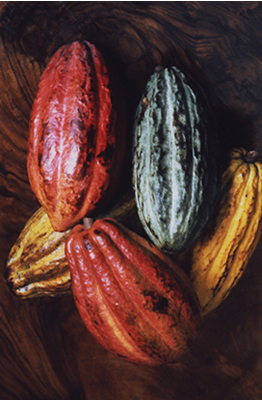
Cacao pods (also known as cabosses). The dark pod is not yet ripe. Ripe pods turn bright colors, from yellow and orange to red. It is not possible to determine the type of cacao (Criollo, Forastero or Trinitario) based on the exterior appearance of the pod; experts can tell by splitting the pod open and looking the beans. Photo courtesy of chocolatier Pierre Marcolini.
March 2005
Last Updated April 2017
|
|
Chocolate Glossary: Chocolate Definitions
Terms & Definitions: C
On this page you’ll find chocolate definitions like cabosse, cacao, conching and couverture. If you think we should consider chocolate terms and definitions other than those we have provided, or you’d like to suggest additional words for inclusion, click on the Contact Us link on this page. Also enjoy our many other food glossaries.
Use this index bar to visit other pages.
a b c d e f g h i j k l m n o p q r s t u v w x y z
This glossary is protected by copyright and cannot be reproduced in whole or part.
|
CABOSSE DE CACAO, CACAO POD or COCOA POD
The pod-like fruit of the cacao tree (see photos, top left and right), which flowers almost year-round, with one or two major flowering periods during the 10th to the 12th year in the life of the tree. Cocoa pods have differing shapes and sizes based on the variety of cacao, but can be likened in size to small pineapples.
CABRUCA
The system of saving the rainforest by cutting down just a few of the tall rainforest trees, and planting the mid-height cacao trees underneath. While this results in lower yields than clearing the rainforest and planting on open land, it results in less disease and less attack by insects than planting in open land.
|
|
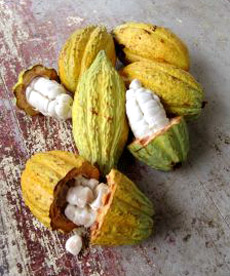
The seeds, or beans, are located inside the white, pulpy fruit. After the seeds are removed, the leftover pulp and shell are used for cattle feed. Photo of Criollo cabosses by Darius Martin | SXC. |
CACAHUATL
In the Nahuatl language of the Aztecs, the word for the cacao bean and the drink it produced. Pronounced cah-cah-WA-tay, it is derived from the Mayan word, xocoatl. See also kakawa (source: The True History of Chocolate, by Sophie Coe & Michael Coe).
|
CACAO
(1) The name of both the tree native to Amazon forests (Theobroma cacao L.) and the unprocessed seeds (beans) from which chocolate is made. Americans refer to the bean as cocoa. The word cacao comes from the Olmec, a highly cultured civilization that preceded the Maya in the southern Gulf of Mexico area from 1500 and 500 B.C.E. Cacao is divided by quality: either flavor or fine, or special or sweet cacao, and bulk cacao.The first group includes Criollo, Trinitario and Arriba or Nacional beans. The Arriba or Nacional bean is a unique Forastero, the only flavor Forastero, and is found only in Ecuador. The latter group comprises the Forastero cacaos. Each group has many hybrids and clones: There are more than 12,500 identified cacao clones. Legend tells us that the the Aztec god Quetzalcoatl bestowed cacao beans on mankind via his messenger Cacaoti, for whom cacao is named.
|
|
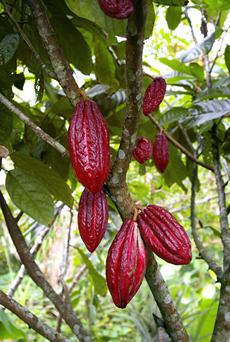
Beautiful red cabosses on a young tree. Photo courtesy Viable-Herbal.com. |
(2) From the U.S. Food and Drug Administration (FDA) Standards of Identityrefers to the bean, which is the source of the cacao components of chocolate liquor, cocoa butter and cocoa powder. Many people incorrectly refer to this as the cocoa bean or the chocolate bean. In the U.K., the term “cocoa” is preferred.
CACAO NIB
See nib. Other terms used to identify the nib include amande de cacao, amandes décortiquées, cacao en grains and grain de cacao.
|
CACAO CONTENT or COCOA PERCENTAGE
The percentage of cacao or chocolate liquor in the processed chocolate. In general, the higher the cacao content, the lower the amount of sugar used in making the chocolate; and the more intense the chocolate flavor. For people who like the flavor of pure cacao, fine bars of 100% cacao content, containing no sugar, are delicious to eat and also can be eaten by those who need to restrict sugar from their diets. A higher percentage is not an indication of higher quality, only of higher concentration of whatever quality of cacao was used to begin with.
|
|
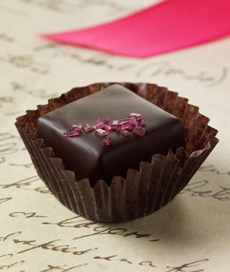
Experts consider 70% cacao content to be the perfect level for bittersweet chocolate. Photo courtesy Zoe Chocolate. |
CACAO CONTENT ~ U.S. STANDARDS
U.S. cacao standards require milk chocolate to contain at least 10% chocolate liquor. Semisweet or bittersweet chocolate must contain at least 35% chocolate liquor. The higher the percentage of cacao, the more intense the chocolate flavor.
CACAO FEVIER
The French word to indicate a bean-to-bar chocolate producer.
CAFFEINE CONTENT
Chocolate does contain caffeine, but only a small amount. A one-ounce serving of chocolate has about as much caffeine as a cup of decaffeinated coffee (6mg), so chocolate can be consumed anytime during the day or night or by most people on caffeine-restricted diets. The caffeine content of chocolate compares to these common foods as follows:
| Bittersweet chocolate |
1 ounce |
5-10 mg |
| Milk chocolate |
1 ounce |
5 mg |
| Cocoa |
6 ounces prepared |
10 mg |
| Coffee |
8 ounces |
100-150 mg |
| Cola |
12 ounce can |
50 mg |
| Tea |
8 ounces |
35 mg |
|
CARRAQUE
Solid milk or dark chocolate pieces, which are sometimes topped with raisins, almonds, walnuts and hazelnuts.
CARRÉ
The French word for square. A small tasting square of chocolate, generally five to 10 grams. See also napolitain. You can buy a tin of 36 squares, half Valrhona’s 64% semisweet grand cru Manjari, half 40% grand cru milk chocolate Jivara.
|
|
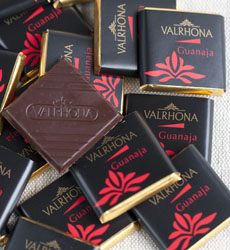
Carré, or squares, originally created to accompany after-dinner coffee. Photo courtesy Chocolate.co.uk. |
CHOCOLATE
The food product made from the roasted seeds (beans) of the cacao tree. The hulled meat of the bean, the nib, is ground and processed, into various forms for eating and drinking. For thousands of years, chocolate was only a beverage, xocoatl: it has only been eaten in solid form since 1847. Eating chocolate (candy) is generally mixed with sugar, vanilla, and sometimes other flavorings and generally lecithin as an emulsifier; milk chocolate also contains milk. Quality manufacturers may also add cocoa butter for extra richness and mouthfeel. Chocolate for cooking is left unsweetened and generally unflavored. Quality eating chocolate is further divided as follows:
| |
Cacao Content* |
Bars Most Often Found† |
| Milk Chocolate |
30% - 49% |
33%, 43% |
| Semisweet Chocolate |
50% - 69% |
50%, 60%, 65% |
| Bittersweet Chocolate |
70% - 100% |
70%, 75%, 80%, 85%, 99%, 100% |
| Plus: |
|
|
| White Chocolate |
0% Cacao but at least 33% cocoa butter
|
Not Applicable |
*The cacao referred to here is the chocolate liquor. See definition below.
† When manufacturers designate cacao content on their bars. Each manufacturer will produce a different mix of bars, based on their interests and production methods.
|
The most likely scenario for the development of the word chocolate is that the Spaniards combined the Maya word chocol, meaning “hot,” and the Aztec atl, meaning “water,” to produce chocolatl. The proper pronunciation of tl is “te” (pronounced tay in Spanish). It is surmised that the Spaniards created this word, instead of using the Aztec word cacahuatl, because “caca” in Spanish is a vulgar word for feces. The True History of Chocolate authors Sophie Coe and Michael Coe suggest that the Spaniards substituted the Maya chocol because they were uncomfortable with a a thick, dark-brown drink that began with “caca.”
|
|
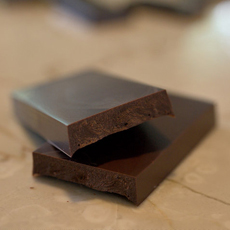
Photo courtesy Potomic Chocolate. |
|
CHOCOLATE BAR
For 90% of its history, from about 1500 B.C.E. when it was made as a drink by the Olmecs in Mesoamerica, chocolate was only a beverage. Solid chocolate was not created until 1847. Then, Arthur Fry, the great-grandson of the founder of Joseph Fry & Company, then managing the family business, discovered a way to mix some of the cocoa butter back into the “Dutched” chocolate (cocoa powder). He added sugar, creating a paste that he molded into the world’s first chocolate bar, which was called chocolate for eating to distinguish it from drinking chocolate. It was rough and gritty, not the smooth, velvety bar we enjoy today. It took another 32 years for Rodolphe Lindt to invent the conching machine to improve the texture of chocolate.
|
|
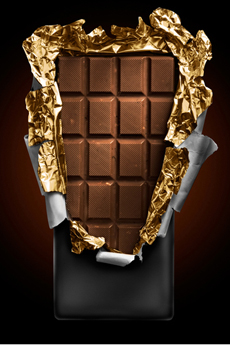
Photo courtesy LaChocolate.com.au/ |
CHOCOLATE CHIPS or CHOCOLATE MORSELS
|
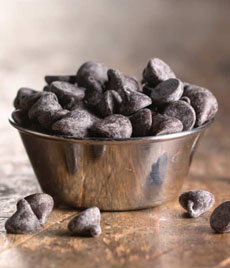
Miniature drops of chocolate used in baking which keep their shape in the finished product. Chocolate chips also are used in ice cream, for decorative purposes on various sweets, and for snacking. Chocolate chips are made in milk, semisweet, and white chocolate; and can be found in “kiss” shapes as well as oblong chunks. Chips are made by mass producers as well as by the finest chocolate houses. Chocolate chips can be melted for recipes requiring melted chocolate, but they contain less cocoa butter than regular chocolate, so they may not produce the same results. Chips are also made in non-chocolate flavors such as butterscotch, coffee, mint and peanut butter.
|
|
Chocolate chips. Photo courtesy King Arthur Flour. |
CHOCOLATE LIQUEUR
An alcoholic cordial with chocolate flavoring like crème de cacao, which can be drunk as a liqueur or as an ingredient in a cocktail. Not to be confused with chocolate liquor.
CHOCOLATE LIQUOR or COCOA MASS or COCOA SOLID or COCOA LIQUOR or PATÉ de CACAO
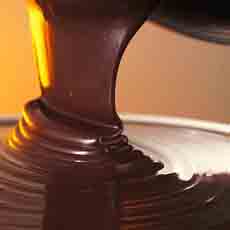
(1) A misleading but basic term, chocolate liquor is a thick, gritty, dark brown paste—a solid mass that contains no alcohol (the term refers to the “essence”—see below). It only turns liquid when it is heated. It is obtained by grinding the nibs, or meat, of the cacao beans. Chocolate liquor is about half cocoa butter and half cocoa solids (which are what is left when the bean is pulverized and the impurities are removed). While technically not yet chocolate, chocolate liquor is the “essence” of chocolate, the pure ground product of the roasted cacao beans, the base for (and main ingredient in) all chocolate products.
|
|
Chocolate liquor. Photo courtesy Lindt. |
(2) From the U.S. Food and Drug Administration (FDA) Standards of Identity: Chocolate liquor is produced by grinding the cacao bean nib (or center) to a smooth, liquid state. In the U.S., chocolate liquor is also called chocolate, unsweetened chocolate, baking chocolate, or bitter chocolate. In Canada and Europe, other names include cocoa (cacao) mass and cocoa liquor.
CHOCOLATE MEXICANO
See Mexican chocolate.
CHOCOLATE MILK
Milk that has had sugar and chocolate added for flavoring. Chocolate milk is available in whole, low fat and nonfat (skim) milk.
CHOCOLATE MODELING PASTE
A mixture of chocolate and corn syrup that creates a malleable product, similar to marzipan. It is used in decoration to create flowers, leaves, ribbons, and other decor for desserts. The paste, which can be made with dark, milk, or white chocolate, is thinly rolled out, cut, and shaped.
|
|
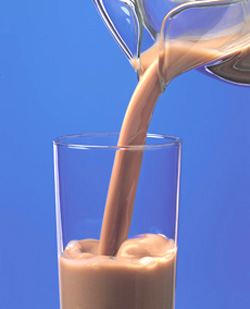
Photo courtesy Midwest Dairy Association.
|
CHOCOLATES
A distinction is made between chocolate, the general food product made from cacao beans, and chocolates, which refers to confections made from chocolate: bonbons, pralines, truffles, etc. While “chocolates” is also the plural form of “chocolate,” simple grammar rules should make this distinction clear. In 1912, the Belgian chocolatier Jean Neuhaus invented the first hard chocolate shell, which he called called couverture, enabling fillings of any kind and consistency—cream, soft caramel, light ganache, liqueurs, etc. Previously, only relatively solid centers like caramels and nut pastes could be enrobed in chocolate—anything less solid would have leaked out. However, this engendered layers of confusion regarding filled chocolates:
|
|
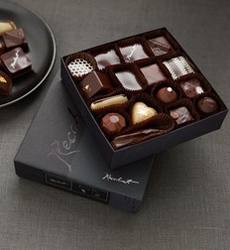
Fine chocolates not only taste great;
they are beautiful to look at. Photo
courtesy Recchiuti Confections.
|
Neuhaus called his chocolates pralines (creating a dual meaning and confusion with the French caramelized almond pralines, made since 1636). Other chocolatiers referred to them as truffles (creating a dual meaning and confusion with the French balls of ganache, covered in cocoa; sometimes, the shells are filled with ganache, sometimes with creme, whipped cream, fruit purée, liqueur, nut paste, etc.).
CHOCOLATE SYRUP or CHOCOLATE SAUCE
A liquid form of chocolate, chocolate syrup is a beverage mixer, a sweet topping and a cooking and baking ingredient. Made in dark, milk and white chocolate, syrups are commonly used to make chocolate milk and shakes, top ice cream sundaes and cakes, and to decorate dessert plates. Chocolate syrup is made from chocolate based foods with sweeteners added. Quality chocolate syrup has a rich chocolate flavor from the cocoa powder or chocolate from which it is made, but many syrups are artificially flavored. Vegetable oils are used to make syrup (replacing the cocoa butter of chocolate), plus sugar, any other flavorings (mint, orange, or raspberry, e.g.) and stabilizers for easy flow. Fudge sauces are thicker, and typically made with butter, cream, chocolate or cocoa powder and sugar.
|
|
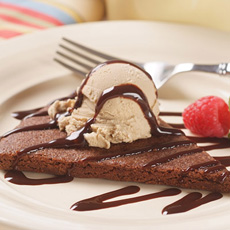
Chocolate syrup drizzled as a dessert garnish. Photo courtesy Nescafe.
|
CHOCOLATIER
This word has three definitions. First, it signifies a candy maker who specializes in the creation of fine chocolate confections using artisanal techniques. It also refers to the shop of that person. The title is also given to individuals who hold various positions in chocolate production facilities, e.g., who evaluate beans or supervise roasting, conching, and blending. These chocolatiers adjust the blends, roasting times and other factors to ensure a final formula that conforms with the house style.
CHOCOLAT SUPÉRIEUR or CHOCOLAT DE LUXE
The French term for fine chocolate.
CHUAO
A single origin growing area in the Venezuelan state of Aragua, producing some of the finest beans beans in the world. While much of the crop is Criollo, only the upper part of the Chuao plantation is planted with 100% Criollo beans. The rest is a hybrid of Criollo blanco and Amelonado, a species of Forastero—a cross-breeding technique that has yielded a hardier and more productive plant. An assertive and powerful cacao that has intense flavor, with notes of blueberries, plums, molasses, and traces of vanilla. The chocolate is slightly tart with a lingering intensity, and the finish is clean, long, and strong. With just one taste, it is easy to understand why this chocolate is so highly prized.
COCOA BEANS or CACAO BEANS
Cocoa is a misspelling of cacao that appeared on a ship’s manifest in the 18th century and led to the replacement of the original word with the erroneous one. The “beans” are the seeds from the pod, or fruit, of the Theobroma cacao tree. At the center of the bean is the nib, from which chocolate is made. There are three species of bean—Criollo, Forastero, and Trinitario—and many subspecies. More than 13,000 clones of cacao have been classified.
|
|
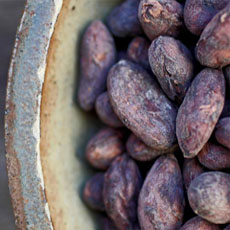
Cacao beans. Photo courtesy Castronovo Chocolate.
|
COCOA (BEVERAGE)
Cocoa is a hot beverage made from cocoa powder, generally served sweetened. It is the evolution of the original chocolate, which was a spiced, cold drink of the Maya and Aztecs (and still made by their descendants in Mexico today) brought to Spain by the Conquistadors. While the Maya used honey as a sweetener in their cacahuatl after the conquistadors brought bees to the New World, the Aztecs drank their xocoatl unsweetened. Some people also refer to cocoa powder as cocoa; but the word alone refers to the beverage. The difference between cocoa and hot chocolate is that the former is made with cocoa powder, and the latter is made with pieces of solid chocolate.
See cocoa powder, below.
|
|
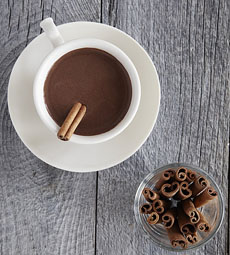
A cup of hot cocoa. Photo courtesy Cisse Trading Company | Open Sky.
|
COCOA BELT
The band 20° north and south of the Equator where the Theobroma cacao tree grows. From its origins in Brazil and Central America, it now grows in Ghana, the Cote d’Ivoire, Madagascar, Grenada, Java, Sri Lanka, and Sumatra, in addition to Venezuela, Ecuador, and Mexico.
COCOA BUTTER
(1) The natural vegetable fat present in the cacao bean. Cacao beans contain approximately 52% cocoa butter by weight, depending on the variety of the bean. After the beans are roasted and finely ground, they are hot from grinding into chocolate liquor (which is liquid due to the natural high fat content), the cocoa butter is squeezed from the liquor by high pressure (hydraulic press). It is pressed through fine screens that permit the run-off of the cocoa butter. It solidifies into a yellowish-white fat, solid at room temperature (see photo at right). Most producers then deodorize the cocoa butter to eliminate bitterness and the cocoa butter is added back into the chocolate, where it adds smoothness and mouthfeel—it is responsible for the “melt in your mouth” quality of chocolate.
|
|
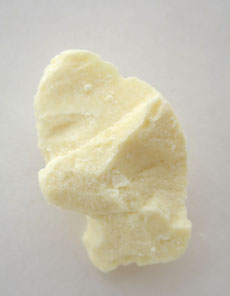
Virgin cocoa butter is not deodorized, keeping the delicious chocolate aroma with its natural characteristics. Normally hard at room temperature, it melts at body temperature. Photo by Claire Freiermann | THE NIBBLE. |
(While cocoa powder, i.e. that made into beverages, is created by removing the cocoa butter from the chocolate liquor, chocolate bars and other eating chocolate are made by adding it back in. Besides enhancing the flavor, the added cocoa butter serves to make the chocolate more pliant.) If it is not used for chocolate, cocoa butter is sold off for other uses, like cosmetics and pharmaceuticals. Thus, deodorizing the cocoa butter, which removes the flavors and aromas, can be amalgamated for sale. (Producers of cocoa powder, do not use the cocoa butter, so sell it off.)
Cocoa butter is not a dairy product and does not contain cholesterol. Cocoa butter is to cocoa beans what olive oil is to olives. While technically classified as a saturated fat because of its chemical structure, it acts almost exactly the opposite in the human body. Composed mostly of stearic acid compounds, it is a healthy fat: it has a neutral effect on cholesterol levels and is not a source of trans fat.
About 5% of cocoa butter is used for cosmetics and pharmaceuticals. Cocoa butter is unique among vegetable fats because it is a solid at normal room temperature and melts at 89°F to 93°F, just below body temperature. It resists oxidation and rancidity and under normal storage conditions, it can be kept for years without spoiling.
(2) From the U.S. Food and Drug Administration (FDA) Standards of Identity: Cocoa Butter is the fat naturally present in cacao beans that melts at body temperature and gives chocolate its unique mouth feel. The amount of cocoa butter in cacao beans typically ranges from 50% to 60%.
COCOA BUTTER TRANSFER
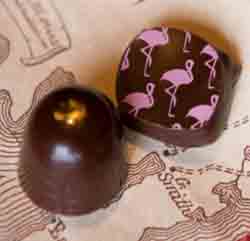
A technique used to transfer designs to the surface of chocolate bonbons. As you can see in the photos at right, sheets of paper with the design are set atop the enrobed chocolate (top photo). The design is transferred through rubbing, resulting in the finished chocolate (bottom photo).
COCOA CAKE
Same as press cake. See photo below.
|
|
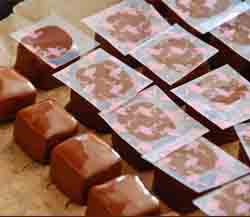
Above, cocoa butter transfer sheets with flamingo designs. Below, the finished “flamingo” bonbon from Black Dinah Chocolate. Photos courtesy Black Dinah.
|
COCOA CONTENT
The percentage of a chocolate bar that is made from cocoa beans. This percentage can include the beans themselves, the nibs, chocolate liquor, cocoa butter, and/or cocoa powder. If the cocoa content of a bar is 50%, then the remaining 50% is mostly sugar, with some lecithin as an emulsifier and vanilla for flavor. The higher the cocoa content, the darker the chocolate and the stronger the cocoa flavor (also, the higher the level of antioxidants and the more expensive to produce, because cocoa beans are 10 times costlier than sugar). See also cocoa solids content.
COCOA DANCE
After the beans are spread to dry, in some cacao-growing regions of Latin America women perform a ritual dance, shuffling through the beans to continually turn them. This helps the beans dry evenly. The cocoa dance is performed twice a year, after each harvest.
COCOA MASS
The same as chocolate liquor.
COCOA POWDER
|
A finely pulverized powder made from the solid portion or press cake that remains after the cocoa butter has been mechanically pressed under tremendous force from the chocolate liquor (i.e., defatted chocolate mass made from roasted cacao nibs). Cocoa powder is categorized by the amount of cocoa butter that remains after pressing. Cocoa products can range from 10% to 24% fat, depending on whether they’re beverage, breakfast, or cooking cocoa. The powdered product is made by pulverizing and sifting the press cake. From the U.S. Food and Drug Administration (FDA) Standards of Identity: Cocoa or cocoa powder is the product made by removing part of the fat (i.e., cocoa butter) from the cocoa bean and grinding the remaining material to a powder.
|
|
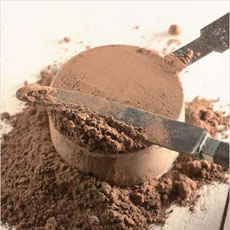
Dutched cocoa. Photo courtesy King Arthur Flour.
|
|
The two main types of cocoa powder are natural cocoa powder, also known as natural process cocoa and non-alkalinized cocoa; and Dutch cocoa powder also known as Dutched, alkalinized, or Dutch processed cocoa powder.
The Difference Between Cocoa & Hot Chocolate
Cocoa is made from cocoa powder, hot chocolate is made from shaved chocolate. Hot chocolate is richer because chocolate contains the cocoa butter that was removed during the processing of cocoa (and finer chocolate has extra cocoa butter added on top of that). However, you can add a teaspoon or more of unsalted butter to a cup of cocoa to compensate. Some people also add the butter to hot chocolate, for an even richer experience—it’s better than making the beverage with half and half or cream.
|
|
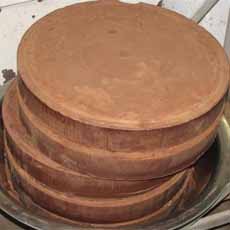
Press cakes. After the cocoa butter is removed with a hydraulic press, the remainder is called a press cake. This cake is ground and sifted into cocoa powder.. Photo courtesy Linked In Pulse| Yasmin Shamalisham.
|
How Cocoa Powder Is Made
After the nibs are roasted, they are ground by powerful machinery into what is called chocolate liquor, which hardens as it cools. It is pumped into a giant hydrauic press,and pressure removes most of the cocoa butter from the liquor. What remains isis called a press cake, Cocoa powder is ground To make cocoa powder, the liquor is pumped into giant hydraulic presses that apply just over 40,000 kPa to the substance. This high pressure process removes most of the cocoa butter from the liquor through filters and leaves a cake like substance. This cake is ground, pulverized then sifted. If it the factory wishes to make chocolate bars, the cocoa butter is kept in the liquor and additional cocoa butter is added in.
|
A. Black Cocoa, more heavily Dutched for intense flavor.
B. Double Dutch Cocoa Blend
combines Dutch-process and black cocoas.
C. Triple Cocoa Blend combines Dutch-process, black and red cocoas.
D.Bensdorp, a high fat Dutch-process cocoa.
E. Cocoa rouge, Dutch-process cocoa that lends a reddish color to the finished productl.
F. Natural Cocoa (un-Dutched).
|
|
Different Cocoa Types For Different Baking Needs
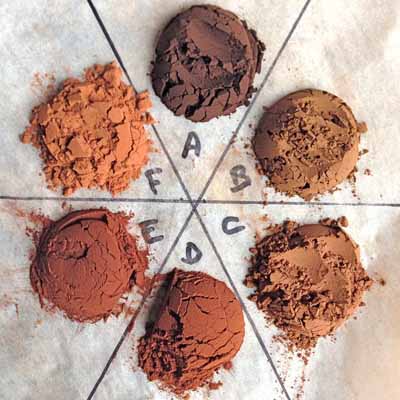
Graphic courtesy King Arthur Flour.
|
COCOA SOLIDS
Same as chocolate liquor.
COCOA SOLIDS CONTENT
The weight of the non-fat cocoa portion of the chocolate. This term is sometimes seen in the labeling of products, and is related to, but not the same as, the cocoa content.
COMPOUND COATING
See confectionary coating.
CONCHING or LISSAGE
After the beans are ground into chocolate liquor or chocolate paste, the paste is refined through uninterrupted stirring, or conching, that smoothes the texture of the chocolate and enhances its flavor. This mechanical rolling and kneading process takes place in huge vats with rotating paddles or blades (the paddles are shaped like conches, giving the process its name). The technique was invented in 1879 in Switzerland by Rodolphe Lindt to make chocolate more blendable (the French word is lissage).
|
|
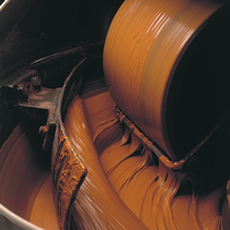
Conching. Photo courtesy International Cocoa Organization. |
The process breaks down the sugar crystals that are added to the chocolate, and blends in the sugar, vanilla, additional cocoa butter, powdered milk (for milk chocolate) according to the producer’s formula. The friction and aeration of the paste into a smooth mass also engenders chemical changes that develop and round out the flavor of the liquid chocolate, eliminate moisture and acidity, and flush out volatile flavors, unpleasant odors, and bitterness. Conching enables complete homogenization and emulsion of the cocoa butter into the cocoa paste, producing a velvety smooth chocolate with no grittiness. The chocolate then goes to the molding room, where the chocolate is tempered, poured into the molds, passed through a refrigerated tunnel and then unmolded. The invention of conching machine enabled “modern” chocolate as we know it: smooth, velvety, without graininess or bitterness. New technology can grind the chocolate particles very finely, which can reduce conching time. Fine chocolate is conched for at least a day, some for several days, depending on the bean and the producer’s preference.
CONFECTIONARY and CONFISEUR
Confectionary comes from the Latin noun “confect,” meaning that which is produced with skill. It is also the name given to the shop of a confectioner. Confections, or sweet preparations, have been made by confectioners since Babylonian times (the city of Babylon was founded in 4000 B.C.E.). Confiseur is the French word for confectioner. Confections include cake and pastry, candy, jams and preserves, and other sweets.
CONFECTIONARY COATING or COMPOUND COATING or DECORATOR’S CHOCOLATE or PATÉ GLACÉE or SUMMER COATING
A chocolate-type product that substitutes vegetable oil for all or part of the cocoa butter. Along with sugar and cocoa powder, traditional chocolate production techniques are used to create a less expensive coating that does not require tempering, melts easily and hardens quickly. Confectionary coating is used to coat fruit and for other decorating purposes. Products made with confectionary coating will be designated “chocolate-flavored.” In milk chocolate-flavored coatings, whey powders, whey derivatives and dairy blends can be used instead of powdered milk.
|
|
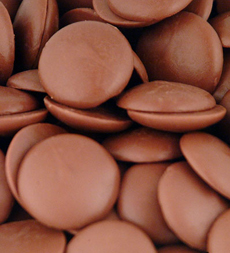
Confectionary coating wafers that approximate milk chocolate. Photo MakeNMold.com. |
The coating is typically sold in wafer form.
CONFISEUR
The French word for confectioner. Like chocolatier, the term can refer to either a company or a person.
COTYLEDON
A leaf of the embryo of the cacao bean (or any seed plant). Also called seed leaf.
COULIS
A purée of fruits or vegetables that is strained to create a thick sauce-like consistency. Fruit coulis is served with cakes, crêpes, French toast, ice cream, soufflés, and waffles. Bonbons can be filled with a coulis of passion fruit, raspberries, strawberries and other fruits, which provides a rush of fresh fruit flavor. In fruit creams, the coulis is mixed with cream to create a thicker, creamy center.
|
|
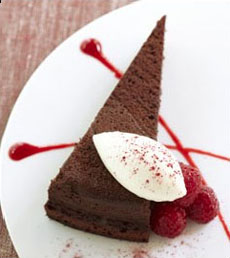
Flourless chocolate cake with raspberry coulis. Photo courtesy Chandon USA. |
COUVERTURE CHOCOLATE or COATING CHOCOLATE
Couverture (COO-ver-tyoor, French for covering or coating, from couvrir, “to cover”) chocolate is professional-quality coating chocolate made with better beans, ground to a finer particle size and with a higher cocoa butter content than chocolate bars for eating, giving it a different texture and consistency. The bars come in kilo (2.2 pound) to 10 pound blocks, and some are made in two-pound blocks for home bakers and confectioners.
|
Some companies make smaller blocks and “wafers,” discs smaller than a quarter, for the home baker and chocolatier. Couverture is used as covering for candies or other confections. It has been tempered to form a thin, smooth, shiny coating on hand-dipped candies. The extra cocoa butter, generally 36%-39%, makes it easier to work with and allows for a thinner coating shell than non-couverture chocolate. Some chocolatiers use more than one, based on their feeling that different chocolates pair better with different items—some for filled chocolates, e.g., and others to enrobe nuts, fruit peel, yet another for their plain bars. Each chocolate producer makes a variety of couvertures in dark, milk and white.
|
|
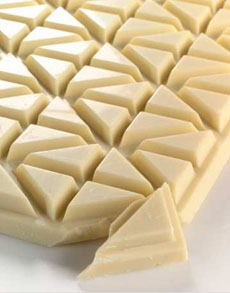
A two-pound block of couverture chocolate. Photo courtesy King Arthur Flour. |
|
Some chocolatiers use the straight product, others might blend different beans or percentages. Still others might have the chocolate producer mix a special blend “recipe” according to the chocolatier’s own specifications (e.g., more cocoa butter for a smoother mouthfeel). Always ask chocolatiers which couverture they use. It gives the chocolate its defining taste. By understanding, e.g., that you like Couverture A and don’t like Couverture B as much, you will understand your tastes and profiles in chocolate. (It’s like knowing that, e.g., you like French Burgundies far better than Oregon Pinot Noirs.) With most chocolatiers, the brand of couverture isn’t a secret—they’re proud of their choice(s) and want you to be an educated consumer.
|
|
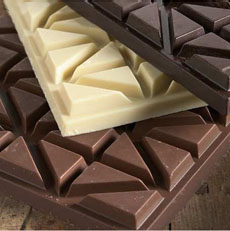
Couverture chocolate in milk, white and dark chocolate. Photo courtesy King Arthur Flour. |
And, understanding your preferences lets you make more informed choices the next time you purchase chocolate. If you know you love chocolate made with Valrhona couverture, e.g., the next time you see a Guittard chocolate bar you can buy it with impunity. Or, the next time you encounter a new chocolatier and find that he or she uses Guittard couverture, you have a good chance of really enjoying those chocolates.
Here’s more about couverture chocolate.
|
|
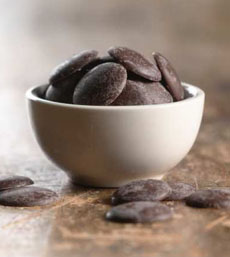
Home confectioners often prefer using couverture disks or wafers, which are easier to melt . Photo courtesy King Arthur Flour. |
CRIOLLO
Criollo is a flavor cacao, and one of the three primary varietals of cacao bean and the finest of the beans in terms of the flavor and aroma of the processed cacao. Criollo means “Creole” (“native”) in Spanish. It originated in Mexico, Central America, and Venezuela. At the time of Spanish exploration of the New World, it was the predominant type of cacao.
|
Today Criollo cacao accounts for no more than 5% of the world cacao crop (some estimates are as low as .1%), and is used for the world’s finest chocolate. While some Criollos have been successfully transported to elsewhere, e.g. Java Whites, most grow in their place of origin, Venezuela and Colombia; with some in Comores and Madagascar. The beans used to grow in the Caribbean but proved too delicate to weather the hurricanes, and were replaced by Trinitarios. Due to their soft thin skin, fragility, susceptibility to disease and low productivity yields, Criollo’s existence is now in drastic decline and many varietals are threatened with extinction. The fresh beans are thick and have white or pink cotyledons, low acid levels and low bitterness. Once processed they produce a high quality, intensely aromatic, very flavored, smooth chocolate that is very low in acidity, with deep and delicate undertones of varying degrees.
|
|
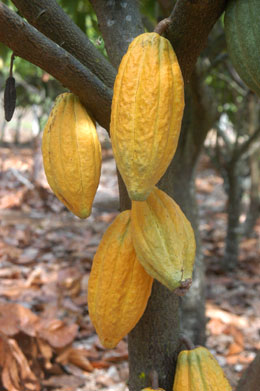
Photo of Criollo cabosses courtesy of Amano Artisan Chocolate. |
The rarest of the Criollo beans is Porcelana. Experts recommend that you look at the origin of the bean—i.e., the single origin characteristics—to understand the flavor of cacao, rather than look at the Criollo bean as having a specific flavor profile. As with wine grapes, the flavors differ widely by terroir, as well as botanical/horticultural factors. There is prolific crossbreeding among cacao trees, and there are few “pure species” cacao farms. Even the famous Criollo cacao, Chuao, has some Forastero trees growing amid the Criollos. Chuao (and all single origin cacao) needs to be tasted for its origin qualities, and not for “Criollo” qualities. See our single origin flavor chart for more information. Also see Theobroma cacao.
CRU
Cru is a word borrowed from the wine world, meaning terroir or the physical environment in which the plant is grown. In the cacao world it is used to indicate single varietals and/or areas that have specific plants. The names of the crus generally reflect countries and provinces where the cacao is grown, e.g., Valrhona’s Guanaja (an island off Honduras), Caraïbe (Caribbean), Manjari (Madagascar), and Jivara (South America). [Valrhona further creates bars from cacao grown on particular estates: Gran Couva (a plantation in Trinidad), Ampamakia (a plantation in northern Madagascar), Palmira (a plantation close to Lake Maracaïbo in western Venezuela). In some cases, producers have invented cru names, analogous to brand names. Examples of the latter are Domori’s Puertofino, Puertomar and Apurimac. Different producers can buy beans from the same place of origin but their chocolate will taste very different. There are different factors that contribute to the final product: the specific trees from which the beans came (i.e., the genetics of the cacao), how ripe the pods were at harvest, fermentation technique, optimal drying, and then, the particular “recipe” of the chocolatier, including roasting, refining, conching and blending.
CRUMB or CHOCOLATE MILK CRUMB
Crumb is the mixture of milk, sugar, and chocolate liquor created in the manufacture of milk chocolate. It is a liquid mixture, not a dry crumb as the name might indicate.
CRUSHING
After roasting, the beans are crushed into small particles. It is at this stage that blending occurs (except for single origin chocolate): the chocolatier blends cacao of different varieties and origins to make the house recipes.
CUVÉE
A blend of different types of cacao beans.
Continue To Next Page: Terms With D & E
Go To The Alphabet Index Above
-
-
Lifestyle Direct, Inc. All rights reserved. Images are the copyright of their respective owners.
|