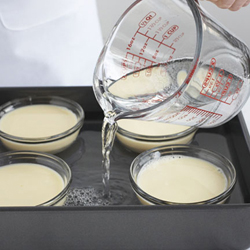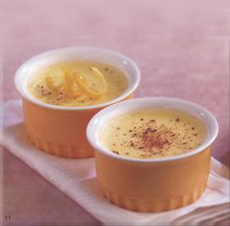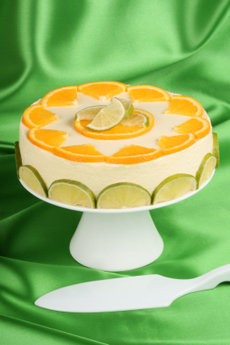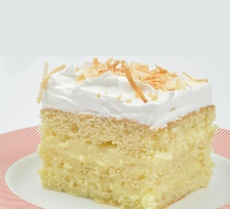
A delicious dish of crème caramel.
September 2006
|
 |
Custard Glossary
All About Custard, The Eggy Splendor From The Middle Ages
Custard as we know it dates back to the Middle Ages, when it was used as a filling for a flan or a tart. The word custard is derived from “crustade,” a tart with a crust. After the 16th century, fruit creams became popular and it was about this time that custards began to be made in individual dishes or bowls rather than as fillings for a crust. Yet, as things move full circle, today custard is used to fill tarts, Danish pastry, flans, cream puffs and éclairs; it is mixed into trifles and otherwise part of other sweet and savory delights. Custards are prepared in two ways: stirred or cooked on top of the stove, or baked in the oven.
Types Of Custard: A Glossary Of Custard Terms
Bavarian Cream (Crème) or Bavarois: A mold of crème anglaise (a rich custard, see below), combined with gelatin, beaten egg whites, and lightly whipped cream. It can be flavored with vanilla, fruit purée, chocolate, liqueur et al., then put into a decorative mold, chilled and unmolded.
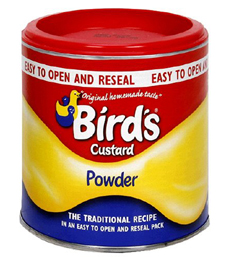
Bird’s Custard: An artificially-flavored commercial custard powder, one of the numerous instant and commercial “custards” that are not true custards because they are not thickened with eggs but cornstarch. It was invented by Alfred Bird and Sons Ltd. of Birmingham, England, in 1837. Bird created it because his wife was allergic to eggs, the key ingredient used to thicken traditional custard. Some people prefer using powdered custard sauce because it is much easier to make and there is no concerned with the eggs curdling, the chief challenge of making a traditional custard.
Blancmange: French for “white food,” it can be a white or pinkish molded pudding made from milk or almond milk and/or cream, sugar, gelatin or cornstarch and a flavoring, usually almond. The original blancmange used pulverized almonds instead of cornstarch.
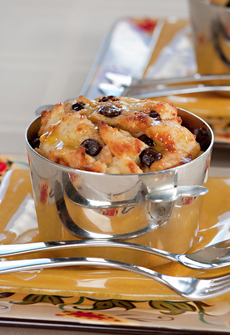
Charlotte: A molded custard that can be cold or hot. Traditionally, the mold used is smaller in diameter at the base than at the top, or bucket-shaped, but almost any mold is acceptable.
For a cold charlotte, the mold is lined with sponge cake, ladyfingers, biscuits or bread and filled with layers (or a mixture) of fruit and custard or whipped cream that has been fortified with gelatin (Bavarian cream) or mousse. The dessert is chilled thoroughly and unmolded before serving. Charlotte Russe, said to have been created for the Russian Czar Alexander, uses a ladyfinger shell filled with Bavarian cream, and is decorated elaborately with whipped-cream rosettes. Apple Charlotte (Charlotte aux Pommes) is typical of a hot charlotte, which uses a buttered-bread (or brioche) shell filled with
sweetened fruit or fruit puree, baked and served hot with fruit sauce.
In an Apple Charlotte, the apples are sautéed with Calvados, an apple brandy.
Cheesecake: A cheesecake is essentially a baked cheese custard. A pie is a custard when an uncooked custard filling is poured into an unbaked or partially baked pie crust, and then baked. Thus, the cheesecake is actually a pie! Similarly, pumpkin pie is a pumpkin custard, lemon meringue pie is a lemon custard. A cream pie, on the other hand, starts with a fully baked crust. A cooked filling is poured into it; the pie is then chilled until the filling sets.
|

Cheesecake is a cheese custard pie, quiche is a savory custard pie. |
Cream Puff: A cream puff is a choux pastry (pâte à choux) filled with whipped cream or custard. It originated in Italy in the 1600s and is said to have been created by Poelini, a chef to Catarina de’ Medici; in 1533 she married the duc d’Orléans, the future King Henri II of France, and brought her favorite foods (including ice cream) to France. The name derives from the old French meaning “to cherish,” which is the same as the word for cabbage (choux). Some say pâteà choux, or cabbage paste, is so named because the cream puff looks like a cabbage, but “cherish” has a stronger hold. The paste is a mixture of water, butter and flour which rises due to steam expansion. It crusts on the outside, trapping steam inside, creating a puffed shape with a hollow interior to be filled. The pastry is finished with a glaze. Classic French desserts made with cream puff pastry include croquembouche, éclairs, Gateau St. Honoré and profiteroles. The cream puff debuted in America at the 1924 Wisconsin State Fair.
Crème: The French word for custard.
Crème Anglaise: French for “English custard,” a rich, pourable custard sauce that can be served hot or cold over cake, fruit or other dessert.
Made with eggs, sugar and milk or cream, it is stirred over heat until it thickens into a light sauce. However, it’s a delicate operation: too much heat turns it into scrambled eggs! Vanilla is the basic flavoring, but coffee, chocolate or liqueurs can be added. With additional yolks and with heavy cream, it becomes the “custard” used for French ice cream. With additional yolks, gelatin, whipped cream and flavoring, it becomes Bavarian cream.
Crème Anglaise Collée: Custard thickened with gelatin, for pastries.
Crème Bavarois: See Bavarian Cream.
Crème Brûlée: The richest and thickest of the three classic, silky, baked French custards (crème caramel and pot de crème are the others). All three are made of eggs, sugar, milk and/or cream in different proportions, along with a flavoring such as vanilla. Crème brûlée is made of all heavy cream and egg yolks, and is topped with a brittle layer of caramelized sugar (brûlée is French burnt, crème brûlée means “burnt custard”). The sugar is usually burned under a salamander or other intense heat source. Crème brûlée can be served cold or warm, and is usually served in individual ramekins. While the traditional custard base is flavored with just vanilla, variations include chocolate and the entire international spice cabinet, liqueurs, green tea, et al.
|

Crème brûlée. |
The Spanish crema catalana, which has been made since the 18th century, predates the French crème brûlée, which dates from the late 18th century, and the U.K.’s Cambridge Burnt Cream or Trinity Cream, which was introduced almost century later, in the 1860s.
Crème Caramel or Flan (see photo at top of page): The lightest of the classic French custards, crème caramel is made with whole eggs as well as yolks, milk as well as cream. Caramel syrup is poured into the mold or ramekin before adding the custard base. After the custard has set, it is unmolded, leaving the caramel sauce on top and pooling around it. Note that crème caramel will usually cook much faster than the other custards because of the extra egg whites—their proteins coagulate at a lower temperature than egg yolks. Also due to the egg whites, crème caramel is stiff enough to stand on its own. Crème caramel came to the U.S. in the 19th century via New Orleans, but did not become popular until the 1980s when it was introduced by French chef Alain Sailhac of New York’s Le Cirque restaurant.
Crème Pâtissière: Pastry cream—a stirred custard thickened with cornstarch or flour and typically flavored with vanilla, although other flavors can be used. It is used to fill éclairs or to top fresh fruit tarts. It is made of egg yolks, sugar and cream or milk like crème anglaise, but the addition of starch gives it the stability to be brought to a boil. With the addition of beaten egg whites, it becomes a crème Saint-Honoré, a filling for cream puffs.
Crème Plombières: A custard filing into which beaten egg whites and a flavoring (e.g. chocolate) or fresh fruits are folded. It is spooned over sponge cake or ladyfingers, then chilled.
Crème Saint-Honoré: A crème pâtissière with stiffly beaten egg whites added, used as a filling for tarts and cream puffs, and as a dessert cream. It can be flavored with virtually anything: vanilla, chocolate, liqueur, grated orange peel, et al.
Curd: Not a custard because it lacks cream,
curd is made from fruit juice, typically citrus, plus sugar, eggs and butter. It is used to fill tarts, as a spread and as a base for mousse.
Custard: Custard is a range of preparations based on milk and eggs, thickened with heat. Most commonly, it refers to a dessert or a dessert sauce; but custard bases are also used for quiches and other savory foods.
|

Custard tart. |
Custard Ice Cream: See Frozen Custard Ice Cream.

Éclair.
|
Éclair: A finger-shaped pastry made of pâte à choux with a glacé icing, filled with custard or whipped cream. It is known to have originated in France around the turn of the 19th century. Many food historians speculate that éclairs were first made by Marie-Antoine Carême (1874-1833), the first “celebrity chef,” considered the founder and architect of French haute cuisine, cookbook author, and chef to Talleyrand, the future George IV of England, Emperor Alexander I of Russia and Baron James de Rothschild.
|
The Oxford English Dictionary traces the term “eclair” in the English language to 1861. The first known recipe for éclairs appears in the 1884 edition of the Boston Cooking-School Cook Book edited by Mrs. D.A. Lincoln. “Éclair” is the French word for lightning. It is suggested that the pastry received its name because it glistens when coated with confectioner’s glaze.
Flan (Custard): A version of crème caramel in Spanish and Latin American countries. It is the national dessert of Spain. In Mexico, dulce de leche is often used instead of caramel syrup.
Flan (Pie): A second meaning for flan is an open face pie, similar to a tart, filled with filled pastry cream and covered with fresh fruit.
Floating Island: Also known as oeufs à la neige, “snow eggs,” a delicate dessert of stiffly beaten, sweetened egg white mounds (the “islands”) that have been poached in milk, then floated in a thin custard sauce. In France, île flottante, “floating island,” is a liqueur-sprinkled sponge cake spread with jam, and topped with nuts and whipped cream, surrounded by a pool of custard.
|

Floating Island. |
Frangipane: Almond custard filling, a thick type of crème pâtissière mixed with powdered almonds or crushed macaroons. It is used as a filling for tarts or crêpes.
French Ice Cream: Ice cream with a cooked egg-custard base. See crème anglaise.
Frozen Custard Ice Cream: Another term for French ice cream. In the U.S., frozen custard also refers to a soft-serve ice cream. However, “frozen custard” was served as early as the late 1800s, long before the invention of soft-serve. The Department of Agriculture standards recognize the term Frozen Custard for an egg-based ice cream, not a soft-serve ice cream:
NOTE ON “FROZEN CUSTARD”: Means “French Ice Cream,” “French Custard Ice Cream,” ice custard, parfaits and similar frozen products. In addition to the definition above, it shall also contain for each ninety pounds thereof not less than (a) five dozen of clean wholesome egg yolks, (b) one and five-tenth pounds of wholesome dry egg yolk containing not to exceed seven percent of moisture, (c) three pounds of wholesome frozen egg yolk containing not to exceed fifty-five percent of moisture, or (d) the equivalent of egg yolk in any form.
Gelatin: A clear, odorless and flavorless setting agent derived from animal bones. It is used to set cold desserts such as mousses and bavarian creams. Strict vegetarians and kosher people who do not consume any animal products use vegetable setting agents, including one made from agar agar, an algae.

Chocolate mousse piped into a chocolate cup.
|
Mousse: A French term meaning “froth” or “foam,” mousse is a rich, airy custard made of whipped cream, eggs and gelatin that can be either sweet or savory and hot or cold. Cold dessert mousses are usually made with fruit purée, a spice (vanilla, almond) or other flavoring such as chocolate. A mousse is light and airy due to the addition of whipped egg whites, whipped cream, or both. Fruit mousses are usually fortified with gelatin. Mousses are too soft to mold into a semi-rigid form, so they are usually piped or scooped into the final dessert presentation and garnished with additional whipped cream prior to serving. |
Savory mousses can be made from meat (ham, chicken, veal, e.g.), fish, shellfish, foie gras, cheese or vegetables. Hot mousses usually get their light texture from the addition of beaten egg whites. They’re generally baked in a water bath to prevent the mixture from curdling.
Mousseline: In savory cooking a mousseline is a sauce made by folding unsweetened whipped cream into a hollandaise. In sweet dishes, it refers to a buttercream lightened with crème pâtissière that is used as a filling for cakes and pastries.
Pastry Cream: See Crème Pâtissière. This is the form of custard used to fill cream puffs and éclairs.
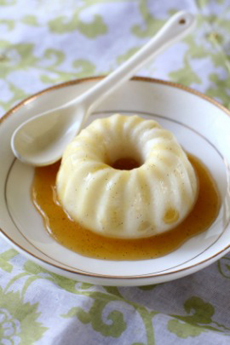
Panna Cotta: Italian for “cooked cream,” it is a light, silky-smooth egg custard made with heavy cream and gelatin and typically served with fresh fruit or a fruit purée. Panna cotta originated in the Piedmont area of northern Italy, a region known for its cream.
|

Panna cotta. |
Pot de crème. Shown, Fitz & Floyd Rondelet.
|
Pot de Crème: French for “cup of cream,” it is an eggy, soft and smooth custard made of equal parts of cream and milk and an extensive amount of egg yolk—e.g., 6 yolks per 2 cups of cream/milk (or half and half). It is traditionally served unadorned, except perhaps with a decorative candied violet, in a small, lidded porcelain cup (the “pot”). The porcelain pots can be plain white or colored ceramic; or they can be ornately-decorated fine porcelain. Pots can be single- or dual-handled.
|
Quiche: A savory custard that may include other ingredients. Quiche Lorraine has onions and emmentaler cheese. Bacon quiche adds bacon. Potato quiche adds potato. A royale is a plain savory custard with no other added ingredients.
Renversée: Unmolded.
|

Quiche Lorraine.
|
Sabayon: A mixture of egg yolks, flavoring and sugar, beaten over simmering water until thick, then beaten until cool. It is the French version of zabaglione (see below), served over fresh fruit or grilled over fruit (when it is called a gratin). Sabayon is the base for mousses and buttercreams.
Tiramisu or Tirami-su: While there are many variations of the recipe, it is typically composed of layers of sponge or ladyfingers, soaked in espresso liqueur or a similarly flavored syrup, and layered with a mascarpone cheese and custard mixture; then dusted with cocoa or shaved chocolate. The name means “pick me up,” from the espresso flavoring.
Trifle or Zuppa Inglese: A British dessert made by layering a thick custard, sponge or pound cake, fruit and whipped cream. It is usually arranged with the fruit and sponge cake on the bottom, custard or pastry cream and whipped cream on top. There are many variations of the recipe. Some trifles soak the cake in an alcohol syrup (the dish was originally developed to use stale cake), others sprinkle it with Port, sweet sherry or Madeira. Zuppa inglese is an English trifle especially common in Tuscany, because the English who lived there in the 19th century often asked for it. While there are numerous variations of the zuppa inglese recipe as well, it is commonly made with Italian ingredients including ladyfingers, rum, an aromatic liqueur like amaretto or Strega, and cocoa powder.
|

Trifle, also called zuppa inglese (“English soup”). |
Vanilla Sauce: See crème anglaise. Also called cream sauce, custard sauce English crème and English sauce.
Zabaglione: An egg custard sauce flavored with sweet wine, generally marsala. It is a classic Italian dessert cooked on the stovetop; the custard is most often served warm over fresh strawberries (in this respect, it is very similar to Strawberries Romanoff, except that custard is flavored with Grand Marnier or Cointreau instead of marsala). It can be enjoyed on its own or over a slice of plain cake or ladyfingers. See also sabayon.
Zuppa Inglese: See Trifle.
Nibble Tip
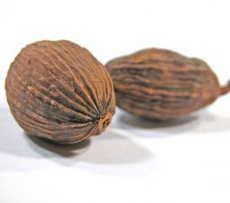
- One of our favorite complements to custard—whether a sauce or a baked custard—is nutmeg.
- When baking a vanilla or chocolate custard, grate some fresh nutmeg over the top.
- We like making a savory custard sauce by cooking a crème anglaise without the sugar and substituting nutmeg for vanilla.
|

Nutmeg. |
© Copyright 2005-
2008
Lifestyle Direct, Inc. All rights reserved. Images are the copyright of their respective owners.

|
 |
|
|