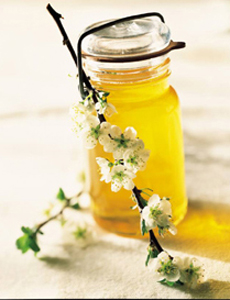
An assortment of varietal, comb (yellow jar at top), and whipped (with spoon) honeys. Photo courtesy of National Honey Board.
February 2005
Updated August 2006
|
 |
Types of Honey
A Glossary Of Honey Terms
If you’re a honey lover who has only tried one type of honey in your life—most likely, the plain liquid variety—you’re missing out on a buffet table of golden beauties. Pure honey is available in different forms to compliment food and beverages, or simply to enjoy like candy.
- Honey is defined as a sweet and viscous fluid produced by honeybees and other insects from the nectar of flowers. It is a mixture of sugars; 70% to 80% of honey is largely fructose and sucrose,
with some maltose, melezitose and sucrose. The rest is water, minerals and traces of protein, acids, and other substances.
The specific composition of any batch of honey will depend largely on the flowers consumed by the bees that produced the honey. Honey is significantly sweeter than table sugar. According to the United States National Honey Board and other nations’ food regulations, the definition of honey stipulates a pure product that does not allow for the addition of any other substance, e.g. water or other sweeteners. Bees other than honeybees (the genus Apis) produce honey, but it has very different properties.
- Crystallized or granulated refers to the transformation of the liquid honey unto hard crystals. This happens in varieties of honey that have a higher proportion of glucose to fructose (this is referred to by some people as “hardening”). In scientific terms, honey is a supersaturated solution because it is composed of so much more sugar (more than 70%) relative to the water content (often less than 20%). The sugars are largely glucose and fructose. The glucose tends to precipitate out of the solution; honey varieties that are high in glucose will crystallize readily; honeys that are high in fructose will not. Crystallized honey can be reliquified by applying heat (30 seconds in a microwave or 10 to 15 minutes in a pan of hot water). Some varietals, like raspberry honey, have such glucose content that they crystallize immediately upon removal from the comb. Such honeys can only be offered in cremed form, a finely crystallized, spreadable state. (In other varietals, crystallization can be deliberately induced to make the cremed form.) Controlled crystallization results in a product with a smooth, spreadable consistency; spontaneous crystallization results in a coarse and grainy product.
Processing Techniques
-
Blended honey is a combination of honey from different floral sources—e.g. alfalfa, wildflowers, clover. Blending is done with the more commonly available and less distinctly flavored honeys to create a common denominator flavor profile for mass-merchandising. The result tends to be “sweet” and “honey” without any other flavor characteristic. The opposite of blended honey is varietal honey (see below).
- Raw honey is unprocessed. It is honey as it exists in the beehive or as obtained by extraction, settling or straining without adding heat (pasteurization). Raw honey contains some pollen and may contain small particles of wax. Raw honey comes out of the comb and go into the bottle: it is one of the purest foods on the table.
-
Strained honey or filtered honey has been passed through a mesh filter to remove particles (pieces of wax, e.g.) without removing pollen. It has a cloudy appearance due to the included pollen, and tends to crystallize more quickly than ultrafiltered honey. Popular with health food buyers.
-
Ultrafiltered honey is processed by very fine filtration under high pressure to remove all extraneous solids and pollen grains. Ultrafiltered honey is very clear and has a longer shelf life, because it crystallizes more slowly. Preferred by the supermarket trade.
- Pasteurized honey. Supermarket honey is often pasteurized to help prevent crystallization on the shelf. Crystallization is not harmful; the crystals will dissolve in the microwave (heat for 30 seconds) or in a pan of hot water (10 to 15 minutes).
- Varietal or monofloral honey comes from a single flower, e.g. orange blossom, lavender, sage. In addition to the flavor of the honey, it will express secondary flavor characteristics of the lavender, sage, raspberry, et al, and the better honeys will have complex tertiary flavors as well. The opposite of varietal honey is blended honey.
Forms of Honey
- Comb honey is honey that is sold as it was produced—in the honey bees’ wax comb. The comb is edible as well.
- Cut comb honey or chunk honey is liquid honey that has added chunks of the honey comb in the jar. Also known as liquid-cut comb combination.
- Liquid honey, the form most familiar to us, is free of visible crystals. It is extracted from the honey comb by centrifugal force, gravity or straining. Because liquid honey mixes easily into a variety of foods, it is especially convenient for cooking and baking. Most of the honey produced in the United States is sold in the liquid form.
- Naturally crystallized honey is honey in which part of the natural glucose content has spontaneously crystallized.
- Whipped or cremed honey (also known as churned honey, honey fondant, sugared honey and spun honey) is brought to market in a finely crystallized state. While all honey will crystallize in time, whipped honey is intentionally crystallize via a controlled process so that, at room temperature, the honey can be spread like butter. In many countries around the world, whipped honey is preferred to the liquid form and used instead of jelly or jam.
Specialty Honey Products
- Flavored/fruited honey has either fruit, coloring or flavoring added.
- Infused honey has had flavors of herbs, spices, peels, etc. added to it by steeping.
- Dried honey has been dehydrated and mixed with other ingredients to keep it free-flowing.
- Honey sticks are liquid honey in plastic straws, generally holding a teaspoon of honey. They can have added flavorings. The honey is sipped from the straw like candy; or the contents can be emptied into a beverage.
Stash Tea has honey sticks in 13 flavors: original clover plus infusions like bergamot, chai, cinnamon, ginger, lemon, and raspberry.
|
 |
| |
 |
Infused honeys like Palette Foods’ Star Anise Honey can make an ordinary muffin, pound cake, vinaigrette or cup of tea seem extraordinary. |
|
Specially Certified Honey
- Kosher honey is honey that is produced, processed and packaged in accordance
with Jewish dietary regulations and certified by a kosher-certifying organization.
- Organic honey is produced, processed and packaged in accordance with USDA regulations on organic products and certified by a USDA-certified agency or organization. It should bear a USDA-certified organic seal.
Honey Varietals (Monofloral Honey)
Not all flowers have nectar that makes good honey; and bees other than honeybees make honey for food. but there are many hundreds of honey varietals. The flavor and color of honey are determined by the nectar source. The U.S. produced 171.7 million pounds of honey from 26 million bee colonies in 2003—from clear-as-water to dark brown, from very mild to very strong flavored, from delicately perfumed to pungent. (NOTE: New Zealand and Australian specialty honeys are included in this chart because they are now arriving in U.S. specialty food venues. Look for them.)
Crystallization depends on the proportion of fructose to glucose in the honey (each varietal has its own proportion); the higher the fructose, the less likely to crystallize.
As with wine, the flavor and color of honey can differ every year, even from the same location and beekeeper. While the same type of flower from a different region can produce a different region, even locally, as with grapes, a difference in the weather and “blossoming season” will make a difference in the honey.
Finally, it’s important to note that while some honeys taste exactly like their source—buckwheat honey tastes exactly like buckwheat—a honey does not necessarily taste like the fruit of the plant. Blueberry honey does not necessarily taste like blueberries, nor raspberry honey like raspberries, etc. Honeys are based on the nectar of the flower, not on the infusion of the fruit of the plant. Sometimes there’s a close correlation, sometimes not. Some fruit honeys are enhanced with extra flavor; read the labels carefully. Raw honey means that nothing has been added. “Milky” is the classic honey flavor.
| Honey Varietal |
Flavor |
Color |
| Acacia (Black locust tree) |
Mild, slightly tangy, floral, doesn’t crystallize |
Water white to pale amber |
| Alfalfa (generally blended) |
Nearly flavorless to milky, some has spicy notes |
White |
| Apple Blossom |
A hint of apple in the aroma |
Light to medium amber |
| Aster |
Flavor depends on region and species of aster; crystallizes quickly |
White to light amber |
| Avocado |
Fairly strong, buttery flavor |
Dark amber |
| Basswood |
Strong, zesty (becomes minty when mixed with a mild honey) |
Dark amber |
| Blackberry |
Delicate and sweet with a hint of fruit |
Very light amber |
| Black Button Sage |
Slightly herbaceous, slow to crystallize |
Medium amber |
| Black Locust |
Fruity, rare (the trees blossom only every few years) |
Pale to dark amber |
| Blueberry |
Fruity, blueberry aftertaste |
Medium amber |
| Buckwheat |
Strong buckwheat, malty flavor |
Dark brown |
| Blue Curl |
N/A |
N/A |
| Canola |
Delicate, low acid, crystallizes easily |
Light amber to white |
| Chestnut |
Strong, nutty, spicy, a bitter aftertaste (perfect with gorgonzola and parmesan) |
Dark brown |
| Clover |
Tangy and delicate; most labeled “clover” are actually blended; crystallizes easily |
Water white to amber |
| Cranberry |
Mild fruity flavor with tart aftertaste |
Medium amber |
| Eucalyptus —Yellow Box, Blue Gum, Red River Gum (U.S. & Australia) |
Mildly sweet, fruity aftertaste; some varieties have a slight menthol flavor |
Dark |
| Fireweed |
Mild, fruity, buttery |
Light to medium amber |
| Gallberry |
Tart wildflower flavor |
Dark amber |
| Goldenrod |
Robust flavor of wildflower and beeswax |
Light amber |
| Heather (Scotland) |
Slightly bitter with an aftertaste of burnt caramel |
Dark amber |
| Huckleberry |
Full-bodied |
Dark amber |
| Kamahi (New Zealand) |
Full-bodied, complex |
Light amber |
| Lavender |
Lavender floral |
Medium amber |
| Leatherwood (Tasmania) |
Strong and spicy |
Dark amber |
| Linden |
Spicy |
Pale amber |
| Lehua |
Buttery with lily-like overtones |
Crystallizes quickly and is made into a light golden cremed honey |
| Mint/Spearmint |
N/A |
N/A |
| Nodding Thistle (New Zealand) |
Delicate floral |
Light amber |
| Orange Blossom |
Hints of citrus-orange and orange blossom |
Light amber to dark amber |
| Pine Honey (Turkey) |
Molasses |
Dark amber |
| Poplar (Tulip Poplar) |
Strong |
Medium amber |
| Pumpkin |
Light with a hint of pumpkin flavor |
Medium amber |
| Purple Sage |
Mild flavor, slow to crystallize |
Water white |
| Rata (New Zealand) |
Mild, rich, almost salty |
White |
| Raspberry |
Will have a mild hint of raspberries; crystallizes as soon as it leaves the comb so is always sold in cremed form |
Cremed light |
| Rewarewa (New Zealand) |
Rich, malty |
Burnished amber |
| Rosemary |
Fragrant and herbaceous; great with cheese |
Pale amber |
| Safflower |
Milky flavor |
Amber to dark amber with a slight greenish cast |
| Sage |
Herbal notes |
Medium amber |
| Saw Palmetto |
Citrusy and herbal with woody overtones |
Medium amber |
| Silkweed |
Strong scent and flavor, spicy condiment honey |
Dark amber |
| Snowberry |
Butterscotch |
N/A |
| Sourwood |
Spicy ginger |
Medium amber |
| Sunflower |
Distinctive floral aroma; crystallizes easily |
Light to medium amber |
| Tawari |
Butterscotch |
Light amber |
| Thyme |
Herbal notes |
Burnt grass |
| Tupelo |
Medium, complex; slow to crystallize |
Golden amber with a slight greenish cast |
| Ulmo (Chile) |
Anise and violet |
N/A |
| Viper’s Bugloss (Borage) (New Zealand) |
Delicate flavor, floral bouquet |
Light amber |
| Wildflower |
Depending on flowers, can be medium-strong and tangy |
Medium amber |
| White Sage |
Clover-like flavor, elegant floral aftertaste |
Translucent yellow |
| |
|
|
Numerous other varietals are available. See HoneyLocator.com.
Some definitions courtesy of Wikipedia and the National Honey Board. The National Honey Board enhances the ability of U.S. honey producers to compete efficiently and effectively in the marketplace and to promote honey and honey products to the consumer.
Be The Queen Of The Hive
 |
 |
 |
| Cooking With Honey: Hands-on practical advise for cooking with honey. Click here for more information. |
Joy With Honey: 236 delightfully honey packed time tested recipes. Click here for more information. |
Covered in Honey: Discover the bounty of flavors with varietal honey. Click here for more information. |
Create A Buzz
| |
 |
 |
| . |
Black Stoneware Platter: This 14x10 inch stoneware platter is perfect for serving your honey slathered creations. Click here for more information. |
Teacup Set: Sleek and sexy, these eye-catching 3-piece teacups keep tea warm and interesting. Click here for more information. |
Honey definitions ® © National Honey Board. Additional material © Copyright Lifestyle Direct, Inc. Images are copyright of their respective owners.

|
 |

|
|