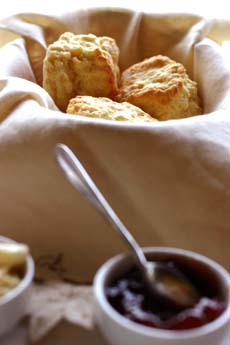
When it’s time to reach for the jam, reach for the best. We nibbled our way through dozens of artisan-made jams to find them for you. Photo by N. Joy Neish.
|
STEPHANIE ZONIS is a contributing editor.
|
|
June 2006
|
 |
The Best Strawberry Jams & Preserves
Berry, Berry Good
CAPSULE REPORT: Just nine flavors account for 80% of all jam and jelly sales in the U.S., and strawberry is the most popular flavor of jam. Seeking a finer alternative to the Smuckers and other commercial jams of our youth, we started with a long list of artisanal jam producers to investigate. Just because a company is a boutique producer doesn’t necessarily make its products better than a mass-marketed one; but we did find more than 17 strawberry jams worth your attention and space in your refrigerator.
The earliest known example of a recipe book dates from the first century A.D. The Roman epicure Marcus Apicius, the author, included recipes for fruit preserves, but it is likely that preserves had been around for far longer. There is debate about this, but most sources accept that the custom of extending the life of fruits by cooking them with a sweetener originated in the Middle East, where cane sugar grew naturally. It is thought, too, that Crusaders returning to Europe introduced fruit preserves there; preserves were popular by the late Middle Ages and sometimes served as a dessert all by themselves. Europeans settling in the New World brought their cooking practices with them, and jam-making was known in what would later become the U.S. before the end of the 1600s. In an era when cane sugar was a luxury item (if it could be had at all), settlers used what they could to sweeten preserves of fruit—usually honey, maple syrup or molasses.
Fast forward to the modern era. Americans, known for having a sweet tooth, now consume 4.4 pounds per person per year of what the industry calls “fruit spreads.” Retail sales of jams, jellies, preserves and related products are more than $630 million dollars per year, according to the International Jelly and Preserve Association. That’s a lot of morning toast! The single most popular flavor of jam is strawberry, while grape reigns supreme among jellies. Just nine flavors of jams and jellies account for 80% of all sales.
Our goal was to find the best of the most popular strawberry fruit jams and preserves (jellies and fruit butters were not part of our search, nor were products sweetened with concentrated fruit juices or fruit syrups, commonly referred to as “fruit spreads” by their manufacturers). Our intention was to omit low-sugar strawberry jams and preserves, but, rather shockingly, the FDA has no legal standards for such products, so it wasn’t always possible to determine in advance that a strawberry jam or preserve was low in sugar. No jams or preserves labeled as “low sugar” or “reduced sugar” were tested, but some of the products evaluated were unquestionably lower in sugar than many others. Apart from the category of “low sugar” products, the finer a preserve (i.e. the more and better the quality of the fruit in it), the less sugar is required to sweeten it.
|
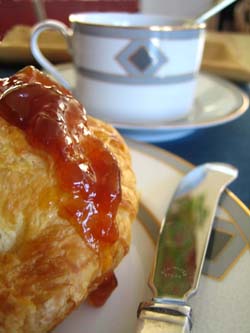
Jam from Tea Together. Click here for our full review of the Tea Together line. |
As only a few flavors dominate in the U.S., so, too, do a handful of companies rule the roost in sales and brand recognition. Any grocery or convenience store offers these mass-marketed products, and we all know their names—most of us grew up eating them. But readers of THE NIBBLE™ know that there are always a host of small producers making jams, jellies and preserves in small batches, many using artisanal techniques, sometimes offering flavors far removed from the everyday. Just because a company is small doesn’t mean it turns out superior products, but some do; we started with a long list worth investigating. We focused our search mostly on domestic artisanal producers.
Preserve Us! The Difference Between Jam & Preserves
How are fruit preserves made, and what’s the difference between a jelly, jam, preserve, marmalade and conserve?
- Traditional fruit preserves of all types are made from fruit mixed with sugar and pectin. Pectin is a fiber occurring naturally in the cell walls of most fruits. When heated in water, if the correct quantities of sugar and acid are present, pectin will form a colloidal solution that gels, or thickens, upon cooling. If a fruit is too low in pectin, as is the strawberry, pectin can be added in powdered or liquid form, or the strawberry can be combined with another fruit higher in this fiber.
Now, about the differences between fruit preserves:
- Jellies are made only from the juice of fruit, and they are typically the stiffest type of fruit preserves.
- As a rule, a jam is a thick puree, made from fruit pulp or crushed/mashed fruit.
- Preserves are similar to jams, except that they consist of chunks of fruit (or even whole fruit) in a thickened syrup (for the sake of convenience, the terms “preserves” and “jam” are used interchangeably throughout this article).
- Traditionally, marmalades are preserves, but they’re citrus-based.
- And a conserve is a jam made from a blend of fruits. Conserves usually contain some form of citrus, as well as nuts and/or raisins (many contain alcohol, as well).
Read our more extensive glossary of jams and jellies and related terms.
|

Whether jelly, jam or preserve, great products start with great fruit. Photo by Scott Weller courtesy of U.S. Agricultural Research Service. |
Note that these terms tend to be technicalities; many manufacturers of jam refer to their product as a preserve, and vice versa. Not infrequently, products seemed like hybrids of the two categories, with big chunks of fruit in thick purées.
There’s far more that must be considered when one is making jam or preserves than just nomenclature, of course.
- The correct level of acidity is important in making a jam or preserve (a pH of about 3.1 is ideal). If there is too much or too little acid, the spread will not thicken properly, or it may “weep,” an occurrence known as “syneresis.” In cases where fruits lack natural acid (and, believe it or not, strawberries are such a fruit), acidity can be increased to proper levels through the addition of lemon juice or other citrus fruits.
- Conveniently, commercial pectins of the type often added to a strawberry jam or preserves usually contain acids that help to ensure a proper pH and, hence, gelling. Manufacturers take some liberties with their formulations; some don’t add pectin or lemon juice (or either). There’s nothing wrong with that, but it can result in a jam with a thinner consistency, unless the spread is cooked for a much longer time. It’s up to you to decide how thick you like your preserves.

One of our favorite great food finds in this article are these Strawberry and Grand Marnier Preserves from Prince Edward Island Preserve Company. So good, they take us back to the days when people ate preserves plain for dessert.
|
In a traditional jam or preserve, sugar assists in gel formation, acts as a preservative and, of course, adds sweetness. Levels of sweetener (and the type of sweetener used) can be as important to a preserve as levels of acidity and pectin. Too much sugar can yield a stiff, sticky jam, or, conversely, one that refuses to “set”; too little can encourage mold growth. In contrast to the Colonial era in the U.S., sugar is now cheaper than fruit, and has been for many decades. In the early 20th century, some manufacturers sold jams and preserves that consisted of little more than fruit-colored, gelled sugar syrup. As a result, for many years now, the FDA has had strict standards regarding minimum quantities of fruit in fruit spreads. For strawberries, not less than 47 parts fruit (by weight) are mandated for 53 parts sugar (again, by weight). |
When making jams or preserves, it’s important to combine fruit, pectin and sweetener in the proper order. If the fruit and sugar are combined before the pectin is added, the pectin might not hydrate properly and a proper gel won’t be achieved. Other potential problems include, but are not limited to, crystal formation in the finished product, bubbles (these may denote nothing more than the fact that air became trapped in the hot product, but they may also indicate spoilage), cloudiness, darker than normal color, a product that is tough or stiff, shriveled-looking fruit or lack of a characteristic fruit flavor. None of this considers filling and sealing the jars of preserves, a critical step for any manufacturer. Sterilized jars and lids and a tight seal are crucial for shelf life. Unlike with cheese, where one can just scrape off the mold and enjoy the cheese, most authorities today are adamant that mold growing on a jam renders it unsafe to eat; scraping off the mold and eating the rest of the jar can be hazardous to your health! Consequently, manufacturers whose products sit on store shelves for any length of time must be very concerned with keeping their products and processes aseptic.
The review continues below.
Cooking With Strawberries
 |
 |
 |
| Totally Strawberries Cookbook, by Helene Siegel and Karen Gillingham. One of the popular “Totally...Cookbook” series, a diverse collection of recipes, each delicious and easy to make. Highly recommended for all strawberry lovers. Click here for more information or to purchase. |
Cooking With Strawberries, by Margaret and Virginia Clark. You don’t have to have a strawberry patch like the Clarks, but if you love strawberries, you can share their collection of 120 recipes for fresh or preserved strawberries. Click here for more information or to purchase. |
Grandma’s Favorite Strawberry Recipes, by Lanette Coalson. An exceptional cookbook filled with more than 150 taste-tested selections, from nostalgically traditional to the temptingly elegant. Click here for more information or to purchase. |
About The Sugar
One of the distinguishing characteristics of American society is the existence of a dietary villain or two at any given time. These villains change after a month or a year, but as things stand now, refined sugar is one of the new bad guys in town. Should you be eating preserves or jam at all? What about corn syrup or HFCS (high fructose corn syrup) as a sweetener? Why not switch to preserves sweetened only with concentrated fruit juice?
It’s already been noted that sugar is an important component of many preserves. Most healthy people can consume refined sugars (or any other type) within reason. Some jam manufacturers use corn syrup, or HFCS in their products; the chief virtue of the two seems to be that they are less expensive than sugar. In addition, there is some evidence linking consumption of HFCS to increased caloric consumption and weight gain, although much of that evidence has been derived from soft drink consumption. Of more importance for the scope of this article is the fact that the use of corn syrup, particularly HFCS, leads to a syrupy sweetness and sticky texture in a jam or preserve. Using either or both will allow a manufacturer to produce a jam or preserve at less cost, and therefore one that can be sold at a lower price. However, the jam/preserve thus produced will almost certainly be excessively sweet and of lesser quality. Fortunately, most of these preserves are of the grocery store variety and can easily be avoided.

Jams, jellies and preserves are made with
sugar: you can taste the strawberries. If
products are sweetened with fruit juice
concentrate, generally grape or pear juice, the strawberry taste is subdued by those flavors. Photo by Gaston Thauvin.
|
The amount of sugar in a jam or preserve (as well as in some other products, such as wine) is measured in degrees Brix, abbreviated as “dB” and commonly called a “Brix reading” or “Brix number.” Simply put, degrees Brix is a measure of the ratio of dissolved sucrose in a water-based food system. It’s measured with an instrument called a “saccharimeter.” (Technically, a refractometer, also often used for measuring dB, will give you information on total dissolved solids, not just sucrose.) Typical jams and preserves have a Brix number that ranges from the 40s into the 60s, indicating a substantial percentage of sugar. So why not switch to a fruit spread, one sweetened with fruit juice concentrate or fruit syrup? Why bother to factor sugar into the equation at all? |
Allyn Johnston of Mountain Fruit Company answers this question perfectly and succinctly by asking, “What are you buying?” Much of the fruit juice concentrate used to sweeten products is from pears or grapes. Both are chosen for several factors, especially their cost; they’re relatively inexpensive. They need to be, because concentrated juice isn’t as sweet as sugar, so you’ll need plenty of it to sweeten your fruit spread. The question should come down to how much fruit is in your jam or preserve versus how much sweetening it contains. In a jam or preserve sweetened with fruit juice concentrate or fruit syrup, you won’t have refined sugar, but you’ll have plenty of other sugar, albeit of a different type. Again, what are you buying? If you’re going to buy strawberry jam or preserves, don’t you want to be paying for a product that’s mostly fresh strawberries, not white grape juice concentrate or pear juice concentrate? Hopefully, you also want a product that tastes like strawberries. Fruit spreads sweetened with grape juice or pear juice concentrate often have their strawberry taste overwhelmed, or at least greatly subdued, by these concentrates.
A further note about the use of fruit in jams and preserves: Some companies use dried fruits in their preserves. Although this seems to be less of a problem in strawberry jam than in, for instance, apricot, companies are not legally required to tell you if they’re using dried fruit, unless the fruit contains sulfites. If you see a jam jar label with a warning that the jam within contains or may contain sulfites, it’s a good indication that at least some dried fruit has gone into the mix. Dried fruit has several advantages over fresh fruit, including shelf life and the fact that it’s invariably sweeter than fresh fruit, which can cut down on the amount of sweetener a manufacturer needs to add to its product.
Mixed-Fruit Jams
Given the popularity of strawberry jam, it isn’t surprising that so many companies produce it. What is surprising is the number of manufacturers offering a strawberry-rhubarb jam or preserve. A few companies even make this variety without manufacturing a plain strawberry! Strawberry and rhubarb is the most popular combination, by an order of magnitude, among manufacturers who combine strawberries with another fruit or flavor.
A few combinations involving strawberries and cranberries were evaluated, but to this reviewer’s taste buds, the cranberry taste invariably overwhelmed the preserve. Strawberries have a relatively delicate flavor, and their taste can be easily “masked” by that of another food item meant to enhance a jam. Combinations of strawberries and liqueurs, hot peppers, herbs, fruits other than cranberries or rhubarb, and even balsamic vinegar were all tested.
|

Rhubarb, resembling pink celery, is often mistaken for a fruit; but it is a vegetable that is closely related to garden sorrel. It originated in Asia more than 2,000 years ago and was initially cultivated for medicinal purposes. It was not until the 18th century that it was grown for culinary purposes in the U.S. and the U.K. Nutritious and low in calories (a ½ cup has just 15 calories), it is rich in vitamin C and dietary fiber, and also has some calcium. Photo courtesy of Ohio Farm Bureau Federation, Inc.
|
What To Look For
What makes a good jam or preserve? Before you even open the jar, look at the color. If it’s strawberry, does it retain any red color? Because jams and preserves are cooked, their color won’t be as red as that of a fresh strawberry, but they should still be red, although not aggressively so. If you’re looking at a preserve, do you see any chunks of fruit in the jar?
Most jams or preserves won’t have a strongly fruity aroma in the jar, even when first opened. However, jams/preserves should smell pleasant, with some fruit aroma, and never have a burned or “off” smell.

Do you like your jam thin, or thick and chunky like the preserves above? Photo by Tyler Olson.
|
How’s the consistency? Some people like a thinner spread, while others insist on something thicker. Some of the jams or preserves in this review were definitely on the thin side; conversely, others were very stiff. This can make a genuine difference to consumers. A jam or preserve that is very thin may drip off a slice of toast, while one that is stiff may tear bread or refuse to spread to any significant degree. How about chunks of fruit? Large chunks of fruit in a preserve, delightful to some, will leave others gnashing their teeth over the difficulty of spreading it readily. Think about the texture of those fruit chunks, as well. Are the chunks hard? Are they mushy? Fruit chunks in a preserve should retain some texture, but they shouldn’t be at all difficult to chew.
|
There are a number of aspects to the flavor of a jam or preserve. First off, it should taste like the fruit (or fruits) from which it is made. Sweetness should not be the predominant taste! It can be helpful to look at the product label; if sugar or another sweetener is the first ingredient listed, your strawberry jam may not have much strawberry flavor. If there is more than one fruit, you should get the flavor of both (or all). How’s that balance? If there is lemon juice or zest in the preserve, does it overwhelm the taste of the fruit?
Finally, think about the aftertaste, if there is one. Is the lasting impression that of fruit? Sugar? Lemon? Jams and preserves should have a clean aftertaste; it shouldn’t be syrupy-sweet. And the aftertaste shouldn’t be unpleasant. In a top product, it should be berries all the way.
The review continues below.
Have Some Brunch With Your Jam
 |
 |
 |
| Brunch: 100 Recipes from Five Points Restaurant, by Marc Meyer and Peter Meehan. If you can’t get to Manhattan’s popular Five Points restaurant, you can still enjoy brunch, with this delicious book. Ricotta cheese pancakes, waffles with rhubarb compote and sweet potato hash will make brunch at your house the hot event in town. Click here to purchase. |
The Big Book of Breakfast:
Serious Comfort Food for Any
Time of the Day, by Maryana
Vollstedt. Basic recipes plus
highly original and creative ones, including Green Eggs and Ham. Readers love the “stress-free recipes” and one states that the recipe for Shrimp and Artichoke Strata alone is worth the price of
the book. Click here to purchase. |
Breakfast and Brunches, by Culinary Institute of America. The professionals who train some of the best chefs in the country present excellent, easy-to-follow recipes, from the traditional to the very modern, with exquisite photos to match. Whether you feel like serving sticky buns, palmiers with prosciutto or watercress sandwiches, you’ll find it here. Click here to purchase. |
Testing Methods
It should be noted that autumn and winter, when we researched this story, are not ideal times of year to conduct a tasting of this type. While many of the largest producers (those who supply chain grocery stores) will use whatever berries they can get to produce their jams, smaller-scale preserve makers tend to be more selective about their fruit. Hanover Homemades, for example, will only use one variety of strawberry to make their preserves, and that berry doesn’t come into season until May. The amount of jam these companies can make in a season is limited, so some were sold out when contacted about this article.
For the purposes of this review, all jams and preserves were tasted at room temperature. No bread or other “vehicle” was used for tasting; jams and preserves were tasted from stainless steel spoons, and water was used to clean the palate between tastings. A jar was opened, stirred for a few seconds (where possible—some were too stiff to allow this), then tasted. About three minutes were allowed to elapse after palate-cleansing and before the next jam was tasted; no more than five preserves were tasted at one sitting.
The number of companies that make a strawberry or strawberry-based jam is almost overwhelming. A list of 134 producers was developed based on awareness and additional research, and companies were asked to send only strawberry or strawberry-based jams/preserves. Of those who complied with our request, most sent at least one jar of each type of strawberry or strawberry-based fruit spread they produce. In our travels during the time this article was being researched and written, several additional jars of strawberry or strawberry-based jams were purchased.
A total of 88 jams and preserves were evaluated. Many were good, but only those deemed most noteworthy of sending for are listed below, in alphabetical order. Jams or preserves are listed as categorized by the manufacturer, although some of the “jams” are clearly preserves, and vice versa. In some instances, manufacturers that make multiple strawberry or strawberry-based jams/preserves have only one product on our recommended list. When this occurs, it may be that other products were unavailable, or it may reflect the opinion that their other products weren’t as special. Remember that it is always worth forming your own opinion of a food product!
Our Favorites
Pure Strawberry Jams & Preserves
- Green Briar Jam Kitchen Strawberry Jam. The Thornton Burgess Society in Massachusetts produces this, a thin syrup with enormous strawberry chunks. Several whole berries were found in the jar, in fact. Intense berry flavor, with a very clean aftertaste. Contains neither pectin nor lemon juice.
- Westmoreland Berry Farm and Orchard Strawberry Preserves. A duller red color than most with a good berry flavor. Not too sweet, with very good fruit flavor. Thick with enormous chunks of strawberries. A winner.
- Whitestone Organic Farm Strawberry Jam. Lots of chunks of strawberries in a rather thin syrup. Brighter red color than many. Terrific strawberry flavor, especially in strawberry chunks. Contains no pectin. This jam is not certified organic.
Strawberry With Other Flavors
Hot Stuff
Berkshire Berries Berry Hot Strawberry. If you like jalapeño, you’ll have a hot time with this little bottle of dynamite—not from arid New Mexico, but from the lush wooded hillsides of Massachusetts. It’s not just hot, you can taste the chiles. We ate it at breakfast on corn bread, on a bagel with cream cheese and in a jelly omelet.
Special thanks to The National Center for Home Food Preservation, Allyn Johnston of Mountain Fruit Company in Chico, CA and Mike at Pacific Pectin, Incorporated, of Oakhurst, CA.
Strawberry Fields Forever
 |
 |
 |
| Portmeirion Strawberry Fair Salad Bowl. The highest quality earthenware salad bowl from the famed producer. You can also fill it with fruit, chips, popcorn and party food. 11-Inch bowl. In addition to the pieces shown here, there are many other matching pieces available. Click here for more information or to purchase. |
Portmeirion Strawberry Fair Ewer Pitcher. Another beautiful piece in the beautiful Strawberry Fair pattern, this 2-quart earthenware pitcher can serve water, lemonade or any beverage in the dining room or kitchen; it’s also charming as a bedroom water pitcher. Click here for more information or to purchase. |
Portmeirion Strawberry Fair Serving Dish. Like all Portmeirion earthenware pieces, this 15" oval platter is dishwasher, microwave and freezer-safe, and oven safe to 390 degrees. Use it to serve anything from hors d’oeuvres to roasts to desserts. Click here for more information or to purchase. |
 |
 |
| Copco Strawberry Teakettle. This 2-1/2-quart enamel on steel kettle by designer Maryana Vollstedt perks up any kitchen and is so cute, it may even make the tea taste better. Click here for more information or to purchase. |
Strawberry Ice Cube Tray. These flexible rubber trays make strawberry-shaped ice cubes for your water, lemonade and other drinks. You can freeze red juices (cranberry, e.g.) to drop into other juices or sparkling water, or color the water red with a few drops of food coloring before freezing. Click here for more information or to purchase. |
© Copyright 2005-2008 Lifestyle Direct, Inc. All rights reserved. Images are the copyright of their respective owners.

|
 |


| |