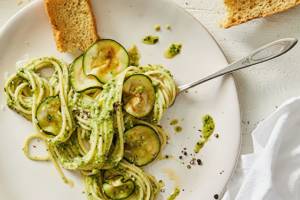
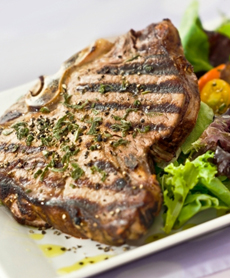
 A favorite beef cut among connoisseurs: a dry-aged Porterhouse steak. Photo courtesy of NimanRanch.com. A favorite beef cut among connoisseurs: a dry-aged Porterhouse steak. Photo courtesy of NimanRanch.com.
June 2005
Last Updated November 2025
|
|
Beef Cut Types
Beef Glossary Page 2: C, D, E
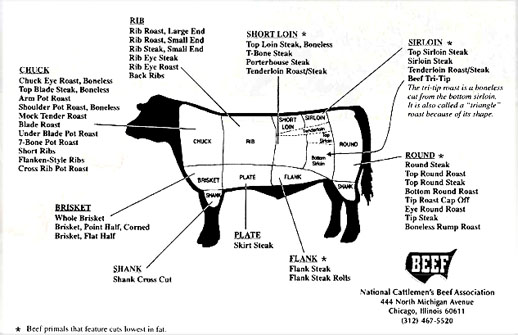
On this page, you’ll find beef cut types such as Certified Angus Beef®, chipped beef (often called chip beef), dry-aged beef and When looking up a beef cut, it’s helpful to refer to the beef cut diagram, courtesy of the National Cattleman’s Beef Association. If you enjoy this Beef Glossary, check out our food glossary collection with almost every category of food.
Click on a letter to go to the appropriate glossary section.
a b c d e f g h i j k l m n o p q r s t u v w x y z
This glossary is protected by copyright and cannot be reproduced in whole or in part.
You are welcome to link to it.
CALF FRIES
Another term for fried bull testicles or prairie oysters. In particular, calf fries are taken from very young animals.
CARPETBAG STEAK
Not a cut of meat but a preparation, first popularized in Sydney, Australia, around 1950. It consists of an end cut of rib-eye steak (known as scotch fillet steak in Australia), served standing up like an old-fashioned carpetbag (or a miniature mountain). Small cuts make pockets in the meat, into which Sydney rock oysters are stuffed and secured with toothpicks. The whole may be wrapped in a strip of bacon, and it’s often served with roasted new potatoes.

Filet mignon stuffed with oysters: a different surf and turf! Here’s the recipe (photo via Day Day News).
CENTER CUT
Generally refers to steaks cut from the heart of the rib-eye. A very flavorful, juicy, tender cut.
CERTIFIED ANGUS BEEF®
Certified Angus Beef is a trademarked brand that licenses the trademark to ranchers who are approved by the licensor. The brand promises the consumer consistently flavorful, juicy, and tender cuts. Less than 8% of beef is Certified Angus Beef. It is the best-known brand; more than 50% of all beef approved through USDA brand certification (i.e., branded beef) is Certified Angus Beef. See also Angus cattle.
|
|
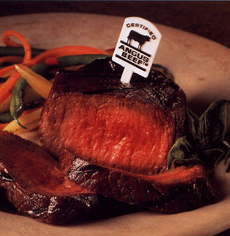
Photo courtesy Certified Angus Beef. |
CHATEAUBRIAND or TOURNEDOS or FILET DE BOEUF
Chateaubriand is not a cut of meat but a recipe using the tenderloin. It was created by the personal chef, Montmireil, of Vicomte François-René de Chateaubriand (1768-1848). The Vicomte was a French author, considered to be the founder of Romanticism in French literature. He was also a soldier and statesman who served Napoleon as an ambassador and King Louis XVIII as Secretary of State. According to Larousse Gastronomique, during the time of the Vicomte, the steak was cut from the chewy but tasty sirloin and served with a white wine and shallot sauce that included demi-glace, butter, tarragon, and lemon juice.
|
|
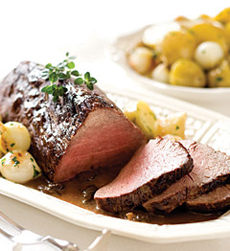
Chateaubriand from Montana Legend is available at MackenzieLtd.com. |
Montmireil instead chose the very tender (although less flavorful) tenderloin. The meat was cut from the thickest part of the tenderloin, which provides just two portions (all of the tenderloin can be cut into filet mignon). It was grilled “larded,” with a strip of bacon or lard around it to keep it moist, and served medium rare (never well done); the bacon was discarded. Modern chefs have learned to quickly sear the roast and then finish it in a hot oven until rare or medium-rare. Today, Béarnaise sauce or red wine and mushroom sauce is served. The accompanying château potatoes, which were cut into the shape of large olives, parboiled, and cooked in butter, can easily be replaced with roasted new potatoes. Serve Chateaubriand with Bernaise sauce, or an easy red wine and mushroom sauce.
CHEESE STEAK or PHILLY CHEESE STEAK
A fast-food sandwich invented by a Philadelphia hot-dog stand owner in 1930, the cheese steak consists of thin, grilled slices of steak topped with melted cheese on a hoagie roll. Today, Cheez-Whiz is the topping of choice because it melts the quickest, although white American cheese and provolone are considered authentic (Cheez-Whiz was not invented until 1952).
|
|

A cheese steak (photo © DiBruno Bros | Facebook). |
CHICAGO-STYLE STEAK
A preparation of steak that’s cooked to the desired level and then quickly charred. The diner orders it by asking for the style followed by the level of doneness, e.g., “Chicago-style rare.” In some areas, it is also referred to as Pittsburgh-style steak.
CHICKEN-FRIED STEAK or COUNTRY FRIED STEAK
A Southern specialty, chicken-fried steak is the American version of Wiener Schnitzel*, but instead of a tenderized veal cutlet, a tenderized cut of beef (a cube steak) is coated with seasoned flour and pan-fried. It gets its name from its resemblance to fried chicken.
In a redundant and ironic twist, the dish called “chicken fried chicken” pounds a chicken cutlet flat, breads it with flour, and pan-fries it. This preparation is distinctively different from regular fried chicken, which breads bone-in chicken parts and deep-fries them.
Country-Fried Steak
A very similar dish to chicken-fried steak is country-fried steak. It is the same fried steak, but topped with brown beef gravy instead of white country gravy. This is where it gets confusing: Chicken-fried is topped with country gravy; country-fried is topped with brown beef gravy. Many people are confused, which is why there are so many recipes called country-fried that are actually chicken-fried.
Here’s a recipe for chicken-fried steak, including the history of the dish.
National Chicken-Fried Steak Day is October 26th.
______________
*Wiener Schnitzel means Viennese scallops, referring to the scallops of veal, another word for a thin cutlet. Wiener Schnitzel is the national dish of Austria.
|
|

Chicken-fried steak with white country gravy (photo © Taste Of Home).

Country-fried steak: The difference is the brown gravy. Here’s the recipe (photo © The Spruce Eats). |
CHIPPED BEEF or CHIP BEEF
Chipped beef, erroneously referred to as chip beef, is dried smoked beef similar to Italian bresaola, which is more flavorful because it is aged; the “chips” refer to the slivers in which it is packaged. Creamed chipped beef on toast was standard diner fare in the first half of the century. The recipe sauce rehydrates the dried beef and mixes it in a white sauce flavored with parsley and pepper, served atop toasted bread. You can further flavor the dish with Worcestershire sauce and fresh or dried parsley.

Creamed chipped beef on toast (photo © Potato Rolls).
CHUCK or SHOULDER CUTS
There are more than half a dozen cuts from the shoulder (the area between the neck and the shoulder blade), including arm steak, blade steak, chuck steak, chuck eye steak, mock tender steak, seven bone steak, shoulder steak, and under bone steak. All of them have excellent flavor, but they are usually tougher than cuts from the loin, sirloin, or rib sections, and are thus less expensive. These multi-muscled steaks are best cooked by braising. Ground chuck has the best percentage of meat to fat for hamburgers. The blade steak is one of the most tender of all steaks after a line of tough connective tissue down the middle is removed. It has a great flavor and is inexpensive compared to steaks from the loin, sirloin, and rib. The rest of the steaks from the chuck all have good flavor and texture, but they can be quite fibrous. They can be bone-in or boneless, cut thick or thin, and can be broiled or roasted successfully, especially if marinated or tenderized. However, the best way to cook chuck steaks is to braise them by searing them on both sides, adding a small amount of liquid (seasoned broth or wine), covering them tightly, and simmering until tender.
CHUCK ROAST
A full-flavored roast, rectangular in shape, is popular for a classic pot roast. Best for slow-cooking in the crock pot, braising, or in stews. It can also be stir-fried.

A chuck roast requires a long cook time to tenderize the meat (Iphoto © Good Eggs).
CHUCK STEAK
An extremely well-marbled, full-bodied, and robust steak. The typical chuck steak is a rectangular cut, cut about one inch thick, with parts of the shoulder bones, and is known as a “7-bone steak.” This is a reference to the shape of the bone, which resembles the numeral 7. From a good producer, this can be a very satisfying cut.
|
|

Chuck roast. Photo courtesy Cybercucina.com. |
CHUCK TENDER STEAK
Don’t trust the name; this cut is not tender! It is a flavorful cut, however, from the shoulder clod. It needs to be marinated or braised before broiling, grilling, or pan-searing. Alternate names include chuck clod tender, chuck fillet steak, chuck mock tender steak, and Scotch tender.
CLOSED HERD
A herd of farm animals that is 100% born and raised on the farm. No animals are ever brought in from the outside. This ensures the health of the herd; outside animals can bring in infections, viruses, and diseases, including “mad cow” and hoof and mouth disease. Maintaining a closed herd is especially important to an organic herd, since animals cannot be treated with antibiotics, and an animal requiring such care must be removed from the herd.
CLUB STEAK
Although really a strip steak, the term “club steak” refers specifically to the last steak from the rib end of the loin. It has the flavor and texture of a strip steak. It is cut from the short loin, next to the rib end; it is smaller than a Porterhouse steak but with the same large “eye” section. When cut properly, it is a tender steak.
CONNECTIVE TISSUE
The tissue between and within muscles helps bind muscles together and attaches muscles to bone for support.
COWBOY STEAK or CÔTE DE BOEUF
A cowboy steak, called côte de bœuf in French, is a bone-in rib eye steak with a frenched rib bone. This “raw bone” feature and the fact that this cut is generally around two pounds of meat, make it big enough for the hungriest cowboy—or enable two people to share. It’s sometimes called a cowboy chop because it looks like an enormous chop.
.
|
|
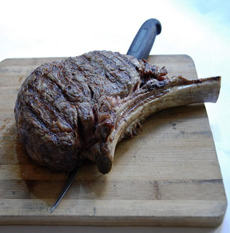
Cowboy steak. Photo courtesy OnlyWithTilia.com. |
CORNED BEEF
Corning refers to curing or pickling the meat in a seasoned brine. The word refers to the “corns” or grains of kosher (or other coarse) salt that are mixed with water to make the brine. Typically, brisket is used to make corned beef. The dish has many regional variations and seasonings. Historical note: Irish immigrants adapted corned beef from their Jewish neighbors on New York’s Lower East Side as a cheaper alternative to Irish bacon, precipitating the now-traditional Irish-American dish, corned beef and cabbage. Smoking s corned beef and adding extra spices produces pastrami.
|
|
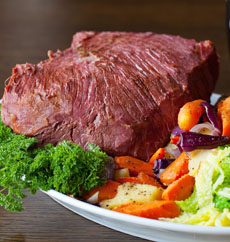
Corned beef with carrots and cabbage. Photo courtesy Guinness. |
CORN FED or GRAIN FED
Cattle that eat a diet of corn. In addition to being unhealthy for the animal, it creates fattier meat than the leaner, grass-fed beef.
CÔTE DE BOEUF
See cowboy steak, above.
COUNTRY-FRIED STEAK
See chicken-fried steak above.
CUBE STEAK or MINUTE STEAK
A flavorful cut of beef, generally from the top or bottom round. It is tenderized (cubed) by pounding it with a mallet or running it through a tenderizing machine—cubing is a process, not a cut. Either technique makes a cube-shaped pattern in the meat. Cube steak would be too tough to eat without being tenderized. It is the cut generally used for Salisbury steak and chicken-fried steak, where it is coated and pan-fried, almost as if it were a piece of fried chicken. It is also a popular cut for steak sandwiches and cheesesteaks. See also minute steak.
|
|
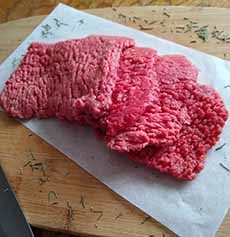
These beautiful cube steaks are available from the ninth-generation Dillingham Family Farms. |
While mankind has used different grinding, pounding, and scoring techniques to tenderize tough meat, cube/cubed steak seems to have appeared in the 1920s. There is a reference to the Cube Steak Machine Company of Boston, which patented a cubing device in 1926. The company advertised in Good Housekeeping magazine: “Cubing improves the flavor in any cut of meat...triples the cooking surface and reduces the time required for cooking.” (Source: FoodTimeline.org.)
CULOTTE STEAK or TOP SIRLOIN CAP STEAK
A small, boneless steak, the sirloin cap steak is a flat, triangular-shaped muscle that lies immediately over the top sirloin. Culotte steaks are flavorful but lean, with less marbling than a New York strip steak or a Porterhouse. Thus, they are a bit tougher than other sirloin steaks, requiring marinating prior to cooking. It can be cooked whole, cut into cubes for kabobs and stews, or cut into strips for stir-fries or steak sandwiches.

Culotte steak (Gemini photo).
DELMONICO STEAK or SPENCER STEAK
See rib-eye steak.
DRY-AGED
Dry-aged beef is fresh beef that’s been hung to dry (or set on wooden racks) in an aging room for several weeks under controlled temperatures, humidity, and airflow to reduce spoilage and enhance flavor and tenderness. It is compared to aged wine: The flavors have deepened and mellowed. Only the more expensive cuts of meat can be dry-aged, as the process requires meat with a large, evenly distributed fat content. In the process, the meat may lose up to 25% of its weight in liquid, which is part of concentrating the flavor. Dry aging also makes the meat a darker color, with an aged aroma.
|
|

Rib-eye steaks dry-aged for 50 days at Catch New York. |
Some connoisseurs prefer dry-aged beef because this concentration results in a more intensely flavored (if smaller) piece of meat. In addition to the loss of liquid, changes occur in the meat itself. Natural enzymes in the meat break down the fibers, enhancing the taste with a delicious nutty flavor and tender texture. During dry-aging, steaks are kept on racks in a special room with temperature, humidity, and air circulation carefully controlled at near-freezing temperatures. That’s why dry-aged beef is rarer and more costly than fresh-packed beef and is generally available only at specialty butcher shops and fine restaurants. See also wet-aged beef, also known as vacuum-aged beef.
DRY-HEAT COOKING
The most tender cuts—rib steak, strip steak, sirloin, chuck, or round steaks—can be cooked quickly by dry heat—broiled, grilled, pan-fried, or roasted.
ENTRECÔTE
The French word for what Americans call the rib-eye steak. Pronounced on-truh-COAT, the word means “between the ribs”—specifically the ninth through 11th ribs. A lean, tender cut of meat, the entrecôte is best grilled or broiled, served rare or medium rare.
|
|
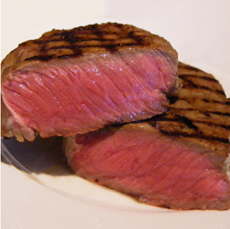
The entrecôte, or rib-eye steak. Photo courtesy OnlyWithTilia.com. |
EYE OF ROUND ROAST
The leanest of all roasts and the most tender of roasts from the round, you can see from the photo at the right that there is virtually no exterior fat. Just season and roast this cut for 20 minutes per pound at 300°F. It also does well cooked in warm, moist heat such as a crock pot.
Continue To The Next Page, Terms With
F, G & H
Go To The Glossary’s Alphabet Index, Above
|
|
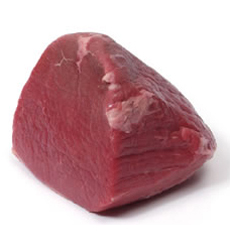
Eye of round roast. Photo courtesy GlacierBeef.com. |
Lifestyle Direct, Inc. Some definitions were provided by the Cattlemen's Beef Board and are © Copyright 2005 Cattlemen’s Beef Board. All rights reserved. Images are the copyright of their respective owners.
|