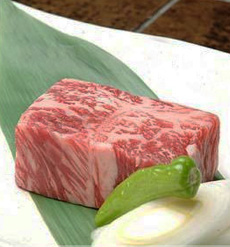
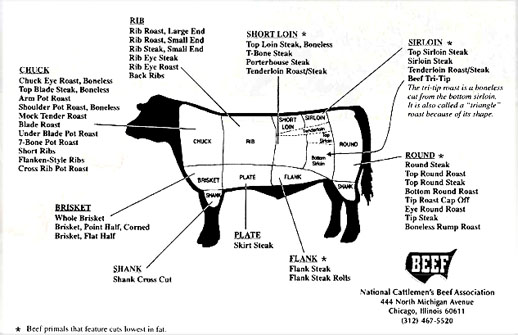
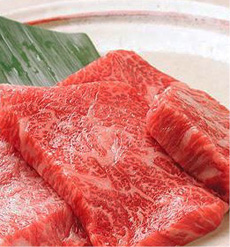
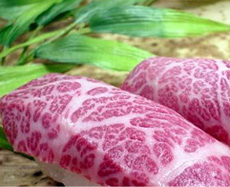
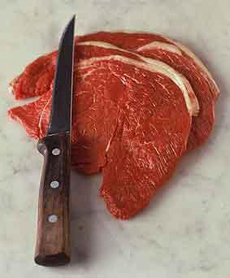
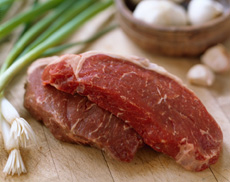
In the beginning, the marketing led people to belief that these cattle were pampered, massaged, brushed with saké, and fed beer-and-saké mash. That may have been true with the original small herd, but large production makes that kind of treatment unfeasible. Still, this is quality stock, treated well, and it produces very tender yet full-flavored beef. Because of import restrictions, branded Kobe is not currently available in the U.S., due to testing issues for BSE* required by the USDA and the ability to consume most of what is produced at home. However, other Wagyu beef is now being imported to America, inspected as BSE-free before it leaves Japan, and again by the USDA. Also, U.S. ranchers are applying the same breeding practices and producing a domestic Wagyu. For a comparison of prices, at Lobel’s Prime Meats in New York City, a 16-ounce boneless American Wagyu steak sells for $68.98, and a prime dry-aged boneless New York strip steak is $46.98 (as of April 2007). LOIN CUTSCuts of beef from the loin are among the most tender and the most expensive, but not necessarily the most flavorful. The tenderloin is the most tender of all steaks. It is a boneless cut that comes from the long muscle that runs along both sides of the backbone. It lies beneath the strip loin (strip steak). It can be purchased as a whole or partial tenderloin, but is usually cut into small medallions or filet mignon. Since filet mignons contain very little fat or marbling, they are usually wrapped in bacon or cooked with some form of fat to add flavor. Chateaubriand is a large section cut from the thickest part of the tenderloin. It is meant to serve two people. The T-bone is a steak with a T-shaped bone: on one side is an oval tenderloin, on the other side is a top loin, or strip steak. Some call it the “king of steaks” because it is two steaks in one, the best of both of cuts in one steak: the tenderness of the tenderloin and the flavor of the strip steak. The porterhouse is a larger T-bone, containing more of the tenderloin and the sirloin strip.
MEAT INSPECTIONRequired by federal law to provide assurance of the wholesomeness of meat to be sold. Meat inspection assures that meat is wholesome, has been handled in a sanitary manner, and is properly labeled. Inspection of meat products is conducted by the USDA/FSIS as a public service and is paid from tax funds. MIDDLE MEATSCuts from the rib and loin section of the beef animal.
MOIST HEAT COOKINGMoist-heat cooking uses liquid to cook the meat in a covered pot in the oven, on the range or in a slow-cooker. It is used for tougher cuts such as chuck, round, tip, foreshank, plate and flank. NATURAL BEEFWith natural beef, the animals are allowed to grow naturally, i.e., without growth hormones. They are fed quality diets, generally a vegetarian corn-based diet for 300+ days. This natural feeding process takes an additional 45 days for the animals to reach market, which is why natural beef is both more expensive and higher quality. While there are many fine natural ranchers, there is no industry regulation of the term “natural.” Thus, any company can call its product natural, and, unlike with organic products, there is no inspector to verify whether it is or not. See also organic beef.
NEW YORK CUTAlso known as the Philadelphia cut, the New York system of cutting beef is the major system used in the U.S. The other is the Boston cut. The first point of difference is when a side of beef is cut across at right angles to the backbone, into the hind quarters and the fore quarters. In the New York system, all ribs are left on the forequarter; in the Boston system, three ribs are left on the hindquarter. Thus, the first cut of the fore quarter in the New York system (a prime rib roast) is the same piece of meat as the first cut on the hind quarter in Boston. There are many other points of confusion. The U.S. Department of Agriculture uses the New York system; the Boston system is used only in New England.
The strip steak is also known as the strip loin, Delmonico, boneless loin, boneless club steak, or sirloin strip (which is confusing because it’s not really part of the sirloin). Ideally, the steak should be cut 1-1/2 to 2 inches thick. Connoisseurs say that keeping the bone in optimizes the flavor. Go To Next Page, Terms Beginning With O & P Go To Glossary Alphabet Index, Above
Follow Us On:


|
The Nibble Blog
The Latest Products, Recipes & Trends In Specialty Foods
New food adventures are served up daily. Check it out!
Food Glossary
Our Food Directories Are "Crash Courses" In Tasty Topics
Photo glossaries of more than 100 foods and beverages let you explore your favorites. Take a look!