 A glass enjoyed at the winery. Photo by Erica Thorpe | SXC.
|
R. VERONIQUE FITZGERALD is wine consultant and writer in New York City.
|
|
March 2008 |
|
Product Reviews / Main Nibbles / Wine Brunello di Montalcino:
The Great Red Wine Of Tuscany ~ Part I
CAPSULE REPORT: R. Veronique Fitzgerald reports on one of the world’s great red wines, made of the Sangiovese grape. It’s a clone of the same grape used to make Chianti, a neighbor in Tuscany; but there’s a world of difference. Take a tour of Brunello di Montalcino, its history and environs; learn what to expect from the new release; and see what bargains you should be snapping up while they’re still on the shelf. This is Part I: An overview of Brunello. Information on the new vintage, plus tasting notes and buying tips, is in Part II.
In the eastern reaches of Tuscany, a grape cultivated for millennia (since the time of the ancient Etruscans) was ignored for most of history. Today, it makes a red wine in demand by many, Brunello di Montalcino (broo-NELL-loe dee MOHN-tahl-CHEE-no). Brunello is the grape’s nickname. It means “the little dark one,” so named for the brown hue of its skin. It is made from the Sangiovese (SAN-joe-VAY-zay) Grosso (GROS-so) grape, a clone of the grape used to make Chianti. Chianti is a neighbor in Tuscany, as are Vino Nobile di Montepulciano (also made with Sangiovese) and the dessert wine Vin Santo (made from Malvasia and Trebbiano grapes).
Some wines from this area are called “Super Tuscans,” an informal class that has emerged since the 1970s. Some are made outside of DOCG regulations (e.g., are blends of Sangiovese and Cabernet Sauvignon), but of extremely high quality and commanding hundreds of dollars per bottle upon release. Even the “regular” Brunello bottlings are pretty super, part of a vibrant culture and are often the center of celebrations. Brunello di Montalcino is one of the most expensive and revered wines of Italy.
Montalcino Wine-Growing History
The name Sangiovese derives from sanguis Jovis, “the blood of Jove” (a.k.a. Jupiter, the Roman name for the Greek god Zeus), is believed to date back to ancient times and to have been known to the Etruscans, the original Tuscans. It was an obscure, unappreciated grape until the 1700s, by which time it was widely planted around the region.
Sangiovese is known to behave very differently, depending on where it is planted and how it is allowed to yield. So although Sangiovese Grosso was officially identified as a clone in 1906, Montalcino’s Sangiovese Grosso, and the wines it produces, have been distinguishable from any other Sangiovese-based wines in the region for many centuries. Montalcino’s reputation for producing great wine is documented in texts as far back as the 1500s.
|
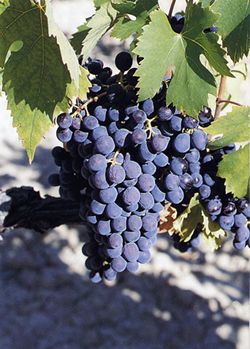 The Sangiovese Grosso grape produces dark red, slow-maturing wine. Photo courtesy of the Consorzio del Vino Brunello di Montalcino. The Sangiovese Grosso grape produces dark red, slow-maturing wine. Photo courtesy of the Consorzio del Vino Brunello di Montalcino.
|
A DOCG* since 1980, the hill town of Montalcino rises almost 1,800 feet above the valleys of the Ombrone, the Orcia and the L’Asso Rivers. It lies about 70 miles southwest of Florence, just south of the city of Siena, and offers stunning views of the surrounding valley in addition to its great wine.
*DOCG is an acronym for Denominazione di Origine Controllata e Garantita—literally, “wine from an area that is controlled and guaranteed.” This is meant to indicate that the land on which the grapes are grown produces fruit of the highest quality. However, all of Chianti and Tuscany are designated DOC or DOCG growing areas, despite the fact that not all the wines produced in these areas are top quality. So, the designation is relative, at best, in the way that wines from Napa Valley are generally better than wines from Texas. There are four major categories of Italian wines, of which DOCG represents the highest quality with the most stringent regulations regarding yields, and the wines must pass an evaluation by a tasting committee (the “guarantee”). The four categories are Vino Da Tavola, table wine that can be made from any grapes (although some very fine wines that don’t conform to standard rules must be called Vino Da Tavola); Vino a Indicazione Geografica (IGT), which assures that the grapes came from a specific locale; Vino a Denominazione di Origine Controllata (DOC), equivalent to the French AOC, where the grapes come from well-defined regions and are made according to specific rules that preserve the traditional wine-making practices of those regions; and Vino a Denominazione di Origine Controllata e Garantita (DOCG), which is more stringent than DOC regarding yields and other criteria. Tuscany has 29 DOC and 7 DOCG areas.
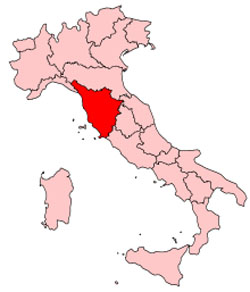
The Tuscany region of Italy, on the Mediterranean Sea, the west coast of Italy. The east coast borders the Adriatic sea, and the southern coast borders the Ionian Sea. Map courtesy of Wikipedia.org.
|
Settled since Etruscan times, Montalcino’s ancient name was Monte Ilcinus, after the Holm Oak that grows there. The oaks have covered the hills and valleys from prehistory to the present day, sharing the soil with olive and chestnut trees and Sangiovese Grosso grapevines for millennia. During the Middle Ages, in 1260, Montalcino was overtaken by the Sienese; in 1555, Siena was conquered by Florence under the Medici family. The Grand Duchy of Tuscany was one of the numerous city-states that became part of the united nation of Italy in 1861. Today, the town is fortunate to sit in the middle of one of the world’s most important grape-growing areas, amid the vines that produce among the best-known and costliest wines of Italy. This hilly turf grows grapes that produce the wines known for their rich fruit, and for the quality tannins that give them long aging potential. |
Brunello di Montalcino, grown in high-altitude, hillside vineyards, tends to be more tannic and capable of more lengthy aging than wines made from Sangiovese Grosso in other Tuscan appellations, or wines made from Sangiovese Piccolo, another of the 14 clones of Sangiovese (sometimes known as the Sangioveto, it is used to make Chianti Classico DOC wines). This uniqueness owes itself in part to the terroir, and in part to the low yields to which quality estates restrict their vines (the more pruning back on the vine, and the fewer grapes produced by each vine, the higher the concentration of the juice and flavor in each grape). Although each of the two broad categories actually covers a variety of clones, the more widely planted Piccolo, which has smaller berries and tighter clusters and is grown in many other parts of the region including Chianti and Montepulciano, is considered to be the inferior Sangiovese.
|
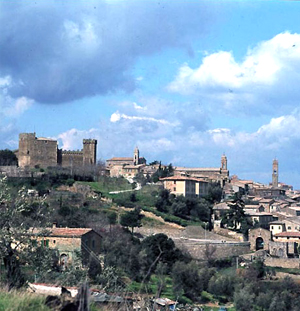 The hillside town of Montalcino. Though called a “città,” or city, the population is just north of 5,000. The hillside town of Montalcino. Though called a “città,” or city, the population is just north of 5,000.
|
The Birth Of Modern Brunello Ferruccio Biondi-Santi is credited with creating the style of today’s Brunello di Montalcino, at the end of the 19th century. He started his first vineyards of Brunello 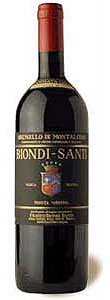 with the goal of creating a long-lived wine. His first estate, Il Greppo, is perched in the mountains at an altitude of roughly 1,500 feet. (For those of you who question how grapes can be grown on mountains: The most challenging land grows the best grapes. The farther the roots have to dig down in rocky soil to find nutrients, the better the flavors in the wine.) Today, Il Greppo is stewarded by the sixth generation of Biondi-Santis. Ferruccio, the third generation, learned his viticultural skills from his grandfather, Clemente Santi. Ferruccio’s son, Tancredi, carried through his father’s vision by typifying the style and marketing Biondi-Santi Brunello di Montalcino, with great success. with the goal of creating a long-lived wine. His first estate, Il Greppo, is perched in the mountains at an altitude of roughly 1,500 feet. (For those of you who question how grapes can be grown on mountains: The most challenging land grows the best grapes. The farther the roots have to dig down in rocky soil to find nutrients, the better the flavors in the wine.) Today, Il Greppo is stewarded by the sixth generation of Biondi-Santis. Ferruccio, the third generation, learned his viticultural skills from his grandfather, Clemente Santi. Ferruccio’s son, Tancredi, carried through his father’s vision by typifying the style and marketing Biondi-Santi Brunello di Montalcino, with great success.
Photo: A Biondi-Santi Brunello Riserva from the Il Greppo estate.
Today, Brunello’s† welfare and reputation are protected by The Consorzio del Vino Brunello di Montalcino, a voluntary association of producers created in 1967, after the region first earned its DOC. Based in the town of Montalcino, with a population of slightly more than 5,000, the Consorzio represents 250 producers. They are responsible for marketing the wines of the region at home and abroad, as well as rating the vintages and upholding the standards of the DOCG. In the Middle Ages, Montalcino was known for its tanneries and leather goods. Today it’s a wine town.
†Note that Brunello wine is produced in the town of Montalcino; Brunello is the nickname of the Sangiovese grape. The wine is formally called Brunello di Montalcino. There is a municipality of Brunello, in the region of Lombardy, in the north of Italy. No Brunello wine is made there. It can get confusing!
Modern Brunello is a full-bodied and earthy wine—mushrooms on the nose, and red berries on the palate, are classic characteristics, along with a deep, rich texture. It is vinified to be conducive to long periods of bottle aging. Riserva wines are more complex still. The less expensive Rosso wines, which we’ll discuss below and in Part II, are lighter and less intense, with a younger, fresher character.
Brunello Rules
Just as France imposes appellation rules (AOC) on the wines (and other agricultural products) of various regions, Italy has regulations for its DOC, or Denominazione di Origine Controllata, products. In the case of Brunello:
- Brunello di Montalcino must be produced within delineated boundaries.
- Wines labeled Brunello di Montalcino DOCG (the G stands for Garantita, or guaranteed), which are 100% Sangiovese Grosso, must age for two years in oak barrels and for at least four months in the bottle before release (these are some of the longest aging requirements in Italy), though they usually age another two to three years in the producer’s cellar before release.
- Brunello di Montalcino Riserva, made of the finest grapes, requires longer aging, which adds greater complexity. It may be released on January first of the fifth year following the harvest.
- Brunello di Montalcino and Rosso wines may only be sold in Bordeaux-shaped bottles.
Most wineries also make a second tier Rosso di Montalcino DOC (Montalcino Red), a less-expensive version of Brunello, which is lighter and less intense and has a younger, fresher character. It can be released after only one year of aging and helps to keep cash flowing into the estates while the Brunellos and Riservas enjoy long, luxurious aging. Also, it enables producers to make a better Brunello for the DOCG level wine because they can reserve only the best grapes for this purpose, using the rest to make Rosso.
Continue to Part II:
|
|
Lifestyle Direct, Inc. All rights reserved. Images are the copyright of their respective owners.
|
|