THE NIBBLE (TM) - Great Finds for Foodies (tm)


RSS feed
olives
Olive oil is pressed from the fresh-picked fruit of the olive tree.  Photo by Iliana | SXC.
MENU


Oils, Vinegars &
Salad Dressings

Category Main Page
Articles & Reviews


Main Nibbles

Main Page
Articles & Reviews Of Foods
From A To Z


Product Reviews

Main Page
Food, Beverages, Books,
News & More


November 2005
Updated March 2008

Product Reviews / Main Nibbles / Oils, Vinegars & Salad Dressings

Olive Oil Glossary

Learn About This Versatile Fruit (Yes, Fruit!)


INTRODUCTION: Olive oil has been a staple in the Mediterranean diet for millennia. It has become exceedingly popular in the United States, not just because of the growing appreciation of its fine flavor, but because of its medically researched impact on cholesterol levels. Not only are our store shelves filled with wonderful oils from around the world: California has hundreds of entries and its own olive oil council to market California oils to world markets.

This has resulted in the availability of a wider range of olive oils in most areas of the country. However, along with choice comes disparity in definition. While most countries use the standards of the International Olive Oil Council (IOOC), two formidable entities, the European Communities and the United States, do not, each using still other standards and definitions. The California Olive Oil Council (COOC), working apart from the United States Department of Agriculture (USDA), has attempted to protect its crop by issuing a seal to oils which exceed IOOC Extra Virgin olive oil quality standards: its products surpass global standards.

There’s a lot of information about olive oil here. If you think we should consider terms or definitions than those we have provided, click here. Also read our article, Flavors and Aromas of Olive Oil. Also visit our collection of food glossaries to learn more about almost 50 other food products.

You can click on the letter of the alphabet in the bar below to get to a term
without having to scroll manually.

a  b  c  d  e  f  g  h  i  j  k  l  m  n  o  p  q  r  s  t  u  v  w  x  y  z

ACDITY

The natural acid in olives is oleic acid. If the acidity of the cold-pressed oil is less than 1%, it is known as extra virgin olive oil. If the acidity is between 1% and 3.3%, the oil is called virgin olive oil. Any oil obtained from the first cold pressing that has a natural acidity above 3.3% cannot be sold as virgin olive oil. It is usually sent to a refinery to reduce the acidity and eliminate any other objectionable qualities in aroma and flavor, and is sold as “olive oil” or “pure olive oil,” a refined product.

ARBEQUINA

One of the main Spanish olive varieties, grown in Catalonia, in northeast Spain, and other areas. The small, brown olive produces an oil that is very fruity and fresh, with a smooth, fluid mouthfeel, nuances of green almonds and fresh-cut grass. It is often used in blends to provide the “fruity” notes. It is perfect for vegetable or meat marinades where flavors are more subtle. It is also enjoyed as a table olive. with a slight apple taste, green grass, not very bitter or pungent, and of a sweet flavor. It has medium-low stability, i.e., it does not retain its freshness for long, so buy it in small quantities and don’t let it linger on the shelf or it will go rancid.

ANOINTING OIL

A term for condiment oil: an extra virgin olive oil with fine flavor and aroma that should be used as a surface accent, and not for cooking or baking.

A.O.C.

Appellation d’Origine Controlée, the French certification of authenticity of origin. Italians use D.O.P., which stands for Denominazione d’Origine Protetta (some other countries in the European Union also use D.O.P. now, including Portugal), and the Spanish use D.O., or Denominacion de Origen.

ARTISANAL OIL

As opposed to blended olive oil, a term given to an oil from a single estate, or made from a single variety of olive, which produce a superior oil. These single-estate oils and artisanal oils are among the world’s finest, and are made in very small quantities. See also Estate Oil.
BARNEA OLIVE

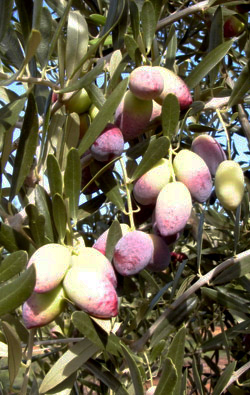
The barnea is a modern cultivar bred in Israel to be both high-yield and disease-resistant; it is also grown in Australia and New Zealand. It is used both for oil and as a table olive. The oil has a pronounced, leafy green flavor.

BLACK OLIVES

A black olive is a fully ripe olive, and will contain more oil than a green olive. Whether ripe or green, the olive fruit is naturally is very bitter and not palatable; it needs to be fermented or cured with lye or brine. There are different techniques—see Curing, Picholine and Spanish Olives. Green olives are allowed to ferment before being packed in a brine solution. Domestic black olives are not fermented, which is why they have a milder flavor than green olives or imported black olives.

BLENDED OLIVE OIL

IOOC Definition: Most supermarket brands of olive oil are blended from oil from many different varieties, regions, and even countries.  (1) Because olive oil from the same grove tastes differently from year to year due to weather, to create an oil that tastes the same blenders must take oil from many sources and come up with a recipe to create the same taste. (2) Blending some oil high in polyphenols with one which does not will increase its shelf life. (3) Sometimes olive oil is blended with canola or other vegetable oils. This should be stated on the label. Illegal blending of cheaper hazelnut oil can be profitable for the unscrupulous and can be difficult to detect.

BULK OIL or COMMERCIAL OIL

Many of the name brands sold in food stores in the United States (and in many other parts of the world) are a blend of bulk olive oils from one country or several countries. For example, a leading brand of virgin olive oil may contain a blend of virgin oils from Spain, Greece and Turkey; or a bottle of extra virgin oil may contain a blend of extra virgin olive oils from different regions of one country, such as Italy or Spain. The label will usually designate the origin of the oil blend. The blending of different batches of olive oil of the same grade does not indicate that the product is inferior, but it allows the manufacturer to sell the product at a reasonable price. Many blended olive oil brands are among the most popular. As opposed to estate oil, larger producers enjoy economies of scale which permit them to offer an excellent product at a more affordable price.

COLD PRESSING or FIRST PRESSING or FIRST COLD PRESSING

IOOC Definition: “Cold pressed” is an anachronistic and largely unregulated label description for olive oil. Fifty years ago when most oil was made in vertical presses, the Harvested Olivespaste was pressed to make olive oil (see First Press) and then mixed with hot water or steam and pressed again to remove more oil. This “second pressing” was not as good; the heat had evaporated some of the delicate flavors. Today the paste is almost always warmed to room temperature during the malaxation process (no heat is used above about 60°F) before being centrifuged using horizontal decanters (olives are harvested in the winter when it is cold). According to IOOC regulations this is still considered “cold pressed.” Heating the paste excessively increases yield but degrades flavor. Producers would lose money by attempting to extract a little more oil by overheating and degrading the flavor of the oil to the point where it would not qualify as more profitable extra virgin. After the oil is pressed out of the paste, the dry pomace (pits and flesh) is sometimes sold to refineries where steam and solvents are used to remove any residual oil. This oil is called olive pomace oil.
Harvested olives waiting to be pressed at O Olive Oil.

COLOR

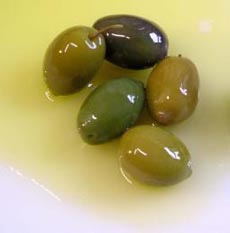
Color is an indicator of freshness, but not necessarily an accurate indicator: smell and Dish Of Olive Oiltaste should be the guide. There are many different varieties of olives, and different cultivars produce different colors of oil. Some types of olives will produce an oil that is more golden, some are quite green. The color also depends on the ripeness of the olives at the time of harvest. Very ripe olives will produce oil that is more yellow than green olives. This is neither good or bad, but a matter of preference when you taste the oil.
Photo by Daniel West.

CONDIMENT OIL

See Annointing Oil.

COOC

The California Olive Oil Council, the regulating body that establishes standards for member producers that make olive oil in California.

CORATINA OLIVE

The Coratina olive is cultivated largely in southern Italy, in the provinces of Apulia and Baria. It has a high level of fruitness, the aroma of green leaf and hints of apple. It has characteristic bitterness and pungency, plus astringency with a slightly noticeable sweetness. The oill has a high degree of stability.

CORNICABRA OLIVE

One of the main Spanish olives, grown in the La Mancha region of central Spain (Castille), near Toledo. It produces a rustic oil—a medium to high olive fruity flavor and a strong aroma—bringing to mind the flavorful nuances of fresh, ripe fruit. pungent and green flavor. Cornicabra oils are very smooth on the palate and can have a slight almond finish. The oil is very stable, i.e., retains its freshness and does not turn rancid for a longer period than most other olive oils.

CULTIVAR

A variety of a plant that has been created or selected intentionally and maintained through cultivation. From the five subspecies of olive free, there are thousands of cultivars of the olive. In Italy alone at least three hundred cultivars have been enumerated, but only a few are grown to a large extent.

CURING

Olives are unpalatable until they are cured. They can be brine-cured, dry-cured, lye-cured, oil-cured or water-cured. Green olives must be soaked in a lye solution (sodium hydroxide) prior to brining and then washed thoroughly in water to remove oleuropein, a naturally bitter carbohydrate (a glycoside) in the fruit. Ripe, black olives can proceed straight to brining. Green olives are fermented before being packed in a brine solution. American black olives are not fermented, which is why they have a milder flavor than either green olives or imported black olives.

D.O. or DENOMINATION OF ORIGIN

The Denomination of Origin  is a regulated and controlled qualification managed by a Council that is responsible for controlling the characteristics, as well as the authenticity of the products protected by the denomination. It reports to the Ministry of Agriculture. The Denominations of Origin of Spanish olive oil are Baena, Les Garrigues, Priego de Córdoba, Sierra de Segura, Sierra Mágina, Siurana, and Montes de Toledo. Denominations of Quality which have less regulation, include Murcia and Aragón. There are analogous bureaus in Italy, and France to protect their famous agricultural heritage: wines, cheeses, olive oils, and other products. In France the designation is A.O.C. or Appellation d’Origine Controlée. Italians use D.O.P., which stands for Denominazione d’Origine Protetta (some other countries in the European Union also use D.O.P. now, including Portugal).

D.O.P. or DENOMINAZIONE d’ORIGINE PROTETTA

Denominazione d’Origine Protetta (some other countries in the European Union also use D.O.P. now, including Portugal), the Italian certification of authenticity of origin.  See also D.O. and A.O.C.

EARLY HARVEST OLIVE OIL -or- FALL HARVEST OLIVE OIL

IOOC Definition: Olives reach their full size in the fall but may not fully ripen from green to black until late winter. Green olives have slightly less oil, more bitterness and Harvesting Olivescan be higher in polyphenols. The oil tends to be more expensive because it takes more olives to make a bottle of oil. Many people like the peppery and bitter quality of early harvest oil. Flavor notes of grass, green, green leaf,  pungent, astringent are used to describe early harvest fall oils. Because of the higher polyphenols and antioxidants, early harvest oils often have a longer shelf life and are blended with late harvest oils to improve their shelf life.  See also Late Harvest Olive Oil.
Photo: Harvesting olives in Provence at CastelaS.

EMPELTRE OLIVE

A medium-size, black olive grown in Spain that produces a high-quality olive oil. It is also enjoyed as a table olive.

ESTATE OIL -or- SINGLE ESTATE OIL

Top quality oil from olives grown on a single individual estate or farm. The olives are usually harvested by hand and the oil is pressed and bottled on site. Estate production is generally characterized by small production, more ideal growing, harvesting and production conditions. While not better in terms of healthful qualities, estate oils do offer consumers a wider choice of complex flavors and aromas. Estate oils are among the best that are available and they are expensive. They are usually sold on site or in specialty shops and are often displayed away from bright light, which caused deterioration in the flavor and quality of the oil. (In food stores, displays of olive oil may be exposed to heat and light, but because of the quick turnover in most stores, this may not result in a significant problem with the quality. Because premium-priced oils move less quickly, it is an in issue with the most expensive oils.)

EXTRA LIGHT OLIVE OIL

The lowest quality olive oil generally available at retail, this oil is heavily processed. The next best grade is pure olive oil (or simply, “olive oil”), which is minimally processed; then virgin and extra virgin olive oil.

EXTRA VIRGIN OLIVE OIL

For a complete definition, see Virgin Olive Oil, below. It the most expensive and highest in quality, with excellent flavor and aroma, and is best used as a condiment for dressing foods and salads or as a dipping oil. Although it can be used for baking, it is best not to heat it this fine oil, as its high quality flavors will dissipate.

FLAVORED OLIVE OIL

IOOC Definition: Technically, olive oil which has had herbs or fruits infused in it cannot be called olive oil. According to IOOC regulations it must be called “fruit juice.” In reality, few producers comply with this labels their products “lemon infused olive oil” or “basil olive oil.”  Because of their immense popularity, the California Olive Oil Council is trying to come up with a meaningful labeling standard for flavored oils.

Additional information: Flavored extra virgin olive oils are manufactured by adding ingredients to the olives as they are being pressed. Lower quality grades of olive oil are enhanced only after the oil has been produced. A heat treating process is used to infuse the oil with flavoring agents. Citrus extracts and citrus zest, such as the lemon zest in the olive oil above, are popular additions; as are garlic, basil, rosemary, peppercorns, and chipotle. NOTE: It is not safe to prepare homemade flavored olive oils unless they will be used immediately. Homemade flavored oils may promote bacterial growth that can cause illness. Commercial processes eliminate harmful bacterial growth.

FINO OLIVE OIL

A blend of extra virgin and virgin oils (fino is Italian for “fine”).

FIRST PRESS

IOOC Definition: First press is no longer an official definition for olive oil.  A century ago, oil was pressed in screw or hydraulic presses.  The paste was subjected to increasingly high pressures with subsequent degradation in the flavor of the oil.  Today the vast majority of oil is made in continuous centrifugal presses.  There is no second pressing.

FRANTOIO OLIVE

The primary olive planted in Italy, the Frantoio is one of the four olives in the classic Tuscan blend (along with the Leccino, the Moraiolo and the Pendolino). The olive produces a fruity oil with a lighter taste. It has a scent of green leaves and grass, a hint of green apple and almond layered onto the olive fruitiness and a wee amount of bitterness, pungency and astringency. Overall, it’s a sweet olive oil with average stability.

FRESHNESS

For the freshest oil possible, know when your olives are picked. For example, in Italy, olives are picked in most regions beginning from mid-October through early November; with some cultivars the picking can continue into December and January. Olives are pressed within 24 to 48 hours after harvest, and bottled soon afterwards. So, a retailer should receive the new harvest oil’s in January or February. Look for it then. Oil from olives harvested the southern hemisphere (e.g. Australia) will arrive in the summer.

GREEN OLIVES

Green olives are obtained from olives harvested during the ripening cycle when they have reached normal size, but prior to color change. They are usually hand-picked when there is a slight change in hue from leaf-green to a slightly yellowish green and when the flesh begins to change consistency but before it turns soft. The olives are taken to the plant for processing on the same day if possible. While more oil is in the olive the darker it becomes, acidity increases at the same time; so the grower has to decide to pick exactly at the right time to maximize the oil while minimizing the acidity (the lower the acidity, the higher the grade of oil and the price it commands). Green olives are processed in two principal ways: with fermentation (Spanish or Sevillian style) and without fermentation (Picholine or American type). Green olives are often pitted and stuffed with savory fillings such as almonds, anchovies, blue cheese, capers, jalapeños, onions and, most popularly, pimientos (roasted red peppers). See also Black Olives.

GRADES OF OLIVE

Olives are graded into sizes based on either diameter (American standards) or number per kilo or pound (international standards). There are more than 15 grades, from Sub Petite (181 to 220s olive per pound) to Super Mammoth (41-45 olives per pound). In-between are Small, Medium, Large, Extra Large, Jumbo, Extra Jumbo, Giant, Colossal, Super Colossal, Mammoth and other designations that will eternally puzzle olive buyers until labeling includes the number of olives per pound so consumers know the difference among Extra Jumbo, Giant, Colossal, Mammoth, etc.

HAND-PICKED

IOOC Definition: This somehow implies that hand picking produces a better olive oil than fruit harvested with a shaker, rakes or row type harvester. Mechanical harvesting can bruise the fruit, increasing acidity, but mechanically harvested fruit can also get to the press quicker, which lowers acidity. Olives harvested with a hand-held pneumatic rake are usually considered “hand picked.” 

HARVESTING

Harvesting of the fruit is done in the autumn. Harvesting usually continues for about two months, or until the fruit becomes damaged by frost. The table olive harvest is done by hand-picking so as not to bruise the fruit; ladders are used to climb into the tree.

HEALTH CLAIMS

The FDA allows olive oil manufacturers to place a health claim on bottles linking olive oil to reduced risk of coronary heart disease. Olive oil controls LDL (“bad”) cholesterol levels while raising HDL (“good” cholesterol) levels. Continuing research indicates there may be other benefits as well, from the redistribution of body fat to painkilling properties, but these have not yet received FDA sanction.

HOJIBLANCA OLIVE

One of the major olive varieties of southern Spain, grown in the provinces of Córdoba, Granada, Malaga and Sevilla. Hojiblanca produces a yellow oil with a green and violet tinge. Its flavors vary between intense and fruity, and smooth and sweet. The oil is known for nuances of apple and green grass, which can give it a hint of bitterness, and almond finish. It is enjoyed for its smooth taste and lightness on the palate. Its stability is considered average.

INFUSED OIL

Infusion is a method of flavor enhancement that adds the flavor of herbs or fruits into olive oil. It differs from the more arduous artisan method of steeping the herbs/fruits in the oil and then removing them. While many infused oils are sold as “gourmet” olive oils, the base oil used is often simple refined olive oil, not virgin or extra virgin olive oilSee Flavored Olive Oil.

IOOC

The International Olive Oil Council (IOOC) determines standards for grades of olive oil for most of the world.

KALAMATA OLIVE

A large, meaty black or deep purple olive, with a rich, fruity flavor. It is largely used as a table olive, not generally pressed into oil. It is named after the city of Kalamata, Greece, in the southern Peloponnesian mountains.

KORONEIKI OLIVE

A small olive from the area around Kalamata, Greece, which represents close to 60% of the total Greek olive-growing area. Although difficult to cultivate, it has a high yield and produces olive oil of exceptional quality. The oil is very fruity, with an aroma of leaves and grass and a flavor with notes of green apple. It has some astringency, with hints of almond, fig and bark. Though very flavorful, it has low stability, i.e., has a short shelf life once the bottle is opened, so use it up quickly.

LAMPATE VIRGIN OLIVE OIL

Defective olive oil that is high in natural acid (3.3% or more), has poor flavor, or an unpleasant odor. It is not fit for human consumption without additional processing, after which it is known as refined oil and can be sold simply as olive oil.

LATE HARVEST OLIVE OIL -or- WINTER HARVEST OLIVE OIL

IOOC Definition: The fruit is picked black and ripe. The fruit may have a little more oil but it is risky because waiting longer into the winter increases the risk the fruit will be damaged by frost. Late harvest or “winter” fruit is more ripe; like other ripe fruit it has a light, mellow taste with little bitterness and more floral flavors. Flavor notes include peach, melon, perfumy, apple, banana, buttery, fruity, rotund, soave and sweet.

LECCINO OLIVE

One of the main Italian cultivars, along with Carolea and Frantoio—some call it the second most important oil variety in Italy, after the Frantoio. The olive has a mild, sweet flavor and produces a fresh-tasting oil, often used in blends—it is one of the four olives used in the “Tuscan blend,” along with the Frantoio, the Moraiolo and the Pendolino. Its oil has a slight fruitiness, very slight bitterness and pungency. Like Frantoio, it has a sweetish flavor. It’s a high-yield, tolerant (to weather) olive that is also enjoyed as a table olive. The oil has average stability.

LIGHT OLIVE OIL -or- LITE OLIVE OIL

IOOC Definition: In the U.S., flavorless and often low quality (refined) oil is sold as "lite" or "light" oil for a premium price. The "light" designation refers to flavor, not caloric content, as all olive oil has the same amount of calories (120 calories per tablespoon).  There is no official definition of lite or light.

LUCQUES OLIVE

The lucques olive originated in the south of France. It is green and elongated like the picholine, but larger in size. Like the picholine, the flavor is mild and nutty.

MILD OLIVE OIL

Processed olive oil that is lighter in flavor. See also Light Olive Oil.

MISSION OLIVE

A black olive, the cultivar was bred in the Franciscan missions of California, and is a widely-grown olive throughout California. Principally used for table consumption, it is also made into artisan oil, which has a good level of olive fruitiness, with hints of green apple, notes of almond and an overall sweet sensation. The mouthfeel is dense, owing to the low content of linolenic acid. The oil has a medium-to-low stability.

MORAIOLO OLIVE

The Moraiolo olive is usually cultivated alongside the Frantoio for blending (the two join the Leccino and the Pendolino in the classic “Tuscan blend”). It has similar qualities to the Frantoio: good fruitiness, green apple and almond notes and slight bitter and pungent qualities that are balanced with a sweet sensation in the mouth. Like the Frantoio, it is slightly astringent and has a grassy aroma. The Moraiolo has a more robust flavor than the more refined Frantoio, ripens earlier in the season and is hardier, with good tolerance to wind and adverse weather conditions. However, the oil has low stability, i.e., a tendency to go rancid quicker than other oils.

OLIVE

The stone fruit of the olive tree, Olea europaea L. Within this genus, there are many different varieties of olives throughout the world. Small and round, the stone or pit is surrounded by the flesh or meat. Olives vary in color from bright green to black, depending on ripeness when the fruit was picked. Olives are mainly used to produce olive oil or for eating as an appetizer, an addition to a relish tray or as an ingredient added to sandwiches, pizza, salads and other dishes.

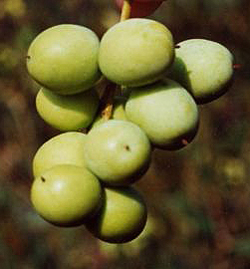
Olives
Photo of green olives courtesy of OliveOil.com.

About 10 pound of olives are provided to produce one quart of oil. The average olive tree produces enough fruit to make three quarts of oil, although some trees produce three times as much. Olive trees require a Mediterranean-type climate: mild winters, hot summers. They are grown in Algeria, Argentina, Australia, Chile, Croatia, Cyprus, France, Greece, Italy, Israel, Jordan, Morocco, New Zealand, Portugal, Slovenia, South Africa, Spain, Syria, Turkey, Tunisia, and the United States.

  • Spain, Italy, and Greece represent more than three-fourths of the total olive oil output in the world. Rounding out the Top 10 are Turkey, Syria, Tunisia, Morocco, Egypt, Algeria and Portugal (2003 production/tons).
  • Spain supplies 1/3 of the world’s olive oil, Italy 1/4, and Greece 1/5.

The olive was first referenced in print in Egypt in the 17th century B.C.E. It is mentioned numerous times in the Bible. Our word “olive” comes from the Latin olivea, which first appeared in English around 1200 C.E. There are hundreds of varieties of olive. Some, such as the Chemalali, Corregiolo, Leccino, Picual and Zorzalina, are grown primarily for oil extraction. Other varieties, such as the Amygdalolia, Ascolano, Karydolia, Manzanillo, Misson and Sevillano, are used principally as table olives. Generally, the name of the olive denotes the location where it originated or was grown, e.g., the Mytilini olive, grown in Mytilini, the capital of Lesvos, a Greek island in the Aegean Sea. In addition to place of origin, olives may also be named for the type of cure, the type of marinade used after the cure, or the cultivar name of the olive tree on which the fruit is grown. When olives are first picked from the tree, they are inedible because of the glucoside in their flesh. Once the glucoside is leached from the flesh through a curing process, the olives become edible. Olives are stored in brine or are salted to preserve them. See also Olive Tree.

OLIVE CAKE

IOOC Definition: Olive cake is the solid phase that remains after pressing olives. Also called pomace or sansa.

OLIVE OIL - GENERAL

The pressing of olives to make olive oil dates back to about 3,000 B.C.E. The oil produced from manual or machine pressing of the fruit of the olive tree (olives). The flavor and color of the olive oil produced from the same variety of olive may vary significantly from one region to the next, even from grower to grower in the same region, since, as with wine grapes, the soil and microclimate (“terroir”) create different flavors within fruit. (That refers to fine olive oil which represents perhaps the top 10% of production.) At the time of harvest, the maturity of the fruit and the extraction process also affect the color and taste. Flavors range from mild, buttery, citrusy and herbal to spicy, tart, and somewhat peppery tasting. There are four basic grades of olive oil readily available in food stores: extra virgin (from the first pressing of olives); virgin (the second pressing); olive oil or pure olive oil (minimally processed), and extra light (heavily processed). Compared with other oils, olive oil contains one of the highest percentages of monounsaturated fat. This type of fat is known to influence blood cholesterol by lowering low-density lipoproteins (LDLs or “bad cholesterol”), while protecting or raising the beneficial high-density lipoprotein (HDL) cholesterol. Olive oil should be stored in a dry, dark area and should not be exposed to excessive heat. Bottled oils can be kept for a year before they begin to loose their flavor. However, it is best to buy no more than you expect to use within six months. Today, about 90% of the world’s olive oil comes from the Andalusia region of southern Spain.

OLIVE OIL - GRADE (also called PURE OLIVE OIL)

The olive oil grade known simply as Olive Oil is a refined (processed) oil with virgin or extra virgin oil added. This grade of oil is the lowest of the three consumer grades, the least expensive, and the most widely used for cooking. Generally, refined olive oil needs to have a percentage of virgin or extra virgin olive oil added to provide some pleasing color, flavor, and aroma characteristics, as refined olive oil has no or very little taste or smell. Products labeled “Olive Oil” or “Pure Olive Oil” usually have a ratio of 85% refined oil to 15% virgin or extra virgin oil. The maximum acidity level of “Olive Oil” may not exceed 1.5% (after the addition of the virgin or extra virgin oil).

Depending on the producer, this type of oil may be labeled as “Olive Oil,” “Pure Olive Oil,” or “100% Olive Oil,” indicating that no other types of oil have been added. The refined oils may also be labeled as “Mild Olive Oil” or “Light Olive Oil.” The “Olive Oil” grade has the same health benefits of the higher quality virgin and extra virgin grades. It also has a higher smoke point than virgin or extra virgin oil, making it the best choice for cooking. See also Refined Oil.

OLIVE PASTE

After the fruit is harvested and washed, it is crushed and ground into olive paste, and pressed to extract the oil.

OLIVE TREE

The olive is a subtropical, broad-leaved evergreen tree (Olea europea L.), grown for the production of its fruits which are utilized for table olives and for the extraction of the olive oil. It is a member of the family Oleaceae, which also includes the privet, lilac, ash, forsythia and jasmine. The origin of the edible olive, Olea europaea, is lost in ancient history.  It was probably first collected wild in the eastern Mediterranean or south central Asia.

olive trees
Photo by Bianca de Blok | SXC.

Certainly it is one of the oldest cultivated crops: it was an olive leaf that the dove brought to Noah’s ark. There is evidence that the olive was grown on the island of Crete about 3,500 B.C.E. The Semitic people apparently cultivated it as early as 3,000 B.C.E. Olive oil was a highly prized luxury for anointing the body in Greece during the time of Homer, about 900 B.C.E., and it was an important crop of the Romans around 600 B.C.E. In subsequent times, olive growing spread to all other countries bordering the Mediterranean. The olive tree is relatively slow-growing but very long-lived, some specimens reportedly being more than 1,000 years old. There are at least five natural subspecies: Olea europaea, subspecies europaea (Europe); Olea europaea subspecies cuspidata (Iran to China); Olea europaea, subspecies guanchica (Canary Islands); Olea europaea, subspecies maroccana (Morocco); Olea europaea,  subspecies laperrinei (Algeria, Sudan, Niger).

100% OLIVE OIL or PURE OLIVE OIL

A labeling that indicates only that the contents are 100% olive oil, i.e. that no other types of oil have been added. It does not indicate quality. It is a blend of refined oil and virgin or extra virgin olive oil.  See also Refined Oil.

ORGANIC OLIVE OIL

Oils that are organically-certified carry the USDA green-and-white organic seal. However, numerous U.S. growers have farmed organically for generations: they simply are too small or do not wish to invest the time and money to pursue organic certification. Their labels will speak to organic practices without bearing the USDA ORGANIC seal. International oils that are products of organic farming or organically grown and/or are certified organic by agencies are identified as “Da Agricoltura Biologica” (Italian), “Agricultura Ecologica” (Spanish), and “Produto De Agricultura Biologica” (Portuguese). One oil, the Portuguese CARM, is said to be certified organic according to USDA standards, by a USDA-approved agency, but you will not find the typical green-and-white seal anywhere on its label.

ORGANOLEPTIC

Perceived by the sensory organs. The organoleptic properties of olive oil are color, bouquet and taste.

PENDOLINO OLIVE

The Pendolino olive trees are the “weeping” olive trees that one sees immediately surrounding Florence. The small olives ripen at mid-season and produce a beautifully fruity olive oil (and are part of the classic “Tuscan blend” along with the Frantoio, Lecchino and Moraiolo); but they also make delicious green and black table olives as well.

PICHOLINE-STYLE OLIVES

Picholine is a variety of olive from Languedoc and Lucques in southern France, and also a style of processing these olives, as well as other varieties from Morocco and Algeria. The picholine olive is a medium-size green olive that is elongated in shape. The flavor is mild and nutty, an there is also a mild saltiness as a result of the cure. The bitterness of the olives is removed by treating them in a lye solution for 8 to 72 hours until the lye has penetrated three-quarters of the way through the flesh. They are rinsed several times over the next day or two, and then placed in a brine solution for two days, and then a second brine solution. The acidity is corrected with citric acid  and after 8 to 10 days they retain their intense green color and are ready to be eaten.

PICUAL OLIVE

Originally from Andalusia, Spain, the Picual is a medium-size olive with an elongated pointed shape and has a shiny black flesh when fully ripe. It produces a full-bodied and flavorful oil; the flavor will vary based on the region, from grassy to intensely fruity. The classic Andalusian oil has notes of fig and fresh bark. It is also used as a table olive. Due to its particular acidic composition, its oil is very stable—it will stay fresh (i.e., not go rancid) for a much longer time than oil from other cultivars.

POMACE OLIVE OIL

IOOC Definition: Pomace is the ground flesh and pits after  pressing.  Olive-pomace oil is the oil obtained by treating olive pomace with solvents or other physical treatments, to the exclusion of oils obtained by re-esterification processes and of any mixture with oils of other kinds. Olive-pomace oil is the oil comprising the blend of refined olive-pomace oil and virgin olive oils fit for consumption as they are. It has a free acidity of not more than 1 gram per 100 grams and its other characteristics correspond to those fixed for this category in this standard. In no case shall this blend be called “olive oil.” It is considered an inferior grade and is used for soap making or industrial purposes.

PURE OLIVE OIL or 100% OLIVE OIL or OLIVE OIL

A labeling that indicates only that the contents are 100% olive oil, i.e. that no other types of oil have been added; it does not indicate quality. It can be a blend of refined oil and virgin or extra virgin olive oil and is considered to be minimally processed.

REFINED OLIVE OIL

IOOC Definition: Refined olive oil is the olive oil obtained from virgin olive oils by refining methods which do not lead to alterations in the initial glyceridic structure. It has a free acidity, expressed as oleic acid, of not more than 0.3 grams per 100 grams (0.3%) and its other characteristics correspond to those fixed for this category in this standard. This is obtained by refining virgin olive oils which have a high acidity level and/or organoleptic defects which are eliminated after refining. Over 50% of the oil produced in the Mediterranean area is of such poor quality that it must be refined to produce an edible product. Note that no solvents have been used to extract the oil but it has been refined with the use of charcoal and other chemical and physical filters. An obsolete equivalent is “pure olive oil.”

REGIONAL OIL

Olive oil obtained from olives grown in a particular region of a country. They usually have distinct, identifiable flavors and aromas and may be more expensive than bulk olive oils.

RIPE OLIVES

Olives that are harvested when the fruit is close to being fully ripe, once it has attained the color and oil content corresponding to each particular variety.

SINGLE ESTATE OIL

See Estate Oil.

SPANISH or SEVILLIAN-STYLE OLIVES

This refers to the processing of the green olives picked from the tree. Olives cannot be eaten straight from the tree and must be processed to leach the oleuropein which makes them inedible. The olives are treated in a diluted lye solution (sodium hydroxide) to eliminate and transform the oleuropein and sugars. Fermentation is then carried out with the olives covered in brine. Traditionally, this was done in wooden casks; more recently, larger containers of modern materials are used. When properly fermented, olives keep for a long time. Olives can be whole, stoned (pitted) or stuffed with anchovies, pimento, etc. The most commonly used varieties are Manzanillo, Gordal and Moroccan Picholine.

SPREMITURA A FREDDO

Italian for “cold pressed.”

STONE GROUND

An artisanal technique using a traditional millstone to crush and grind the olives.

SOURI OLIVE

The souri (Arabic for “Syrian”) originated in Lebanon; it is widespread in the Levant— Israel, Jordan, Lebanon, Syria and the Palestinian territory. It has a high oil yield and exceptionally aromatic flavor.

STABILITY

The degree to which the olive oil retains its freshness, i.e., does not turn rancid. This is a function of the intrinsic composition of the cultivar—the amount of oleic acid, linolenic and palmitoleic acids. Of course, keeping the oil tightly-capped in a dark, cool space will help; and the ultimate aid is using a wine preservative spray to displace the oxygen in the bottle, thereby slowing oxidation. (But, sprays are expensive, and need to be balanced against the cost of replacing the bottle. If it’s a bottle brought back from Europe that is difficult to obtain, it may be worth it.)

TERROIR

Pronounced tur-WAH, the French word for soil, land or terrain, “terroir” has long been used in wine and coffee analysis to denote the special characteristics of geography that give the grape or bean its individuality: soil, geology, aspect, altitude. It is an extended meaning of the word for land and can be loosely translated as “a sense of place,” the sum of the effects that the environment has on the creation of what is grown there. The term can also be used to describe olive groves (or cacao beans, or cheese, any other agricultural product where the flavor is significantly impacted by its surroundings), as the same variety of olives grown in the same region can create different-tasting and different-colored oil based on the terroir of the grove. The term is now being used, appropriately, for cacao beans.

UNFILTERED OLIVE OIL

IOOC Definition: Unfiltered oil contains tiny particles of olive flesh, which leaves the oil cloudy. Olive oil aficionados claim this adds additional flavor. Unfortunately it causes a sediment to form at the bottom of the bottle over time which can become rancid, negatively impacting flavor and shelf life. Unfiltered oil should be carefully stored and used within 3 to 6 months of bottling.

USDA

USDAThe U.S. Department of Agriculture. Most countries use the IOOC standards. The U.S. is one of the few major markets which has not adopted the IOOC definitions. Instead the USDA has a 1948 classification which uses terms such as “fancy” and “choice.”  As of this writing, new standards are being presented for comment and adoption.

VIRGIN OLIVE OIL

These are the official IOOC definitions: This oil is obtained only from the olive, the fruit of the olive tree, using only mechanical or other physical means in conditions, particularly thermal conditions, which do not alter the oil in any way. It has not undergone any treatment other than washing, decanting, centrifuging and filtering. It excludes oils obtained by the use of solvents or re-esterification methods, and those mixed with oils from other sources. It can be qualified as a natural product, and virgin olive oil can have a designation of origin when it meets the specific characteristics associated with a particular region. Virgin olive oils can have the following designations and classifications depending on their organoleptic (taste and aroma) and analytic characteristics (the degree of acidity refers to the proportion of free fatty acids, not to the taste).

  • Extra Virgin Olive Oil: Virgin olive oil which has a free acidity, expressed as oleic acid, of not more than 0.8 grams per 100 grams (0.8%), and the other characteristics which correspond to those fixed for this category. Extra Virgin olive oil accounts for less than 10% of oil in many producing countries. Used on salads, added at the table to soups and stews and for dipping.
  • Virgin Olive Oil: Oil which has a free acidity, expressed as oleic acid, of not more than 2 grams per 100 grams (2.0%) and the other characteristics which correspond to those fixed for this category in this standard.
  • Ordinary Virgin Olive Oil: Virgin olive oil which has a free acidity, expressed as oleic acid, of not more than 3.3 grams per 100 grams and the other characteristics which correspond to those fixed for this category in this standard. Ordinary oil may still be fine for frying or where flavor is not wanted or needed.
  • Lampante Virgin Olive Oil: Virgin olive oil not fit for consumption as it is, designated lampante virgin olive oil, is virgin olive oil which has a free acidity, expressed as oleic acid, of more than 3.3 grams per 100 grams and/or the organoleptic characteristics and other characteristics of which correspond to those fixed for this category in this standard. It is intended for refining or for technical use.

As with all olive oils of all grades, the health benefits are the same regardless of quality and cost.

VARIETIES OF OLIVE

See Cultivar.


© Copyright 2005-2008 Lifestyle Direct, Inc.  All rights reserved.  Images are the copyright of their individual owners.


Spread The Word: Each icon below links to a site where you can bookmark, share and comment on this article:
Dine52    del.icio.us    ma.gnolia    Newsvine    Yahoo Myweb    BlinkList    simpy    reddit


.