THE NIBBLE (TM) - Great Finds for Foodies (tm)


RSS feed
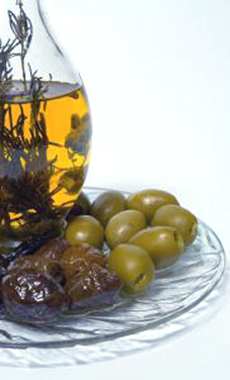
Olive OilEach cultivar (variety) of olive has its own flavor and aroma characteristics, which can vary by region due to “terroir.” Photo of Greek olives and olive oil by Yiannis Papadimitriou |Sxc.
MENU


Oils, Vinegars &
Salad Dressings

Category Main Page
Articles & Reviews


Main Nibbles

Main Page
Articles & Reviews of Foods From A to Z


Product Reviews

Main Page
Food, Beverages, Books,
News & More


ABOUT THE AUTHOR
KAREN HOCHMAN is Editorial Director of THE NIBBLE. She has a fondness for green and grassy olive oils.


November 2005
Updated May 2007

Product Reviews / Main Nibbles / Oils, Vinegars & Salad Dressings

The Flavors & Aromas of Olive Oil

How To Taste & Evaluate Olive Oil ~ Part II


Olive oil can show a broad variety of desirable flavors depending on the type of olive, region and terroir, maturity, processing, age, and other factors (there are also undesirable flavors, stemming from flawed production and old oil). While the more than 200 different varieties of olive can be expected to produce a broad range of flavors and styles. Different people will have different classifications, but one way to look at oils is by style or flavor profile:

  • Intense: Full-Bodied & Earthy. Strongly-flavored, big oils for those who like full flavor and rich mouthfeel. Can have a peppery punch as well. Best used with strong-flavored foods.
  • Robust: Fruity & Peppery. More olive flavor, more verdant flavor, very often accompanied by a peppery aftertaste, Best used with pasta dishes, robust soups, or as a finishing drizzle.
  • Moderate: Smooth & Buttery. Luscious, fruitier oils that retain a sense of delicacy; best used on salads, vegetables, poultry.
  • Moderate: Fruity & Herbal. These are the herbal, grassy oils. One of our favorites, delicious on anything but especially with vegetable, pasta and seafood dishes.
  • Mild: Subtle & Nuanced. Delicate, ethereal olive oils with complexity; best used for the lightest dishes, such as grilled white-fleshed fish or fresh mozzarella.

Olive oil is unusual in flavor profile, because two qualities that can be questionable in other foods—bitterness and pungency (which appears as a peppery bite in the back of the throat)—are positive qualities here. The third quality to look for is fruitiness, the actual olive flavor. (It’s a good time to make the point that, despite that it is savory and not sweet, the olive is, in fact, the fruit of the olive tree, and not a vegetable.)

There are many other nuances of flavor and aroma to be found in olive oils. Different cultivars (the comparable word for grapes is variety) yield different qualities, as do different terroirs and microclimates.

LEARN MORE ABOUT OLIVE OIL WITH THESE REFERENCE GUIDES
Olive Oil Glossary
An Overview Of Extra Virgin Olive Oil

The terms below are divided into desirable and undesirable qualities. Some terms can be both, depending on the extremes in which they appear. The Olive Oil Sensory Wheel can help you quickly make sense of, and speed up your master of, the many aromas and tastes of virgin olive oil.

There are so many wonderful olive oils on the market. Just as you have your favorite Cabernet Sauvignons and your favorite Chardonnays, you’ll enjoy discovering your favorite extra virgin olive oils.

  • Just as wines pair to specific foods, so do olive oils: those that are good for meats may be too strong for some delicate fish.
  • An oil that is exquisitely delicious on its own can be drizzled straight on pasta or salad; a more bland oil can be blended with flavorful vinegars and citrus for a tasty dressing.
  • Strong oils make good bread dippers.

See if there’s a store in your town that specializes in olive oil. They will have someone who can guide your choices, and may also have informal tastings as well as formal classes where you can learn more. Take a look at some of our favorite books about olive oil.

Desirable Flavors/Aromas  
Almond Reminiscent of fresh almond or dried almond.
Apple Reminiscent of fresh apple.
Artichoke Reminiscent of fresh artichoke.
Astringent A  puckering sensation caused by tannins.
Banana Reminiscent of fresh banana.
Bitter A positive characteristic of oils usually obtained from green olives or olives turning color.
Fresh Good aroma of freshly pressed fruit; fruity, not oxidized.
Fruity
Flavor and aroma of the mature, freshly pressed, olive resulting from picking the fruit at optimum maturity (all oils are fruity after pressing, but this dissipates after a few months; authentically fruity oil maintains the characteristic).
Ripe Fruity
Flavor of olive oil obtained from ripe olives, with a flat aroma and a sweet taste.
Green Fruity Another term for the bitter flavor of oil from green olives.
Grass
A green, grassy taste associated with green olives, or more mature olives crushed with leaves and twigs.
Green
Descriptive of a young, fresh, fruity and slightly weedy oil. Green oil is often mixed with bitter oil, providing a spicy-bitter “cough” sensation at the back of the throat.
Green Leaf
A sensation obtained when a small quantity of fresh olive leaves are added to the press.
Harmonious All of the qualities of the oil blend/work well with each other.
Hay/Hay-like Reminiscent of hay (dried grass).
Herbal Having herb-like qualities.
Lemony Reminiscent of fresh lemon.
Melony/Perfumy The fragrance of a ripe melon (ethyl acetate).
Musky Reminiscent of musk. A trace characteristic. Musky, nutty, and woody, all trace characteristics, are desirable in moderation; they become undesirable when overwhelming.
Nutty Sometimes particular nuts can be associated, e.g. roasted hazelnut, almond. A trace characteristic.
Peppery A peppery bite in the back of the throat that can force a cough.
Pungent/Stringent A rough, burning or biting sensation at the back of the throat; stronger than peppery.
Rotund Descriptive of a filling oil with a pasty body and no aroma. It is always from mature olives. It is satisfying though without character.
Suave Characteristic of very mature olives, a pale gold in color. A very sweet aftertaste.
Sweet The opposite of bitter, stringent or pungent. Smooth and mellow.
Tomato/Green Tomato Reminiscent of a tomato or a green tomato plant.
Woody Notes of woodiness. A trace characteristic.
Undesirable Flavors/Aromas  
Bitter Listed above as a desirable characteristic in moderation, it becomes undesirable if overpowering. Characteristic of olives that are unripe and have little meat.
Briny Salty, made from brined olives.
Burnt/Heated

A burnt taste resulting from excessive heating during processing.

Coarse

Without smoothness or nuance.

Cucumber An off flavor that can develop if oil is kept in sealed bottles or tin cans for a prolonged period.
Dirty Oils that have absorbed the unpleasant odors and flavors of the vegetable water with which they remained in contact for too long after pressing.
Dreggish

Reminiscent of the odor of lubricating oil. Caused by the poor execution or omission of the decanting process.

Earthy Oil that has acquired a musty, humid odor because it has been pressed from unwashed, muddy olives.
Esparto Grass A hemp-like flavor acquired when olive paste has been spread on esparto mats. Flavors will vary depending on whether the mats are made of green or dried grass.
Fiscolo A defect caused by the use of filtering panels that are not perfectly cleaned; reminiscent of hemp.
Flat

Having no aroma or taste.

Frozen Olives that have been exposed to freezing temperatures. When cooked, the oil gives off very unpleasant odors.
Fusty An off flavor due to olives fermenting in piles while in storage, awaiting pressing.
Greasy A diesel, gasoline, or grease flavor.
Grubby A flavor imparted by grubs of the olive fly.
Hay-Wood Dried olive taste.
Heated See burnt.
Impersonal Having neither character nor personality. It is a trait common in all manipulated oils, and a serious defect for virgin oil.
Lampantino Denotes oil with defects that should be sent to a refinery where it can be made edible.
Metallic

Metallic flavors acquired as a result of processing or storage with extended contact to metal surfaces.

Moldy or Old A quality of unhealthy or fermented olives due to excessive storage in warehouses.
Muddy Having too much sediment.
Musty A moldy flavor from being stored too long before pressing.
Olearic Fly or Olearic Worm Oil pressed from fruit infected by this insect: the flavor is both rotten and putrid.
Phenic Acid A flavor that develops in poorly kept, very old oils.
Poor Conservation Oil absorbs the odors and flavors of everything surrounding it, even if not in direct contact. A very common defect.
Rancid Old oils that have started to oxidize due to exposure to light or air.
Rough Pasty, thick greasy mouth feel.
Sour/Winey High acidic taste.
Vegetable Water An off flavor from storage in contact with the juice from the olive.
Warm A flavor that results from the fermentation of olives kept too long in bags.  If fruit is not crushed within hours of picking, the oil can become increasingly acidic and take on detrimental flavors and aromas.
Winey See Sour.
   

The article continues below.

Learn More About Olive Oil

The Flavors of Olive Oil Olive Oil Zingerman's
The Flavors of Olive Oil, A Tasting Guide and Cookbook, by Elizabeth Krasner. This book may be the answer to your prayers as you browse the fifty or more different labels of olive oil on the shelves. It is a great introductory course to regional differentiations in taste and so much more. Click here for more information. Olive Oil From Tree to Table, by Peggy Knickerbocker. The complete story of olive oil, taking you firsthand to witness the harvesting, pressing, and grading of the oil; color photos make you feel as if you were witnessing the process. With 112 great recipes. Click here for more information. Zingerman’s Guide to Good Eating, by Ari Weinzweig. The famed Ann Arbor specialty food store owner demystifies olive oil plus cheese, pasta, chocolate, and other gourmet favorites. Click here for more information.


Why Oils Taste Different

Why will 30 oils taste so distinctly different? The following factors play a role in the quality of olive oil produced:

Agriculture Harvesting Production
  • Cultivar of olive
  • Climate (latitude of
    production area)
  • Soil type
  • Cultural techniques
    (irrigation, drainage,
    pesticide residues, etc.)
  • Health of fruit (degree of
    pest and disease
    infestation)
  • Maturity of fruit (time of
    harvesting)
  • Harvesting method
  • Harvesting method
  • Method and period of
    post-harvest fruit
    storage
  • Method of fruit
  • transport
  • Oil extraction
    system
    (including extraction
    temperatures)
  • Method and period
    of oil storage prior
    to packing
  • Type of packaging
    (bottle, can)
  • Period of storage in
    final package prior
    to use


According to expert Paul Vossen, head of the California Olive Oil Tasting Panel, the top determinants affecting flavor are:

  1. Quality production and storage methods. The biggest determinant—no surprise—is that you must start with good olives.
  2. Fruit Maturity. A Tuscan and a Spanish olive picked green may produce a more similar oil than a Tuscan olive picked late or early in the season.
  3. Olive Variety. Click here to download a U.C. Davis paper by Paul Vossen (the University of California at Davis is the country’s leading school for olive agriculture).
  4. Growing Region. Just as chardonnay grapes grown in Australia, California, Chile, France and South Africa produce distinctively different wines, the same is true with the identical olive cultivar grown in different regions.
  5. Seasonal Variations. Both weather and growing conditions affect the flavor.

While pressing method is often mentioned as a determinant, and there is much discussion of different pressing techniques, according to Vossen, if the olives are properly pressed, the same olives will produce very similar oils regardless of the pressing technique.

For more information about olive oil, visit The Olive Oil Source.

© Copyright 2005-2008 Lifestyle Direct, Inc.  All rights reserved.  Images are the copyright of their individual owners.


Spread The Word: Each icon below links to a site where you can bookmark, share and comment on this article:
Dine52    del.icio.us    ma.gnolia    Newsvine    Yahoo Myweb    BlinkList    simpy    reddit


.