May 2005
Updated February 2008
|
 |
Cheese Glossary
Types Of Cheese, Terms & Definitions Every Cheese Lover Should Know
Demystify the terms tossed out by cheesemongers and master the language of cheese. A read through our cheese terms and definitions, below, will give you new confidence the new time you approach a cheese counter. And, you’ll discover new types of cheeses! If you’d like to suggest additional cheese definitions, click on the link. When you’re finished with cheese, you can look at our other food glossaries.
You go immediately to the glossary. But before you start, we’d like to point out why some cheeses are spelled with a capital letter and others aren’t. It can appear to be capricious (or an error), but it isn’t.
-
When a cheese is named after a geographical place that is capitalized, e.g. the valley of Aosta and the towns of Cabrales and Roquefort, we capitalize the cheese.
-
Parmigiano means “of or from Parma,” and Reggiano means “of or from Reggio,” two cities in north central Italy; Parmigiano-Reggiano, a domaine-protected cheese that can only be made in these cities, is capitalized. We also capitalize Parmesan, an Americanization of the word Parmigiano (although “Parmesan” cheese does not indicate a D.O.C.-protected Parmigiano-Reggiano, and can be made anywhere in the world).
-
If the cheese name comprises nouns or adjectives that are normally not capitalized, e.g. fromage blanc (white cheese), formaggio al tartufo (truffle cheese) chèvre (goat), ricotta (“recooked”) or cream cheese, we don’t capitalize it.
-
We try to observe the accent marks appropriate to the language, but even here there are challenges. For example, most American chevre producers don’t observe the accent mark on the French word, chèvre. When we are writing about chèvre in general, we will observe the accent; when we are writing about Cypress Grove Chevre, we will spell the word as they spell it, without the accent. And of course, proprietary-name cheeses like Cypress Grove’s Humboldt Fog are capitalized.
Click on the letter of the alphabet in this bar to get to a section
without having to scroll manually:
a b c d e f g h i j k l m n o p q r s t u v w x y z
ACID or ACIDIC
A term used to describe a cheese with a lightly sourish flavor.
AFFINAGE and AFFINEUR
The aging of cheese to its optimum maturity. Affinage is an expertise separate from cheesemaking. It is an analogous division of labor to the agriculturalist who grows the grapes and the winemaker who creates the wine. The affineur manages the cave* in which the cheeses are aged. Fine restaurants noted for their cheeses and which offer many different cheeses, like Picholine and Artisanal in New York City, have a full-time affineur to ensure the cheeses offered to diners are at peak development (“a point”) for their enjoyment.
|
|
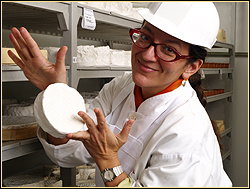
Daphne Zepos, Director of Affinage at Artisanal Cheese in New York City, where she tends to the aging and care of more than 300 cheeses. |
*While some farmstead cheeses in Europe are aged in the same rock caves as 1000 years ago to acquire the bacteria and other environmental elements that provide their distinctive qualities, today’s aging caves are state-of-the-art units that allow for different temperature zones and other settings that accommodate the needs of different types of cheese.
AMMONIATED
Certain cheeses past their prime and overripe, particularly soft cheeses such as Brie and Camembert, can smell and often taste of ammonia. They are still safe to eat.
ANNATTO or ACHIOTE
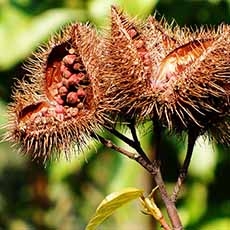
A natural food coloring derived from the ground seed pods (achiote) of the annatto tree, native to Central and South America. Cheese is naturally the color of the milk from which it is made. Some traditional cheeses once had a natural orange hue caused by the vitamin D that cows ingested from grazing on green plants. But winter milk comes from cows that are fed silage (forage plants that are stored in a silo) and the cheeses that result from this milk are white. This variation persuaded some cheesemakers to color their cheeses so they would look uniformly nutritious. The earliest colorings were carrot juice and marigold petals. For the last century at least, cheesemakers who wish to use color have used annatto instead. |

Annatto seeds, also called
achiote. Available at
FrontierHerb.com.
|
AOC (APPELLATION d’ORIGINE CONTRÔLÉE)
Controlled designation of origin, the AOC mark guarantees, among other things, that the cheese originates from a specific region of France and has been produced in a traditional way. There are 35 types of cheese carrying the AOC mark, which guarantees that: (1) The cheese was produced within a specific geographical area, from milk from specific herds of animals in the same area and partly matured there. (2) The cheese was made using strictly defined methods that have been handed-down over several centuries. (3)
The characteristics of the cheese that have been precisely defined—its size, type of rind, texture and minimum fat content—are adhered to strictly.
(4)
The producers submit themselves to review by a public control commission, which guarantees the authenticity and quality of the products. See also D.O. and D.O.P. |

Selles-sur-Cher was the first chevre to be designated AOC, in 1975. Photo courtesy of Fromagerie-Jacquin.com. |
A POINT
Pronounced ah-PWAN in French, the term refers to a cheese which is at the peak (the “point”) of its development, at the perfect stage to be consumed. In English, say “at peak” instead of “at point.”
AROMA
A cheese’s scent, which can vary from faint and milky (fresh cheeses) to lightly aromatic to pungent and overpowering. While most strong-smelling cheeses will also be strong-tasting, this is not a hard and fast rule: Limburger, Brick and Liederkranz have distinctive aromas but are not overly strong-tasting cheeses unless well-aged.
ASH-COVERED
After molding, some goat cheeses are dusted with a fine powder of charcoal, traditionally from oak but today often vegetable ash. These are known as ash-covered goat cheeses. Originally, the ash was used to protect the delicate cheeses. Today it is decorative.
Grand Caprin is a fresh goat cheese covered in ash. Photo courtesy of Fromagerie-Jacquin.com. |
 |
BARNYARDY
A term often used to describe a cheese’s aroma and sometimes its taste: aged goat cheeses are often barnyardy. It is considered a positive characteristic of the cheese.
BLEU
Bleu is the French spelling of blue. See blue mold cheeses.
BLOOMY RIND or WHITE RIND CHEESES
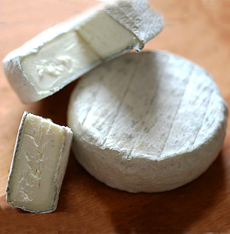
This class or category of cheese comprises the white cheeses with soft creamy interiors. The rind is composed of one of the greatest cheese molds, Penicillium candidum, which grows naturally as the cheese ages. The mold grows on the outside of the cheese, breaking down the protein and fat inside, making it soft, runny, and more complex. Bloomy rind cheeses are usually made of cow’s milk, resulting in a very creamy and very soft paste. They are aged quickly, resulting in mild and subtle flavors. The most popular cheeses in the world—Brie and Camembert—fall into this category.
|

Délice de Bourgogne triple crèmes. |
Other bloomy-rinded favorites include triple crèmes such as Brillat-Savarin and Pierre Robert, with 75% butterfat. Bloomy rind cheeses are generally aged for two weeks, which produces a mild flavor and subtle aroma.
BLUE MOLD or BLUE VEINED CHEESES
A class of cheese unto itself, simply for the mold it carries inside. Penicillium roqueforti, a relative of bloomy mold—but dark blue in color rather than the pristine white—is sharp and powerful. Penicillium roqueforti,
Penicillium gorgonzola or Penicillium glaucum spores
are injected into the cheese, which provide the
blue-green colors and piquant flavor (although some blues are mild). The mold will not thrive until oxygen comes into contact with it, so the cheeses are pierced with pins.
Then air is injected, which causes the cheeses to develop a very high acid content and crumb-like texture.
|
Roquefort, available at
MurraysCheese.com via the
caves of Combalou in southern France. |
Blues can range from high-moisture to firm and well-aged; the common thread is the addition of the mold spores into the milk during the cheesemaking process.
Blue cheeses are found in all categories except for fresh cheeses—even in bloomy-rinded
runny cheeses. The most famous blues include Danish Blue, Gorgonzola, Roquefort and Stilton. Blues are typically aged for 90 days, which enable them to become more solid.
BÛCHE
The French word for log, a popular shape for goat cheese (chèvre). It is made in whole logs (generally 8 ounces) and half logs. Pronounced as a cross between “boosh” and “beesh.”
BUFFALO MOZZARELLA
See mozzarella di bufala.
|
Pink peppercorn log of fresh chèvre from Vermont Butter & Cheese Company. Read our review. |
BURRATA
A ball of mozzarella di bufala, filled with scraps of mozzarella and fresh cream, and wrapped in the leaves of asphodel, which indicate the cheese’s freshness. A specialty of the Murgia area of Puglia, Italy, it can be served as mozzarella is served, although the creamy insides beg for fresh, crusty bread or crostini. With a very short shelf life, it is flown to specialty cheese shops in the U.S., but can be hard to find. |
Burrata photo courtesy of Wikipedia. |
BRIE & CAMEMBERT
These popular cheeses are essentially the same cheese (the recipe is the same), differing only in the locales in which they are made and the sizes in which they are made: Camembert, named after the village in northwestern France where it is made, is made in 4.5-inch wheels, while Brie is made in much larger formats, 11 to 11.8 inches (28 to 30 cm). The paste is straw-colored and flavor is buttery and mushroomy. The soft, bloomy rind, made of Penicillium candidum, is fully edible. As a result of the terroir, and of the faster evaporation in a smaller-size cheese, there are nuances of flavor difference. Read our full article on the difference between Brie and Camembert. Brie, named for the province in northern France where it originated, is made from raw cow’s milk cheese. While it is made in many locales today, only two Bries are AOC-protected: Brie de Meaux and Brie de Melun. The Melun Brie has very ancient origins—manuscripts suggest that it predates the Roman invasion. At the Vienna Congress of 1815, Brie was declared the “king of cheeses” during a diplomatic banquet; it has also been called the “queen of cheeses,” and fights Roquefort and Parmigiano-Reggiano for the king’s crown.
Photo of Brie, above, courtesy of MurraysCheese.com.
BRUSHED
Certain types of natural rind cheeses, both cooked and uncooked varieties, have their rinds brushed during the period they spend ripening. This brushing, done by hand or machine, helps the interior of the cheese to keep moist during the ripening period. It also has an effect on the final flavor of the cheese.
CAMEMBERT
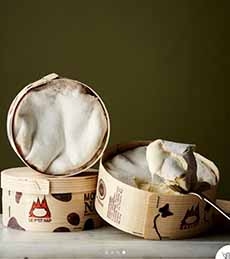
See Brie. Camembert’s round wooden box first appeared in 1880, developed to protect the cheese during transportation by rail. Brie and Camembert are two of the few cheeses that stand up to the structured, tannic red Bordeaux. They also pair well with Red Burgundies and Côtes du Rhone.
CASEIN
The element of milk which solidifies when coagulation takes place. Caseins are insoluble milk proteins which form suspended masses in milk, and thus create emulsions.
|

Photo of Camembert courtesy of
MurraysCheese.com. |
CELLAR
A room, sometimes underground, where cheeses are left to ripen. Some cheeses, like Roquefort, are ripened in caves from which they pick up bacteria that give them their distinctive flavors.
CHEDDARING
A cheese production technique where the curd cut into blocks, which are turned and stacked at the bottom of the cheese vat at intervals of ten to fifteen minutes for about one-and-a-half hours. This is an additional step in the production of Cheddar-style cheeses, and one of the most complex techniques in cheesemaking. (Other cheeses, in addition to Cheddar, are made this way.) The milk is set, cut, cooked lightly, and allowed to mat at a warm temperature. The matting and stacking of blocks of curd allow for the bacteria to consume the lactose in the milk and convert it to lactic acid. This acidifies the cheese and creates the sharp flavor. The curds become stringy; and are then shredded, salted, and pressed into drums for about 24 hours. Examples include Cheddar, Cantal and Salers. |

Keen’s Farmhouse Cheddar,
produced in Somerset since
1899.
Available at
MurraysCheese.com.
|
CHEESE
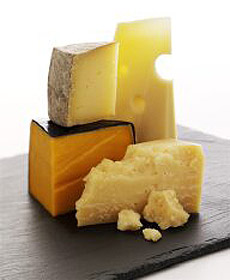
Cheese is a solid food made from the curdled milk of various quadruped mammals—cheese can be made from the milk of the yak, water buffalo, reindeer and the horse as well as the cow, goat, and sheep common to American and European cultures. The word cheese comes from Latin caseus and, later, West Germanic kasjus (in modern German it is Käse). Cheese was created to store excess milk in a form that would not spoil as rapidly as fresh milk; in a sense, cheese is a controlled spoilage of milk. There are hundreds of types of cheese, based on different breeds of cow, goat and sheep; species of bacteria and molds; different levels of milk fat; variations in length of aging; and different processing treatments (cheddaring, pulling, brining, mold wash). Other factors include milk, animal diet, and the addition of herbs and spices that flavor some cheeses. |

Photo by K. Connors, courtesy of MorgueFile.com. |
The first step in cheesemaking is to coagulate the milk into curds with an acid (vinegar, lemon juice, Cynara cardunculus [a proteinase], or the enzyme rennet, which comes from bovine calf stomach). When rennet is used to set the milk, it can result in a very un-cheeselike cheese such as fromage blanc, skyr or quark—all of which have the consistency of yogurt. Yogurt, not made with rennet or other acid, is simply cultured milk (milk with bacteria cultures added) and thus is not a cheese, no matter how similar in taste and appearance it is to the other three products. In cheesemaking, bacteria are added to reduce the pH, alter texture and develop flavor. Some cheeses also have mold, either on the outer skin, the interior or throughout. In some parts of the world (including Wisconsin) where the milk fat is low in beta-carotene, annatto plant dye is used to make the cheese less pale.
CHEESEMONGER
A person who sells cheese. A monger is a broker or dealer. The word monger is usually used in combination with another word, such as in fishmonger.
CHÈVRE or GOAT CHEESE
Chèvre (the French word for goat and goat cheese) is characterized by its whiteness and tangy, distinctive flavor. It is unprocessed and (with the exception of fresh chèvres, meant to be eaten within a few days of production) aged for two weeks or more, and often has an edible white rind. The paste varies from creamy to semi-firm. Chèvres are made in a variety of shapes including cylinders, cones, discs, crottins, logs (bûches) and pyramids. Examples include Crottin and Le Chevrot.
Puligny Saint Pierre, a classic pyramid-shaped chevre. Photo courtesy of Fromagerie-Jacquin.com. |
 |
CLOSE
Used to describe a cheese’s texture: A close-textured cheese is one which is smooth, unblemished and devoid of holes or cracks. See also Open.
COAGULATION
The transformation of milk into curd, which is the first step in cheese production. The milk is brought to a temperature of 64°-66°F and a lactic fermenting agent, or starter culture, is added. Rennet is then added to allow the gentle coagulation of the milk over 1 to 2 days (lactic curd). In some cheeses, such as Camembert, three times as much rennet is used so that the milk coagulates more rapidly—in as little as one hour (mixed curd). |
 |
The first step in cheesemaking: mixing the milk, starter, rennet, and in the case of Stilton, blue cheese mold, to coagulate the curd. Photograph copyright 1997-2004, Stilton Cheesemakers’ Association. All Rights Reserved.
COOKED CURD CHEESES or COOKED PRESSED CHEESES
A step in the cheesemaking process when the cheese curd is heated, sometimes in the surplus whey. Cooked cheeses are all hard cheeses and other Swiss types, traditionally the biggest wheels of cheese from the mountains: Gruyère, Beaufort, and the “cheeses with eyes” like Swiss Emmenthaler, the cheese most Americans think of as “Swiss cheese.” (This technique also makes semi-hard cheeses.) The difference between the pressed cooked and uncooked cheeses is (of course) the heating/cooking of the curds before wheels are formed. It is easy to detect those that have been cooked: the paste has a heated, cooked-milk aroma unique to this family of cheese. |

Emmenthaler, also spelled Emmentaler. Made from the milk of
high alpine pasture cows and aged in caves at those same altitudes,
this fine cheese is available at
MurraysCheese.com.
|
CREAM
The fatty element of milk.
CREAMY
A term used to describe the taste, and sometimes the texture, of certain cheeses.
CRÈME FRAÎCHE
Crème fraîche is cultured cream, a thickened cream with a slightly tangy, nutty flavor and velvety, creamy texture. The fresh cream is set aside to let the natural lactic bacteria take over. The bacteria thicken the cream to a consistency and richness almost like sour cream, though with a more delicate texture and tartness. Crème fraîche does not separate or curdle when cooked with wine or at high temperatures, so is perfect for thickening sauces and soups, and imparting rich flavor and texture—it is a staple of French cuisine. The French make crème fraîche with unpasteurized cream; in the U.S., all fresh diary products (aged fewer than than 60 days) must be made with pasteurized milk or cream.
|

Crème fraîche from Vermont Butter & Cheese Company. Read our review. |
CROTTIN
A goat cheese shaped like a drum, but some claim the name means earthier: Crottin means “dropping” or horse dung in French. The cheese is so-named because as the cheese ages, it becomes dark and hard and bears a resemblance to the animal dropping. See photo at right. Crottin is the signature goat cheese shape of the Loire Valley; Crottin di Chavignol, an AOC-designated cheese, has been produced in and around the village of Chavignol since the 16th century. Crottins, where are small in shape, are often served with a salad.
CRUMBLY
A term referring to a cheese that has portions that breaks off when the cheese is cut. Blue-veined cheeses are particularly crumbly.
CRYSTALS
See Tyrosines. |

These crottins are made in European fashion by Vermont Butter & Cheese Company. Read our review. |
CURD
Cheese is made of curds. Curd comes from the Latin word coagulare, meaning to thicken or to clot. Curds are obtained by curdling (coagulating) milk with rennet (an enzyme) or an acid such as lemon juice or vinegar; then draining off the whey. Whey is the liquid portion of milk, after the solids (protein and fat) have been extracted. The solids become curds when an acid (vinegar, lemon juice) or enzymes are added. The curds are broken down in a vat to separate them from the whey. As larger curds contain more water than small curds, a large curd is prepared for soft cheeses, a medium-sized curd for firmer cheeses, and a small curd for hard cheeses. The curds are cut up into lumps, and the curd mass is constantly stirred to prevent it from clumping together again.
|
|

Photo of curds and whey courtesy of Vella Cheese. |
A draining board or ladles are used to remove the curds from the whey. With pressed cheeses, the whey filters through strong cloth bags which retain the curds. The curds themselves are made up of caseins (large molecules of milk protein) and fat.
CURDING
Refers to the temperature at which the cheese is prepared. Raw cheeses are cooked at temperatures that do not exceed 100°F; semi-cooked cheeses from 100°F to 120°F, and wholly cooked at temperatures over 120°F.
Fontina, a semi-coked cheese. Photo courtesy of Valsana.it. |
 |
CURDLING
An early stage in cheesemaking when milk coagulates after the introduction of rennet.
CURD MOLDING
The stage of cheesemaking in which the cheese curd is ladled into molds that determine the final shape of the cheese: round, rectangular, cylindrical etc. This process is also known as “hooping the curd.”
Photo courtesy of SproutCreekFarm.org. |
|
 |
CURING or MATURING or AGING
The stage in the cheesemaking process when a cheese is left to ripen.
D.O. or DENOMINACIÓN DE ORIGEN
In Spain, the Denomination of Origin is a regulated and controlled qualification managed by a Council that is responsible for controlling the characteristics, as well as the authenticity of food products to protect their agricultural heritage: wines, cheeses, olive oils and other products. It reports to the Ministry of Agriculture. There are analogous bureaus in France (A.O.C.) and Italy (D.O.P.).
Cabrales, from Asturias, Spain, is an exquisite blue cheese aged in humid caves that enable the development of penicillium molds. Like Gorgonzola and Roquefort, it is often imitated, and requires origin protection. Cabrales available at MurraysCheese.com. |
|
 |
D.O.P. or DENOMINAZIONE d’ORIGINE PROTETTA
Denominazione d’Origine Protetta is the Italian certification of authenticity of origin. Some other countries in the European Union also use D.O.P. now, including Portugal. See also A.O.C. and D.O.
DRAINING
The stage of cheesemaking when the whey is drained from the curd. This can take 24 to 48 hours, depending on the size of the cheese. This stage is followed by further drying procedures, such as scalding. These two stages are critical to successful maturation.
Cheese wheels rest in molds overnight to drain excess whey and become firmer. Photo courtesy of
SproutCreekFarm.org. |
|
 |
DRYING
The stage of cheesemaking when lactic cheeses are left for one to three days in a well-ventilated room, to allow the water to evaporate.
New cheese begins to form a rind within a day of drying. Photo courtesy of SproutCreekFarm.org.
|
|
 |
DRY MATTER
The part of the cheese that remains after all moisture is removed. Soft cheeses, such as Brie and Camembert, will contain on average about 50% dry matter and 50% water. Aged cheeses like Parmigiano-Reggiano are mostly dry matter with very little water.
EARTHY
A descriptive term often used to describe the nature of monastery cheeses.
FAISELLES
Molds with holes that allow the whey to drain out. They come in dozens of different shapes and sizes.
Pyramid-shaped cheese mold. Photo courtesy of TheGrape.net. |
|
 |
FARM CHEESES or FARMSTEAD CHEESES
Cheeses that are made on the farm by the farmer using only the milk from the farm’s own herd.
Cheesemaker Ginnie Tate of Goat Lady Dairy and two of her tribe. |
 |
FAT CONTENT
This term refers to the fat content in the dry matter of the cheese. It is usually indicated on the cheese’s packaging. It can be as low as 4% and as high as 75%. The terms butterfat and milkfat are used interchangeably.
FIRM CHEESES or HARD CHEESES
Firm/hard cheeses represent a broad group of cheeses that be very mild to very sharp. Firm cheeses generally have a texture profile that ranges from elastic, at room temperature (Cheddar, Emmenthaler, Gruyère); some, like Gouda, can age to a hard cheeses that can be grated. Some hard cheeses are hard from the time of their release (Asiago, Parmesan, Pecorino).
|

Wasatch Mountain Gruyère, made in Utah. Available at iGourmet.com. |
FRESH CHEESES or SOFT, UNRIPENED CHEESES or FROMAGE FRAIS
A high-moisture-content, unaged cheese, intended to be eaten within days of its production. While the cheese has not been aged, some, like feta, may be very slightly cured. Fresh cheese is drained, coagulated milk (simple lactic set curd) or lightly renneted milk, served young and lightly salted, that does not undergo a ripening period. These cheeses have a creamy, soft texture and fresh, sweet flavor, although the pasteurized-milk cheeses of the U.S. are less flavorful than fresh cheeses made in other countries from unpasteurized milk (U.S. law requires all cheeses aged fewer than to days to be made of pasteurized milk to eliminate potentially harmful bacteria). The cheeses can be made from any type of milk. Uncomplicated in flavor, fresh cheeses are often used in cooking, for breakfast, or with fruit for dessert. |

Queso fresco. Read our review of Mexican and Latin American cheeses. |
Examples of fresh cheese include many goat cheeses plus burrata, caciotta, cottage cheese, cream cheese, feta, fromage blanc, hoop cheese, mascarpone, mozzarella, ricotta, string cheese, quark, queso blanco and queso fresco.
FROMAGE BLANC
Fromage blanc is a cow’s milk cheese related to quark. It is totally fat free and all protein. (Quark is not fat free). Many people eat it for dessert, either plain or with sugar and/or fruit. Fromage blanc is also used in uncooked savory dishes. Since it has no butterfat, it will separate if cooked. While fromage blanc looks like yogurt (see photo at left), it is a proper cheese, beginning with rennet and a starter culture added to the milk. However, the curds are not allowed to coagulate as they would with a traditional cheese. Instead, they are stirred to the consistency of yogurt. Some producers add cream to achieve more richness, which can produce a product with up to 8% fat. Read the label! Without the cream, it’s a caloric bargain, like nonfat plain yogurt.
|

Fromage blanc from Vermont Butter & Cheese Company. Read our review. |
GOAT CHEESES
Goat cheeses, as a category, may be considered a continuation of the fresh cheese category. In many cases, these are cheeses best consumed after a brief aging period (4 to 6 weeks). While they are no longer “fresh,” (i.e. there is rind development, and the flavors have developed in length and complexity), they do not qualify as bloomy, washed, or pressed cheeses. Examples of goat cheeses are classic Loire styles such as Selles sur Cher, Ste. Maure, Chevrot, and new American classics like Humboldt Fog. |
|
 |
| Chevrot. |
GRUYÈRE
Gruyère is both the name of one of the best-known Swiss cheeses and a general name for large cheeses made in France, such as Beaufort, Emmentaler and Gruyère de Comté.
HÂLOIR
The cheese drying room, where cheeses are laid out during their maturation period.
|
|

Cheese drying room. Photo courtesy of FromagesdeChevre.com |
HARD CHEESE or HARD PASTE CHEESE
These are dry and the hardest of all cheeses. Hard cheeses typically are aged over two years, during which the water and moisture are removed to achieve a hard paste (the water content must be less than 40%). The texture is granular and dry, solid and heavy. Hard paste cheeses vary tremendously: they can be pungent, sharp, aromatic, or piquant; cooked, semi-cooked or uncooked; and range in color from stark white, to deep yellow, orange or brown. The cheeses are covered with a very hard rind, which solidifies as it ages. Examples include Asiago, Manchego, mimolette, Parmesan (Parmigiano-Reggiano), pecorino, Romano, and tête de moine (shown at right). |
|
 |
HOLES or EYES
The openings in the body of Swiss-type cheeses such as Emmentaler and Gruyère. The holes are spherical, equally-spaced and about the size of cherry pits. They are caused by bacterial activity which generates prioponic acid, causing gas to expand within the curd and create the pockets, or holes. See Swiss cheese.
HOMOGENIZATION
Milk that comes straight from the cow will separate into a cream layer at the top. In the old days, cooks would get cream for recipes or tea by skimming it off the top of the milk. The development of homogenization enabled milk and cream to be sold separately, and also gave a longer shelf life to the product. The process is simply the emulsifying of the fat globules in milk into suspended form by spraying the milk at very high pressure against a flat surface. Homogenized milk denatures many of the necessary proteins, making for an inconsistent curd development.
|
|
 |
Homogenization keeps the milk supply safe, although it removes tasty bacteria and enzymes along with any harmful bacteria. Photo courtesy of National Dairy Council.
LACTIC
Referring to the milk aroma, and sometimes flavor, of some cheeses.
LACTIC FERMENTING AGENT
Bacteria which encourage the coagulation of milk by fermenting the lactose in the milk into lactic acid. See starter culture.
LACTOSE INTOLERANCE
An inability to easily digest lactose or milk sugar in cow milk.
Many cheeses, particularly aged cheeses such as Cheddar and Swiss, contain little or no lactose, as well as sheep, goat, and buffalo milk cheeses. Cheese lovers who have difficulty digesting lactose should try these alternatives.
MASCARPONE
This ultra-rich, extremely smooth, slightly sweet fresh cheese is called “Italian cream cheese.” However, the distinction is only half-correct: While mascarpone is made from the cream of cow’s milk, no cheese starter or rennet is used in its production. Mascarpone is made by draining the moisture from heavy cream using a small amount of citric acid and finely woven cloth. The result is similar to Devon Cream or Clotted Cream. Mascarpone is native to the Lombardy region of Italy, which is also home to the town of Gorgonzola. Incorporated into recipes as an ingredient (tiramisu is one of the most famous), it also makes simple yet luscious desserts, served with fruit and biscuits like ginger snaps and strawberries, or as a topping for fresh berries, poached fruit or compote. Use it to stuff figs, dates or dried apricots (sprinkle with chopped pistachios), or as the filling for cookie sandwiches. |

Mascarpone from Vermont Butter & Cheese Company. Read our full review. |
Or, fill tart shells and top the mascarpone with fresh or dried fruit. The name is said to date back to the 16th century, when a visiting Spanish dignitary tasted it and declared it “mas que bueno,” better than good. He was correct!
MATURATION or RIPENING
Also known as ripening. Although some cheeses, once drained, are consumed fresh, others require some time to mature. To do this, they are placed on racks in the hâloir, a cold room which is well ventilated, with humidity of 80%. The cheeses are then regularly turned by hand. The curd slowly develops a rind, which, depending on what bacteria have been used, develops a fine layer of surface mould, which may be white, yellow or brown. The temperature of the air inside the hâloir influences the taste of the cheeses. The cheesemaker monitors their maturation by touch, sight, smell and taste. |
 |
| Photo courtesy of MorgueFile.com. |
Maturation can last from several days to several weeks to several years, in the case of hard aged cheeses like Parmesan and Pecorino. Maturity is distinguished externally by the color and the aspect of the cheese rind. Internally, the paste becomes more dry and compacted.
MICROORGANISMS
Yeasts and other fermenting agents present in milk and milk curd. They can be wild and naturally-occurring or cultured and introduced.
MOLD
Mold is a member of the fungus family. It can be on the surface of cheese (such as the fluffy white bloomy rind cheeses—which are somewhat reminiscent of mushrooms) or can be developed internally. Surface molds are the result of cheese being treated with the Penicillium candidum or Penicillium camemberti spore. Internal molds are very different, and are created by the introduction of Penicillium glaucum or Penicillium roqueforti spores, both used to create blue-veined cheeses. Certain French goat milk cheeses develop a natural bluish surface mould, and some of the newer double crème cheeses like Blue Castello, Bavarian Blue and Duet have both a surface mold and an internal mold. Originally, the molds that made these cheeses were naturally occurring, as in the Roquefort caves. Today, much of the mold is manually introduced by the cheesemaker to guarantee success.
MOLD-RIPENED CHEESES
These are soft cheeses, not pressed, that are salted and covered with mold spores, Pennicillium candidum (white) and Pennicillium glaucum (grey). They use the proteins and fats in the cheese to ripen it from the outside, creating a white rind. The mold acts on the proteins in the curds, breaking them down into more basic components, creating a liquid texture, a more complex flavor and an aroma. Examples include Brie, Camembert and Goats. |

Brie. |
MONASTERY CHEESES or TRAPPIST CHEESES
Certain cheeses were originally developed by monks and are known as monastery cheeses. The majority are of the washed rind variety. Port Salut, Saint Paulin, Esrom and Havarti are examples, as well as several mountain cheeses including Beaumont and Reblochon.
MOZZARELLA or MOZZARELLA DI BUFALA
Legally, in Italy, mozzarella is made from the milk of the water buffalo, and is mozzarella di bufala; cow’s milk mozzarella is known as fior di latte, “the flower of the milk.” Water buffalo, native to Asia, were brought to Italy in the 1400s. Water buffalo’s milk is both higher in fat protein than cow’s, yielding 1.6 times more cheese. It also lacks the yellow pigment, carotene, found in cow’s milk, so mozzarella di bufala is pure white. Almost all American-made mozzarella is from cow’s milk. Mozzarella is a pasta filata, a spun paste. Like other cheeses, it begins with a rennet-curdled milk. But unlike other cheeses, whose curds are then gathered and molded, mozzarella curds are plunged into hot whey or lightly salted water, kneaded and pulled to develop the familiar stretchy strings (pasta filata), then shaped into the desired form (mozzarella, provolone, scamorza).
MUSHROOMY
A description of the flavor and aroma of certain soft and semi-soft cheeses, particularly members of the Brie and Camembert family.
NATURAL RIND CHEESES
These cheeses have rinds that self-form during the aging process. Generally, no molds or microflora are added, nor is washing used to create the exterior rinds. Those that do exhibit molds and microflora in their rinds get them naturally from the environment. Most natural rind cheeses are aged for many weeks to develop their flavor as well as the rinds, and many are made from raw milk. Examples include many “tomme” style cheeses such as tomme de Savoie and mimolette, Stilton and Lancashire. |

Photo courtesy of Gastrocorner.dk. |
NUTTY
Often referring to hazelnut, a flavor that occurs naturally in some cheeses.
OPEN
A texture description referring to a cheese which contains openings and holes in its body. The opposite of close.
PANIR
Panir is an Indian fresh curd cheese that looks like ricotta though is very different, actually similar to the Latin American queso blanco. It is used in sweet and savory dishes. All cheese starts off by the addition of a coagulant (curdling agent) to milk that has been brought to boiling point. With many cheeses, an enzyme, rennet, is used to coagulate the milk. Rennets coagulate the milk proteins coagulate, but the whey proteins (albuminous proteins) don’t coagulate. They are drained, and can be used to make ricotta. Panir is made by adding an acid reagent to the milk (vinegar is used or lemon juice, yogurt, citric acid, or cultured buttermilk) rather than rennet; when the milk curdles, both the milk proteins and the whey proteins coagulate. The cheese is usually pressed until firm, and, like ricotta, can be eaten fresh and raw. But unlike ricotta, it can also be grilled, pan-fried, barbecued or deep-fried.
PARAFFIN
Many cheeses, particularly those destined for export markets, are coated with a paraffin wax to protect the cheese. Edam, covered in bright red wax, is probably the best known.
PARMESAN (PARMIGIANO-REGGIANO) CHEESE
Parmesan is a hard-textured cheese that is cooked but not pressed. It has been described by connoisseurs as the King of Cheeses (and wine collectors enjoy it with big wines like Barolos and Barbarescos). It is made from raw cow’s milk, partially skimmed by gravity. Traditionally, cows have to be fed only on grass or hay. The cheese is aged an average of two years. The name is trademarked, and in Italy there is a legal exclusive control exercised over its production and sales by the Parmigiano-Reggiano cheese Consorzio (created by a governmental decree). |
|
 |
| Aging wheels of Parmigiano Reggiano. Photo courtesy of Wikipedia.org. |
Each wheel must meet strict criteria early in the aging process, when the cheese is still soft and creamy, to merit the official seal and be placed in storage for aging. Cheese which fails to meet these criteria is removed. The whey, which is a by-product of cheese making, is fed to the pigs that produce Prosciutto di Parma.
PASTA FILATA CHEESES
Pasta filata, or spun paste, refers to a family of cheeses, mostly Italian, that are cooked and kneaded, or “spun.” The cheeses range from very fresh to hard grating cheeses, and includes mozzarella, provolone and scamorza.
Scamorza. Photo courtesy of ApullianFood.com. |
|
 |
PASTE or PÂTÉ
The interior body (non-rind portion) of the cheese. It is described by its texture, density, and color. When milk is too low in beta-carotene, producing pale cheese, the vegetable dye annatto can be added to the curds to give the paste more color.
Cowgirl Creamery’s Mt. Tam has a light gold, semisoft paste with eyes.
|
|
 |
PASTEURIZATION
Pasteurization kills all bacteria in milk. The milk is heat treated to a specified temperature for a specified time: 145°F for 15 minutes (heat treatment) or 185°F for 15 seconds (flash pasteurization). The heat kills off all the microbial life in the milk—bad as well as good bacteria—making a clean medium for the starter culture. However, pasteurization also kills many of the natural enzymes in the milk which create flavor complexity, which is why many connoisseurs prefer raw milk cheeses—and cheesemakers prefer to make them.
See also Raw Milk Cheeses.
Pasteurized milk from Straus Farms, one of America’s finest family dairies and the first all-organic dairy. They still sell milk the old-fashioned way: not homogenized, so the cream floats to the top (“cream top”). |
 |
PENICILLIUM
See Mold.
PERSILLE or FROMAGE À PÂTE PERSILLE
A French term for a blue vein cheese, because the blue veins resemble parsley (persille in French).
PIQUANT
A descriptive term for a sharp-tasting cheese.
PRESSED, UNCOOKED CHEESES
One of the largest groups of cheeses, the paste is usually semi-firm to firm (i.e., hard and semi-hard cheeses). The curds are pressed to dispel the maximum amount of whey and lengthen the cheeses’ shelf-life; since, before refrigeration and easy transport, cheese needed to be sturdy enough to travel to market. The most commonly recognized names in this category are Cheddar and Colby in hard cheese; Double-Gloucester, Edam and Gouda in semi-hard cheese. |
|

Cheddar. |
PROCESSED CHEESES
These are cheese by-products made from a combination of natural cheese and added ingredients, such as stabilizers, emulsifiers and flavor enhancers. The objective is not to create artisan cheese, but a consistent and shelf-stable product for mass market consumption. Cheeses in this category include American cheese, processed cheese spreads and “cheese flavored” spreads. Velveeta, a popular product for nachos, doesn’t even have enough cheese by-product to quality as a processed cheese: It is a “cheese food.” |

American cheese photo
courtesy of BuyCheeses.com. |
PRONOUNCED
A descriptive term for a cheese’s aroma or flavor.
QUARK
Quark is a soft, unripened cheese with the consistency and flavor of sour cream. It has approximately the same calories but a richer flavor than lowfat sour cream. Quark is the German word for curds. This cow’s milk cheese, produced all over Central Europe, is virtually identical to Fromage Blanc, but is whipped before packaging and has a slightly higher fat content. Quark can be eaten like yogurt, blended with fruit or jam. It is also a common ingredient used in filled pastries, savory and sweet sauces, spreads, soufflés, cheesecakes and mousses. Quark is so popular in Germany that it accounts for almost half of that country's total cheese production. The average German eats about 10 pounds of Quark a year. |

Quark from Vermont Butter & Cheese Company. Read our full review. |
RAW MILK CHEESES
Pasteurization kills many of the natural enzymes and good bacteria in the milk which create flavor complexity, which is why many connoisseurs prefer raw milk (unpasteurized) cheeses. However, despite modern sanitation, raw milk may still harbor a host of disease-causing organisms (pathogens), including listeria and salmonella. A small number Americans become ill each year from raw milk-related causes (and in the past, there have been periodic related fatalities in Europe). Thus, the sale of raw milk cheeses is not allowed in the U.S., except those which have been aged 60 days or longer. |
 |
Jasper Hill Farm’s raw milk cheeses are aged 60
days or more, enabling them to be sold in the U.S. |
Many small farmers feel that fresh milk from healthy animals, handled in a responsible manner and used immediately, does not require pasteurization. They drink their own milk raw, because it is far more flavorful, as do their customers, who purchase it at the farm (while it is not legal to distribute raw milk in the U.S., it is possible to purchase raw milk if you bring your own container to the dairy). The decision to drink raw milk or eat raw milk cheese is a personal one, analogous to eating any potential microbe-carrying raw food, like sushi or steak tartare.
RENNET
Rennet is a coagulating enzyme that is added to milk as the first step in making cheese.
Used to curdle milk, it causes clumps (curds) to form and separate from the liquid (whey). Rennet is added after the cultures and is also integral to the final flavor of the cheese, including the release of peptides, which play an important role in cheese maturation. The traditional source of rennet is the abomasum (fourth stomach or rennet stomach) of slaughtered, milk-fed new-born calves or other young ruminants. It is also possible to produce rennet from fungi.
|
 |
The traditional source of rennet, calf-based
rennet has been largely replaced by rennet
made from modified yeast or bacteria. |
Today, most commercial rennet is made from genetically modified yeast or bacteria, allowing the production of cheese that is considered vegetarian. This rennet is both less expensive and thought to yield greater consistency in cheese quality than traditional animal rennet.
rBST
Recombinant bovine somatotropin (rBST), also called rBSG, is a growth hormone used to increase milk production in cows. It has been sold in the United States since 1994 and is controversial because it can cause health problems in cows. According to a 2002 survey by the Department of Agriculture, rBST is used in 22 percent of the nation’s dairy cows. Many health conscious consumers prefer not to consume dairy products from rBST treated cows. Currently there is no test that can distinguish between milk from rBST treated and untreated cows. Controlling the source of the milk is the key to guaranteeing that dairy products are rBST free. Farmers who do not treat their herds generally label their products ”rBST-free.” |
RICOTTA
Actually not a cheese but a by-product of cheese-making. With many cheeses, an enzyme, rennet, is used to coagulate the milk, but the whey proteins (albuminous proteins) don’t coagulate. This milky-colored whey is drained and then heated a second time and curdled with vinegar and ricotta is produced from the curds that precipitate from those proteins. Ricotta means “re-cooked,” referring to the second boiling of the milk.
RIND
The protective external surface of a cheese. Rinds can be natural or artificially created, thick or thin, hard or soft, washed, oiled, brushed or paraffinned. Their prime role is to protect the cheese’s interior and allow it to ripen and develop harmoniously. Their presence affects the final flavor of the interior of the cheese.
RIPENING
Except for fresh cheeses, the majority of cheeses are ripened in a ripening cellar or special storage room. Cheesemakers often put their cheeses in a drying room to speed up the maturation. The ripening cellar may be humid and warm or relatively cool: temperature, humidity, and the natural movement of air are all critical to the ripening process. While temperatures can range from 32° to 77°F, most cheeses are ripened between 46° and 60° with very high humidity—often close to 100%. During maturation, the cheese dispels liquids; and flavor components develop more complexity. Some cheeses get washed every two to three days to inspire surface bacteria; some grow molds on the outside; others, like cloth-bound cheeses, simply get turned and wiped down every few days. |
 |
Cheeses ripening at Farmersville Cheeses in
New Jersey. |
SEMI-HARD CHEESE
The descriptions semi-hard and hard refer mainly to moisture content, not to texture. The cheeses in this category actually include a broad range of textures, from semi-firm to very firm and from cheeses that are only weeks old- to those aged up to several months or more. Because these cheeses contain less moisture than the soft and soft-ripened types, they hold their shape much better. Examples include young Asiago, Cheddar, Colby, Edam, Fontinella, Gouda, Manchego, Provolone and Queso Blanco. |
SKIMMING
The removal of fat content from the milk. When part or all of the cream has been removed from milk, the milk is referred to as skimmed (although the more popular consumer term is now fat free). Cheeses made from skimmed milk generally have a lower fat; some (but not all) remain quite flavorful. Skimmed milk cheeses have less than 20% fat, semi-fat fheeses have 20% to 41% fat, and Whole milk fat cheeses have 42Tor more fat content. |
SOFT CHEESE or SOFT-RIPENED CHEESE or SEMI-SOFT VHEESE
Soft-ripened cheeses are uncooked, unpressed cheese, which, as a result, are creamy or even runny when fully ripe.
They ripen from the outside in, and have been allowed to mature to various degrees. Some soft-ripened cheeses ripen (or age) inside of a fluffy white rind (see bloomy rind cheeses) and become softer and creamier as they age. The rind is edible and is produced by spraying the surface of the cheese with Penicillium candidum. Other soft cheeses may have a reddish washed rind or no rind. All cheeses in this category have a high moisture content. Mild when young, they usually develop a fuller, more mature flavor as they age.
Bloomy-rind examples include Brie, Camembert, St. Andre and Teleme. Other semi-soft cheeses include
blue cheeses, Colby, Fontina, Havarti and Monterey Jack.
|

Brie, perhaps the most popular soft cheese. Photo courtesy of MurraysCheese.com. |
STARTER CULTURES
Also called a “friendly” culture, starter cultures are added to milk at the start of the cheesemaking process. The cultures change the lactose or milk sugar, the carbohydrate in milk, into lactic acid. This equalizes the pH so the milk protein will form curds when the rennet is added. The cultures used by the cheesemaker are a closely guarded secret as they contribute to the distinct qualities of each cheese. |
SUPPLE
A descriptive term describing a cheese’s texture, e.g., firm but not hard, pliable and resilient.
SWISS CHEESE
Swiss cheese is the generic name used in the United States for several related varieties of cheese, originally made in Switzerland. Emmenthaler is the cheese Americans think of as the generic Swiss cheese. While Americans believe Swiss cheese has “holes,” not all kinds of Swiss cheese do.* There are 450 known Swiss cheeses, classified into five categories: extra-hard, hard, semi-hard, semi-soft, and soft. Cow milk is used in 99% of the cheeses produced. The categories of Swiss cheese include:
|

Emmentaler cheese. Photo courtesy of
MurraysCheese.com. |
- Extra-Hard: Sbrinz
- Hard: Emmentaler or Emmenthaler or Emmental, Gruyère/Greyerzer, Sapsago, Vacherin Fribourgeois
- Semi-Hard: Appenzeller, Bündner Bergkäse, Mutschli, Raclette cheese, Tête de Moine, Tilsiter
- Semi-Soft: Vacherin Mont d’Or
- Soft: Gala
*Three types of bacteria are used in the production of Emmentaler cheese: Streptococcus thermophilis, Lactobacillus, and Propionibacter shermani. In a late stage of cheese production, P. shermani consumes the lactic acid excreted by the other bacteria, and releases carbon dioxide gas. This forms the bubbles that appear to be “holes” when the cheese is sliced. The cheese industry calls these holes or tunnels “eyes.” Swiss cheese without eyes is known as “blind.”
TABLE CHEESE
As opposed to a cooking cheese, which gets incorporated into recipes (mozzarella and ricotta, for example), a table cheese is cheese meant to be eaten at the table—as part of a cheese plate, on a sandwich or a burger, etc.
TANGY
A descriptive term describing a cheese’s flavor a sharp, distinctive, flavorsome.
TERROIR
Pronounced tur-WAH, the French word for soil, land or terrain. The term is used to convey the larger concept “of the land,” i.e., how the specific place where an agricultural product is produced bears the taste of that particular piece of land, its specific soil composition and microclimate. In the case of cheese, the grass and other vegetation upon which the animals graze impart a flavor nuances to their milk. The same animals, transported five miles away to graze in other pastures, would produce milk with different nuances of flavor that would be reflected in the flavor of the cheese.
TEXTURE
A cheese’s texture can be soft, firm, supple, waxy, open, close, etc. Texture is largely dependent on moisture content: the softer the cheese, the higher its moisture content.
TOMME
A medium-size rustic cheeses, usually made in the mountains.
TRIPLE-CRÉME CHEESES
Cream is added to the milk to create the richest, most buttery group of cheeses. Triple crèmes are a type of bloomy rind cheese and also are aged about two weeks. In order to qualify as a triple-créme, the cheeses must have at least a 65%-75% fat content, which provides the smooth texture. As with other cheeses that have short aging periods, the flavors are mild and the aromas are subtle. Examples include Brillat-Savarin, Explorateur, and St. Andre. |
 |
| Brillat-Savarin. |
TYROSINES
These small, crunchy white crystals are a crystallization of the amino acid, tyrosine, a result of the breakdown of casein (the main protein in milk) as the cheese ripens. They’re perfectly fine to consume—in fact, some people purchase tyrosine supplements, which are believed to reduce stress and help sleep. Certain aged cheeses, like Gouda, Gruyère, Parmigiano-Reggiano and Piave Vecchio, will have the a preponderance of them. Most cheese lovers consider the crunchy texture one of the delights of the cheese.
TUROPHILE
A lover of cheese. The word comes from the Greek words for cheese, tyros, and lover, philos. The love of cheese is turophilia.
WASHED CURD
During the cooking process half of the whey is removed and replaced with water at the same temperature to speed up the shrinking process (syneresis). Examples include Edam and Gouda.
Gouda. Photo courtesy of MurraysCheese.com. |
 |
WASHED RIND CHEESES
These cheeses that are surface-ripened by washing and brushing the cheese throughout the ripening/aging process with brine, beer, wine, brandy, a mixture of these ingredients, or any other interesting liquid that will impart both flavor and create a different chemical balance for the growth of the bacteria, Breyibacterium linens, which ripens from the outside in by breaking down the proteins and fats inside.
The rind is cleaned and brushed off, which causes the cheese to age more quickly, enhancing the flavor and acidity of the cheese and creating a bolder, more noticeable tang.
|
 |
Epoisses. Photo courtesy of
MurraysCheese.com. |
Washed rind cheeses also are called red surface bacteria cheeses, though the colors range from light pink to orange to brown. The tint is from the B. linens which covers the cheese, but the color also can be faked with annatto. The longer the cheeses are left to ripen, the stronger the aroma, which is the inspiration behind the phrase, “It is not cheese that smells of feet, it is feet that smell of cheese.” Most of the aromatics will ripen into soft, pungent cheeses; however, some aromatics are firm cheeses that will never go soft. The most infamous of this group is the brandy washed French classic, Epoisses. Other examples include Livarot, Munster, Prattigau, Pont L’Eveque and Taleggio. The aging period usually ranges from 6 to 8 weeks, and the cheeses have a shelf life of 5 to 6 weeks.
WHEY
Whey is the liquid portion of milk, after the solids (protein and fat) have been extracted. The solids become curds when an acid (vinegar, lemon juice) or enzymes are added. Whey is a high acidity by-product; the more whey that is removed during production, the drier the cheese will be. Whey is reheated to make ricotta cheese (ricotta means re-cooked) and is used to make the Norwegian cheese Gjetost. The by-product is used to add nutrients to animal feed, make high protein drinks, infant formula, and bakery products.
|
 |
| Photo courtesy of Oregon State University. |
When Little Miss Muffet was sitting on her tuffet eating her curds and whey, she was eating cottage cheese, which contains a good deal of whey. Parmesan, on the other hand, contains very little whey. See also Curds.
WHEY CHEESE
When milk is renneted and sets, it becomes curds, the solids; and whey becomes the liquid. This liquid contains a percentage of the albuminous proteins that were in the milk from the start but which the rennet didn’t capture in the curd. The method of capturing this leftover protein is with high heat and an acid, like vinegar. The protein coagulates at about 175°F with the addition of acid (vinegar or other), into a very light mass creating the great fresh cheese, ricotta. Examples include Ricotta and Gjetost. |
 |
| Ricotta. |
Thanks to Murray’s Cheese Shop and others who contributed their expertise to this glossary.
© Copyright 2005-2008 Lifestyle Direct, Inc. All rights reserved. Some material copyright Murray’s Cheese. Images are the copyright of their respective owners.

|
 |
|
|