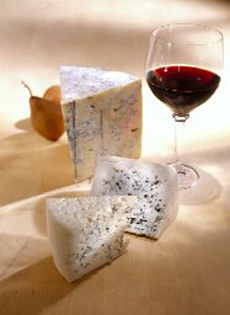
 Without mold, there would be no blue cheese. Photo of Gorgonzola and Buttermilk Blue courtesy Wisconsin Milk Marketing Board. Without mold, there would be no blue cheese. Photo of Gorgonzola and Buttermilk Blue courtesy Wisconsin Milk Marketing Board.
May 2005
Last Updated October 2025
|
|
Cheese Glossary
Types Of Cheese, Terms & Definitions Every Cheese Lover Should Know
Page 7: Cheese Terms Beginning With M & N
This is Page 7 of a 12-page glossary. Click on the letters below to find terms of interest. When you’re finished with cheese, visit our entire collection of food glossaries.
Click on a letter to go to the appropriate glossary page.
a b c d e f g h i j k l m n o p q r s t u v w x y z
This glossary is protected by copyright and cannot be reproduced in whole or in part.
MASCARPONE
|
This ultra-rich, extremely smooth, slightly sweet, fresh cheese is called “Italian cream cheese.” However, the distinction is only half correct: While mascarpone is made from the cream of cow’s milk, no cheese starter or rennet is used in its production. Mascarpone is made by draining the moisture from heavy cream using a small amount of citric acid and a finely woven cloth. The result is similar to Devon Cream or Clotted Cream. Mascarpone is native to the Lombardy region of Italy, which is also home to the town of Gorgonzola. Incorporated into recipes as an ingredient (tiramisu is one of the most famous), it also makes simple yet luscious desserts, served with fruit and biscuits like gingersnaps and strawberries or as a topping for fresh berries, poached fruit, or compote. Use it to stuff figs, dates, or dried apricots (sprinkle with chopped pistachios), or as the filling for cookie sandwiches.
|
|
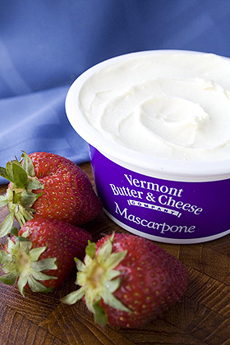
Mascarpone from Vermont Butter & Cheese Company. Read our full review. |
Or, fill tart shells and top the mascarpone with fresh or dried fruit. The name is said to date back to the 16th century when a visiting Spanish dignitary tasted it and declared it “mas que bueno,” better than good. He was correct!
MATURATION or RIPENING
|
Although some cheeses, once drained, are consumed fresh, others require some time to mature. To do this, they are placed on racks in the hâloir, a cold room that is well-ventilated, with a humidity of 80%. The cheeses are then regularly turned by hand. The curd slowly develops a rind, which, depending on what bacteria have been used, develops a fine layer of surface mold, which may be white, yellow, or brown. The temperature of the air inside the hâloir influences the taste of the cheeses. The cheesemaker monitors their maturation by touch, sight, smell, and taste.
|
|
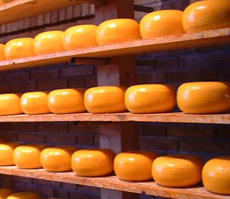
Cheeses ripening in a hâloir. Photo courtesy of MorgueFile.com. |
Maturation can last from several days to several weeks to several years, in the case of hard-aged cheeses like Parmesan and Pecorino. Maturity is distinguished externally by the color and the aspect of the cheese rind. Internally, the paste becomes drier and compacted.
MANCHEGO CHEESE
|
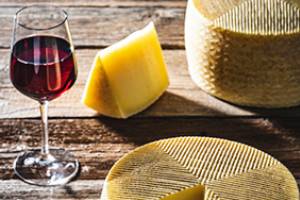
Manchego is the great cheese of central Spain, made from the milk of the Manchega breed of ewe. Aged Manchego has an intense, zesty, piquant, nutty taste and a crumbly texture that’s rich and full, with a slight saltiness on the finish. The cheese can also be enjoyed in its younger states, aged from 3 to 9 months. Manchego is a true “workhorse” cheese in that it does almost everything well, including melting. You can enjoy it on a sandwich, in a casserole, on a pizza, pretty much everywhere. Versions from Mexico and the southwestern U.S. may be called Manchego, but are a much milder cheese made from cow’s milk. Here’s more about Manchego and the history of the cheese (plus a recipe for sweet potato and apple pizza with Manchego).
|
|
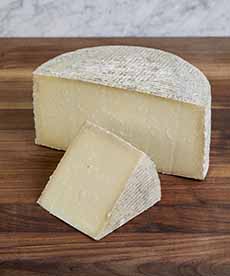
Manchego cheese is to Spain what Cheddar is to England. Read our full review. |
MAYTAG BLUE CHEESE
|
Handmade in central Iowa, Maytag Blue was one of the first great American farmstead cheeses. It is ripened in caves dug into the rolling hills of the Iowa countryside, just as Roquefort is ripened in caves (though naturally occurring) in southwest France. However, Maytag is a cow’s milk cheese, while Roquefort is made from sheep’s milk. Maytag Blue Cheese is made by the same family that produces washing machines. Fritz Maytag, son of Frederick Louis Maytag, founded the Maytag Dairy and previously owned the Anchor Brewing Company. Perhaps not coincidentally, the cheese pairs well with a medium-bodied ale or lager or a glass of sweet wine.
|
|
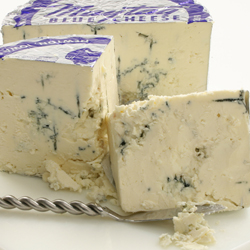
You can buy Maytag Blue at stores nationwide and at iGourmet.com. |
MELTER or MELTING CHEESE
Cheeses that melt well are essential when you want a smooth, creamy melted cheese texture for dishes like casseroles, gratins, grilled cheese sandwiches, fondue, nachos, pasta dishes, pizzas, and quesadillas. Some popular melty cheeses are Cheddar, fontina, Gouda, Gruyère, Monterey Jack, mozzarella, and provolone (note that names of cheeses and other foods are capitalized only if they are named after an area of origin, such as Asiago, Brie, Camembert, Gouda, Gruyère, and Parmesan). Most good melting cheeses have a higher fat content that helps them melt smoothly. The amount of the protein casein is also crucial for a cheese’s melting ability.
|
|
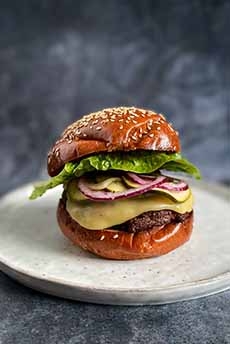
Cheddar is a great melter, which is why it’s a favorite for cheeseburgers, nachos, and more (photo © Truffle Melbourne | Facebook). |
MEMBRILLO
Membrillo is a semisoft cheese condiment made from quince. It is made in loaves and sliced to serve on cheese platters. A relative of the apple and the pear, quince is high in pectin, and the resulting paste has the consistency of a thick jelly. It has a sweet and tart taste and looks somewhat like a dense fruit gelatin dessert. Any salty or blue cheese pairs well with membrillo, but it works best with Spanish cheeses like Roncal, Mahón, or Manchego. See more cheese condiments and suggested pairings.
|
|
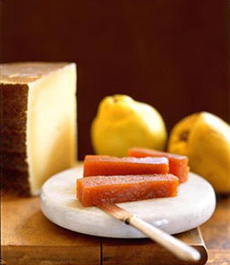
Membrillo, a sweet paste made from quince (in the foreground—photo © Forever Cheese). |
MICROORGANISMS
Yeasts and other fermenting agents are present in milk and milk curd. They can be wild and naturally occurring or cultured and introduced.
MIMOLETTE
| |
Mimolette is an unusual cheese, spherical like an Edam but with a rough, moon-like surface and a bright orange interior. It originated in Holland and is made in a similar way to Edam. It is believed to have been introduced to France when Flanders was a part of that country. Some believe that in the 17th century, the French minister Colbert forbade the importation of foreign goods, including cheese, so the French began making it for themselves. It is now made in Flanders and also in other parts of France, particularly Brittany, and it is often known as boule de Lille, or ball from Lille. The name mimolette derives from the French mi-mou, meaning half-soft. Thus, it is not a formal name, so is not capitalized. |
|
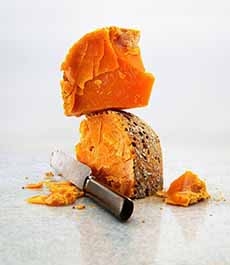
Mimolette (photo © Murray’s Cheese).
|
MOLD
Mold is a member of the fungus family. It can be on the surface of cheese (such as the fluffy white bloomy rind cheeses—which are somewhat reminiscent of mushrooms—or can be developed internally. Surface molds are the result of cheese being treated with the Penicillium candidum or Penicillium camemberti spore. Internal molds are very different and are created by the introduction of Penicillium glaucum or Penicillium roqueforti spores, both used to create blue-veined cheeses. Certain French goat milk cheeses develop a natural bluish surface mold, and some of the newer double crème cheeses like Blue Castello, Bavarian Blue, and Duet have both a surface mold and an internal mold. Originally, the molds that made these cheeses were naturally occurring, as in the Roquefort caves. Today, much of the mold is manually introduced by the cheesemaker to guarantee success.
MOLD-RIPENED CHEESES
Surface mold-ripened cheeses are soft cheeses, not pressed, that are salted and covered with the mold spores Pennicillium candidum (white) and Pennicillium glaucum (grey). The spores use the proteins and fats in the cheese to ripen it from the outside, creating a white rind. The mold acts on the proteins in the curds, breaking them down into more basic components. The presence of this mold gives these cheeses a characteristic appearance: a felt-like coating of white mycelia, as well as a typical aroma and taste. The paste has a creamy texture and a more complex flavor and aroma. Examples include the “bloomy rind” cheeses like Brie and Camembert, and mold-ripened goat cheeses. Eat the rind: It’s delicious!
|
|
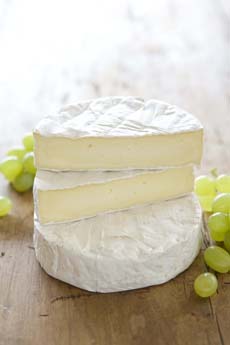
Brie (photo © Whole Foods Market). |
MONASTERY CHEESES or TRAPPIST CHEESES
Certain cheeses were originally developed by monks and are known as monastery cheeses. Some examples are washed-rind cheeses like Munster, Maroilles, and Époisses, as well as semi-hard cheeses like Tête de Moine, and artisanal cheeses from Trappist monasteries like Chimay, Westmalle, and La Trappe. Chimay (in the photo), from Scourmont Abbey near Chimay, Belgium, has a history that dates to 1876 when Brother Benedict traveled to France to learn cheesemaking. He returned and created semi-soft Chimay cheese.
|
|
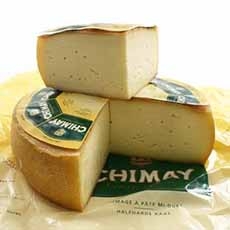
Chimay (photo © Atalanta). |
MONTEREY JACK
Rather than a new type of cheese, Monterey Jack is a simple renaming of Mexican queso blanco. In the late 19th century, a Monterey-area cheesemaker named David Jacks began to sell cheeses throughout California. His queso blanco was mass-marketed, first as Jack’s Cheese and eventually as Monterey Jack—for the county and his own name, minus the “s.” The cheese is also aged into Dry Jack and mixed with chiles into Pepper Jack. Here’s more of the history of Monterey Jack.
|
|
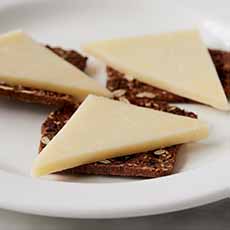
Monterey Jack (photo © Murray’s Cheese). |
MOUNTAIN CHEESE
|
These are also known as Alpine cheeses since they initially referred to large wheels of cheese made in the Alps. According to Caseus Montanus, an international association of mountain cheese producers, a mountain cheese is one produced and aged above 800 meters (approximately 2500 feet). Most are made in France, Italy, Spain, and Switzerland. A Vermont-made mountain cheese, Tarentaise, was named “Best Farmstead Cow's Milk Cheese” at the 25th American Cheese Society Conference for American-made cheeses.
According to ArtisanalCheese.com, scientific studies on the flavor profile of mountain cheeses have found as many as 100,000 micro-organisms in the flora of the high-altitude mountains, as compared to less than 10,000 microorganisms in lower prairie altitudes. This intensity of micro-organisms is responsible for the deep and complex flavors of mountain cheeses.
Popular mountain cheeses (cow’s milk, except as noted) include Appenzeller (Swiss), Beaufort (French), Bleu des Basques Brebis (French, sheep’s milk blue cheese), Cantalet (French), Comté (French), Fontina Val d’Aosta (Italian), Fourme d’Ambert (French, blue cheese), Gruyère (French and Swiss), Hoch Ybrig (Swiss), Sbrinz (Swiss), Tête de Moine (Swiss) and Valdeón (Spain, blue goat’s milk cheese). Cheeses made in the French or Swiss Alps are also called Alpine cheeses.
|
|
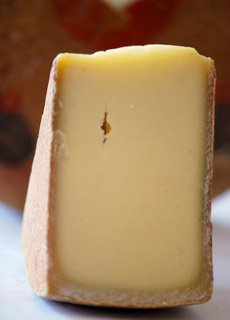
Hoch Ybrig is a mountain cheese made from cow’s milk in Canton Schwyz, Switzerland. It is washed in a white wine brine, which provides additional complexity (both photos © Artisanal Cheese).
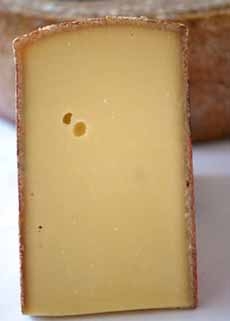
Appenzeller is produced in the Appenzellerland region of northeast Switzerland.
|
MOZZARELLA or MOZZARELLA DI BUFALA
|
Legally, in Italy, mozzarella is made from the milk of the water buffalo and is mozzarella di bufala; cow’s milk mozzarella is known as fior di latte, “the flower of the milk.” Water buffalo, native to Asia, were brought to Italy in the 1400s. Water buffalo’s milk is higher in both fat and protein than cow’s milk, yielding 1.6 times more cheese. It also lacks the yellow pigment, carotene, found in cow’s milk, so mozzarella di bufala is pure white.
Almost all American-made mozzarella is from cow’s milk. Mozzarella is a pasta filata, a spun paste. Like other cheeses, it begins with rennet-curdled milk. But unlike other cheeses, whose curds are then gathered and molded, mozzarella curds are plunged into hot whey or lightly salted water, kneaded, and pulled to develop the familiar stretchy strings (pasta filata), then shaped into the desired form (mozzarella, provolone, scamorza).
|
|
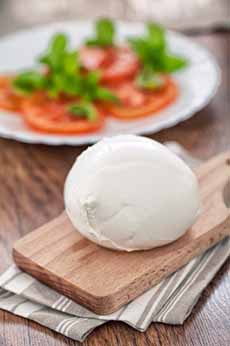 A ball of mozzarella (photo © S. Vario Photo | Panther Media). A ball of mozzarella (photo © S. Vario Photo | Panther Media). |
Mozzarella had been the #1 cheese in the U.S. for decades, largely due to America’s love of pizza, plus chicken parm, eggplant parm, and baked pasta dishes. It comprises 30%-35% of all cheese consumed (Cheddar typically ranks #2.)
World Mozzarella Day is October 23rd. The history of mozzarella.
MUENSTER CHEESE
|
Muenster cheese (with an “e”) is a mild American cheese, not to be confused with the pungent Munster cheese from the Alsace region of France (see next description. It is the evolution of the cheese made by European immigrants to the U.S. in the 1880s. While some artisan cheesemakers make round, aged muensters in the Alsatian style, most are factory-made loaves meant to be eaten young as a sandwich, cooking, or snack cheese (it is made in flavored varieties including caraway, cranberry, and hot pepper). It is a great melter for grilled sandwiches, burgers, and other dishes. While European-style Munster is a washed-rind cheese, in the U.S., the rind is generally not washed (washing provides more pungency). But annatto is used to provide an orange coating. The paste is semi-soft, smooth, and elastic.
|
|
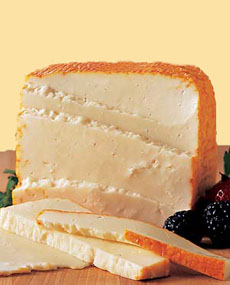
Domestic muenster. Photo © Wisconsin Cheeseman. |
MUNSTER CHEESE
|
Munster cheese (no “e”) is an assertive cheese believed to that originated in the eastern Vosges Mountains of the Alsace region of France. It is a monastery cheese that dates to the early Middle Ages; the name Munster derives from the local dialect for monastery (in Latin, monasterium). Made of unpasteurized cow’s milk in small and large flat wheels, Munster is the only cheese native to Alsace. A washed-rind cheese, Munster has a very pronounced, powerful aroma. In the five-week to three-month aging period, the rind is periodically washed with brine. It is rubbed by hand with a cloth moistened with a brine solution of rock salt and water (the salt inhibits the growth of mold). This added moisture encourages the development of the bacteria that give Munster its characteristically strong flavors and aromas, as well as its “red” rind (actually orange).
|
|
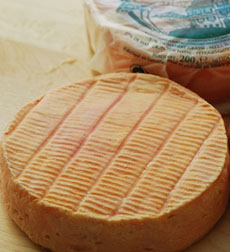
Alsatian Munster. Available at ArtisanalCheese.com. |
When ripe, Munster has the aroma of porcini mushrooms, and the runny interior evokes truffles. (When young, the paste is creamy.) Washed rind cheeses, also known as “stinky” cheeses, are popular with connoisseurs for their depth of flavor and character. Other popular examples include such as Limburger, Livarot, Pont L’Eveque, and Taleggio. Munster has been AOC-protected (Appellation d’Origine Contrôlée) since 1969. Serve with a spicy Alsatian Pinot Gris, a Riesling, sherry, or a Belgian ale.
MUSHROOMY
A description of the flavor and aroma of certain soft and semi-soft cheeses, particularly members of the Brie and Camembert family.
NATURAL RIND CHEESES
|
These cheeses have rinds that self-form during the aging process. Generally, no molds or microflora are added, nor is washing used to create the exterior rinds. Those that do exhibit molds and microflora in their rinds get them naturally from the environment. Most natural rind cheeses are aged for many weeks to develop their flavor as well as the rinds, and many are made from raw milk. Examples include many “tomme” style cheeses such as tomme de Savoie and mimolette, Stilton, and Lancashire.
|
|
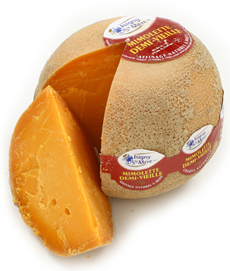
Mimolette, a natural rind cheese with an extraordinarily beautiful color to match its fine flavor, is available at iGourmet. |
NEUFCHÂTEL CHEESE
|
There are two types of Neufchâtel, French and American. They are very different. French Neufchâtel is one of the oldest cheeses in France and the oldest cheese in Normandy, dating back as far as the sixth century. Soft and crumbly, its dry, white rind is velvety and edible. Its buttery, pale paste has a salty, somewhat sharp flavor has soft mushroom notes, like Brie. Like Brie, the cheese develops an earthy character as it ages. The cheese was given a registered designation of origin (AOC) in 1969 and a protected designation of origin (AOP) in 1996.
French Neufchâtel is made in various shapes: briquette (small brick), bonde (log), double-bond (large log), carré (square), coeur (heart), and gros coeur (large heart). The heart shape, which is imported to the U.S. for Valentine’s Day, is a tradition begun by young Norman women, as the story goes, to discreetly express their feelings of affection for young British soldiers during the 100 Years’ War.
American Neufchatel has been sold as a lower-fat alternative to cream cheese, with 1/3 the fat. However, it has been disappearing over the last decade as cream cheese manufacturers have marketed their own low-fat and non-fat versions.
|
|
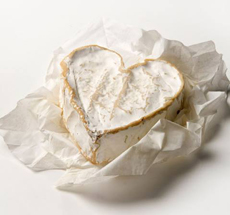
French Neuchâtel cheese (photo © Cheeses Of Europe). is available at iGourmet.
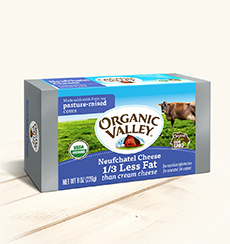
American Neufchatel cheese (photo © Organic Valley). |
NON-MELTING CHEESES
Halloumi from Cyprus and Paneer (Panir) from India are known for staying firm when heated. Whether pan-fried, grilled, or baked, they don’t melt, providing opportunities for sandwiches, salads, casseroles, baked goods, and more.
There are other cheeses around the world that, like halloumi, can be heated without melting. These cheeses have a high melting point due to their unique composition and production methods, cooking the curds at high temperatures to create a firm texture, which allows the cheeses to retain their shape when grilled, fried, or baked.
The chemistry that enables this to happen:
- High protein content. The proteins form a strong network that resists breaking down under heat.
- Low fat content. Low-fat means that the cheese is less likely to liquefy when heated.
- Low moisture content. Cheeses with less water are firmer and more heat-resistant.
- Brining. Some of these cheeses undergo brining during production, which alters their structure and makes them more heat-stable.
|
|
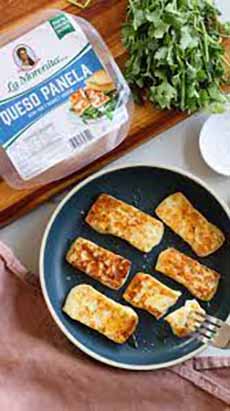
Queso panela is a Mexican cheese called “grilling cheese.” It is also enjoyed without cooking (photo © La Morenita Foods). |
NUTTY
Often referring to hazelnut, a flavor that occurs naturally in some cheeses.
Continue To Page 8: Terms Beginning With O & P
Return To The Article Index Above
Lifestyle Direct, Inc. All rights reserved. Some material copyright Murray’s Cheese. Images are the copyright of their respective owners.
|