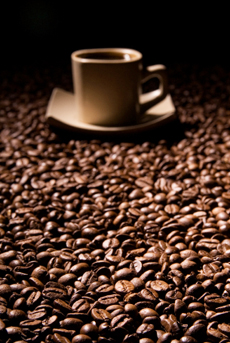
 Don’t buy more coffee than you can use in a week. Fresh-roasted beans deliver the best flavor. Have a fresh cup! Photo by Joan Vicent | IST. Don’t buy more coffee than you can use in a week. Fresh-roasted beans deliver the best flavor. Have a fresh cup! Photo by Joan Vicent | IST.
July 2005
Last Updated November 2025
|
|
Coffee Glossary
Page 3: Coffee Terms & Definitions D & E
Study these terms, and you’ll have a much greater appreciation of your next sip of coffee. Practice the language of coffee by using these terms to describe each cup you drink. Soon, they’ll become natural to you, and you’ll be able to educate others. This is Page 3 of a 6-page Coffee Glossary. For terms specific to espresso, see our separate Espresso Glossary. We have many food glossaries, covering your other favorite foods.
Click on a letter to go to the appropriate glossary page:
a b c d e f g h i j k l m n o p q r s t u v w x y z
This glossary is protected by copyright and cannot be reproduced in whole or in part. You are welcome to link to it.
| DALGONA COFFEE or HAND-BEATEN COFFEE
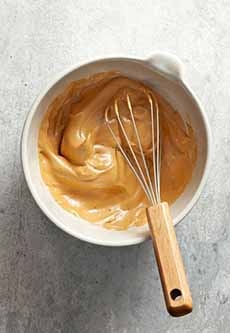
Dalgona coffee, also known as hand-beaten coffee, originated in Macau. It’s made by whipping equal parts instant coffee powder, sugar, and hot water until it becomes creamy and then adding it to cold or hot milk. It can be topped with coffee powder, cocoa, crumbled biscuits, or honey.
The drink is credited to Leong Kam Hon, a shipwright who started a coffee shop after an accident left one arm incapacitated. He created the drink in 1997 at the request of a tourist couple. The drink did not particularly interest him until 2004, when he thought to serve it as a specialty drink to Hong Kong actor Chow Yun-fat and his entourage, who were visiting the café. Chow’s praise for the drink created international attention, with visitors requesting “Chow-Yun-fat coffee” (Hon himself called it “hand-beaten coffee”).
The name “dalgona coffee" is credited to the South Korean actor Jung Il-woo, who ordered this drink at the café in 2020, likening the taste to that of dalgona, a type of Korean honeycomb toffee.
Dalgona coffee is similar to the Greek frappe, which was created in Greece in 1957. It is either hand shaken or whipped with a frothing mixer and is traditionally served cold, but may also be prepared hot.
|
|
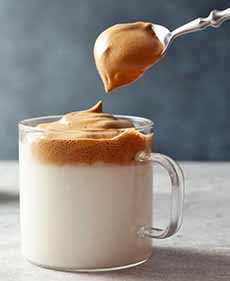
Here’s the recipe for dalgona coffee. Below, beating the coffee granules into the creamy topping (all photos © Taste Of Home).
 |
Perhaps it was Greek tourists who requested that Hon make the recipe!
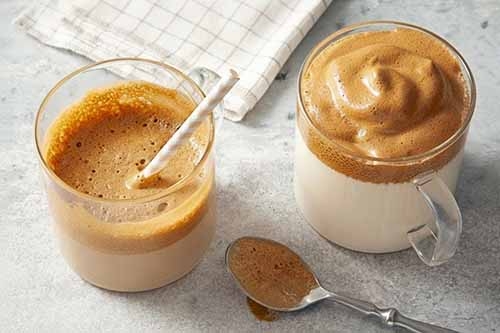
Dalgona coffee can be served cold (at left) or hot.
DECAFFEINATED
Coffee with 97% or more of the caffeine removed. Decaffeinated is not the same as caffeine-free. A 2006 study conducted at the University of Florida that purchased coffee at a variety of different coffee shops and restaurants showed that five to 10 cups of decaffeinated coffee contain as much caffeine as a cup or two of caffeinated coffee. Decaffeinated espresso shots varied widely, from 3 to nearly 16 milligrams, while the caffeine content of the decaffeinated brewed coffee ranged from 12 to 13.4 milligrams per 16-ounce serving. By comparison, a can of Coca-Cola has about 31 milligrams. SOURCE: McCuster, R. Journal of Analytical Toxicology, October 2006; vol 30: pp 611-613.
DECAFFEINATION PROCESS
For a coffee to be called decaffeinated, it must be 98% caffeine-free. Coffee is decaffeinated in its green state using one of three processing methods: the Traditional or European Process, which uses methyl chloride; the Swiss, SWP, or Water-Only Process (which is certified organic); or the Sparkling Water Process, using water and carbon dioxide.
Fine coffees are not decaffeinated with chemicals. The water-only process uses water and carbon filters, like a water-purifying system, prior to roasting. With the sparkling water process, a pressurized liquid form of carbon dioxide is circulated past the beans to remove the caffeine; the caffeine adheres to the carbon dioxide, which is removed, taking the caffeine with it. See also methyl chloride.
DELICATE
Characterized by a fragile, mellow, or subtle flavor. Found in washed Arabica coffees. |
|
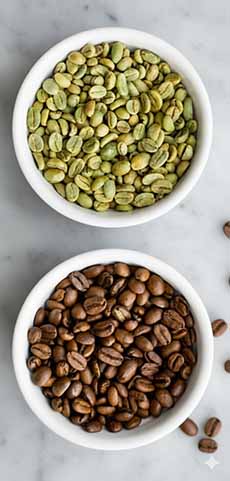
Green and roasted coffee beans (Gemini photo). |
DEMITASSE
French for “half cup,” a half-size cup for espresso or other strong coffee. While some people use the words “espresso cup” and “demitasse cup” interchangeably, a demitasse has traditionally been a cup with thinner walls and porcelain instead of ceramic.
DIRTY
A muddy or otherwise “dirty” taste that underlies the coffee. It shows flavor taints, defects, and other faults. Some coffees, e.g,. Indonesian coffee has natural “forest floor” flavors.
|
|
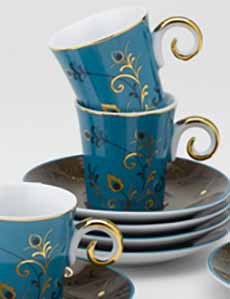
Demitasse cups from Yedi Housewares are available at Amazon.com. |
DOPPIO
A double shot of espresso. Doppio means “double” in Italian.
DRIP COFFEE
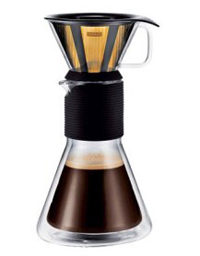
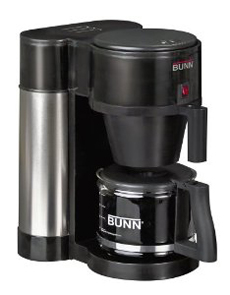
Made by dripping boiling water over coarsely ground coffee. The water filters through the coffee and falls into the pot. The brewing process is slower than regular coffee or espresso, and the hot water is in contact with the ground coffee for much longer. A cup of drip coffee actually has more caffeine than one shot of espresso.
Both of these coffee makers are drip units. The coffeemaker at the left is a manual drip style from Bodum; the one at the right is an electric drip machine from Bunn.
DRY
A coffee with a parching or drying aftertaste, generally due to over-drying the coffee during production.
DULL
Coffee that has lost its original (or usual) zest and pungency: it may be too old, of inferior quality, or poorly prepared.
EARTHY
A flavor and aroma characteristic of some coffees that resembles freshly-turned soil, dirt, or clay. It is found in low-grade coffee and is usually due to poor preparation conditions; although it is found in some higher-quality coffees from Sumatra as well, whose mushroom and herbal characteristics are enjoyed by some coffee drinkers. In many origins, the coffee is literally dried on the ground, and the oils in the coffee absorb flavors from the earth on which it sits.
EGG COFFEE (VIETNAMESE EGG COFFEE)
Hanoi’s famed egg coffee, made with robusta beans, has an ultra-thick texture and heavy froth, as well as extra protein from the egg. Called ca phe trung in Vietnamese, it dates to the 1940s during the First Indochina War, when the city experienced a milk shortage. A bartender began experimenting with whipped egg yolks and sugar as a substitute, and it became a permanent hit, spreading across the country. Some venues use the original formula, while others add sweetened condensed milk for extra creaminess.
Invariably, variations were developed, including chocolate egg coffee (which adds cocoa for a mocha flavor), coconut coffee, and salted coffee.
|
|

Vietnamese egg coffee (photo © Flavor And The Menu). |
EINSPANNER
A rich, black coffee made by forcing water through packed, finely ground roast coffee at high pressure and at a high rate of speed. The standard serving is a single 1-ounce shot made with 7g of finely ground coffee extracted for between 25 and 30 seconds. An espresso roast is the darkest of roast beans, yielding the strongest of brews. A properly prepared espresso will fill half the espresso cup, with the crema forming perfectly on top. Espresso is meant to be drunk immediately. See our Espresso Glossary for more espresso definitions.
|
|
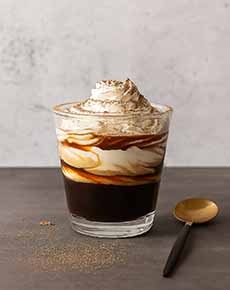
Einspanner, laden with whipped cream (photo © Taste Of Home).
|
EISEKAFFEE
You can probably guess that eisekaffee means “iced coffee” in German, but the German version is more like an ice cream float. A scoop of ice cream is placed in a glass cup, and cold coffee is poured over it, then topped with whipped cream. It’s the cold version of an affogato.
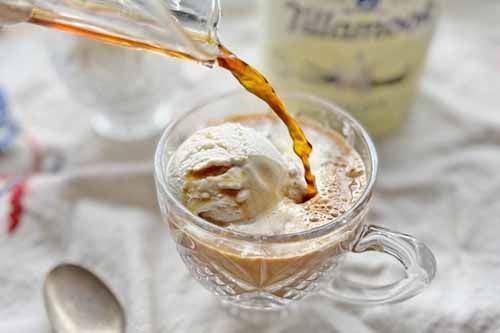
Eisekaffee (photo © Taste Of Home).
ESPRESSO
A rich, black coffee made by forcing water through packed, finely ground roast coffee at high pressure and at a high rate of speed. The standard serving is a single 1-ounce shot made with 7g of finely ground coffee extracted for between 25 and 30 seconds. An espresso roast is the darkest of roast beans, yielding the strongest of brews. A properly prepared espresso will fill half the espresso cup, with the crema forming perfectly on top. Espresso is meant to be drunk immediately. See our Espresso Glossary for more espresso definitions. Plus, the history of espresso.
|
|
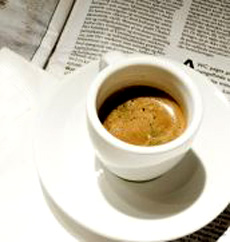
A cup of espresso (photo courtesy SXC).
|
ESPRESSO CORRETTO
Espresso with a shot of grappa (coretto is Italian for “correct”).
ESPRESSO DOPPIO
A double shot of espresso that’s poured over one shot of fresh hot water.
ESPRESSO CON PANNA
An espresso with whipped cream on top (panna is Italian for whipped cream).
ESPRESSO GRANITA
Espresso mixed with brown sugar and frozen into an ice.
ESPRESSO LUNGO
A single shot of espresso that is brewed from a much stronger extract (two full ounces of espresso are extracted from a single shot). Lungo is Italian for “long” or “lengthy.”
ESPRESSO MACCHIATO
Espresso with a dollop of warm, frothed milk added, much less than a latte. The proportions are one part espresso to one part foam. Macchiato means “marked” or “spotted.”
ESPRESSO RISTRETTO
A single shot of espresso that is brewed stronger than regular espresso but not as strong as a lungo (one ounce of espresso is extracted from a single shot).
ESPRESSO ROMANO
An espresso with a squeeze of lemon juice.
ESTATE GROWN
Coffee that’s grown on large farms, as opposed to small peasant plots, which are usually old family-owned plantations.
|
|
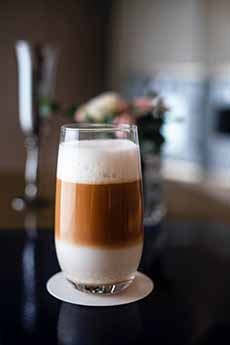
Espresso macchiato (photo © Ruandom Zhong | Pexels). |
EXOTIC
Unusual aromas and flavors such as berry, floral, or spicy.
EXTRA
The second-best grade of coffee. The best grade is called supremo.
Continue To Page 4, Terms F & I
Return To Article Index Above
Lifestyle Direct, Inc. All rights reserved. Images are the copyright of their respective owners.
|