May 2005
Last Updated June 2023
|
|
Butter Glossary: Types Of Butter
Terms & Definitions: C
Butter terms beginning with C, including clarified butter and compound butter. If you’d like to suggest other terms, use the Contact Us link on this page. This is Page 2 of a seven-page glossary. Click on the black links below to visit other pages. See a wealth of food knowledge in our many other food glossaries.
CHURNING
The physical process by which liquid cream is “worked” to coalesce the butterfat globules, with the concurrent expulsion of buttermilk.
CLARIFIED BUTTER or DRAWN
BUTTER
Clarified butter is unsalted butter that has been slowly melted, evaporating much of the water and separating the milk solids. All that remains is pure liquid golden-yellow butterfat. Because the milk solids have been removed, clarified butter has both a long shelf life (it will keep from going rancid longer) and a high smoke point (it can be used in frying without burning); it also is less flavorful than regular butter. To clarify butter, melt unsalted butter in a saucepan over low heat. Skim the froth from the top and carefully pour off the clear liquid, leaving the milky residue behind. Clarified butter is used in sautés, sauces, in baked dishes, and for dipping. It’s easy to make. Just heat butter over low heat and skim the foam off the top and strain though a fine sieve or cheesecloth. See also ghee.
|
|
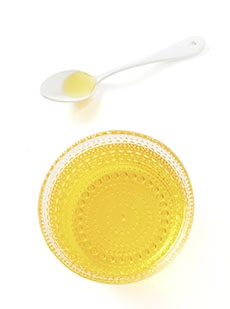
Melted butter, front, is skimmed of its milk solids to produce clarified butter (photo © Go Bold With Butter). |
CLOTTED CREAM or CLABBER
CREAM
A type of thick cream with a yellowish crust, popularized in the English counties of Devon and Cornwall. Clotted cream is an essential ingredient of cream tea. It contains an average fat content of 63% (the minimum is 55%) and is produced by cooking full-fat milk over a bain-marie. Known as crème fraîche in France and racreme in Scandinavia, “clabber” is an archaic English word for a cupboard or pantry.
COCOA BUTTER
Not a dairy product, but the fat portion of the kernel (nib) of the cocoa bean. More about cocoa butter, including a photo.
|
|
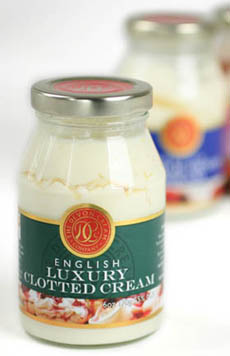
Clotted cream (photo © iGourmet). |
COLOR
Color in butter comes primarily from the presence of carotene and xanthophyll, which are natural compounds present in the feed of cows.
COMPOUND BUTTER (FLAVORED
BUTTER)
Butter flavored with herbs, garlic, wine, or other seasonings, most often made by mixing them into softened butter. The butter is then rolled into a log shape and refrigerated until needed; slices are cut from the roll and placed directly on hot meat, fish, or vegetables, where it melts immediately, creating a sauce. Herb butter and anchovy butter can be forms of compound butter: it is the creation of the log and the slice-as-needed usage to create a sauce that creates the reference. Here’s more about compound butter, including recipes.
|
|
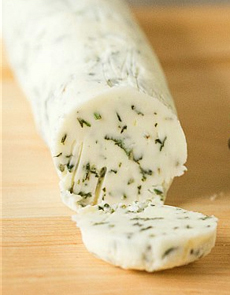
Compound butter flavored with dill (photo © Brown Eyed Baker). |
CONTINENTALS
Foil-wrapped teaspoon-sized portions of salted or unsalted butter, packed in trays for food service use.
COOKING FATS
This refers to butter, margarine, vegetable oils, and vegetable shortening, all of which are used to moisten and flavor foods during cooking and to enrich and tenderize baked goods.
|
|
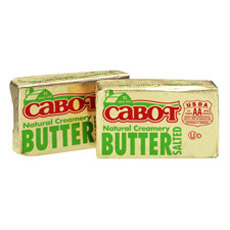
Continentals are individually wrapped pats (photo © Cabot Creamery). |
CREAM
The word cream comes from the Greek chriein, which means “anoint,” and which is also the root of Christ (“the anointed one”). The link between ancient rituals and rich food is oil, the substance used to anoint the chosen, and the defining element of cream. Cream is a form of milk in which the fat globules have become more concentrated than usual, whether by rising to the top in a bottle or spinning off from the heavier water phase in a centrifuge. There are several grades of cream marketed today, including heavy cream, light cream, and half-and-half. Cream is also a verb meaning to beat until soft, smooth, and fluffy, as with butter and sugar.
|
|
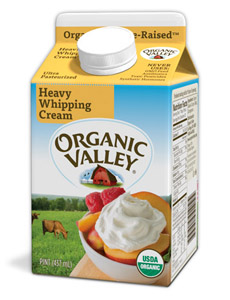
Heavy cream (photo © Organic Valley). |
CRÈME FRAÎCHE
A matured, thickened cream with a slightly tangy, nutty flavor and velvety-rich texture. The thickness can range from that of commercial sour cream to almost as solid as room-temperature margarine. In France, it is unpasteurized and contains the bacteria necessary to thicken it naturally. In the U.S., the fermenting agents necessary for thickening are obtained by adding buttermilk or sour cream. A very expensive American facsimile of crème fraîche is sold in some gourmet markets.
|
|
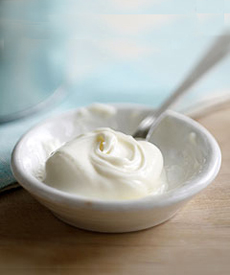
Crème fraîche (photo © Vermont Creamery). |
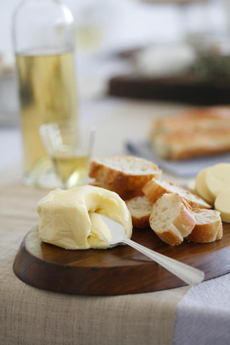
CULTURED BUTTER
Fresh cream butter is made by adding live bacterial cultures to fresh cream (lactic acid cultures). The cultures ferment the cream, developing a tangy flavor (not unlike what happens during yogurt production). After fermentation, the cream is churned into butter which adds distinctive flavor to baking and cooking. Cultured butter is most popular in European countries. Try it whenever you want a bit of acidic tang.
CUP OF BUTTER
Two sticks of butter equal one cup, or 8 ounces. One stick of butter is 4 ounces, 8 tablespoons, 1/2 a cup, 115g, and 115ml. Another tough measurement: 3/4 stick of butter, 6 tablespoons, is 3/8 cup.
|
|
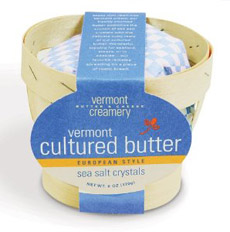
Cultured butter (photo © Vermont Creamery). |
Continue To The Next Page: Terms Beginning With D
Go To The Article Index Above
Some content courtesy of Cornell University School of Agriculture, Wisconsin Milk Marketing Board, U.S. Department of Agriculture.
|